

TL;DR:
- Proper HVAC sizing matches equipment capacity to a home’s true thermal load, reducing energy bills and maintaining comfort. Accurate load calculations like Manual J prevent short cycling and ensure efficient moisture removal, extending system lifespan and comfort quality. Homeowners should request detailed load analyses and verify proper installation practices to optimize performance and savings.
Proper HVAC sizing is defined as matching your heating and cooling equipment’s capacity precisely to your home’s actual thermal load, and it is the single most direct factor controlling your monthly energy bills. The U.S. Department of Energy confirms that correct sizing affects both efficiency and moisture removal, with a rough starting point of 20 BTU per square foot that still requires deeper inputs to be accurate. The recognized professional standard for this calculation is ACCA Manual J, a room-by-room load analysis that accounts for insulation, window area, climate zone, and occupancy. The National Institute of Standards and Technology (NIST) has found that incorrectly sized systems can waste up to 30% more energy than a properly matched unit. Getting sizing right is not a luxury. It is the foundation of every dollar you save on heating and cooling.
Why proper HVAC sizing reduces bills: the core efficiency mechanisms
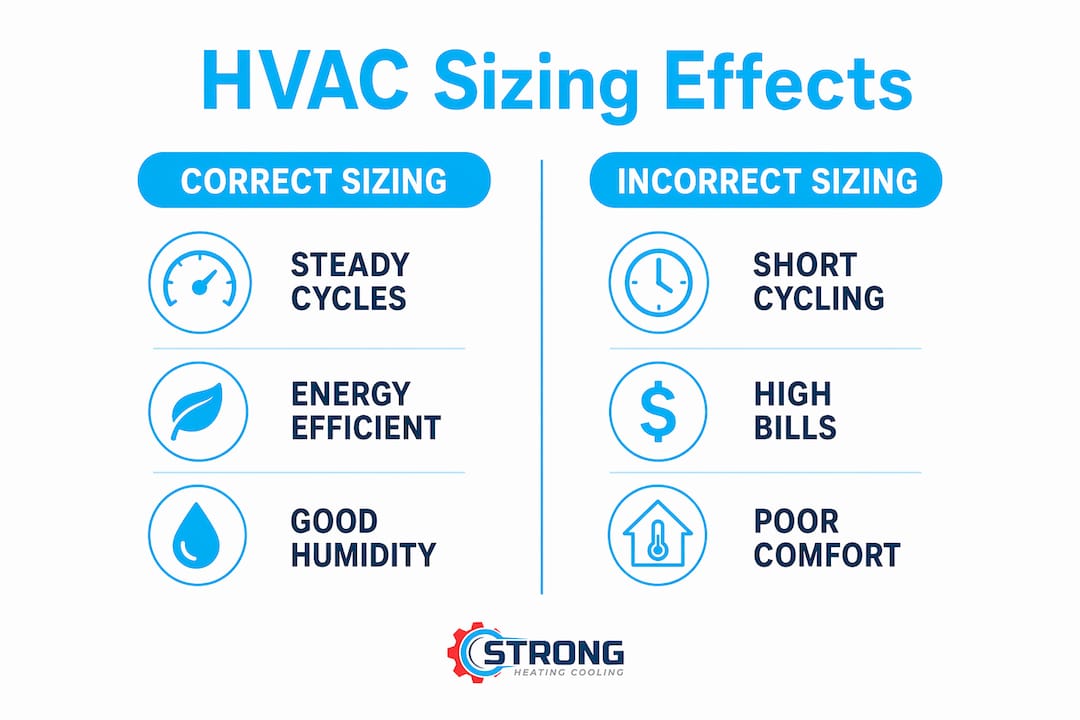
A correctly sized system runs in longer, steadier cycles rather than switching on and off repeatedly. That distinction matters more than most homeowners realize, and it explains why two homes with identical equipment ratings can produce very different utility bills.
Oversized units reach the thermostat setpoint too quickly and shut off before completing a full conditioning cycle. This behavior is called short cycling, and short cycling wastes energy through frequent high electrical inrush currents every time the compressor restarts. Each startup draws a surge of electricity that is disproportionately large compared to steady-state operation, and a system that starts six or eight times per hour accumulates that cost across every billing cycle.
Undersized units face the opposite problem. They run continuously without ever reaching setpoint on the hottest or coldest days, consuming electricity the entire time while still failing to deliver comfort. Neither scenario reflects the efficiency rating printed on the equipment label.
SEER ratings, which measure seasonal energy efficiency, assume steady-state operation. An oversized unit that short cycles never achieves that steady state, so its real-world efficiency falls well below its rated number. A homeowner who pays a premium for a high-SEER unit and then installs it oversized is paying for efficiency they will never actually receive.
Humidity control adds another layer to the bill equation. Air conditioning removes moisture from indoor air as a byproduct of cooling the refrigerant coil. That process requires the coil to stay cold long enough to condense humidity out of the air. When a system short cycles, the coil never reaches the temperature needed for effective moisture removal, leaving the home feeling clammy even after the temperature setpoint is met. Occupants respond by lowering the thermostat further, which drives up consumption.
| Condition | Cycling behavior | Energy impact | Humidity control |
|---|---|---|---|
| Correctly sized | Long, steady cycles | Achieves rated SEER efficiency | Effective moisture removal |
| Oversized | Short cycles, frequent restarts | Energy surges at every start | Poor, coil stays warm |
| Undersized | Runs continuously | High consumption, no relief | Inconsistent, overwhelmed |
Pro Tip: If your system runs for fewer than ten minutes before shutting off on a mild day, short cycling is likely occurring. Note the pattern over a few days and share it with your HVAC technician as evidence of a potential sizing problem.
What are the risks and costs of improper HVAC sizing?
The financial damage from a poorly sized system extends well beyond the monthly utility bill. Equipment lifespan, repair frequency, and comfort quality all degrade when sizing is wrong, and those costs compound over the years you own the home.
Oversized systems have higher repair costs and shortened service lives because rapid on/off cycling stresses mechanical components. Compressors, contactors, and capacitors are all rated for a finite number of starts. A system that doubles its start frequency effectively halves the useful life of those parts, and some research suggests improper sizing can reduce equipment lifespan by up to ten years. That is a significant loss on a system that costs several thousand dollars to replace.
Comfort problems also drive indirect energy costs. When a home feels humid despite the air conditioner running, occupants lower the thermostat to compensate. When temperature swings between rooms are wide, people adjust settings repeatedly throughout the day. This behavior, sometimes called thermostat fatigue, adds consumption without adding comfort. The NIST finding that incorrect sizing can increase energy use by 30% captures both the direct waste from cycling and the indirect waste from occupant responses to discomfort.
Recognizing the symptoms of a badly sized system in your home is the first step toward addressing the problem. Common signs include:
- Rooms that feel humid or sticky even when the thermostat setpoint is met
- Noticeable temperature differences between floors or between rooms on the same floor
- A system that turns on and off multiple times within a single hour during mild weather
- Unusually high utility bills relative to neighbors with similar home sizes
- Frequent repair calls for compressor or capacitor failures within the first five years of installation
Pro Tip: Pull out your last twelve months of utility bills and look for months where consumption spiked without a clear weather explanation. Unexplained spikes in spring or fall, when loads are moderate, are a strong indicator of short cycling from an oversized unit.
Proper HVAC energy efficiency depends on more than equipment ratings. It depends on whether the equipment was matched to the home in the first place.
How is proper HVAC sizing determined?
The professional standard for residential HVAC sizing is ACCA Manual J, a load calculation method that analyzes your home room by room rather than applying a single square footage multiplier. Manual J accounts for insulation levels in walls, ceilings, and floors; window area, orientation, and glazing type; local climate data including design temperatures; internal heat gains from occupants and appliances; and infiltration rates based on construction quality. The result is a precise heating and cooling load expressed in BTUs per hour, specific to your home.
Manual J does not stand alone. Manual S governs equipment selection based on the Manual J load, and Manual D governs duct system design to deliver conditioned air where it is needed. All three work together. A correctly sized unit installed into an undersized duct system will still short cycle because restricted airflow prevents the system from moving enough air to satisfy the load. Duct design is not an afterthought. It is part of the sizing chain.
The contrast between rule-of-thumb sizing and Manual J is significant. Many contractors default to a simple square footage estimate, often adding a buffer “just to be safe.” That buffer almost always results in oversizing, particularly in modern, well-insulated homes that have lower loads than older construction of the same size. Rule-of-thumb sizing is the main cause of oversizing in energy-efficient homes, and it is the reason the IRC 2024 building code now requires Manual J or an approved equivalent for all new residential HVAC installations.
| Sizing method | Inputs used | Accuracy | Risk |
|---|---|---|---|
| Rule of thumb (sq ft) | Square footage only | Low | Frequent oversizing |
| Manual J load calculation | Insulation, windows, climate, occupancy, infiltration | High | Minimal when done correctly |
| Manual J + Manual S + Manual D | Full load, equipment, and duct design | Highest | Negligible |
Pro Tip: Before signing any HVAC installation contract, ask the contractor for a written Manual J report. A reputable contractor will provide one without hesitation. If the answer is “we use square footage,” that is a clear signal to look elsewhere.
Understanding AC SEER ratings alongside Manual J results gives you a complete picture of what you are buying and what you can realistically expect to save.
What practical steps can homeowners take to ensure correct HVAC sizing?
Taking an active role in the sizing process protects your investment and your comfort. These steps give you a clear path from evaluation to installation.
-
Request a written Manual J report before any equipment is selected. The report should list inputs including insulation values, window counts, and local design temperatures. A verbal assurance is not sufficient.
-
Ask whether Manual S and Manual D will be completed as part of the project. Equipment selection and duct design must follow from the load calculation. Skipping either step undermines the accuracy of the Manual J work.
-
Verify that the contractor will test airflow after installation. Duct leakage and airflow testing confirm that the installed system performs as designed. This step is often skipped but is required under many state energy codes.
-
Consider equipment with variable speed compressors or two-stage cooling. These systems modulate their output to match the actual load at any given moment, which reduces short cycling even when sizing is slightly imperfect. They also improve humidity control during mild weather when a single-stage unit would short cycle most severely.
-
Monitor your system’s cycling pattern during the first few weeks after installation. A correctly sized system should run for at least fifteen to twenty minutes per cycle during moderate weather. Shorter cycles indicate oversizing and should be reported to the installer promptly.
-
Track indoor humidity alongside temperature. A simple digital hygrometer, available for under twenty dollars, tells you whether your system is removing moisture effectively. Indoor relative humidity above 60% during summer operation points to a sizing or airflow problem.
-
Schedule annual maintenance to preserve efficiency. Clean coils, fresh filters, and verified refrigerant charge all support the steady operation that proper sizing enables. Maintenance does not fix a sizing error, but it prevents a correctly sized system from drifting into inefficiency over time.
Following a residential HVAC maintenance guide alongside these sizing steps gives you the best chance of achieving and sustaining the energy savings that proper sizing makes possible.
How does proper HVAC sizing impact home comfort beyond energy savings?
Energy savings are the most measurable benefit of correct sizing, but the comfort improvements are what homeowners notice first. The two are closely connected, and understanding that connection helps you evaluate whether your current system is truly performing.
Humidity control is the clearest example. Air conditioning removes latent heat, which is the energy stored in water vapor, as well as sensible heat, which is the temperature you feel. Removing latent heat requires the evaporator coil to stay cold long enough for moisture to condense on its surface. A correctly sized system runs long enough to accomplish both tasks. An oversized system cools the air temperature quickly but shuts off before the coil has time to pull significant moisture from the air. The result is a home that feels cool but damp, and humidity that affects comfort and indoor air quality in ways that temperature alone does not capture.
Temperature uniformity across rooms is the second major comfort factor. When a system runs in long, steady cycles, it circulates air through the duct system long enough to reach every room and equalize temperatures. Short cycling cuts that circulation short, leaving distant rooms warmer or cooler than the thermostat location. Homeowners often attribute these temperature differences to duct problems or insulation gaps when the root cause is an oversized system that never completes a full distribution cycle.
Air filtration performance also depends on run time. Your HVAC filter only cleans air that passes through it while the system is running. A system that short cycles filters less total air volume per hour than one running steady cycles, which means more airborne particles remain in circulation. For households with allergy or asthma concerns, this is a meaningful health consideration, not just a comfort one.
Common comfort complaints that trace back to sizing problems include:
- Condensation on windows or walls during summer, indicating excess indoor humidity
- Hot or cold spots in specific rooms that persist regardless of thermostat adjustments
- A musty or stale odor that returns shortly after the system shuts off
- Difficulty sleeping in upstairs bedrooms due to inconsistent overnight temperatures
Each of these complaints has a direct connection to how long and how steadily the system runs, which is determined by whether it was sized correctly for the home.
Key takeaways
Correctly sized HVAC systems use up to 30% less energy, last significantly longer, and deliver consistent comfort by running in steady cycles that achieve rated efficiency and remove humidity effectively.
| Point | Details |
|---|---|
| Sizing drives real efficiency | Oversized and undersized systems both waste energy; only correct sizing achieves rated SEER performance. |
| Short cycling compounds costs | Frequent compressor restarts spike electricity use and accelerate mechanical wear, raising both bills and repair costs. |
| Manual J is the required standard | IRC 2024 mandates Manual J or equivalent for all residential installations; always request a written report. |
| Comfort and savings are linked | Proper sizing removes humidity effectively and equalizes room temperatures, reducing thermostat adjustments and consumption. |
| Maintenance sustains the gains | Annual service preserves the coil, airflow, and refrigerant charge that correct sizing depends on to deliver savings. |
What I’ve learned after years of sizing conversations with homeowners
The most common mistake I see is homeowners focusing entirely on brand name or efficiency rating when evaluating a new system, without ever asking whether the contractor performed a load calculation. A high-SEER unit installed at the wrong size will underperform a mid-range unit installed correctly, every single time. The rating on the label assumes conditions that short cycling prevents from ever occurring.
The second mistake is accepting a verbal sizing estimate. I have spoken with homeowners who were told their home “needs a three-ton unit” with no calculation to back it up. That number may be right, or it may be off by a full ton in either direction. In a well-insulated Colorado Springs home, a rule-of-thumb estimate almost always oversizes the system because it does not account for modern insulation values or low infiltration rates. The result is a system that short cycles from day one and never delivers the comfort or savings the homeowner expected.
What I tell every homeowner is this: ask for the Manual J report before the equipment is ordered. Ask whether Manual D duct design is included. Ask how airflow will be verified after installation. Those three questions separate contractors who size systems properly from those who do not. The answers will tell you more about the quality of the installation than any equipment brand or warranty term.
Emerging technologies like variable speed compressors and communicating thermostats do help bridge small sizing gaps, but they are not a substitute for accurate load calculation. They are tools that work best when the foundation of correct sizing is already in place. Invest in the calculation first, then consider the technology that builds on it.
— Owner
Get a properly sized HVAC system for your Colorado Springs home

Strongheatingandcooling serves Colorado Springs and surrounding communities with professional HVAC sizing, installation, and maintenance backed by over 40 years of combined experience. Every project starts with a proper load calculation so your equipment matches your home’s actual needs, not a square footage guess. Whether you need a new air conditioning system sized correctly from the start or a heating system that delivers reliable winter comfort without inflated bills, the team at Strongheatingandcooling is ready to help. Financing options are available for qualifying homeowners, making it easier to invest in the right equipment without financial stress. Contact Strongheatingandcooling today to schedule your sizing consultation.
FAQ
Why does HVAC sizing affect my energy bill so directly?
An incorrectly sized system either short cycles or runs continuously, both of which waste energy. Correctly sized systems can use up to 30% less energy than oversized units by running in efficient, steady cycles that match the home’s actual load.
What is ACCA Manual J and why does it matter?
Manual J is the professional load calculation standard required by IRC 2024 for all residential HVAC installations. It analyzes insulation, windows, climate, and occupancy room by room to determine the precise equipment capacity your home needs.
How can I tell if my current HVAC system is the wrong size?
Short cycles of fewer than ten minutes during mild weather, persistent humidity above 60% indoors, and uneven temperatures between rooms are the most reliable signs of an oversized or undersized system.
Does a higher SEER rating guarantee lower bills regardless of sizing?
No. SEER ratings assume steady-state operation, which an oversized system never achieves due to short cycling. Correct sizing is required before efficiency ratings translate into actual savings.
Can variable speed equipment compensate for a sizing error?
Variable speed compressors reduce the impact of minor sizing errors by modulating output, but they cannot fully correct a system that is significantly oversized or undersized. A proper Manual J calculation remains the necessary starting point.
Recommended
Need expert HVAC help?
Colorado Springs' veteran-owned heating & cooling team — Mon–Sat, 8 AM–7 PM. Same-day service when available.