

HVAC Repair vs Replace: How the Decision Works
TL;DR:
- Deciding whether to repair or replace an HVAC system depends on factors like age, repair costs, safety, and efficiency. Financial rules such as the $5,000 and 50% rules provide useful benchmarks but must be combined with safety and efficiency considerations. Ultimately, professional evaluation helps determine the best course to ensure safety, reliability, and cost savings.
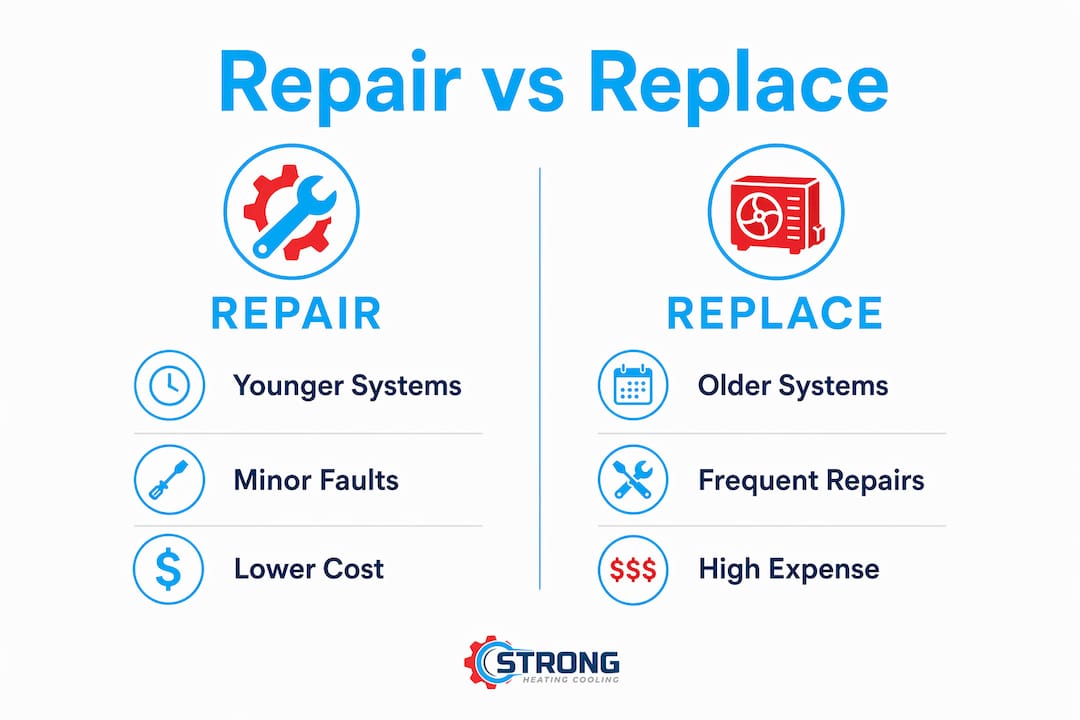
The HVAC repair vs replace decision works by comparing two financial benchmarks against your system’s age, repair history, and safety condition. Professionals use the $5,000 rule and the 50% rule to frame this choice in concrete terms. The $5,000 rule multiplies your system’s age by the estimated repair cost. If that number exceeds $5,000, replacement is usually the smarter financial move. These formulas give you a starting point, but the full picture includes efficiency loss, recurring failures, and safety risks that no single formula captures on its own.
What are the main factors in the HVAC repair vs replace decision?
The repair or replace choice rests on five core factors: system age, repair cost, repair frequency, operating efficiency, and safety condition. Each one carries weight, and they interact with each other in ways that can shift the answer quickly.
System age and expected useful life
Most central air conditioning systems last 15–20 years. Furnaces typically run 15–30 years depending on maintenance and equipment quality. Once a system crosses the 12–15 year mark, the calculus changes. Parts become harder to source, efficiency degrades, and the probability of additional failures rises sharply. Age alone does not trigger replacement, but it amplifies every other factor on this list.
Repair cost relative to replacement cost
Replacement costs for central HVAC systems range between $5,000 and $28,000 depending on system type and home size. That range matters because it sets the ceiling for what a repair can reasonably cost before replacement becomes the obvious choice. A $400 capacitor replacement on a 6-year-old system is an easy repair call. A $3,500 compressor replacement on a 14-year-old system is a much harder one.
Repair frequency as a signal of systemic fatigue
Multiple repairs within 24–36 months are a stronger replacement indicator than age alone. When one component fails, wear tends to spread to adjacent parts under similar stress. A pattern of repairs signals systemic deterioration, not isolated bad luck. At that point, each repair you approve is essentially funding a system that is already declining.
Efficiency and utility costs
Decreased system efficiency causing utility bill spikes is a legitimate financial reason to replace, even when the system still runs. Older equipment operating below its rated efficiency costs you money every month. Newer systems with higher SEER ratings for cooling and higher AFUE ratings for heating can meaningfully reduce monthly energy costs. That long-term savings potential belongs in your repair vs replace calculation.
Safety-critical conditions
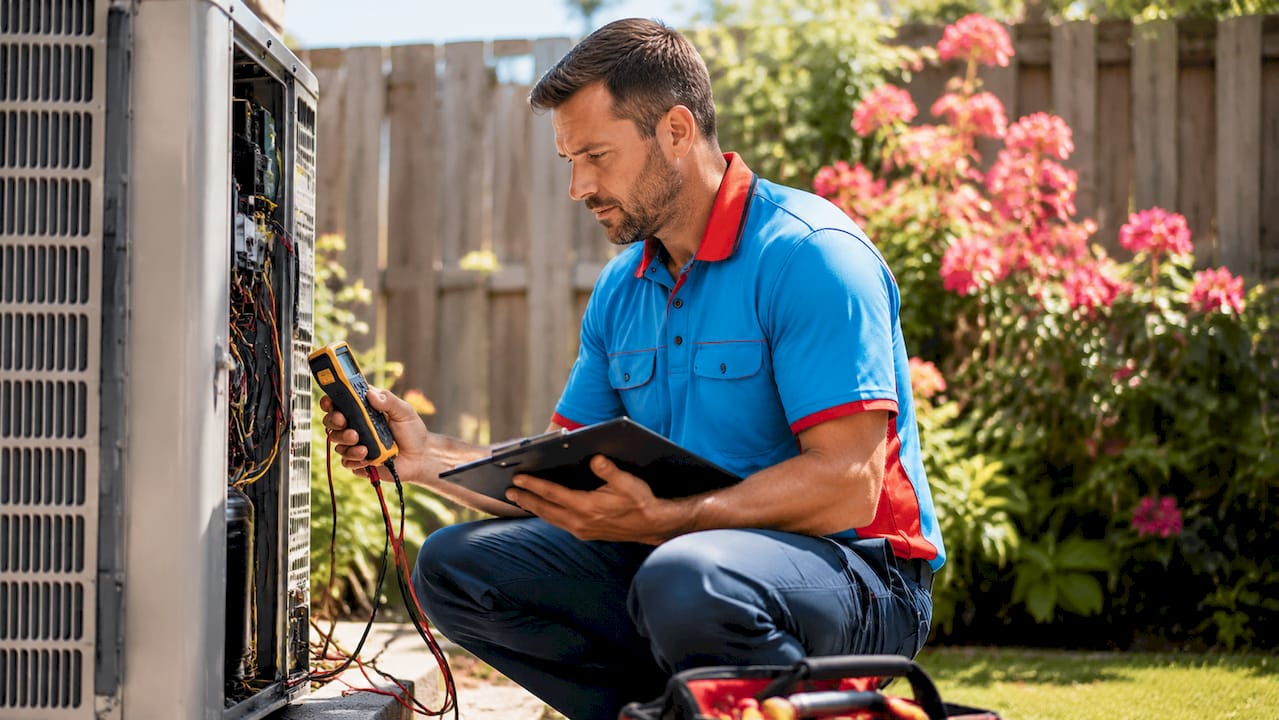
A cracked heat exchanger is the most urgent safety issue in this category. Cracked heat exchangers carry carbon monoxide risks that make continued operation dangerous. This is not a condition where you weigh cost and decide later. It requires immediate shutdown and professional evaluation. Safety issues like this override every financial formula in the decision process.
Pro Tip: Before calling for a repair quote, pull your last two years of utility bills. A steady increase in heating or cooling costs without a change in usage habits is a concrete sign of efficiency loss, and it strengthens the case for replacement.
How do the $5,000 rule and 50% rule work in practice?
These two rules give you a financial framework for deciding HVAC repair vs replace. Neither is perfect, but together they cover most homeowner scenarios with enough accuracy to guide a confident decision.
Applying the $5,000 rule
The formula multiplies system age by repair cost. If your 12-year-old furnace needs a $1,000 inducer motor replacement, the calculation reads 12 x $1,000 = $12,000. That result exceeds $5,000, so replacement is generally the recommended path. If your 4-year-old air conditioner needs the same $1,000 repair, the calculation reads 4 x $1,000 = $4,000. That falls below the threshold, and repair makes sense.
Applying the 50% rule
The 50% rule compares repair cost to new system cost. If a single repair costs more than half the price of a comparable new system, replacement is the wiser financial choice. This rule exists to prevent homeowners from spending “new system money” on “old system parts.” A $2,800 compressor replacement on a system that costs $5,500 new crosses that 50% line clearly.
Scenario comparison
Consider two homeowners facing similar repair quotes.
-
Homeowner A has a 7-year-old central AC unit. A refrigerant leak repair costs $900. The $5,000 rule gives 7 x $900 = $6,300, which exceeds the threshold. However, this is the first repair the system has needed, the unit is under 10 years old, and the repair addresses a single isolated issue. Here, the rule’s result should be weighed against the full picture. Repair is still reasonable.
-
Homeowner B has a 13-year-old furnace. The heat exchanger is cracked and the blower motor is failing. Repair estimates total $2,200. A comparable new furnace costs $4,500. The 50% rule flags this clearly: $2,200 is nearly 49% of replacement cost. Combined with the safety risk from the cracked heat exchanger and the system’s age, replacement is the right call.
-
Homeowner C has a 5-year-old system still under manufacturer warranty. A covered component fails. Repair costs nothing out of pocket. Replacement would cost $8,000. The decision is straightforward: repair and preserve the warranty.
Pro Tip: Always ask your technician whether the repair will restore near-original efficiency or simply address the symptom. A repair that leaves the system running at 70% of its rated capacity is not a full solution, even if it stops the immediate problem.
How warranty status affects the decision
Active manufacturer warranties change the math significantly. Most major HVAC brands, including Carrier, Trane, and Lennox, offer 5–10 year parts warranties on registered equipment. A repair covered under warranty costs you only labor. That shifts the 50% rule calculation considerably and almost always favors repair during the warranty period.
| Scenario | $5,000 Rule Result | 50% Rule Result | Recommended Path |
|---|---|---|---|
| 7-year-old AC, $900 repair, first failure | $6,300 (exceeds) | Well under 50% | Repair, given isolated failure |
| 13-year-old furnace, $2,200 repair, cracked exchanger | $28,600 (exceeds) | Near 50% | Replace immediately |
| 5-year-old system, warranty covers repair | N/A | N/A | Repair under warranty |
| 15-year-old system, $1,500 repair, third in two years | $22,500 (exceeds) | Depends on system cost | Replace |
What does the HVAC replacement process involve?
Understanding what is involved in the HVAC replacement process helps you plan realistically and avoid surprises. The process is more involved than a standard repair call, but a qualified contractor handles most of the complexity.
Step-by-step overview
Full HVAC replacement follows a multi-step process that typically includes the following stages:
- Load calculation: The technician performs a Manual J load calculation to size the new system correctly for your home’s square footage, insulation, and layout. Oversized or undersized equipment causes comfort problems and premature wear.
- Permitting: Most jurisdictions require a permit for HVAC replacement. Your contractor pulls this permit before work begins. Skipping this step creates liability issues and can affect your homeowner’s insurance.
- Removal: The old system is disconnected, refrigerant is recovered according to EPA regulations, and equipment is removed from the premises.
- Installation: The new equipment is set in place, connected to existing ductwork, electrical, and gas or refrigerant lines. Any ductwork modifications needed for proper airflow are completed at this stage.
- Commissioning and testing: The technician verifies airflow, refrigerant charge, thermostat controls, and safety systems before signing off on the job.
How long does HVAC installation take?
Residential replacement typically spans 1–2 days for a full system. An air conditioner only replacement often takes 4–8 hours. A furnace replacement alone runs 4–6 hours in most cases. Full system replacements involving both heating and cooling components take a full day or longer. Ductwork modifications, permit delays, or custom equipment orders can extend the timeline by several days.
| Replacement Type | Typical Time Estimate |
|---|---|
| AC unit only | 4–8 hours |
| Furnace only | 4–6 hours |
| Full system (AC + furnace) | 1–2 days |
| System with ductwork modifications | 2–4 days |
Why commissioning matters
Skipping commissioning can result in comfort problems and premature failure. A properly commissioned system runs at its rated efficiency from day one. Without it, you may have a new system that short-cycles, fails to reach temperature, or runs longer than necessary. Always confirm that your contractor includes commissioning as a standard part of the HVAC installation process.
How do safety and efficiency influence the repair vs replace choice?
Some conditions make the repair vs replace question less about money and more about risk. Safety and long-term efficiency are the two factors most likely to override a purely cost-based analysis.
When safety makes the decision for you
A cracked heat exchanger is the clearest example. Furnaces older than 12–15 years with cracked heat exchangers usually require replacement because repair costs approach new system pricing while the safety risk remains. Carbon monoxide is colorless and odorless. A compromised heat exchanger can allow combustion gases to enter your living space without any visible warning. The standard professional guidance is immediate shutdown and prompt evaluation. Repair is rarely viable on an older unit with this fault.
“Safety guidance strongly advises that cracked heat exchangers warrant immediate system shutdown and prompt professional evaluation due to serious carbon monoxide risk.” — MR. HVAC
New furnaces with AFUE ratings up to 98% eliminate this risk entirely while delivering significantly better fuel efficiency. That combination of safety and savings makes replacement the clear answer when a cracked exchanger is confirmed on an aging system.
When efficiency loss justifies replacement
Efficiency degradation is slower and less dramatic than a safety fault, but its financial impact compounds over time. A furnace originally rated at 80% AFUE that now operates at 65% efficiency costs you measurably more per heating season. The same principle applies to air conditioners with declining SEER performance. You can read more about how efficiency affects long-term costs to understand the full picture.
Technicians assess whether a repair can restore near-original efficiency or simply address a symptom. If a repair only gets the system back to 70% of its rated capacity, the monthly operating cost difference between that repaired unit and a new system may justify replacement within a few years. That calculation belongs in your decision, not just the upfront repair quote.
Pro Tip: Ask your technician to document the system’s current operating efficiency before and after any major repair. That data gives you a concrete baseline for comparing long-term costs against a new system’s rated performance.
When repair is still the right answer
Repair makes clear sense when the system is under 10 years old, the failure is isolated to a single component, the repair cost falls well below both the $5,000 and 50% thresholds, and no safety issues are present. A well-maintained system in this category has years of reliable service left. Replacing it prematurely wastes the remaining useful life and the capital cost of a new system. The goal is not to replace at the first sign of trouble. The goal is to replace at the right time.
Key takeaways
The HVAC repair vs replace decision works by combining the $5,000 rule, the 50% rule, repair frequency, efficiency data, and safety condition into a single, informed judgment.
| Point | Details |
|---|---|
| Use both financial rules together | Apply the $5,000 rule and 50% rule simultaneously; neither alone gives the full picture. |
| Repair frequency signals systemic decline | Multiple repairs within 24–36 months predict ongoing failures and favor replacement. |
| Safety overrides cost calculations | A cracked heat exchanger requires immediate shutdown and usually warrants full replacement. |
| Replacement takes 1–2 days typically | Plan for 1–2 days for a full system swap, longer if ductwork or permits are involved. |
| Efficiency loss has a real monthly cost | A system running below rated efficiency costs more each month, strengthening the replacement case. |
What i’ve learned after 40 years of HVAC decisions
After four decades of combined experience in this industry, the pattern I see most often is homeowners making the repair vs replace decision in isolation. They look at the repair quote, wince at the number, and either approve it or reject it without the full context. That approach costs people money in both directions.
The homeowners who make the best decisions are the ones who ask a second question after hearing the repair cost: “Will this repair restore the system to reliable, efficient operation, or will I be back here in 12 months with another problem?” That question changes the conversation. A technician who gives you an honest answer to that question is worth more than one who simply hands you a quote.
I have also seen the opposite mistake. Homeowners replace systems that had several good years left because one repair felt expensive. A 9-year-old system with a single failed component and no history of recurring issues is almost always worth repairing. Replacing it early means paying for a new system before the old one has delivered its full value.
The signs that point toward replacement are usually cumulative, not sudden. A system does not fail all at once. It gives you signals over 18–24 months before the final breakdown. Paying attention to those signals, and getting a professional evaluation before a crisis forces your hand, puts you in a much stronger position to make a rational choice rather than an urgent one.
My honest advice: get two estimates for any repair over $800, ask each technician directly whether they would repair or replace if it were their own home, and factor in your utility bills from the last two years. That combination of information gives you everything you need to decide with confidence.
— Owner
Get a professional assessment from Strongheatingandcooling
Deciding between repair and replacement is easier with a qualified technician who gives you straight answers, not just a repair quote.

Strongheatingandcooling serves Colorado Springs and surrounding communities with over 40 years of combined experience in heating and cooling. Whether you need a repair evaluated, a full system replaced, or an honest second opinion, the team at Strongheatingandcooling delivers clear guidance and quality workmanship. Explore heating installation and replacement options tailored to your home and budget, or check out HVAC financing options if upfront replacement cost is a concern. Strongheatingandcooling also offers cooling services for homeowners weighing AC repair or replacement decisions. Contact the team today for a professional system assessment.
FAQ
What is the $5,000 rule for HVAC decisions?
The $5,000 rule multiplies your system’s age by the estimated repair cost. If the result exceeds $5,000, replacement is generally the better financial choice.
When should you replace instead of repair an HVAC system?
Replacement is the right call when the system is over 12–15 years old, repair costs exceed 50% of new system cost, or multiple major repairs have occurred within the last two years.
How long does HVAC replacement take?
A full system replacement typically takes 1–2 days. An air conditioner only or furnace only replacement usually takes 4–8 hours, depending on the complexity of the job.
Is a cracked heat exchanger always a replacement trigger?
On furnaces older than 12–15 years, a cracked heat exchanger almost always warrants replacement. Repair costs on older units typically approach new system pricing, and the carbon monoxide risk makes continued operation dangerous.
Does warranty status change the repair vs replace calculation?
Yes. If your system is still under a manufacturer warranty from brands like Carrier, Trane, or Lennox, covered repairs cost only labor. That shifts the financial comparison significantly toward repair during the warranty period.
Recommended
Need expert HVAC help?
Colorado Springs' trusted, veteran-owned heating & cooling team — emergency service.