

TL;DR:
- Having an HVAC emergency response plan safeguards your family’s safety and prevents costly secondary damage. It ensures you are prepared to act quickly during system failures, minimizing health risks and property loss.
An HVAC emergency response plan protects your family’s safety, shields your home from secondary damage, and prevents the kind of panic-driven decisions that cost far more than the original repair. Having one means you already know what to do before the crisis starts.
When your system fails during a heat wave or a Colorado winter night, the first few minutes matter most. Here is what to do immediately:
- Identify whether the failure is a true emergency (gas smell, smoke, electrical sparks, or extreme indoor temperatures with vulnerable people present).
- Shut off the system at the thermostat and, if needed, at the breaker to prevent further damage.
- Move vulnerable household members (elderly, infants, anyone with health conditions) to a safe, temperature-controlled space.
- Call your pre-vetted HVAC contractor using the number you stored in advance.
Your plan’s core elements should include: a contractor contact list, equipment shut-off steps, temporary comfort measures (fans, space heaters, cooling centers), documentation of your system’s model and serial numbers, and your warranty and insurance information.
Pro Tip: Pre-vet a local contractor before you need one, and keep a dedicated emergency repair fund of $500–$1,000 set aside. Contractors you already trust are far less likely to quote panic pricing, and a small fund buys you time to make a clear-headed decision.
Table of Contents
- What counts as an HVAC emergency — and what can wait
- How a response plan directly benefits you as a homeowner
- A ready-to-use HVAC emergency response checklist
- When to call emergency HVAC service versus waiting for business hours
- Why regular maintenance is the best emergency prevention
- What to expect for emergency response time and cost
- How to keep your plan current and ready to use
- Key Takeaways
- What experience actually teaches you about HVAC emergencies
- Strongheatingandcooling is ready when your system is not
- Useful sources and further reading
- FAQ
What counts as an HVAC emergency — and what can wait
HVAC professionals define a true emergency by three criteria: immediate safety threats, health risks to vulnerable occupants, and conditions likely to cause property damage. Everything else can usually be scheduled during normal business hours.
Clear emergencies include:
- A gas smell near the furnace or anywhere in the home (evacuate and call the gas company first).
- Burning odors, visible smoke, or electrical sparks from any HVAC component.
- A breaker that trips repeatedly when the system tries to start.
- Active water overflow from a clogged condensate line threatening floors or ceilings.
- Indoor temperatures climbing into dangerous ranges with elderly residents, infants, or anyone managing a serious health condition present.
Non-emergencies that can wait include a system that runs but cools or heats unevenly, a thermostat display that goes blank (usually a battery), or a unit that is louder than normal but still functioning. Scheduling those during business hours saves you after-hours labor costs.
“If a customer is calling with a need and they’re in distress because their system is broken — and let’s say that it’s 105 degrees outside — they need somebody there right now. We can’t say, ‘All right, we’ll get out there next week. Just sweat for the next week.’ That doesn’t work well.” — Josh Conder, Division Operations Manager, American Residential Services (ARS)
You can find a detailed breakdown of warning signs that require immediate attention to help you apply these criteria in the moment.
How a response plan directly benefits you as a homeowner
The most concrete benefit of HVAC emergency planning is fewer secondary losses. More than 60% of household emergencies involving HVAC failures resulted in avoidable secondary damage because homeowners lacked preparedness. A plan changes that outcome.
Other direct benefits:
- Faster intervention means less time for a small problem (a failing capacitor, a clogged drain line) to cascade into a compressor failure or water damage.
- Pre-defined decision rules reduce decision fatigue, so you are not choosing between contractors at midnight under pressure.
- Knowing your shut-off steps and temporary measures protects vulnerable household members. Heat-related deaths tied to lack of working air conditioning in the Phoenix area underscore how quickly a cooling failure becomes a life-safety issue for at-risk residents.
- A plan prevents panic pricing. Homeowners without one tend to agree to the first quote they receive under stress.
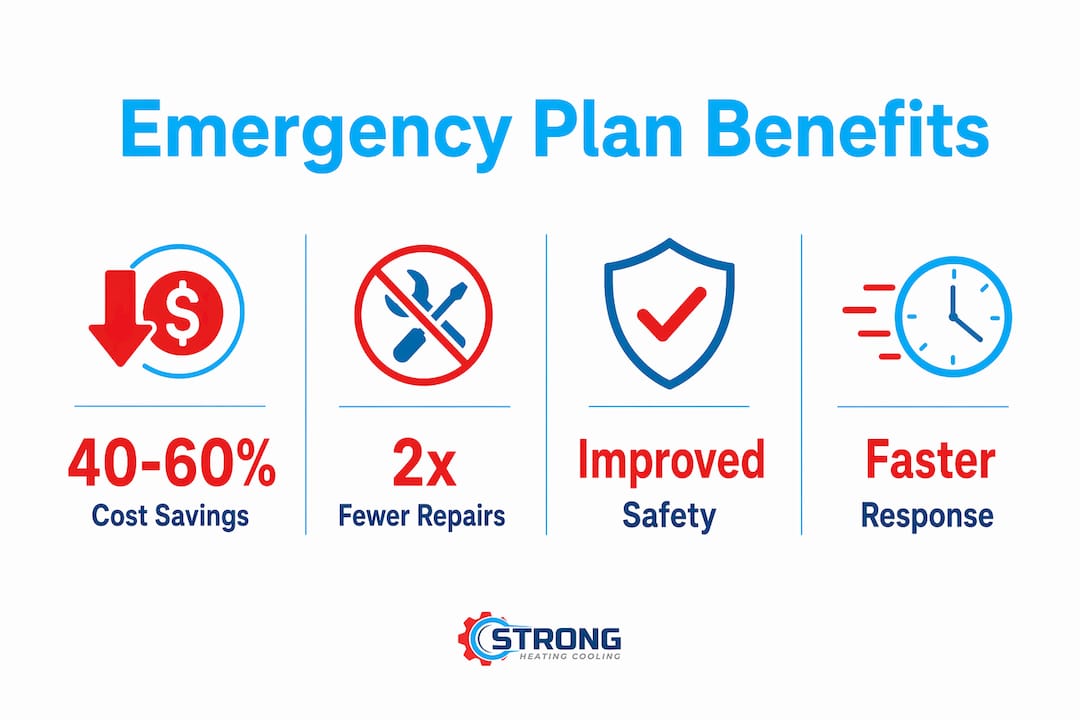
Buildings with proactive HVAC maintenance programs spend 40–60% less on total HVAC costs, and investments in prevention can lead to substantial savings in avoided repairs and energy waste. An emergency plan is the companion piece to that maintenance investment.
A ready-to-use HVAC emergency response checklist
Organize your plan into four phases so it is easy to follow under stress.
Phase 1: Prepare (before any failure)
- Record your HVAC system’s make, model, serial number, and installation date. Store copies digitally (cloud folder or email to yourself) and physically (taped inside the equipment closet).
- Note your warranty expiration date and your homeowner’s insurance policy number. Confirm whether your policy covers sudden HVAC-related water damage.
- Save your contractor’s number, an after-hours line, and one backup contractor in your phone and on a printed card near the thermostat.
- Label your circuit breakers clearly so any household member can find the HVAC breaker in the dark.
- Assemble a basic HVAC emergency kit: three months of spare furnace filters, fresh thermostat batteries, a carbon monoxide detector, a portable thermometer, and a $500–$1,000 repair fund.
Phase 2: Immediate response (first 30 minutes)
- Check the thermostat, breaker, and outdoor disconnect before calling anyone. Many apparent failures are simple resets.
- If you smell gas or see smoke, leave the home immediately. Do not operate any switches. Call 911 and your gas utility from outside.
- If the system is buzzing, clicking, or tripping the breaker repeatedly, turn it off and leave it off. Repeated restarts worsen the damage.
- Move vulnerable household members to a safe space and document what you observe: sounds, smells, water, error codes.
Phase 3: Short-term fixes (hours to a day)
- Use fans, portable heaters, or window AC units as temporary measures while you wait for service.
- Close blinds and avoid heat-generating appliances (oven, dryer) to slow indoor temperature rise in summer.
- Photograph any visible damage, water, or ice before the technician arrives. This documentation supports warranty and insurance claims.
Phase 4: Follow-up (repair, replacement, and paperwork)
- Ask the technician for an itemized written estimate before authorizing work. Review questions to ask an emergency HVAC technician to avoid agreeing to a rushed fix.
- Confirm whether the repair affects your warranty coverage before signing anything.
- File any insurance claim promptly and keep all service receipts.
| Scenario | Typical cost range | Likely response window |
|---|---|---|
| After-hours emergency call | $300–$2,000+ | Same day to 24 hours |
| Planned repair (business hours) | 40–60% lower than emergency repair. | 1–3 business days |
| Expedited parts (emergency) | $200–$500 added cost | Varies by part availability |
Pro Tip: Keep your equipment’s serial number and purchase date in a shared cloud folder (Google Drive, iCloud) so any household member can access it instantly when calling a contractor.
When to call emergency HVAC service versus waiting for business hours
The decision comes down to four factors: safety, vulnerability, spread of damage, and outdoor temperature extremes.
Call for emergency service now if:
- There is any gas smell, burning odor, smoke, or electrical sparking.
- The breaker trips more than once when you try to reset it.
- Water is actively overflowing from the unit and threatening your floors or walls.
- Anyone in the home is elderly, an infant, pregnant, or managing a health condition, and indoor temperatures are becoming dangerous.
- Outdoor temperatures are extreme (above 95°F or below 20°F) and the system is completely non-functional.
Schedule during business hours if:
- The home is warm or cool but manageable, and all occupants are healthy adults.
- The system is running but performing poorly (uneven temperatures, higher bills).
- Evening temperatures will naturally bring relief before a technician can arrive.
Pro Tip: Ask your contractor about priority scheduling or a maintenance membership. Members of service plans typically move to the front of the queue during peak season, which can mean the difference between a same-day visit and a two-day wait.
Why regular maintenance is the best emergency prevention
Extreme weather exposes pre-existing maintenance problems, not random ones. A capacitor that was already weakening, a coil that was already dirty, a refrigerant charge that was already low — heat and cold simply finish what neglect started.
A practical maintenance schedule for homeowners:
- Replace furnace filters every 1–3 months depending on filter type and household conditions.
- Schedule professional tune-ups twice a year: spring for the cooling system, fall for the heating system.
- During each visit, ask the technician to check refrigerant levels, electrical connections, drain lines, and heat exchanger condition — the components most likely to cause emergency failures.
Maintenance plans typically produce 10–15% lower energy bills, include two visits per year (spring and fall), and often come with perks like priority scheduling and discounts that directly reduce emergency costs. Pairing a maintenance agreement with a written emergency response plan gives you both prevention and a clear path forward when prevention is not enough. The same logic applies to other home systems: preventive service contracts for plumbing follow the same cost-reduction pattern.
The Strongheatingandcooling residential HVAC maintenance guide walks through what a complete tune-up covers and how to combine it with an emergency plan.
Pro Tip: During your fall tune-up, ask the technician: “What is the single most likely component to fail on this system in the next 12 months?” That answer tells you what to budget for and whether to keep a specific part on hand.
What to expect for emergency response time and cost
Emergency HVAC repairs typically involve higher costs than planned maintenance, with after-hours labor and expedited parts adding to expenses. Compressor replacements sit at the high end of that range.
Response times vary significantly by season. During peak summer or winter demand, even well-staffed contractors may take 24 hours or longer to arrive. Outside peak season, same-day service is more common.
To reduce both cost and wait time:
- Use a pre-vetted contractor you contacted before the emergency, not one found under pressure.
- Ask for an itemized written estimate before authorizing any repair.
- Confirm whether the repair carries its own warranty, separate from the equipment warranty.
- If the repair cost approaches the system’s remaining value, ask directly whether replacement makes more financial sense.
Pro Tip: A contractor who hesitates to give you an itemized estimate during an emergency is a contractor worth pausing on. Reputable technicians expect the question.
How to keep your plan current and ready to use
A plan that is not reviewed regularly will have outdated phone numbers, dead batteries in the CO detector, and a repair fund that was spent on something else. A simple quarterly check prevents all of that.
Each season, run through this short review:
- Test your carbon monoxide detector and smoke alarms; replace batteries if needed.
- Confirm your contractor’s current phone number and after-hours line.
- Check that your repair fund is still intact.
- Replace any furnace filters that are due.
- Review shut-off steps with every adult in the household, including any caregivers or frequent visitors.
Store the plan in two places: a printed copy taped inside the equipment closet or utility room, and a digital copy in a shared folder accessible to all household members. If you have neighbors who check on your home when you travel, share the contractor contact and basic shut-off steps with them as well.
Key Takeaways
An HVAC emergency response plan matters because it protects your family’s safety, prevents secondary property damage, and eliminates the panic-driven decisions that make emergency repairs far more expensive than they need to be.
| Point | Details |
|---|---|
| Define emergencies clearly | Gas smells, smoke, sparks, active water overflow, and extreme temps with vulnerable people are true emergencies. |
| Prepare before failure | Store equipment info, contractor contacts, and a modest repair fund before any crisis occurs. |
| Maintenance cuts emergency risk | Proactive maintenance reduces total HVAC costs by 40–60% and lowers energy bills by 10–15%. |
| Emergency costs are predictable | After-hours repairs run $300–$2,000+, with labor 40–60% higher than standard rates. |
| Strongheatingandcooling as your local resource | Strongheatingandcooling serves Colorado Springs and surrounding communities with emergency response, maintenance plans, and priority scheduling. |
What experience actually teaches you about HVAC emergencies
Most homeowners build their emergency plan after the first bad experience, not before it. That is understandable, but it is also the most expensive way to learn. The families who come through a mid-winter furnace failure or a July AC breakdown with the least damage and the lowest bills are almost always the ones who had two things in place: a contractor they already trusted, and a clear sense of what counted as a real emergency versus what could wait.
The conventional wisdom says to keep a phone number on the fridge. That is not a plan. A real plan includes decision rules, documented equipment information, a small financial buffer, and at least one household member who knows where the breaker is. The difference between those two approaches shows up in the repair bill and in how the family handles the next 12 hours.
Strongheatingandcooling’s experience across Colorado Springs also confirms what the maintenance data shows: most emergency calls trace back to a problem that was visible months earlier. A spring tune-up is not a luxury. For most systems, it is the single highest-return action a homeowner can take.
Strongheatingandcooling is ready when your system is not
When a heating or cooling failure happens in Colorado Springs, the gap between a manageable situation and a costly one often comes down to who you call and how fast you reach them. Strongheatingandcooling offers emergency HVAC repair in Colorado Springs with over 40 years of combined experience, honest pricing, and no pressure to agree to repairs that do not make sense for your situation.

The team can also help you set up a maintenance plan that reduces the chance of an emergency in the first place, with biannual tune-ups, priority scheduling, and documentation support so your equipment records are always current. For cooling system needs specifically, the air conditioner services page covers repair, replacement, and seasonal maintenance options. To get started, contact Strongheatingandcooling directly for a straightforward conversation about your system and what it needs.
Useful sources and further reading
- When an HVAC failure is a true emergency — HVAC professionals define the safety, health, and property-damage thresholds that separate real emergencies from schedulable repairs.
- HVAC Emergency Plan: Be Ready Before Your System Fails — Covers the decision-tool framework and the secondary-damage statistic cited in this article.
- Why emergency HVAC repairs are more expensive than preventive maintenance — Explains how extreme weather exposes neglected maintenance problems and why proactive care costs less.
- How Proactive HVAC Maintenance Saves Money — ROI data on the 40–60% cost reduction from proactive maintenance programs.
- Preventative Maintenance Plans vs. Emergency Repairs — Cost ranges for emergency repairs and the energy-bill savings from maintenance plans.
- Why Every Homeowner Should Have an Emergency HVAC Plan — Detailed guidance on assembling an HVAC emergency kit, including the repair fund recommendation.
- Strongheatingandcooling blog — Local guidance on emergency safety steps, furnace repair checklists, and maintenance plan details for Colorado Springs homeowners.
FAQ
What is a true HVAC emergency?
A true HVAC emergency involves an immediate safety threat (gas smell, smoke, electrical sparks), a health risk to a vulnerable household member, or active property damage such as water overflow from a failed condensate drain. Issues that are uncomfortable but not dangerous can usually wait for normal business hours.
How much does an emergency HVAC repair typically cost?
Emergency HVAC repairs typically range from $300 to over $2,000 depending on the problem, with after-hours labor running 40–60% higher than standard rates and expedited parts adding $200–$500 in some cases.
How does regular maintenance reduce HVAC emergencies?
Proactive maintenance catches weaknesses like failing capacitors, dirty coils, and low refrigerant before extreme weather exposes them. Buildings with proactive maintenance programs spend 40–60% less on total HVAC costs compared to reactive-only approaches.
When should I call Strongheatingandcooling for emergency service?
Call Strongheatingandcooling immediately if you detect gas, smoke, or electrical sparks, if a breaker trips repeatedly, if water is actively overflowing from the unit, or if indoor temperatures are becoming dangerous for vulnerable household members in Colorado Springs or surrounding communities.
What should I keep in an HVAC emergency kit?
A practical kit includes three months of spare furnace filters, fresh thermostat batteries, a carbon monoxide detector, a portable thermometer, labeled circuit breaker information, and a dedicated repair fund of $500–$1,000.
Recommended
Need expert HVAC help?
Colorado Springs' veteran-owned heating & cooling team — Mon–Sat, 8 AM–7 PM. Same-day service when available.