

What Is a Communicating HVAC System for Homeowners
TL;DR:
- A communicating HVAC system exchanges digital data continuously to control performance in real time, unlike traditional on/off systems. It requires compatible components and professional installation to operate efficiently, providing precise temperature, humidity control, and early fault detection. Properly paired systems offer homeowners increased comfort, energy savings, and predictive maintenance benefits.
A communicating HVAC system is defined as an integrated network where the thermostat, air handler, furnace, and outdoor unit continuously exchange digital data to control performance in real time. Unlike traditional systems that rely on simple on/off switching, a communicating setup sends and receives binary data packets that allow every component to adjust its output based on actual conditions inside your home. This HVAC communication technology represents a meaningful shift in how heating and cooling equipment operates, and understanding it helps you make smarter decisions about comfort, energy costs, and long-term maintenance. Strongheatingandcooling works with these systems daily across Colorado Springs and the surrounding communities.
What is a communicating HVAC system, technically speaking?
A communicating HVAC system replaces the traditional bundle of switching wires with two data wires plus power that carry continuous digital information between components. That shift is more significant than it sounds. Traditional systems use multiple relay wires, each dedicated to a single command like “turn on the fan” or “start the compressor.” A communicating system sends all of that information, plus real-time performance data, through a single data bus.
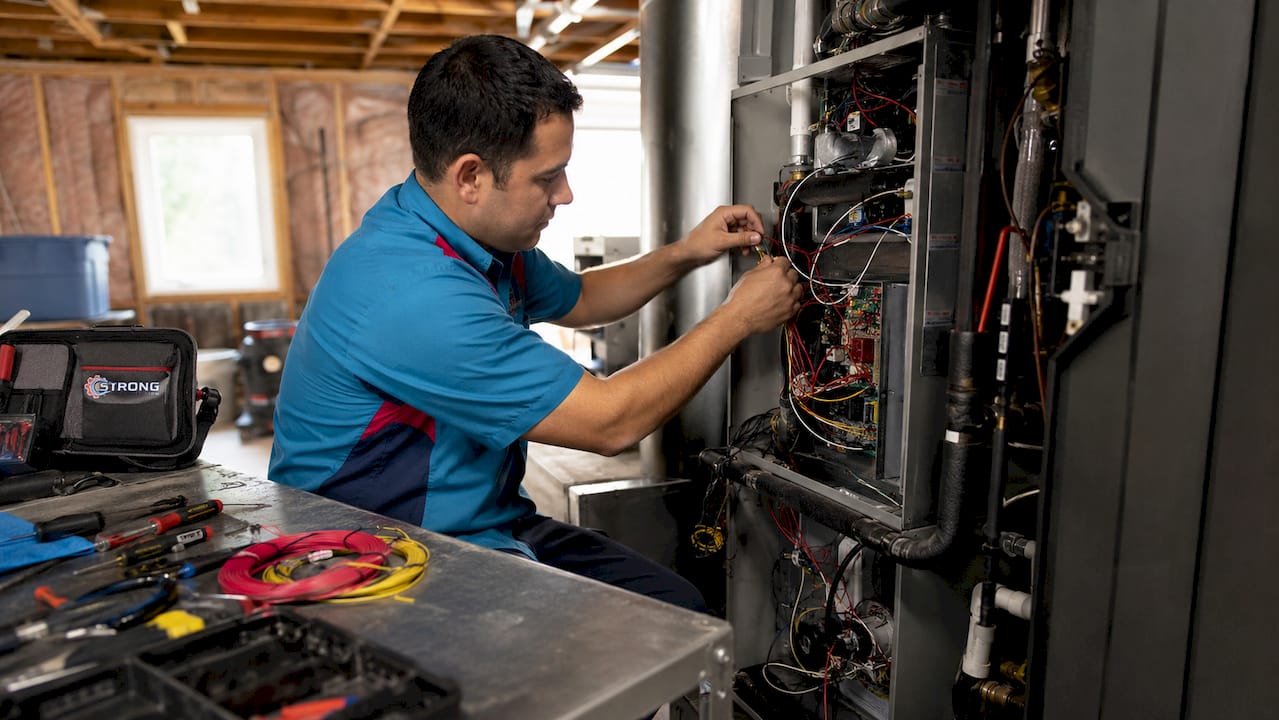
The data travels as binary packets, similar to how a home network transmits information between devices. Each packet can carry details about current temperature, humidity levels, equipment capacity, fault codes, and operating status. The thermostat reads those packets and responds by adjusting fan speed, compressor staging, or heat output in small increments rather than simply switching the system on or off.
Communication protocols govern how this data exchange happens. Open standards like BACnet, an ISO 16484-5 standard, are common in commercial buildings because they allow equipment from different manufacturers to work together. Residential systems, however, frequently rely on proprietary protocols developed by individual manufacturers. That distinction matters when you are planning an installation or an upgrade.
The pairing process during installation is where the communication actually gets established. The thermostat queries the indoor and outdoor units, identifies their model numbers and capacity ratings, and configures itself to manage them correctly. Improper pairing eliminates efficiency gains even when all the hardware is compatible. This is why installation by a trained technician is not optional with these systems.
Pro Tip: A smart thermostat alone does not create a communicating system. The furnace, air handler, and outdoor unit must all have compatible control boards for digital data exchange to occur.
Here is what the communication chain typically includes:
- A communicating thermostat with a digital display and data bus connection
- An indoor air handler or furnace with a compatible control board
- An outdoor condenser or heat pump with its own data interface
- A two-wire data bus connecting all components
- Manufacturer-specific software that interprets the data packets
Each component must be designed to speak the same protocol. Without that alignment, the system defaults to basic on/off operation regardless of how advanced the thermostat looks.
What are the key benefits of communicating HVAC systems?
The most direct benefit of a communicating HVAC system is precise temperature and humidity control. Variable-speed modulation allows the system to run at exactly the capacity needed rather than blasting at full power until the thermostat setpoint is reached. A standard builder-grade system operates like a light switch. A communicating system operates more like a dimmer, dialing output up or down in small steps based on real-time feedback.
That modulation produces measurable comfort improvements. Rooms maintain steadier temperatures because the system runs longer at lower capacity instead of short-cycling at full blast. Humidity drops more consistently because longer run times give the evaporator coil more time to pull moisture from the air. For homeowners in Colorado Springs, where temperature swings between seasons can be significant, that consistency matters.
Energy efficiency is the second major advantage. You can read more about how variable-speed equipment saves energy compared to single-speed systems. Because the equipment runs at reduced capacity most of the time, it draws less electricity and burns less fuel. The savings compound over a full heating and cooling season.
Predictive maintenance is a benefit that often surprises homeowners. Real-time performance monitoring enables the system to detect early fault conditions and alert you before a component fails. That alert might show up as a fault code on your thermostat display or as a notification through a connected app. Catching a failing capacitor or a refrigerant pressure drop early costs far less than an emergency breakdown in the middle of a Colorado winter.
The numbered list below summarizes the core advantages in order of practical impact for most homeowners and property managers:
- Consistent temperature control through variable-speed modulation
- Lower energy consumption compared to single-speed on/off systems
- Better humidity management during long, low-capacity run cycles
- Early fault detection through real-time diagnostics
- Quieter operation because the system rarely runs at full capacity
- Remote monitoring and control through compatible apps and smart devices
Noise reduction is worth calling out separately. A system running at 40% capacity is noticeably quieter than one cycling on at full power. For property managers overseeing multi-unit buildings, that quieter operation reduces tenant complaints and supports longer equipment life.
How do communicating systems compare with traditional HVAC models?
The performance gap between communicating and non-communicating systems becomes clear when you look at how each handles a mild day. A traditional system reads the thermostat, switches on at full capacity, reaches the setpoint, and shuts off. That cycle repeats every few minutes. A communicating system reads the same conditions and simply reduces its output to match the load, running continuously at a fraction of full power.
That difference in operation affects wiring, control features, and long-term costs. The table below compares the two approaches across the factors that matter most to homeowners and property managers.
| Feature | Communicating system | Non-communicating system |
|---|---|---|
| Wiring | Two data wires plus power | Multiple dedicated relay wires |
| Speed control | Variable-speed modulation | Single-speed on/off |
| Temperature consistency | Fine-tuned, steady output | Noticeable temperature swings |
| Humidity control | Improved through longer run times | Limited by short cycling |
| Fault detection | Real-time alerts and fault codes | No built-in diagnostics |
| Installation complexity | Requires pairing and configuration | Straightforward wiring |
| Protocol flexibility | Often proprietary; some open standards | Not applicable |
| Long-term operating cost | Lower due to efficiency gains | Higher due to full-capacity cycling |
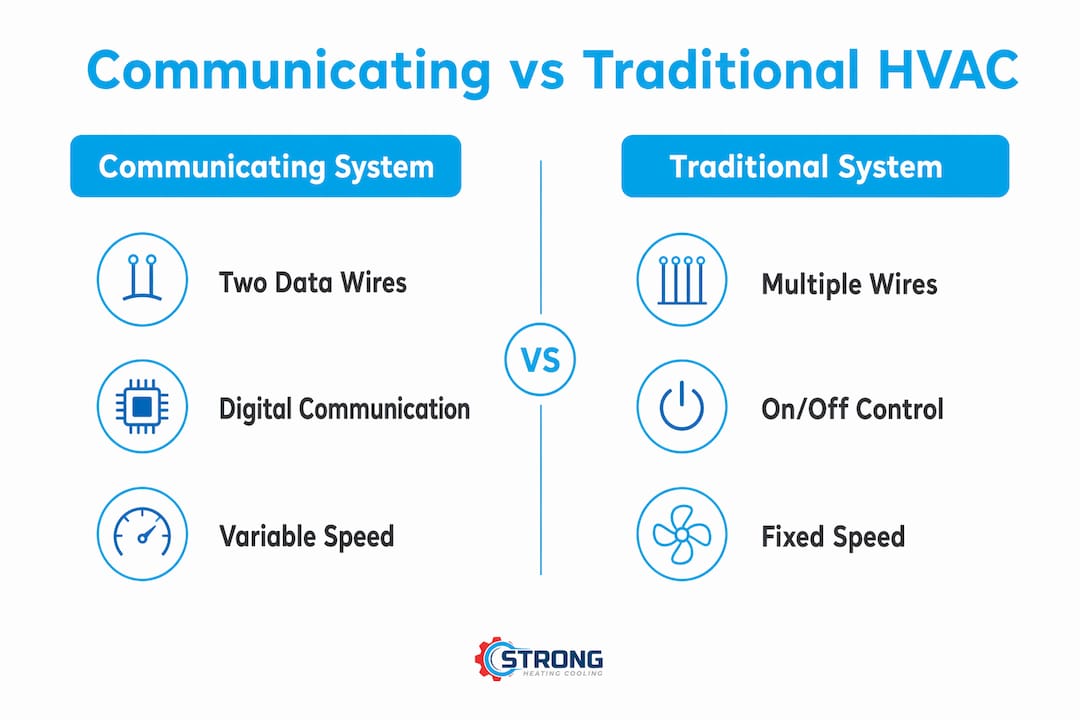
The wiring difference is practical as well as technical. Traditional systems require a wire for each function, which means more connections, more potential failure points, and more labor during installation. Two-wire data communication reduces that complexity at the component level, though the configuration process during setup is more involved.
Long-term cost is where the comparison becomes most relevant for property managers overseeing multiple units. A communicating system costs more upfront. The equipment is more sophisticated, and installation takes longer. Over several years of operation, however, the reduced energy consumption and fewer emergency repairs tend to offset that initial investment. The energy efficiency gains from variable-speed equipment are consistent across climates and building types.
Pro Tip: When budgeting for a communicating system, factor in the cost of a compatible communicating thermostat. A standard thermostat will not unlock the variable-speed and diagnostic features even if the equipment supports them.
What should you know before installing a communicating HVAC system?
Compatibility is the first thing to verify. Both the thermostat and the HVAC equipment must support the same communication protocol for the system to function as designed. Without compatible control boards in the furnace, air handler, and outdoor unit, the thermostat operates the equipment as a basic on/off system regardless of its own capabilities.
Brand compatibility adds another layer of complexity. Proprietary protocols frequently prevent mixing brands, meaning a thermostat from one manufacturer will not communicate with equipment from another. This is a real constraint when replacing one component at a time. If your furnace is from one manufacturer and you want to add a communicating air conditioner from a different brand, you may need to replace the thermostat and the control boards as well.
For commercial property managers, open protocols like BACnet offer a path around vendor lock-in. BACnet allows devices from different manufacturers to share data on the same network, which matters when managing a building with mixed equipment ages and brands. Residential homeowners rarely have access to BACnet-compatible equipment at standard price points, but the principle of checking protocol compatibility before purchasing applies equally.
The installation process itself requires more than running wires. A discovery and pairing process must occur where the thermostat identifies the indoor and outdoor units, reads their capacity data, and configures the staging and modulation parameters. Skipping or rushing this step produces a system that runs but does not perform as designed. You can learn more about how smart thermostat integration affects overall system behavior.
Before scheduling an installation, work through this checklist:
- Confirm that all equipment components support the same communication protocol
- Verify that the thermostat is rated as a communicating control, not just a smart thermostat
- Ask your installer about brand ecosystem requirements for your chosen equipment
- Plan for the pairing and commissioning process as a separate step after physical installation
- Schedule a follow-up maintenance visit within the first season to verify performance data
Ongoing maintenance for a communicating system differs from traditional HVAC service. Technicians need to be trained to read fault codes, interpret performance data, and use manufacturer-specific diagnostic tools. Planned maintenance visits become more productive because the system itself provides a record of how it has been operating.
Key Takeaways
A communicating HVAC system delivers consistent comfort and lower operating costs only when every component, from the thermostat to the outdoor unit, shares the same digital protocol and is correctly paired during installation.
| Point | Details |
|---|---|
| Digital data exchange | Communicating systems use two data wires to replace multiple relay wires, enabling real-time performance adjustments. |
| Variable-speed modulation | Equipment runs at reduced capacity most of the time, producing steadier temperatures and lower energy use. |
| Predictive maintenance | Real-time diagnostics alert homeowners to faults before they become costly breakdowns. |
| Protocol compatibility | Thermostat and all equipment must share the same protocol; smart thermostats alone do not create a communicating system. |
| Professional installation required | Pairing and commissioning are separate steps that determine whether efficiency gains are actually realized. |
What I have seen after 40 years of HVAC work in Colorado
The most common misconception I run into is the belief that swapping in a smart thermostat upgrades the whole system. Homeowners spend $200 on a connected thermostat, install it themselves, and expect the efficiency gains they read about online. What they get is a nicer display on the same old on/off system. The thermostat is only one part of the equation.
The second thing I have noticed is that communicating systems reward homeowners who pay attention. The fault codes and performance alerts are genuinely useful, but only if someone reads them. I have seen systems flag a refrigerant pressure issue for three months before anyone called for service. By that point, the compressor was stressed and the repair cost was far higher than it needed to be. The technology gives you the information. Acting on it is still your responsibility.
The real-world comfort difference is not subtle when the system is installed correctly. Homes with properly commissioned communicating equipment hold temperature within a very tight range, and humidity levels stay consistent through the summer. That is not marketing language. It is what happens when the equipment runs at the right capacity for the actual load instead of cycling on and off at full blast.
My honest recommendation for homeowners in Colorado Springs is to treat a communicating system as a whole-system investment, not a component upgrade. Plan to replace the thermostat, the indoor unit, and the outdoor unit at the same time if you want the full benefit. Mixing old non-communicating equipment with a new communicating thermostat produces a system that is neither fish nor fowl.
— Owner
How Strongheatingandcooling helps with communicating HVAC systems
Strongheatingandcooling has installed and serviced communicating HVAC systems across Colorado Springs and the surrounding communities for decades. The team understands the pairing process, the protocol compatibility requirements, and the commissioning steps that determine whether a system performs as designed.

Whether you are replacing an aging furnace, upgrading to a variable-speed air conditioner, or planning a full system replacement, Strongheatingandcooling provides honest guidance on which equipment fits your home and budget. The team handles heating installation and replacement as well as cooling system services for homeowners who want the efficiency and comfort that a properly installed communicating system delivers. Every installation includes the commissioning and pairing steps that make the technology work the way it should.
FAQ
What is a communicating HVAC system in simple terms?
A communicating HVAC system is one where the thermostat and equipment exchange continuous digital data, allowing the system to adjust its output in real time rather than simply switching on and off.
Does a smart thermostat make my HVAC system communicating?
No. A smart thermostat alone does not create a communicating system. The furnace, air handler, and outdoor unit must all have compatible control boards that support the same digital protocol.
How does HVAC communication work at the wiring level?
Communicating systems use as few as two data wires to carry all performance information between components, replacing the multiple dedicated relay wires that traditional systems require.
Can I mix brands in a communicating HVAC system?
Proprietary protocols used by most residential manufacturers typically prevent mixing brands. A thermostat from one manufacturer will generally not communicate with equipment from a different one.
What maintenance does a communicating HVAC system need?
Communicating systems benefit from scheduled maintenance visits where a trained technician reads fault codes and reviews performance data, catching potential issues before they lead to breakdowns.
Recommended
- What Is an HVAC System? A Homeowner’s Guide | Strong Heating & Cooling
- What Is Predictive HVAC Maintenance for Homeowners | Strong Heating & Cooling
- Smart Thermostat HVAC Trends That Matter | Strong Heating & Cooling
- HVAC Financing: How to Replace a System Without Draining Savings | Strong Heating & Cooling
Need expert HVAC help?
Colorado Springs' trusted, veteran-owned heating & cooling team — emergency service.