
What Counts as an HVAC Emergency: 2026 Guide
TL;DR:
- An HVAC emergency involves a system failure that poses an immediate threat to health, safety, or property. Critical situations include gas leaks, carbon monoxide alarms, electrical hazards, severe water leaks, and extreme temperature failures requiring urgent professional response. Recognizing these emergencies allows proper action, preventing dangerous outcomes and unnecessary costs.
An HVAC emergency is defined as any heating or cooling system failure that creates an immediate threat to your health, safety, or property. Gas leaks, carbon monoxide alarms, electrical hazards, severe water leaks, and total climate control loss in extreme temperatures all qualify as true emergencies requiring prompt professional response. Understanding what counts as an HVAC emergency protects you from two costly mistakes: ignoring a dangerous situation or paying after-hours rates for a problem that could wait until morning. This guide gives you clear thresholds, real examples, and a practical framework for making that call confidently.
What counts as an HVAC emergency?
The industry standard for classifying an HVAC emergency centers on one question: does this failure put a person, pet, or structure at immediate risk? If the answer is yes, you have an emergency. If the answer is no, you likely have an urgent comfort issue that warrants next-business-day service.
The most widely used framework in the HVAC industry is the 90/40 rule. Below 40°F, a heating failure risks hypothermia and burst pipes. Above 90°F, a cooling failure risks heat exhaustion and heat stroke. These temperature thresholds are the clearest dividing line between a comfort problem and a genuine crisis.
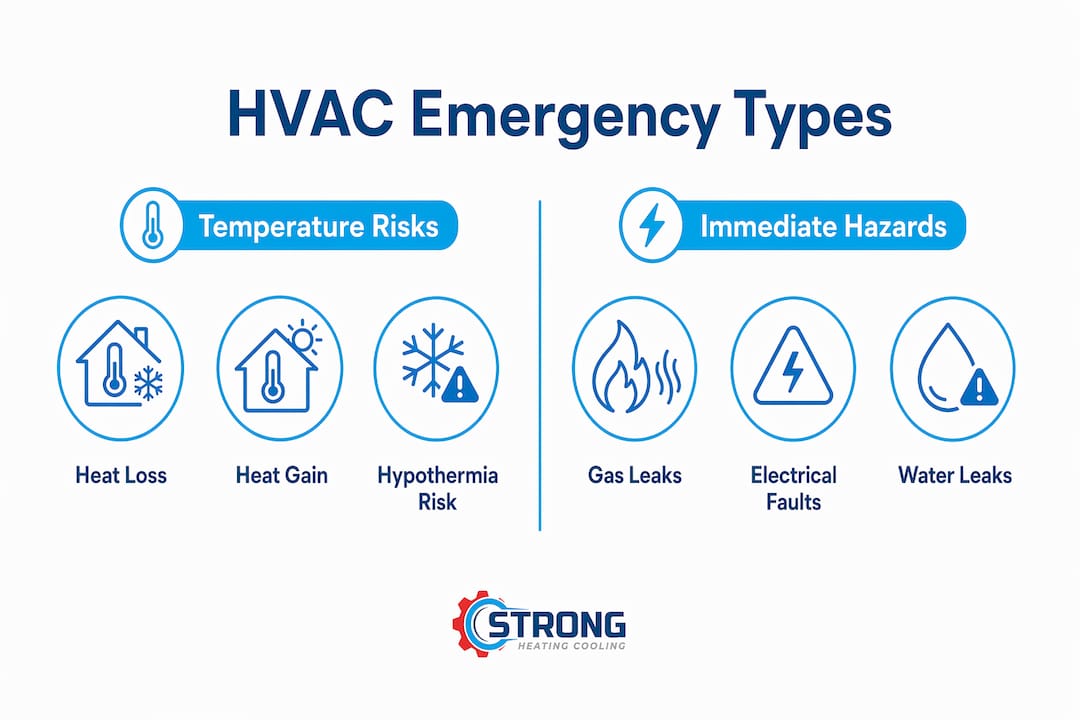
Beyond temperature, five categories of failure always qualify as emergencies regardless of outdoor conditions. Gas leaks, carbon monoxide exposure, electrical hazards, active water leaks threatening your structure, and total system failure during extreme weather all demand immediate action. Each of these situations carries risks that worsen by the hour, not by the week.
Knowing these categories in advance means you spend less time second-guessing and more time acting. The sections below break each category down with specific signs and examples.
Types of HVAC emergencies: examples and categories
The following table organizes the most common types of HVAC emergencies by category, with examples and the appropriate first response.
| Emergency Type | Real-World Example | First Response |
|---|---|---|
| Gas leak | Rotten egg smell near furnace or gas lines | Evacuate, call 911 and your gas utility |
| Carbon monoxide | CO detector alarm with headache or nausea | Evacuate immediately, call 911 |
| Electrical hazard | Scorched wiring, sparks, or burning plastic smell | Shut off power at breaker, call HVAC tech |
| Severe water leak | Active leak from air handler flooding ceiling or walls | Shut off system, call HVAC tech immediately |
| Extreme weather failure | No heat at 20°F outdoor temps, no AC at 100°F | Call for emergency repair, relocate vulnerable occupants |
| Mechanical failure | Loud grinding or banging from furnace or air handler | Shut off system, call for inspection |
Gas leaks and carbon monoxide: the highest priority emergencies
Natural gas suppliers add mercaptan to gas lines specifically so you can detect leaks by smell. That rotten egg odor is not a minor inconvenience. It is a signal to stop what you are doing, leave the building, and call 911 and your gas utility before you contact any HVAC company. Symptoms like headaches, nausea, or dizziness alongside a gas smell confirm the situation is serious.
Carbon monoxide is more dangerous because it has no smell. A CO detector alarm is your only reliable warning. When that alarm sounds, treat it as a confirmed emergency every time. HVAC technicians are not first responders, and a gas or CO situation requires emergency services to clear the building before any repair work begins.
Electrical warning signs that cannot wait
Scorched wiring, soot, or repeated circuit breaker trips indicate dangerous electrical stress that can lead to fire. This is true even if your system appears to be running normally. A breaker that trips once might be a fluke. A breaker that trips repeatedly when the HVAC system runs is telling you something is drawing too much current, and that condition creates a near-miss fire hazard. Shut off power to the unit at the breaker panel and call for professional inspection before restarting the system.
Severe water leaks and mechanical failures
An air handler or condensate line that is actively flooding a ceiling, wall cavity, or electrical panel is an emergency. Water and electricity are a dangerous combination, and structural damage from water can escalate quickly. Loud banging or grinding noises from a furnace or air handler also warrant immediate shutdown. These sounds typically indicate a failing blower motor, a cracked heat exchanger, or a loose component that can cause further damage if the system keeps running.
Pro Tip: If your system makes a loud bang when it starts and then runs normally, that sound often indicates delayed ignition in a gas furnace. This is a serious HVAC malfunction emergency. Shut the system off and call for service rather than continuing to run it.
How do you tell an HVAC emergency from a non-emergency?
The clearest way to distinguish a true emergency from a comfort issue is to ask whether the problem poses a health or safety risk right now. Comfort issues like uneven temperatures, slight noises, or minimal airflow reductions do not count as emergencies. They may require service within a few days, but they do not justify after-hours emergency rates.
The comparison below shows how similar symptoms can fall on opposite sides of that line.
| Situation | Emergency? | Reason |
|---|---|---|
| No heat at 38°F outdoor temp | Yes | Below 40°F threshold, pipe burst risk |
| No heat at 58°F outdoor temp | No | Uncomfortable but not immediately dangerous |
| CO detector alarming | Yes | Immediate life-safety threat |
| Musty smell from vents | No | Likely mold or dirty filter, schedule service |
| Burning plastic smell from unit | Yes | Electrical fire risk |
| Dusty smell at system startup | No | Normal after seasonal shutdown |
| Active water leak from air handler | Yes | Structural and electrical damage risk |
| Condensate drip pan slightly full | No | Monitor and schedule maintenance |
Odor is one of the most misread signs. A dusty smell when you first turn on the heat each fall is normal. A burning plastic or electrical smell at any time of year is a sign of HVAC malfunction that requires immediate shutdown. The difference matters because one situation calls for patience and the other calls for action.
Pro Tip: Before calling for emergency service, check three things: the circuit breaker for the HVAC unit, the thermostat batteries, and the air filter. A tripped breaker, dead batteries, or a clogged filter can mimic serious system failures. Catching these first can save you a costly after-hours call.
Does your household raise the emergency threshold?
Households with infants, seniors 65 and older, people with chronic respiratory or cardiovascular conditions, or heat-sensitive pets face a lower threshold for what counts as an urgent HVAC issue. These vulnerable occupants require stricter emergency consideration during any heating or cooling failure, even when outdoor temperatures have not yet crossed the 90/40 rule boundaries.
Here is why that matters in practice:
- Infants cannot regulate body temperature effectively. A home that drops to 60°F overnight can be dangerous for a newborn even though it would not be an emergency for a healthy adult.
- Adults 65 and older are significantly more susceptible to hypothermia and heat exhaustion. Their bodies respond more slowly to temperature changes, which means the window between discomfort and medical crisis is shorter.
- People with asthma, COPD, or heart conditions face compounded risks when indoor air quality drops or temperatures become extreme. High humidity during a cooling failure, for example, can trigger respiratory distress.
- Pets, particularly dogs and cats, can develop heat stroke at indoor temperatures that feel only warm to humans. A cooling failure on a 95°F Colorado Springs afternoon is an emergency for a household with pets even if the adults in the home feel fine.
Consider a practical scenario: a family with a 78-year-old parent living in the home loses heat on a night when outdoor temperatures are 48°F. By the 90/40 rule, that is not technically an emergency threshold. But for that household, it is. The right call is to treat it as urgent, arrange temporary warmth, and contact an HVAC company for same-day service rather than waiting for the next business day.
The presence of vulnerable occupants does not change what is physically wrong with your system. It does change how quickly you need to act. Strongheatingandcooling recommends that any household with these occupants keep an HVAC company’s contact information accessible and schedule planned HVAC maintenance annually to reduce the likelihood of a failure happening at the worst possible time.
What should you do during an HVAC emergency?
The steps below apply to the most common serious HVAC problems. Follow them in order, and do not skip step one in a life-safety situation.
- Evacuate if you smell gas, detect CO, or see smoke or sparks. Get everyone out of the building, including pets. Do not stop to gather belongings. Do not use light switches or open flames.
- Call 911 and your gas or electric utility before calling an HVAC company. HVAC technicians are not first responders. Emergency services need to clear the scene before any repair work can begin.
- Shut off the system at the thermostat and the breaker if you detect burning smells, sparks, or active water leaks. Continuing to run a failing system almost always makes the damage worse.
- Check the basics before calling for emergency service. Verify the circuit breaker, thermostat settings, and thermostat batteries. Many emergency HVAC calls result from avoidable issues that homeowners can resolve in minutes. A tripped breaker or dead thermostat battery is not an emergency.
- Relocate vulnerable occupants if heating or cooling cannot be restored quickly. Move infants, elderly family members, and pets to a neighbor’s home, a hotel, or a community warming or cooling center while you wait for service.
- Call a licensed HVAC company for emergency repair. Describe the symptoms clearly: what you heard, smelled, or saw, and when it started. This helps the technician arrive prepared.
- Document the situation. Take photos of any visible damage, water, or scorching. This supports any insurance claims and helps your technician diagnose the problem faster.
Regular annual HVAC maintenance reduces emergency breakdowns by 50%, because it catches issues like failing capacitors, clogged drain lines, and thermostat drift before they become crises. That statistic means homeowners without routine maintenance are twice as likely to face an after-hours emergency call. Scheduling a tune-up each spring and fall is the single most effective way to reduce your risk.
Pro Tip: Keep a written list near your thermostat with your HVAC company’s emergency number, your gas utility’s leak line, and the location of your main breaker panel. In a real emergency, you will not want to search for these details.
Key takeaways
A true HVAC emergency is defined by immediate risk to health, safety, or property, not by discomfort alone, and the 90/40 rule plus five life-safety categories give you a reliable framework for making that call.
| Point | Details |
|---|---|
| The 90/40 rule is the core threshold | Below 40°F heating loss and above 90°F cooling loss both qualify as emergencies requiring immediate service. |
| Life-safety hazards always qualify | Gas leaks, CO alarms, electrical sparks, and burning smells are emergencies regardless of outdoor temperature. |
| Vulnerable occupants lower the threshold | Households with infants, seniors, or people with chronic illness should treat failures as urgent at less extreme temperatures. |
| Check basics before calling | Verifying the breaker, thermostat batteries, and filter can resolve many apparent emergencies without a service call. |
| Annual maintenance cuts emergency risk | Routine maintenance reduces emergency breakdowns by 50%, making it the most cost-effective prevention strategy available. |
What i’ve learned after 40 years of HVAC calls
After four decades of combined experience in this industry, the pattern I see most often is not homeowners ignoring real emergencies. It is homeowners who are genuinely unsure, and that uncertainty costs them in two directions. Some wait too long when a gas smell or CO alarm should have sent them out the door immediately. Others call for emergency service at 2 a.m. because the thermostat batteries died.
The calls that concern me most are the ones involving electrical symptoms. A burning plastic smell or a breaker that keeps tripping gets dismissed more often than it should, usually because the system seems to be running. That is exactly the wrong conclusion to draw. A system that runs despite scorched wiring is not fine. It is a fire waiting for the right moment.
I also want to be direct about vulnerable occupants because this is where I see the most hesitation. Families sometimes feel like they are overreacting by calling for urgent service when outdoor temperatures are not extreme. They are not overreacting. If you have an infant, an elderly parent, or a family member with a serious respiratory condition, your emergency threshold is lower than the standard 90/40 rule, and that is the right call to make.
The other thing I tell every customer is this: a well-maintained system almost never fails at the worst possible time. The emergencies we respond to in the middle of a Colorado Springs winter are almost always systems that had warning signs months earlier. A dirty filter, a failing capacitor, a drain line that needed clearing. None of those are dramatic problems on their own. Together, they become a 10 p.m. call in January.
Schedule your maintenance. Know your thresholds. And when you are genuinely unsure, call. A good HVAC company will tell you honestly whether your situation is urgent or whether it can wait.
— Owner
Strongheatingandcooling is ready when you need us
When a real HVAC emergency hits, you need a team that picks up the phone and shows up prepared. Strongheatingandcooling provides 24/7 emergency HVAC repair across Colorado Springs and the surrounding communities, with technicians who carry the parts and experience to resolve most urgent failures in a single visit.

We understand that emergency repairs are unplanned expenses, which is why we offer flexible financing options to help you manage the cost without putting your family’s comfort on hold. Check our current service deals for available discounts on repairs and maintenance. With over 40 years of combined experience and a commitment to honest pricing, Strongheatingandcooling is the team Colorado Springs homeowners and renters call when comfort cannot wait.
FAQ
What is the 90/40 rule for HVAC emergencies?
The 90/40 rule defines the temperature thresholds that turn a heating or cooling failure into a true emergency. Below 40°F, a heating failure risks hypothermia and burst pipes. Above 90°F, a cooling failure risks heat illness.
When should i call 911 instead of an HVAC company?
Call 911 first if you smell gas, your carbon monoxide detector alarms, or you see sparks or smoke from your HVAC system. HVAC technicians are not first responders, and emergency services must clear the scene before any repair work begins.
Are loud noises from my HVAC system an emergency?
Loud banging, grinding, or screeching sounds are signs of HVAC malfunction that warrant immediate shutdown and a same-day service call. A loud bang at startup followed by normal operation often indicates delayed ignition in a gas furnace, which is a serious issue requiring professional inspection.
Does a dirty filter count as an HVAC emergency?
A dirty filter is not an emergency, but it can cause symptoms that mimic one, including reduced airflow and system cycling. Check and replace the filter before calling for emergency service to rule it out as the cause.
How can i reduce my risk of an HVAC emergency?
Annual HVAC maintenance reduces emergency breakdowns by 50% by catching small problems before they become failures. Scheduling a tune-up each spring and fall is the most reliable way to protect your system and your household.
Recommended
Need expert HVAC help?
Colorado Springs' trusted, veteran-owned heating & cooling team — emergency service.