
The Role of Air Handler Units in HVAC Systems
TL;DR:
- An air handler unit is essential for moving, conditioning, and distributing air to regulate indoor temperature, humidity, and air quality. Regular maintenance, including filter changes and coil cleaning, improves energy efficiency, extends equipment life, and safeguards indoor health. Neglecting the air handler can lead to higher costs, reduced comfort, and indoor air quality issues.
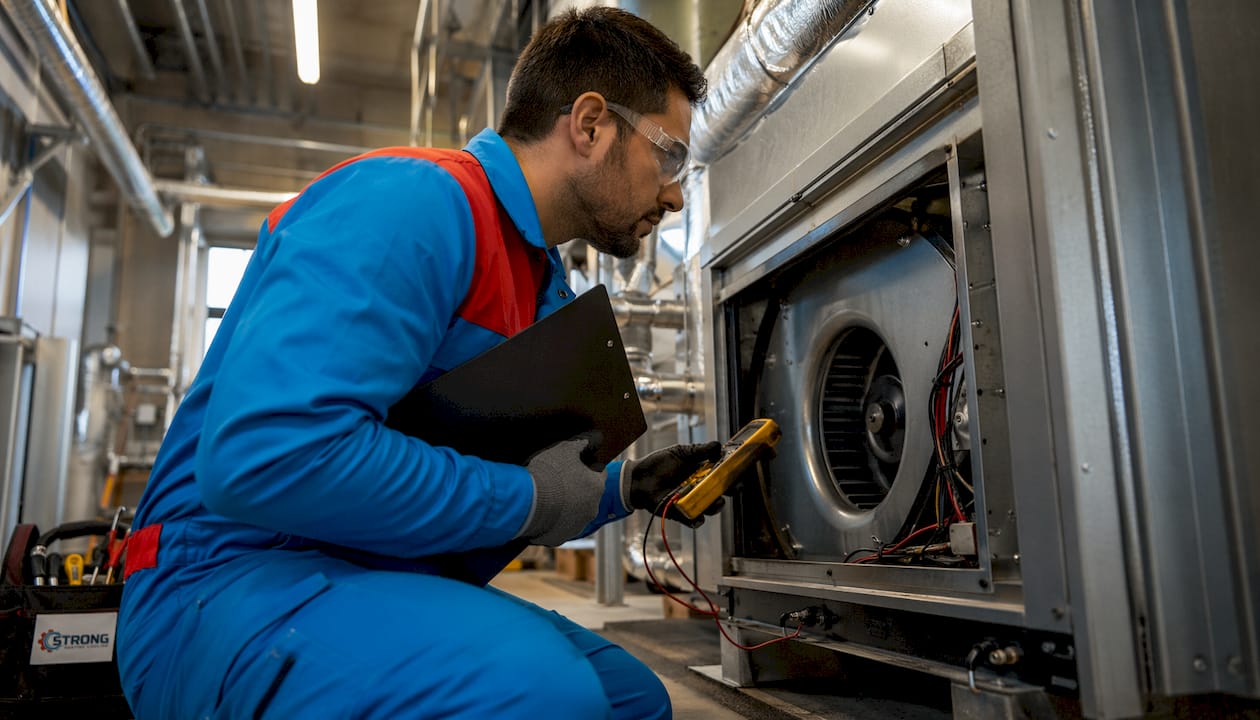
An air handler unit is the central indoor component in most HVAC systems that moves, conditions, and distributes air to maintain comfortable indoor environments. Formally called an air handling unit (AHU), it works alongside your outdoor equipment to deliver heated or cooled air through ductwork to every room in your home or building. The role of air handler unit operation goes well beyond simple airflow. It directly affects your indoor air quality, humidity levels, and monthly energy costs. Understanding how this equipment works gives you the knowledge to maintain it properly and get the most out of your HVAC investment.
How do air handler units work to regulate temperature, humidity, and air quality?
The air handler acts as the command center of HVAC air movement, controlling airflow rate and temperature consistency throughout your home. Its blower motor and internal coils deliver the exact temperature set on your thermostat through the ductwork. That process involves several distinct steps working together in sequence.
The airflow cycle from return to supply
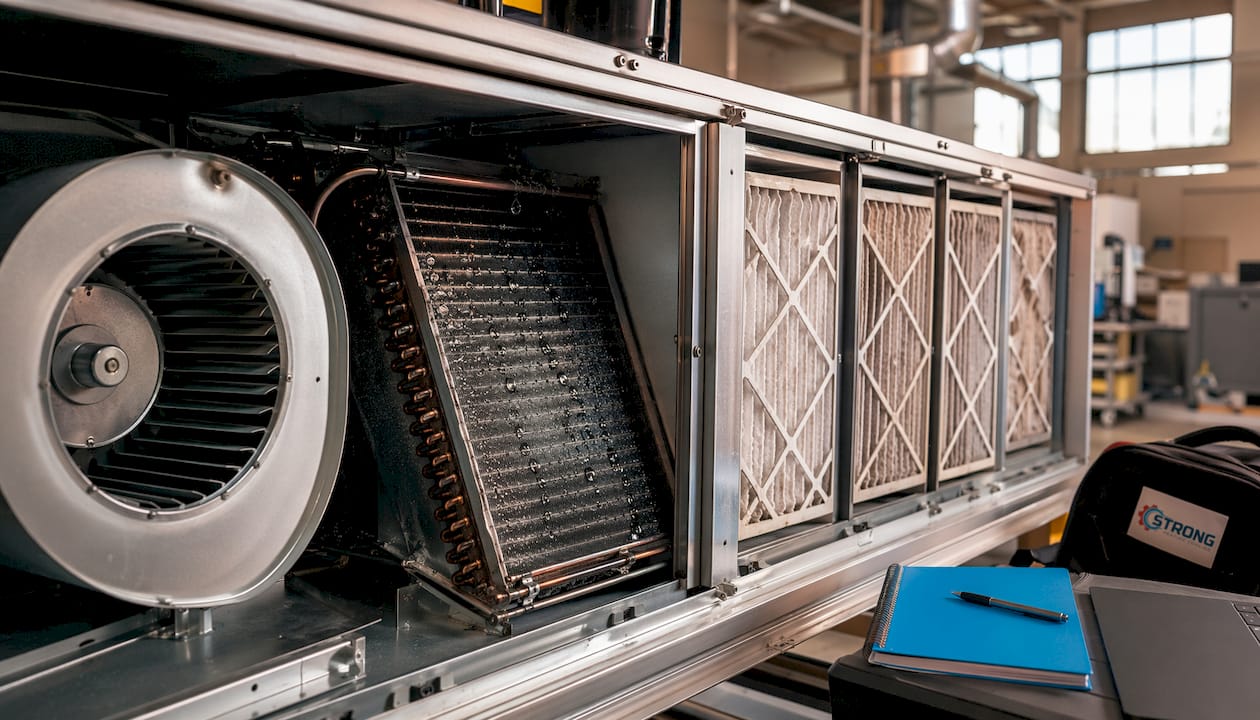
The cycle begins when return air from your living spaces enters the air handler through a return air intake. That air passes through a filter bank, which captures dust, pollen, pet dander, and other airborne particles before the air reaches any mechanical components. Filtered air then moves across the evaporator coil, where heat transfer occurs. In cooling mode, the coil absorbs heat from the air and transfers it to refrigerant. In heating mode, a heating coil or heat exchanger warms the air before it continues forward.
After conditioning, the blower motor pushes the treated air into the supply ductwork and out through vents into each room. The cycle repeats continuously while the system runs, maintaining the temperature your thermostat calls for.
Humidity control and condensate management
Dehumidification happens as a natural byproduct of the cooling process. When warm, humid air contacts the cold evaporator coil, moisture condenses on the coil fins and drips into a condensate pan below. A drain line carries that water away from the unit. This process removes excess humidity from your indoor air, which matters for both comfort and preventing mold growth inside walls and ductwork.
Ventilation and fresh air mixing
Modern air handlers blend fresh outdoor air with recirculated indoor air in controlled ratios. This ventilation function is especially important in newer, tightly sealed homes where natural air infiltration is minimal. Without controlled fresh air mixing, carbon dioxide levels rise and indoor pollutants concentrate. The air handler manages this balance through dampers that open and close based on ventilation settings.
The air handler is often overlooked despite being critical to maintaining the set thermostat temperature and balanced indoor comfort. Most homeowners focus on the outdoor unit, but the indoor air handler is where the actual air conditioning of your living space happens.
What are the benefits and energy efficiency impacts of a well-maintained air handler?
A clean, well-maintained air handler delivers consistent temperatures, lower energy bills, and better air quality. A neglected one does the opposite, quietly driving up costs while reducing comfort. The difference between the two comes down to a handful of maintenance habits.
Energy savings from clean components
A fouled coil or clogged filter increases system run time and electricity costs by forcing the air handler to work harder. Dirty components elevate compressor operating hours, raising power consumption significantly. The blower motor must overcome static pressure in ductwork, and dirty filters or coils create exponentially higher resistance, demanding more fan power and risking motor damage. Keeping filters clean and coils free of dust buildup directly reduces the energy your system consumes every hour it runs.
Airflow consistency and temperature balance
Consistent airflow prevents hot and cold spots from forming in different rooms. When airflow drops because of a dirty filter or a partially blocked duct, the system runs longer to reach the thermostat setpoint. That extended run time adds wear to the blower motor, compressor, and controls. A balanced system reaches setpoint faster and cycles off sooner, which reduces total operating hours and extends equipment life.
Heat recovery ventilation integration
Heat recovery technologies like ERVs or HRVs integrated into air handlers can recover 75–95% of thermal energy from exhaust air. These devices use heat exchangers to pre-condition incoming fresh air with energy from the outgoing exhaust air stream. For Colorado homes that run heating systems through long winters, an ERV or HRV paired with your air handler can meaningfully reduce annual heating costs while still delivering fresh ventilation air. You can learn more about heat recovery ventilation and how it reduces heating and cooling costs through energy recovery.
| Maintenance action | Energy impact |
|---|---|
| Monthly filter check | Prevents airflow restriction and motor strain |
| Annual coil cleaning | Restores heat transfer efficiency and reduces run time |
| ERV/HRV integration | Recovers 75–95% of exhaust thermal energy |
| Condensate drain clearing | Prevents humidity buildup and coil icing |
Pro Tip: Change your air filter every 1–3 months depending on household conditions. Homes with pets or allergy sufferers need more frequent changes. A clean filter is the single lowest-cost action you can take to protect your air handler and lower your energy bill.
What are common air handler unit maintenance tasks and what happens if you skip them?
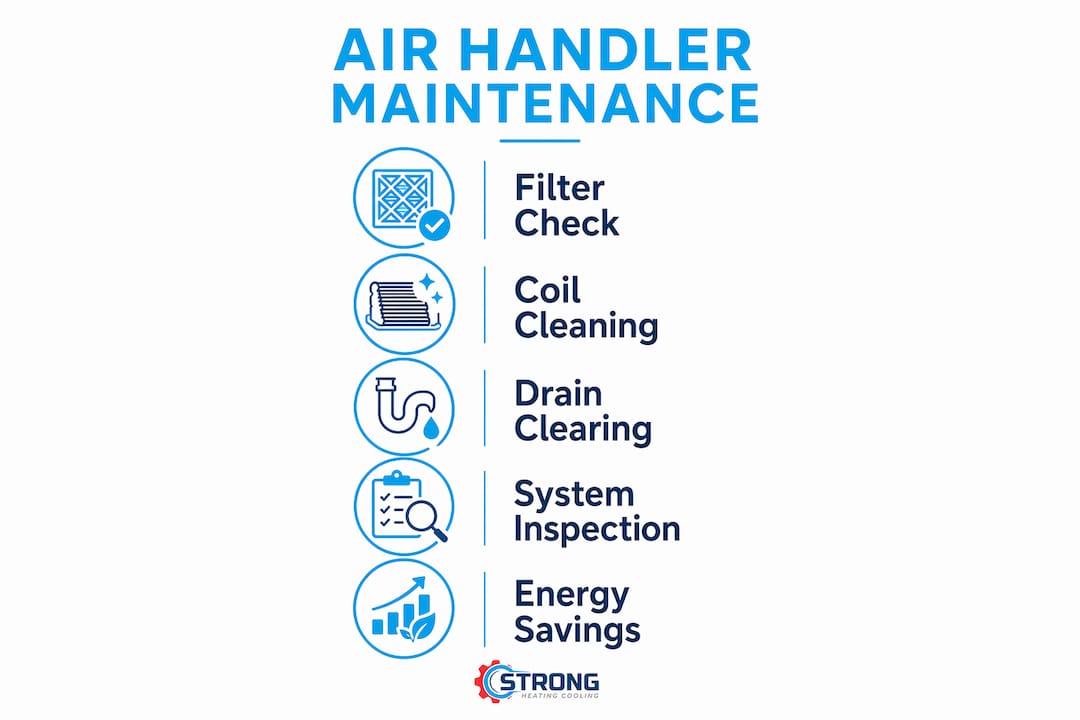
Consistent filter replacement directly improves indoor air quality and prevents system strain. That is the most basic maintenance task, but it is far from the only one. A complete air handler maintenance routine covers several components that each affect system performance in different ways.
Key maintenance tasks
Replacing or inspecting the filter is the most frequent task, typically monthly to quarterly. Beyond filters, coil cleaning removes the dust and biofilm that accumulate on evaporator fins over time. Coil fouling impairs heat transfer and increases both air-side and water-side energy use by forcing longer run times. Dust or biofilm on coil fins reduces efficiency and causes greater energy consumption across the entire HVAC system.
The condensate pan and drain line need clearing at least once per year. A blocked drain causes water to back up into the pan, overflow, and potentially damage ceilings, walls, or flooring below the unit. Fan belts on older belt-driven blowers require tension checks and replacement when worn. Dampers and actuators need inspection to confirm they open and close fully, since a stuck damper disrupts both airflow balance and ventilation ratios.
Filter bank maintenance triggered by differential pressure produces better results than calendar-based replacement alone. Replacing filters at the correct pressure point avoids restricted airflow or premature changes, balancing performance and cost. A simple differential pressure gauge across the filter bank tells you exactly when a change is needed, regardless of how many days have passed.
What neglect costs you
Skipping maintenance does not just reduce comfort. It raises operating costs, shortens equipment life, and creates health risks. A clogged filter restricts airflow, which causes the evaporator coil to freeze. A frozen coil blocks airflow entirely and can damage the compressor. Dirty coils allow biofilm and mold to grow on the fin surfaces, which then circulates through your ductwork and into your living spaces. You can follow a preventive maintenance schedule to stay ahead of these issues before they become costly repairs.
The table below shows how neglect compounds over time.
| Neglected component | Short-term consequence | Long-term consequence |
|---|---|---|
| Clogged filter | Reduced airflow, higher energy use | Coil freeze, blower motor failure |
| Dirty evaporator coil | Reduced heat transfer, longer run times | Compressor overload, mold growth |
| Blocked condensate drain | Water backup in pan | Ceiling or structural water damage |
| Worn fan belt | Noise, reduced airflow | Blower failure, no air distribution |
| Stuck damper | Airflow imbalance | Ventilation failure, poor air quality |
Early warning signs of air handler problems include unusual noise during operation, visible moisture around the unit, reduced airflow from vents, and rooms that take longer than usual to reach the set temperature. Catching these symptoms early keeps repair costs low.
How does the air handler unit contribute to indoor air quality and ventilation?
The air handler is the primary point where indoor air quality is either protected or compromised. Every cubic foot of air in your home passes through the air handler repeatedly throughout the day. What happens inside that unit determines what you breathe.
Filtration and allergen control
The filter bank is the first line of defense against airborne particles. Standard fiberglass filters capture large particles but allow fine dust, pollen, and pet dander to pass through. Higher-rated filters, such as those meeting MERV 8 through MERV 13 standards, capture a much wider range of particles including fine dust and some biological contaminants. Homes with allergy sufferers benefit significantly from filters in the MERV 11–13 range. For more detail on how filter selection affects Colorado homes specifically, the guide on indoor air quality in Colorado covers filtration beyond the basics.
Pro Tip: Match your filter MERV rating to your household’s actual needs. A MERV 13 filter captures more particles but also restricts airflow more than a MERV 8. If your blower motor is older or undersized, a very high-MERV filter can reduce airflow enough to cause problems. Ask your HVAC technician which rating suits your specific equipment.
Ventilation for airtight homes
Modern air handlers play a vital role in ventilation by controlling outdoor and indoor air mixing, which is critical for the health of airtight homes. Homes built or renovated to modern energy codes are sealed tightly enough that natural air infiltration no longer provides adequate ventilation. The air handler, equipped with a fresh air damper or connected to an ERV or HRV, becomes the primary ventilation mechanism.
The benefits of proper ventilation through the air handler include:
- Dilution of indoor pollutants including volatile organic compounds from furniture, paint, and cleaning products
- Control of carbon dioxide levels that rise when people occupy tightly sealed spaces
- Reduction of excess humidity that promotes mold and dust mite growth
- Delivery of fresh air without the energy penalty of simply opening windows in extreme weather
For homeowners dealing with spring allergies, managing HVAC filtration and fresh air intake through the air handler makes a measurable difference in symptom severity.
Key Takeaways
The air handler unit is the core indoor component that conditions, filters, and distributes air throughout your home, and its maintenance directly determines your energy costs, air quality, and equipment lifespan.
| Point | Details |
|---|---|
| Central air conditioning function | The air handler conditions and distributes all air in your home through its blower, coils, and filters. |
| Maintenance drives efficiency | Clean filters and coils reduce blower strain, lower energy consumption, and extend equipment life. |
| Ventilation role in modern homes | Air handlers control fresh air mixing, which is critical for health in tightly sealed buildings. |
| ERV/HRV energy recovery | Heat recovery ventilators integrated with air handlers recover 75–95% of exhaust thermal energy. |
| Early detection saves money | Unusual noise, moisture, or reduced airflow are early signs that maintenance or repair is needed. |
What I’ve learned from watching homeowners overlook their air handler
After years of working on HVAC systems across Colorado Springs and the surrounding communities, the pattern I see most often is this: homeowners pay close attention to their furnace or outdoor AC unit, and they completely ignore the air handler sitting in the utility closet or attic. It is understandable. The outdoor unit is visible. The furnace makes noise when it fires. The air handler just hums quietly in the background.
That quiet operation is exactly why it gets overlooked. And that is exactly why it causes so many problems.
The air handler runs every time your system runs, which in Colorado can mean thousands of hours per year. Because it runs continuously, minor fouling drastically increases electricity costs by lengthening cooling or heating run hours. A filter that has not been changed in six months is not just a minor inconvenience. It is actively raising your energy bill and shortening the life of your blower motor.
What I find most telling is the difference in energy bills between customers who maintain their air handlers and those who do not. The customers who follow a regular HVAC maintenance plan consistently report lower utility costs and fewer emergency calls. The ones who skip maintenance often end up replacing equipment years earlier than necessary.
My honest recommendation is to treat the air handler as the heart of your indoor comfort system. It is not a set-and-forget appliance. It needs regular attention, and the cost of that attention is a fraction of what you will pay if you ignore it.
— Owner
Strongheatingandcooling is here to keep your air handler running right
Strongheatingandcooling has served Colorado Springs and surrounding communities for over 40 years of combined experience, and air handler maintenance is one of the most common services our team handles. Whether your system needs a routine inspection, a coil cleaning, or a full air handler replacement, we provide honest assessments and quality workmanship without unnecessary upsells.

Our team covers heating and cooling services across the region, including heating services in Divide and air conditioner maintenance throughout Colorado Springs. If your air handler has not been inspected this year, or if you are noticing reduced airflow, unusual noise, or rising energy bills, contact Strongheatingandcooling to schedule a service visit. We treat every customer like family, and we back that with straightforward pricing and reliable work.
FAQ
What is the role of an air handler unit in an HVAC system?
The air handler unit moves, filters, and conditions air inside your home, distributing heated or cooled air through ductwork to maintain the temperature set on your thermostat. It houses the blower motor, evaporator coil, and filter bank that together control temperature, humidity, and air quality.
How is an air handler unit different from a furnace?
A furnace generates heat by burning fuel or using electric resistance elements, while an air handler does not generate heat on its own. An air handler works with a heat pump or separate heating source to condition and distribute air, whereas a furnace both generates and distributes heat through its own blower.
How often should an air handler unit be serviced?
Air handler units benefit from professional inspection at least once per year, typically before the heating or cooling season begins. Filter checks should happen monthly to quarterly depending on household conditions, with coil cleaning and condensate drain clearing done annually.
Can a dirty air handler affect my energy bills?
A dirty air handler directly raises energy bills by forcing the blower motor to work harder against restricted airflow. Clogged filters and fouled coils increase run time and electricity consumption, sometimes significantly, while also accelerating wear on mechanical components.
What size filter does my air handler need?
Filter size is specific to each air handler model and is printed on the existing filter’s edge. MERV rating selection depends on your household’s air quality needs. MERV 8 suits most standard homes, while MERV 11–13 is appropriate for homes with allergy sufferers or pets, provided the blower can handle the added airflow resistance.
Recommended
Need expert HVAC help?
Colorado Springs' trusted, veteran-owned heating & cooling team — same-day service.