

The HVAC Contractor Vetting Process: A Homeowner’s Guide
TL;DR:
- Verifying an HVAC contractor’s credentials is essential before starting any heating or cooling work.
- It involves confirming licensing, insurance, workers’ compensation, and certification to prevent costly mistakes.
The HVAC contractor vetting process is the structured practice of verifying a contractor’s credentials, pricing, and track record before any heating or cooling work begins. Skipping this step is one of the most expensive mistakes a homeowner or property manager can make. Proper HVAC system replacement costs between $5,000 and $12,500, and inadequate vetting can lead to system failures within three years due to improper installation. Spending 30–60 minutes confirming licenses, insurance, and certifications protects that investment and prevents thousands in premature repair costs.
What is the role of the HVAC contractor vetting process?
The HVAC contractor vetting process determines whether a contractor is legally qualified, financially accountable, and technically capable of doing the job correctly. It is not a formality. It is the filter that separates reliable professionals from those who will cut corners on your equipment.

The industry term for this practice is contractor qualification or contractor prequalification. Vetting is the plain-language equivalent, and both terms describe the same goal: confirming that the person you hire meets the minimum standards required to protect your home, your warranty, and your safety. Understanding licensed HVAC contractor benefits before you sign any agreement gives you a clear baseline for what to expect.
A fully qualified contractor brings documentation to the table without being asked. That readiness is itself a signal of professionalism. Contractors who deflect, delay, or pressure you to move forward without paperwork are telling you something important about how they operate.
What are the essential criteria to verify when vetting an HVAC contractor?
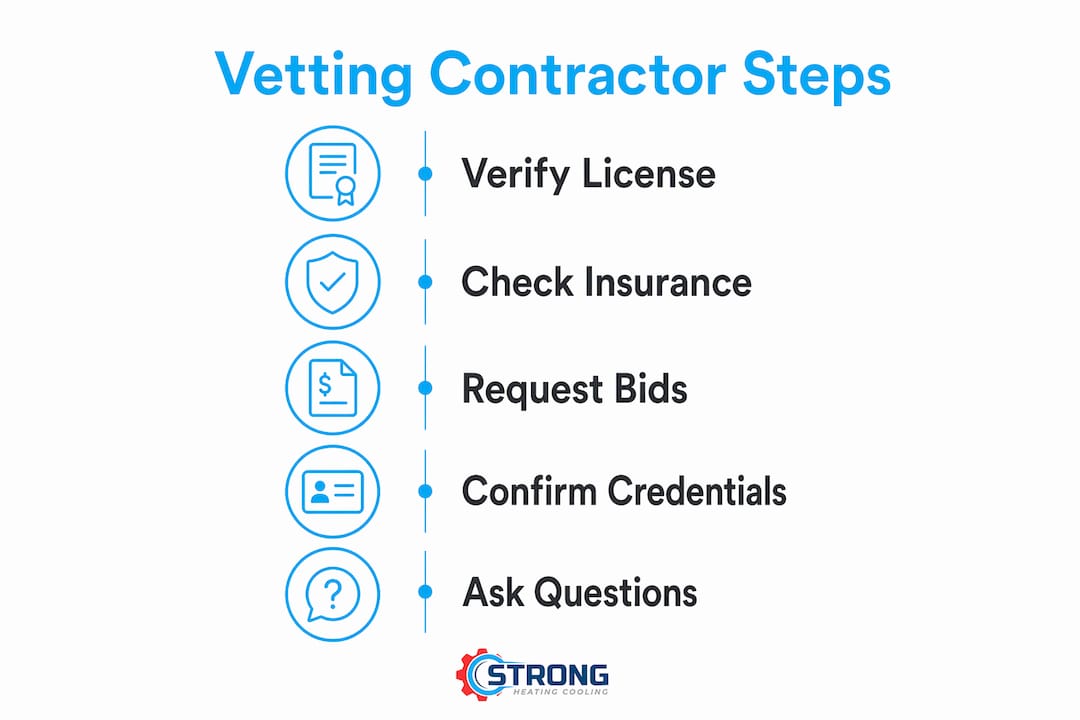
Four checks alone disqualify roughly 50% of advertised contractors. That figure is striking because most homeowners assume that any contractor who shows up with a truck and a business card is qualified. The reality is far more selective.
The four non-negotiable credentials are:
- Active state mechanical or contractor license. Colorado requires HVAC contractors to hold a valid state license. You can verify this through your state’s licensing lookup portal in minutes. An expired or absent license means the contractor cannot legally perform the work.
- General liability insurance at a minimum of $1 million per occurrence. This coverage protects your property if something goes wrong during installation or repair. Ask for a certificate of insurance, not just a verbal confirmation.
- Current workers’ compensation coverage. If a technician is injured on your property and the contractor lacks workers’ comp, you may be held financially responsible. This is a risk most homeowners do not consider until it is too late.
- EPA Section 608 certification. Federal law requires any technician who handles refrigerants to hold this certification. A contractor without it is operating illegally and puts your system at risk.
Pro Tip: Request copies of all four documents before scheduling any work. A legitimate contractor will send them the same day you ask.
Running through this checklist takes less than an hour. It eliminates half the field immediately and leaves you working with contractors who have already demonstrated a baseline level of accountability.
How do pricing, bids, and technical details impact the contractor vetting process?
Price is the most misleading factor in the HVAC contractor selection process. Lowest bids often produce systems that use 20–30% more energy, adding $40–$80 to your monthly utility costs. That gap compounds over years and quickly exceeds any upfront savings from choosing the cheapest quote.
The right approach to comparing bids follows a clear sequence:
- Collect at least three written, itemized quotes. Verbal estimates are not comparable and offer no legal protection.
- Confirm that each quote includes a Manual J load calculation. This calculation determines the precise heating and cooling capacity your home requires based on square footage, insulation, window placement, and local climate.
- Compare line items, not totals. Equipment brand, model number, SEER rating, and labor hours should all be listed separately.
- Ask whether the contractor is a factory-authorized dealer for the equipment they are proposing.
The Manual J calculation deserves particular attention. Skipping this calculation causes oversized or undersized systems that cycle incorrectly, wear out faster, and fail prematurely. A contractor who skips it is not cutting a corner on paperwork. They are compromising the long-term performance of your entire system.
Factory-authorized dealer status matters for a different reason. This status unlocks extended manufacturer warranties that general licensing alone does not guarantee. If your contractor is not an authorized dealer for the brand they install, you may receive a shorter or voided warranty on the equipment itself.
| Bid element | What to look for |
|---|---|
| Equipment model and SEER rating | Specific model number listed, not just brand name |
| Manual J load calculation | Included in writing, not estimated verbally |
| Labor hours and scope | Clearly defined to avoid change-order disputes |
| Warranty terms | Both equipment and labor warranties stated separately |
| Payment schedule | Deposit of 10–30%, remainder on completion |
Pro Tip: If a contractor cannot explain what a Manual J calculation is or refuses to include one, remove them from your list immediately. This is a non-negotiable technical standard, not an optional upgrade.
Understanding how to read HVAC quotes before you sit down with a contractor gives you a significant advantage. You will spot missing line items and vague language that would otherwise go unnoticed.
What practical steps and questions should you use to vet an HVAC contractor?
Effective vetting combines document verification with direct conversation. The goal is to confirm what the paperwork says and identify any gaps through the contractor’s responses.
Start with these verification steps:
- Look up the contractor’s license number on your state’s licensing portal. In Colorado, this is available through the Colorado Department of Regulatory Agencies. Confirm the license is active, not expired or suspended.
- Request a certificate of insurance directly from the contractor’s insurance provider, not just a copy from the contractor. This confirms the policy is current.
- Ask whether the contractor will pull the required permits for the work. Permitted work is inspected by a local authority, which protects you if you sell the home or file an insurance claim later.
- Confirm warranty terms in writing. Ask separately about the equipment warranty and the labor warranty. These are different documents with different durations.
- Ask about the payment schedule before any agreement is signed.
Requesting full payment before work begins is a major indicator of financial instability or lack of accountability. A fair payment schedule is typically 10–30% upfront, with the remainder due on completion. Any contractor asking for more than 30% before the job starts warrants serious caution.
The questions that reveal the most about a contractor are often the simplest ones. Ask how they handle unexpected issues during installation. Ask who will be on-site doing the work, and whether they are employees or subcontractors. Ask what happens if a part fails within the first year. The answers tell you whether this contractor plans to be accountable after the job is done.
Verbal agreements lead to disputes. Every change to the original scope must be documented and signed before work proceeds. This protects both parties and gives you clear recourse if something goes wrong.
Pro Tip: Write down the contractor’s license number and call your state licensing board directly to confirm it. Online portals are accurate, but a phone call takes two minutes and removes any doubt.
Red flags to watch for include vague answers about permits, pressure to sign quickly, refusal to provide insurance certificates, and any request for cash payment only. Professional contractors provide documentation without hesitation. Deflection is a disqualifier.
How do experience, reputation, and reviews factor into vetting HVAC service providers?
A contractor’s track record in the community is one of the most reliable indicators of future performance. Contractors with 10 or more years in business tend to prioritize reputation and accountability, and they are more accessible for warranty service and follow-up work. A newer company is not automatically disqualified, but longevity signals that customers have been satisfied enough to keep the business running.
Online reviews require a specific reading strategy. Check at least 20 reviews across Google and the Better Business Bureau. Do not focus only on the five-star ratings. The one-star and two-star reviews reveal how the company handles problems, which is more predictive of your experience than how they perform when everything goes smoothly.
When you call references, ask questions that go beyond “were you happy with the work?” Useful questions include:
- Did the crew show up on time and communicate clearly throughout the job?
- Was the work area cleaned up after installation?
- Did the contractor follow up after the job was complete?
- Did any issues arise after installation, and how were they handled?
Asking the right questions of a reference surfaces details that online reviews rarely capture. A homeowner who had a minor dispute resolved quickly will tell you that story if you ask directly. That kind of transparency from a reference reflects the contractor’s character more accurately than a polished website.
“Transparency and readiness to provide credentials is a hallmark of trustworthy HVAC contractors.” A contractor who is proud of their record will make it easy for you to verify it.
Checking HVAC contractor reviews in Colorado Springs requires knowing what patterns to look for. Repeated complaints about missed appointments, surprise charges, or poor communication are more meaningful than a single bad review from a difficult customer.
What I have learned from years of watching homeowners skip the vetting process
The most common mistake I see is homeowners assuming that a license means everything is equal. It does not. A license confirms legal eligibility to work. It does not confirm that a contractor performs Manual J calculations, pulls permits consistently, or stands behind their work after the invoice is paid.
The second most common mistake is choosing based on price alone. I have seen families save $800 on an installation quote and then spend $2,000 on repairs within 18 months because the system was improperly sized. The math never works out in favor of the lowest bid when the technical work is substandard.
What actually separates good contractors from poor ones is documentation. The contractors I trust most are the ones who hand over a folder of paperwork before you even ask. License copy, insurance certificate, load calculation worksheet, equipment spec sheet, warranty terms, and a written payment schedule. That folder tells you the contractor has done this correctly before and expects to do it correctly again.
Written agreements protect everyone. I have watched verbal promises dissolve into disputes that cost homeowners time, money, and comfort during Colorado winters. A signed change order is not bureaucracy. It is the only thing that holds anyone accountable when the job scope shifts.
Vetting is not about distrust. It is about giving a qualified contractor the opportunity to prove they are qualified. The ones who are will welcome every question you ask.
— Owner
Strongheatingandcooling: licensed, insured, and ready to show you the paperwork
Strongheatingandcooling serves Colorado Springs and surrounding communities with over 40 years of combined experience in heating and cooling installation, replacement, repair, and maintenance.

Every job starts with a written quote, a Manual J load calculation, and full documentation of licensing and insurance. Strongheatingandcooling is a factory-authorized dealer for the equipment it installs, which means your manufacturer warranty is protected from day one. Whether you need heating installation in Colorado Springs or want to review financing options for HVAC replacement, the process is transparent and the pricing is honest. Call for a free quote and see exactly what a vetted contractor looks like in practice.
Key takeaways
Thorough HVAC contractor vetting requires verifying four credentials, collecting at least three itemized bids, confirming a Manual J load calculation, and reviewing references before any agreement is signed.
| Point | Details |
|---|---|
| Verify four core credentials | Confirm active license, $1 million liability insurance, workers’ comp, and EPA Section 608 certification. |
| Collect three written bids | Compare line items, not totals, and confirm each bid includes a Manual J load calculation. |
| Check factory-authorized status | Dealer authorization unlocks extended manufacturer warranties that a standard license does not provide. |
| Review references directly | Ask references about communication, cleanup, and post-installation follow-up, not just overall satisfaction. |
| Require written agreements | Document every scope change with a signed agreement before work proceeds to prevent disputes. |
FAQ
What does the HVAC contractor vetting process involve?
The HVAC contractor vetting process involves verifying a contractor’s state license, liability insurance, workers’ compensation coverage, and EPA Section 608 certification before hiring. It also includes comparing at least three written bids and checking references.
How long does it take to vet an HVAC contractor?
Researching a contractor’s credentials takes 30–60 minutes and can prevent thousands of dollars in premature repair costs from improper installation.
Why is the lowest bid often a bad choice for HVAC work?
Lowest bids frequently result in systems that use 20–30% more energy, adding $40–$80 to monthly utility costs. Underbidding often signals that the contractor is skipping steps like load calculations or using lower-grade equipment.
What is a Manual J load calculation and why does it matter?
A Manual J load calculation determines the exact heating and cooling capacity a home requires based on its size, insulation, and local climate. Skipping it leads to oversized or undersized systems that fail prematurely.
What payment terms should I expect from a reputable HVAC contractor?
A fair payment schedule is typically 10–30% upfront with the remainder due on completion. Any contractor requesting full payment before work begins is a significant warning sign of financial instability or poor accountability.
Recommended
Need expert HVAC help?
Colorado Springs' trusted, veteran-owned heating & cooling team — emergency service.