
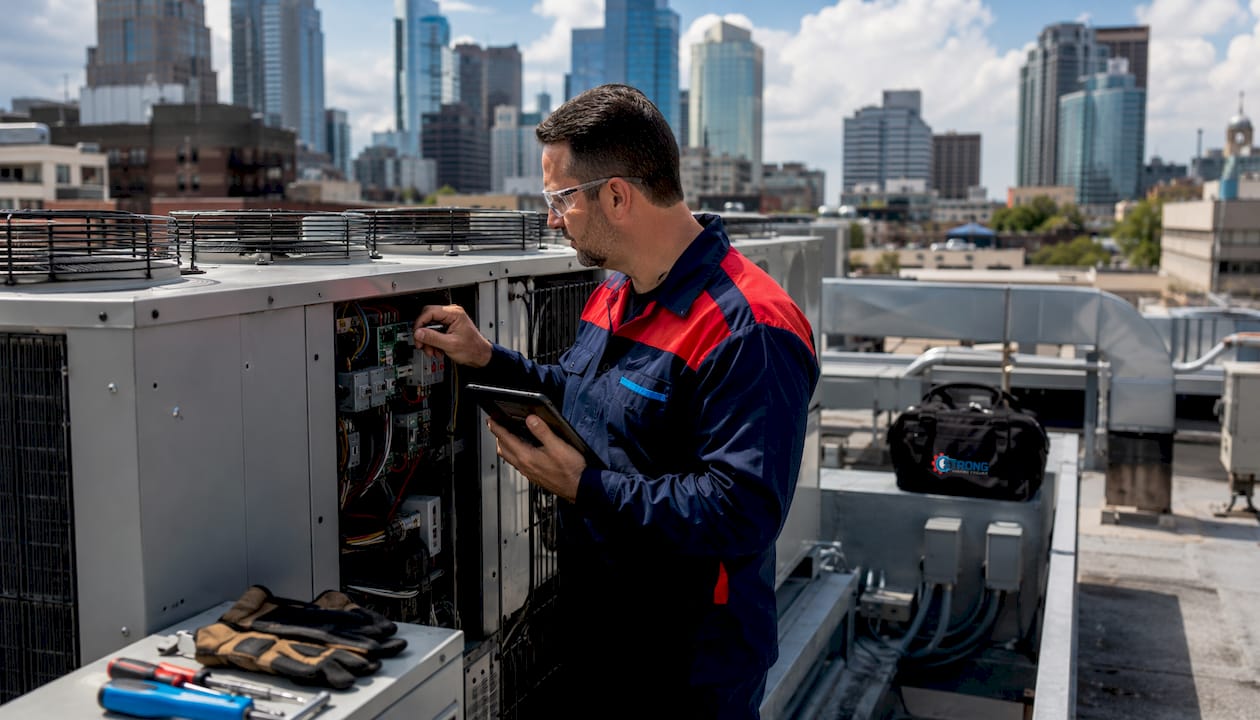
TL;DR:
- Proper maintenance of multi-unit HVAC systems reduces repair costs and improves energy efficiency. Regular tasks at each interval, including inspections, cleaning, and safety checks, ensure reliable performance and compliance. Building a tailored maintenance program with proper documentation supports long-term system health and regulatory adherence.
A well-structured multi-unit HVAC service checklist is the difference between a building that runs smoothly year-round and one that generates emergency calls, compliance headaches, and budget overruns. For facility managers and commercial property operators, preventive maintenance is not optional — it is the foundation of reliable, cost-effective building operations.
The core categories of any commercial HVAC maintenance program break down by frequency:
- Monthly: Filter inspection and replacement, thermostat calibration, lubrication, belt and condensate drain checks, safety control tests
- Quarterly: Coil cleaning, refrigerant verification, economizer and pump inspections, oil checks, documentation updates
- Seasonal: Spring/summer cooling prep, fall/winter heating system safety inspections and burner service
- Annual: Full system performance testing, boiler and chiller overhauls, statutory certifications, compliance audits
ANSI/ASHRAE/ACCA Standard 180 sets the minimum framework for commercial HVAC maintenance compliance, requiring a documented equipment inventory, a written maintenance plan, and archived proof of completed tasks. Manufacturer-specific parameters take precedence where they require more frequent service than the standard specifies. Licensed technicians must perform tasks involving refrigerant handling, safety device calibration, and statutory certifications.
| Frequency | Core Tasks | Compliance Reference |
|---|---|---|
| Monthly | Filters, thermostats, lubrication, belts, safety controls | ASHRAE Standard 180, manufacturer specs |
| Quarterly | Coil cleaning, refrigerant check, economizer test, pump inspection | ASHRAE Standard 180 |
| Seasonal | Cooling/heating prep, burner service, safety valve tests | ASHRAE Standard 180, local codes |
| Annual | Full performance test, boiler/chiller overhaul, certifications | ANSI/ASHRAE/ACCA Standard 180 |
Table of Contents
- 1. What monthly tasks should you complete on multi-unit commercial HVAC systems?
- 2. Which quarterly maintenance tasks protect multi-unit HVAC reliability?
- 3. How should you approach seasonal HVAC maintenance for spring/summer and fall/winter?
- 4. What does an annual HVAC inspection cover for multi-unit commercial properties?
- 5. What are the real benefits of preventive maintenance for commercial HVAC systems?
- 6. How do you build a personalized HVAC maintenance program for multi-unit systems?
- 7. What safety protocols and compliance standards apply to multi-unit HVAC maintenance?
- 8. How do you inspect rooftop units, ductwork, and control systems in multi-unit buildings?
- 9. What tools and equipment do technicians need to service multi-unit HVAC systems?
- 10. How do you troubleshoot common issues unique to multi-unit HVAC systems?
- 11. What recordkeeping and documentation practices should you follow?
- 12. How can you improve energy efficiency across a multi-unit HVAC portfolio?
- Strongheatingandcooling brings 40+ years of experience to your HVAC program
- FAQ
- Key Takeaways
1. What monthly tasks should you complete on multi-unit commercial HVAC systems?
Monthly maintenance keeps individual units performing at baseline and prevents small problems from compounding across a portfolio. The monthly inspection tasks that matter most are filters, controls, lubrication, belts, and condensate management.
- Filter inspection and replacement: Check all air filters against manufacturer pressure-drop specifications. Replace filters that are visibly loaded or have reached their rated service interval. In high-occupancy or dusty environments, monthly replacement is often necessary rather than optional.
- Thermostat and control calibration: Verify setpoints, confirm deadbands are correct, and test that controls respond accurately. A thermostat that reads two degrees high across 50 units wastes significant energy.
- Motor and bearing lubrication: Apply manufacturer-specified lubricants to motors, fan bearings, and pump bearings. Over-lubrication is as damaging as under-lubrication, so follow nameplate guidance precisely.
- Belt and fan blade inspection: Check drive belts for cracking, glazing, and proper tension. Inspect fan blades for debris buildup and physical damage. A worn belt on a rooftop unit can fail within days of showing early signs.
- Condensate drain inspection: Clear condensate pans and drain lines of algae, debris, and blockages. Blocked drains cause water damage and mold growth, both of which create liability exposure.
- Safety control tests: Test high-pressure cutouts, low-pressure switches, and freeze stats. Confirm that each safety device trips at its rated threshold.
- Refrigerant leak detection: Conduct a visual and electronic check for refrigerant leaks at service valves, fittings, and coil connections. Document any findings immediately.
Assign each task to a named technician and log completion with date, findings, and corrective actions taken. Undocumented work is treated as work not performed under ASHRAE Standard 180 compliance audits.
2. Which quarterly maintenance tasks protect multi-unit HVAC reliability?
Quarterly service addresses mechanical wear and refrigerant integrity that monthly checks cannot catch in time. These tasks require more technical depth and, in many cases, a licensed technician.
- Evaporator and condenser coil cleaning: Dirty coils are one of the leading causes of efficiency loss in commercial systems. Clean coils with appropriate chemical cleaners and rinse thoroughly to restore heat transfer capacity.
- Oil and lubrication system checks: Inspect oil levels in compressors and chillers. Replace oil that shows contamination or degradation. Neglecting this step accelerates compressor wear.
- Economizer and control testing: Verify that air-side economizers open and close correctly across the full range of outdoor conditions. Test damper actuators and linkages for binding or slippage.
- Cooling tower and pump inspection: Check cooling tower fill, drift eliminators, and basin for biological growth and scale. Inspect circulating pumps for seal leaks, vibration, and proper flow rates.
- Refrigerant level verification and leak testing: Measure refrigerant charge against manufacturer specifications. Perform electronic leak testing at all joints and service ports. Systems requiring repeated refrigerant additions over 12–24 months warrant a repair-versus-replacement evaluation.
- Documentation update: Record all findings, corrective actions, and parts replaced. Update the equipment inventory if any components were modified or replaced.
A quarterly rhythm also gives you a natural checkpoint to compare performance trends across units. If one rooftop unit consistently shows elevated head pressure compared to identical units on the same building, that pattern points to a specific problem worth investigating before it becomes a failure.
3. How should you approach seasonal HVAC maintenance for spring/summer and fall/winter?
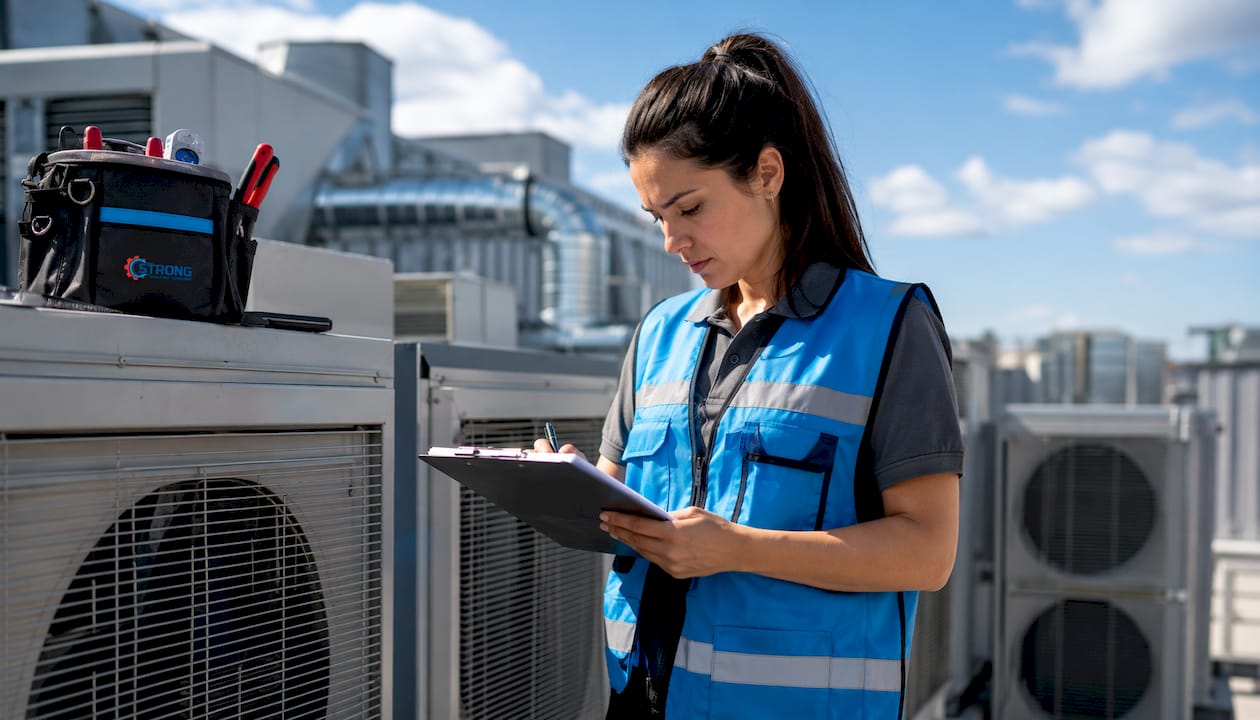
Seasonal maintenance prepares each system for the demands of the coming season. The tasks differ significantly between cooling and heating cycles, and skipping them is one of the most common causes of first-day-of-season failures.
Spring and summer preparation:
- Clean evaporator and condenser coils thoroughly before the first cooling run.
- Verify refrigerant charge and test for leaks.
- Inspect and clean cooling tower basins, fill media, and distribution nozzles.
- Test economizer operation across the full outdoor temperature range.
- Check condenser fan motors, blades, and blade pitch for proper airflow.
- Confirm that all cooling-mode safety controls are calibrated and functional.
- Test the entire cooling sequence from thermostat call to compressor start.
Fall and winter preparation:
- Inspect heat exchangers for cracks, corrosion, and carbon deposits. A cracked heat exchanger is a carbon monoxide risk and requires immediate action.
- Service burners: clean nozzles, inspect ignitors, and verify combustion efficiency.
- Test all heating-mode safety controls, including high-limit switches and pressure relief valves.
- Inspect boilers for scale buildup, corrosion, and proper water chemistry.
- Verify that all freeze protection systems are operational before the first frost.
- Test gas valve operation and confirm proper manifold pressure.
Aligning seasonal tasks with your facility’s criticality level matters. A data center HVAC system may need pre-season checks two weeks earlier than an office building to allow time for corrective work before peak demand arrives.
4. What does an annual HVAC inspection cover for multi-unit commercial properties?
Annual inspections go deeper than any monthly or quarterly visit. They assess overall system health, verify statutory compliance, and set the maintenance plan for the year ahead.
- Full system performance testing: Measure actual cooling and heating output against design specifications. Document efficiency metrics and compare them to prior-year baselines to identify degradation trends.
- Boiler, chiller, and cooling tower overhaul: Conduct comprehensive internal inspections of boilers and chillers. Clean tube bundles, inspect vessel integrity, and verify water treatment records. Cooling towers should receive a full basin cleanout and biological treatment.
- Safety device calibration and certification: Calibrate and certify pressure relief valves, safety cutouts, and combustion controls. Many jurisdictions require annual third-party certification for boilers and pressure vessels.
- Maintenance plan review and update: Compare the past year’s work orders against the maintenance plan. Identify tasks that were missed, components that failed unexpectedly, and areas where frequency adjustments are warranted.
- Documentation audit: Verify that all work logs, equipment records, and compliance certificates are complete and properly archived. Under ANSI/ASHRAE/ACCA Standard 180, documentation gaps are the most common reason facilities fail compliance audits.
- Third-party inspection engagement: For high-criticality facilities, engage a qualified independent contractor to verify system condition and compliance status. Third-party verification adds credibility to your compliance records and often surfaces issues internal teams overlook.
5. What are the real benefits of preventive maintenance for commercial HVAC systems?
The financial case for preventive maintenance is clear. Routine preventive maintenance reduces HVAC repair costs by 3 to 5 times compared to reactive approaches and can cut energy consumption by over 30% through consistent coil cleaning. Scheduled maintenance also extends equipment lifespan by 30–50%.
Beyond the numbers, the operational benefits compound over time:
- Fewer emergency service calls mean less disruption to tenants and building operations.
- Consistent documentation supports warranty claims and protects against liability in the event of an incident.
- Tenant comfort improves when systems maintain setpoints reliably, which reduces complaints and supports lease retention.
- Compliance risk drops significantly when maintenance records are complete and current.
- Budget predictability improves because planned maintenance costs are far more stable than reactive repair expenses.
The documentation piece deserves particular emphasis. Facilities that maintain thorough records are better positioned during insurance claims, regulatory audits, and property transactions. A well-documented maintenance history is a tangible asset.
6. How do you build a personalized HVAC maintenance program for multi-unit systems?
A generic checklist is a starting point, not a finished program. ASHRAE guidance is explicit that maintenance frequencies should be tailored by equipment type, criticality, and run time. A hospital HVAC system and an office building HVAC system are not maintained on the same schedule.
- Inventory all equipment: Document every unit with nameplate data, including manufacturer, model, serial number, refrigerant type, capacity, and location. This inventory is the foundation of your maintenance plan under ASHRAE Standard 180.
- Reference manufacturer-specific parameters: Generic checklists cover the basics, but manufacturer service manuals specify the exact lubricants, torque values, and inspection intervals your equipment requires. Deviating from these can void warranties.
- Assign qualified technicians: Define who is responsible for each task category. Refrigerant work requires EPA Section 608 certification. Boiler work may require a licensed boiler operator depending on your jurisdiction.
- Set condition indicators and thresholds: Establish measurable indicators of unacceptable performance for each equipment type, such as supply air temperature variance, refrigerant subcooling range, or motor amperage limits. When a reading crosses a threshold, a corrective work order is triggered automatically.
- Implement a CMMS: A computerized maintenance management system automates work order assignment, tracks completion, stores photo documentation, and generates compliance reports across multiple sites. CMMS solutions reduce human error and close the documentation gaps that cause audit failures.
Pro Tip: ASHRAE Standard 180 defines two program levels: basic and enhanced. Enhanced (Level 2) includes performance trending and third-party verification. For critical facilities like hospitals, data centers, or large multi-tenant commercial buildings, the Level 2 program is worth the additional investment because it surfaces degradation trends before they become failures.
Maintenance programs also need to evolve. When a facility adds new equipment, changes occupancy patterns, or modifies building systems, the maintenance plan should be updated to reflect those changes.
7. What safety protocols and compliance standards apply to multi-unit HVAC maintenance?
Safety in multi-unit HVAC maintenance is not just about technician protection. It also covers tenant safety, regulatory compliance, and liability management.
Technicians must follow lockout/tagout (LOTO) procedures before servicing any electrical or mechanical component. This applies to rooftop units, air handlers, and any equipment with stored energy. Personal protective equipment requirements vary by task: refrigerant work requires safety glasses and gloves rated for the specific refrigerant in use, while combustion system service requires CO detection equipment.
Refrigerant handling is governed by EPA Section 608, which prohibits intentional venting and requires certified technicians for any work involving refrigerant recovery, recycling, or charging. Facilities using older refrigerants subject to phase-down schedules under the AIM Act should document refrigerant consumption and plan for equipment transitions accordingly.
Boiler and pressure vessel compliance varies by state but generally requires annual third-party inspection and certification by a licensed inspector. Failure to maintain current certifications can result in mandatory shutdown orders.
For thermal comfort compliance in multi-unit residential buildings, maintaining documented evidence of system performance is increasingly important as building codes tighten. Indoor air quality standards under ASHRAE Standard 62.1 set minimum ventilation rates that must be verified and documented as part of any comprehensive maintenance program.
8. How do you inspect rooftop units, ductwork, and control systems in multi-unit buildings?
Multi-unit commercial properties typically include rooftop units (RTUs), centralized air handlers, distributed ductwork, and building automation or control systems. Each requires a distinct inspection approach.
Rooftop units are the workhorses of most commercial multi-unit properties. Inspect the unit curb and roof penetrations for water intrusion at every visit. Check economizer dampers for proper operation and sealing. Inspect the condensate pan and drain for blockages. Verify that the unit’s disconnect is properly rated and that all electrical connections are tight. RTU compressors should be checked for unusual vibration, abnormal amperage draw, and oil contamination.
Ductwork inspection focuses on leakage, insulation integrity, and biological contamination. ASHRAE Standard 180 requires visual inspection of internally lined ductwork up to 20 feet from potential moisture sources, such as supply plenums and outdoor air dampers, for water damage and biological growth. Leaky ductwork in a multi-unit building can account for substantial energy waste and uneven comfort across units.
Control systems require verification that sensors are reading accurately, that sequences of operation match the design intent, and that alarms are configured and functional. Building automation systems (BAS) should be checked for fault logs, sensor drift, and communication errors. A BAS that is not maintained becomes a source of phantom energy consumption and comfort complaints rather than a management tool.
9. What tools and equipment do technicians need to service multi-unit HVAC systems?
Servicing a multi-unit portfolio requires more than a basic service kit. The scope and complexity of commercial systems demand a specific set of instruments and equipment.
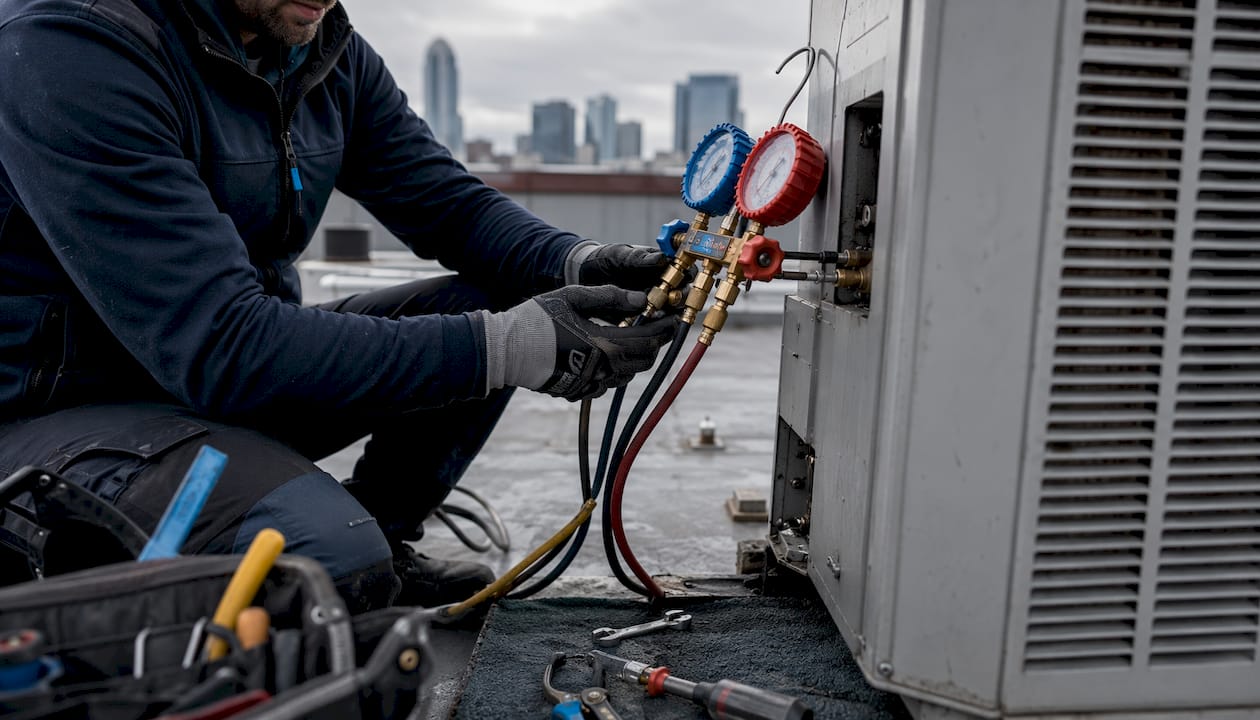
Core diagnostic tools include a digital manifold gauge set compatible with the refrigerants in your portfolio, a calibrated electronic leak detector, a clamp meter for amperage measurement, a non-contact thermometer, and a combustion analyzer for gas-fired equipment. A psychrometer or digital hygrometer is necessary for verifying supply air conditions and humidity control.
For ductwork and air distribution work, a balancing hood or flow meter allows accurate airflow measurement at each register. A duct blaster or blower door setup is used for leakage testing when a more thorough assessment is needed.
Coil cleaning requires a commercial coil cleaning pump, appropriate chemical cleaners rated for the coil type, and a low-pressure rinse system to avoid fin damage. Fin combs in multiple sizes are needed to straighten bent fins after cleaning.
Safety equipment includes refrigerant recovery machines rated for the refrigerants in use, recovery cylinders, LOTO kits, and appropriate PPE for each task category. Technicians working on rooftop units also need fall protection equipment that meets OSHA standards.
A tablet or mobile device running a CMMS application allows technicians to pull up equipment history, record findings with photos, and close work orders in the field, which eliminates the paper-to-system transcription step that introduces errors.
10. How do you troubleshoot common issues unique to multi-unit HVAC systems?
Multi-unit systems present troubleshooting challenges that single-system buildings do not. The most common issues fall into a few predictable categories.
Uneven comfort across units is often a balancing problem rather than an equipment failure. Check supply air temperatures and airflow rates at each unit against design specifications. Duct leakage, damper misalignment, and filter loading differences between units are the usual culprits. A planned maintenance approach that includes regular airflow verification catches these imbalances before tenants notice them.
Simultaneous failures across multiple units usually point to a shared cause: a common refrigerant batch with contamination, a control system firmware issue, or a utility power quality problem. When more than two identical units fail within a short period, investigate the common elements before replacing components.
Refrigerant loss patterns that recur in the same unit after repair indicate a leak that was not fully resolved. Use an electronic leak detector at every fitting, valve, and brazed joint, not just the obvious locations. Persistent leaks in aging equipment warrant a repair-versus-replacement evaluation using the $5,000 Rule as a starting framework.
Control system conflicts in buildings with multiple zones and a BAS can cause units to fight each other, with one zone calling for cooling while an adjacent zone calls for heat. Review the sequence of operation and verify that zone priorities and setpoint limits are correctly configured.
11. What recordkeeping and documentation practices should you follow?
Documentation is where many otherwise solid maintenance programs fail. ASHRAE Standard 180 requires archived proof of completed tasks, and documentation failure is the most common reason facilities fail compliance audits.
A complete maintenance record for each work event should include the date and time, the technician’s name and certification number, the equipment identifier, the tasks performed, measurements taken (temperatures, pressures, amperages), parts replaced with part numbers, refrigerant added or recovered with quantities, findings, and corrective actions taken or scheduled.
Photo documentation adds a layer of verification that written records alone cannot provide. Photos of dirty coils before cleaning, worn belts before replacement, and leak locations before repair create an objective record that supports warranty claims and audit responses.
Retention periods for maintenance records vary by jurisdiction and equipment type. As a general practice, retain all records for the life of the equipment plus three years. Boiler and pressure vessel inspection certificates should be retained indefinitely.
A CMMS makes retention and retrieval straightforward, but even a well-organized shared drive with a consistent naming convention is far better than paper logs stored in a mechanical room. The goal is to be able to produce a complete maintenance history for any piece of equipment within minutes during an audit or insurance claim.
12. How can you improve energy efficiency across a multi-unit HVAC portfolio?
Energy efficiency in a multi-unit portfolio is a product of equipment condition, control strategy, and operational discipline. Coil cleaning alone can recover substantial efficiency losses, and preventive maintenance that keeps systems at peak condition is the most cost-effective efficiency investment available.
Beyond maintenance, several strategies consistently deliver measurable results. Demand-controlled ventilation (DCV) uses CO2 sensors to modulate outdoor air intake based on actual occupancy, reducing conditioning loads during low-occupancy periods. Variable frequency drives (VFDs) on fan and pump motors reduce energy consumption significantly at partial load, which is where commercial systems spend most of their operating hours.
Setpoint optimization across a BAS can reduce energy use without affecting comfort. Widening deadbands slightly, implementing setback schedules for unoccupied periods, and coordinating cooling and heating lockout temperatures across zones all contribute to lower energy consumption. For energy efficiency strategies that go beyond maintenance, equipment upgrades to higher-SEER or higher-AFUE rated systems deliver long-term savings that compound over the equipment’s service life.
Benchmarking energy use intensity (EUI) by building and by unit allows you to identify outliers. A unit consuming significantly more energy than comparable units in the same portfolio is signaling a maintenance issue, a control problem, or an equipment deficiency worth investigating.
Strongheatingandcooling brings 40+ years of experience to your HVAC program
Managing a multi-unit HVAC portfolio means keeping dozens of systems running reliably while staying ahead of compliance requirements, energy costs, and tenant expectations. That is a significant operational responsibility, and having the right service partner makes it manageable.

Strongheatingandcooling brings over 40 years of combined industry experience to commercial and multi-unit HVAC service in Colorado Springs and the surrounding communities. The team understands manufacturer-specific maintenance requirements, works within ASHRAE Standard 180 compliance frameworks, and provides honest, transparent communication about what your systems need and why. Whether you need cooling system maintenance across a commercial portfolio or heating installation and replacement for aging equipment, Strongheatingandcooling delivers quality workmanship at pricing that respects your budget. Contact Strongheatingandcooling today to schedule a professional on-site evaluation and get a maintenance program built around your facility’s actual equipment and compliance requirements.
FAQ
What is the $5,000 rule for HVAC?
The $5,000 Rule is an industry guideline that helps evaluate whether repairing an aging HVAC system makes financial sense. One version multiplies the system’s age by the repair cost; if the result exceeds $5,000, replacement is generally the smarter financial choice. A licensed technician should always confirm the recommendation based on actual system condition.
What is a daily or monthly HVAC maintenance checklist?
A monthly HVAC maintenance checklist covers filter inspection and replacement, thermostat calibration, motor and bearing lubrication, belt and fan blade checks, condensate drain clearing, safety control tests, and refrigerant leak detection. Daily checks in critical facilities typically focus on verifying that systems are operating within normal temperature and pressure ranges and that no fault alarms are active.
What are five items that regularly scheduled maintenance will check?
Scheduled HVAC maintenance consistently covers air filters, refrigerant charge and leak integrity, coil cleanliness, belt and motor condition, and safety control calibration. These five items account for the majority of efficiency losses and unplanned failures in commercial systems.
What should be included in a complete HVAC maintenance program?
A complete program includes a documented equipment inventory with nameplate data, a written maintenance plan specifying tasks and frequencies, assigned technician responsibilities, condition indicators and corrective action thresholds, and archived records of all completed work. ANSI/ASHRAE/ACCA Standard 180 defines the minimum requirements for commercial HVAC maintenance compliance across all of these elements.
Key Takeaways
A structured multi-unit HVAC service checklist built around monthly, quarterly, seasonal, and annual tasks reduces repair costs by 3 to 5 times compared to reactive maintenance, can cut energy consumption by over 30% through consistent coil cleaning, and extends equipment lifespan by 30–50%.
| Point | Details |
|---|---|
| Preventive maintenance ROI | Routine PM reduces repair costs by 3 to 5 times compared to reactive approaches, can cut energy consumption by over 30%, and extends equipment lifespan by 30–50%. |
| Documentation is compliance | ASHRAE Standard 180 requires archived proof of completed tasks; documentation failure is the most common audit deficiency. |
| Customize by facility type | ASHRAE guidance specifies no one-size-fits-all schedule; high-criticality facilities require compressed service intervals. |
| CMMS reduces compliance gaps | Computerized maintenance management systems automate work orders, photo documentation, and multi-site tracking. |
| Strongheatingandcooling | Provides commercial and multi-unit HVAC service in Colorado Springs with 40+ years of combined experience and ASHRAE-aligned maintenance programs. |
Recommended
- Commercial HVAC Best Practices for Facility Managers
- A Facility Manager’s Guide to Planned HVAC Maintenance | Strong Heating And Cooling
- Coordinating HVAC Repairs Between Tenants: 2026 Guide | Strong Heating And Cooling
- Preventive HVAC Maintenance Schedule for Homeowners | Strong Heating And Cooling
Need expert HVAC help?
Colorado Springs' veteran-owned heating & cooling team — Mon–Sat, 8 AM–7 PM. Same-day service when available.