
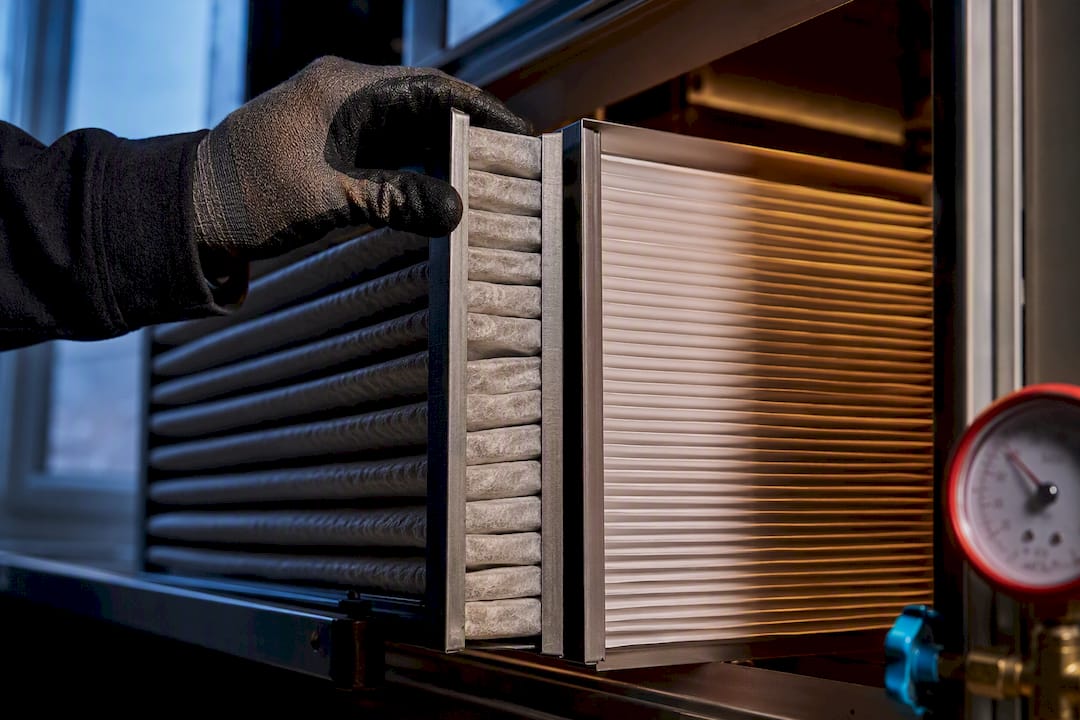
When 99.97% HEPA Is the Wrong Choice: MERV 13 vs HEPA for Homeowners
True HEPA filters remove more particles than MERV 13 filters, full stop. But that fact alone doesn’t tell you what to install. Most homes should run the highest MERV rating their HVAC system can safely handle, then add portable HEPA units in rooms where extra protection matters. True HEPA in the furnace slot is rarely realistic without added equipment, so the real decision comes down to what your blower and ductwork can tolerate.
TL;DR:
- Most homes can safely upgrade to MERV 13 filters if their HVAC systems are analyzed for static pressure and blower motor type first.
- True HEPA filters trap 99.97% of particles at 0.3 microns, while MERV 13 filters typically capture about half that amount at the same size.
- Installing a HEPA filter directly in a standard furnace slot is usually impractical due to increased airflow resistance and sealed housing requirements.
- Portable HEPA units in key rooms often outperform whole-house HEPA filtration by providing nonstop clean air delivery, especially during wildfire smoke season.
- Proper assessment and matching filter type to system capacity prevent equipment damage and ensure effective air quality improvement.
Table of Contents
- MERV 13 vs HEPA: What the Numbers Actually Show
- Why HEPA Usually Isn’t a Simple Furnace Swap
- MERV 13 or HEPA: Matching the Filter to Your Situation
- Upgrading Filtration Without Damaging Your System
- Portable HEPA, Activated Carbon, and Combined Strategies
- What Filtration Upgrades Actually Cost
- Why a Professional Filtration Assessment Matters
- How Filtration Choices Actually Affect Air You Breathe
- Does Better Filtration Come at an Environmental Cost?
- Common Myths About MERV 13 and HEPA Filters
- The Real Question Isn’t Which Filter Wins
- Schedule a Filtration Assessment With Strong Heating & Cooling
- Sources
- FAQ
MERV 13 vs HEPA: What the Numbers Actually Show
The gap between these two filters is measurable, not marketing spin. A true HEPA filter must capture at least 99.97% of particles at 0.3 microns, the size range that includes viruses, fine smoke, and many bacteria. MERV 13 filters are tested to a lower, but still meaningful, standard.
That standard comes from ASHRAE Standard 52.2, which measures how a filter performs across a range of particle sizes and identifies the most penetrating particle size (MPPS), the point where a filter struggles hardest to catch particles. Manufacturers assign MERV ratings based on that testing, not on marketing copy.
Here’s how the two stack up at the sizes that matter most:
- 0.3 to 1.0 microns: MERV 13 captures at least 50%; HEPA captures at least 99.97%.
- 1.0 to 3.0 microns: MERV 13 captures at least 85%; HEPA remains at 99.97% or higher.
- General efficiency claim: EPA data confirms MERV 13’s fractional efficiency is significantly lower than HEPA’s across nearly every particle band.
Statistic Callout: HEPA filters must trap 99.97% of particles at 0.3 microns. A MERV 13 filter, by contrast, only guarantees catching half the particles in that same size range. That’s a real performance gap, not a rounding error.
One labeling trap trips up a lot of shoppers: “HEPA-like” or “HEPA-type” language on box packaging. Neither term means the filter meets the true HEPA standard. If a product doesn’t state “true HEPA” with a certified efficiency rating, treat the claim skeptically.
Why HEPA Usually Isn’t a Simple Furnace Swap
A denser filter means more resistance to airflow, what HVAC technicians call static pressure. True HEPA media is packed far tighter than a standard 1-inch pleated filter, and most residential furnace slots were never designed to handle that resistance. Push a HEPA filter into a standard slot and you risk restricted airflow, a frozen evaporator coil, or a blower motor working overtime to compensate.
Motor type matters here too. Systems with ECM (electronically commutated motor) blowers generally tolerate higher static pressure better than older PSC motors, which can overheat or fail prematurely under added strain. Knowing which motor your system uses is one of the fastest ways to gauge whether a filtration upgrade is even on the table.
Before changing anything, a technician should walk through this sequence:
- Identify the blower motor type (ECM versus PSC) to understand pressure tolerance.
- Measure current static pressure against the manufacturer’s rated limit.
- Check the filter cabinet for a sealed housing versus a basic slot design.
- Determine whether a bypass HEPA system or media cabinet is needed to reach HEPA-level filtration safely.
ASHRAE warns that HEPA-level filtration requires different housing and airtight sealing to avoid leakage around the filter’s edges. Even a tiny gap lets unfiltered air bypass the media entirely.
Pro Tip: Ask your technician for the actual static pressure number in inches of water column, not just a verbal “it’s fine.” That figure is what determines whether your system can handle a denser filter.
MERV 13 or HEPA: Matching the Filter to Your Situation
Most households don’t need the most aggressive filter available. They need the one that fits their system and their actual health concerns.
- General allergies, pet dander, or preventive air quality upgrades: MERV 13 is the practical choice for whole-house coverage, assuming your blower can handle the added resistance.
- Severe asthma or immunocompromised household members: A portable HEPA unit or an installed bypass HEPA system delivers the higher filtration level these situations often call for.
- Wildfire smoke season: Portable HEPA units placed in bedrooms and main living areas cut fine particle exposure faster than waiting on whole-house filtration alone.
- Renters or budget-conscious households: A portable HEPA unit in the bedroom or main living space avoids any HVAC modification and travels with you if you move.
The distinction that matters most here isn’t which filter is “better” in the abstract. It’s which one your specific circumstances, and your specific system, can actually support without creating a new problem to solve.
Upgrading Filtration Without Damaging Your System
Jumping straight to the highest-rated filter you can find online is how homeowners end up with airflow problems six months later. A safer sequence looks like this:
- Pull your system’s manual and confirm the filter size and any manufacturer-stated MERV limit.
- Check blower motor type. ECM motors generally have more headroom for denser filters than PSC motors.
- Request a static pressure measurement from a technician rather than guessing. This single number determines your ceiling.
- If the system supports it, move to the highest safe MERV rating, typically MERV 13 for most modern residential systems. If not, a portable HEPA unit or a properly sealed bypass HEPA installation fills the gap without straining the blower.
- Set a replacement schedule. Higher-MERV filters load with particles faster and need more frequent swaps to avoid rising pressure drop.
Pro Tip: Write your filter’s install date on the frame with a marker. It sounds simple, but it’s the easiest way to catch a filter that’s overdue before it starts choking airflow.
Our guide to air filters and HVAC breaks down filter sizing and replacement cadence in more detail if you want to go deeper on the basics before calling a technician.
Portable HEPA, Activated Carbon, and Combined Strategies
Portable HEPA units solve a different problem than whole-house filters: they clean the air in one specific room, continuously, rather than only when the HVAC system happens to be running. That’s a real advantage. A whole-house filter only cleans air while the blower cycles, but a portable unit runs nonstop if you let it.
Size portable purifiers using CADR, the Clean Air Delivery Rate, matched to your room’s square footage. A unit rated for a small bedroom won’t do much in an open living room.
- CADR measures particle removal only; it says nothing about gases or odors.
- Activated carbon filters address VOCs, smoke odor, and cooking smells that particle filters ignore.
- Pairing a MERV 13 whole-house filter with a portable HEPA unit in key rooms often outperforms chasing whole-house HEPA through a risky retrofit.
Statistic Callout: Because HVAC systems cycle on and off, a continuously running portable HEPA unit with the right CADR can clear a room’s air faster in practice than a whole-house filter that only operates part of the day.
What Filtration Upgrades Actually Cost
Price differences between these two paths are significant enough to shape the decision on their own.
- MERV 13 filters: Inexpensive to buy, though frequent replacement adds up over a year.
- Portable HEPA purifiers: Roughly $200 to $800 depending on room size and unit quality.
- Bypass HEPA systems installed on existing HVAC: Roughly $800 to $2,500 or more, varying by ductwork complexity and labor.
- Energy impact: Denser filters that load with debris raise pressure drop, forcing the blower to work harder and run longer, which shows up on utility bills over time.
Check our furnace filter basics guide for realistic replacement intervals based on filter type and household conditions.
Why a Professional Filtration Assessment Matters
With over 40 years of combined industry experience, Strongheatingandcooling approaches filtration upgrades the way a technician should: measure first, recommend second. A proper assessment includes static-pressure testing, a review of your blower motor’s compatibility, and a look at whether a sealed media cabinet makes sense for your ductwork.
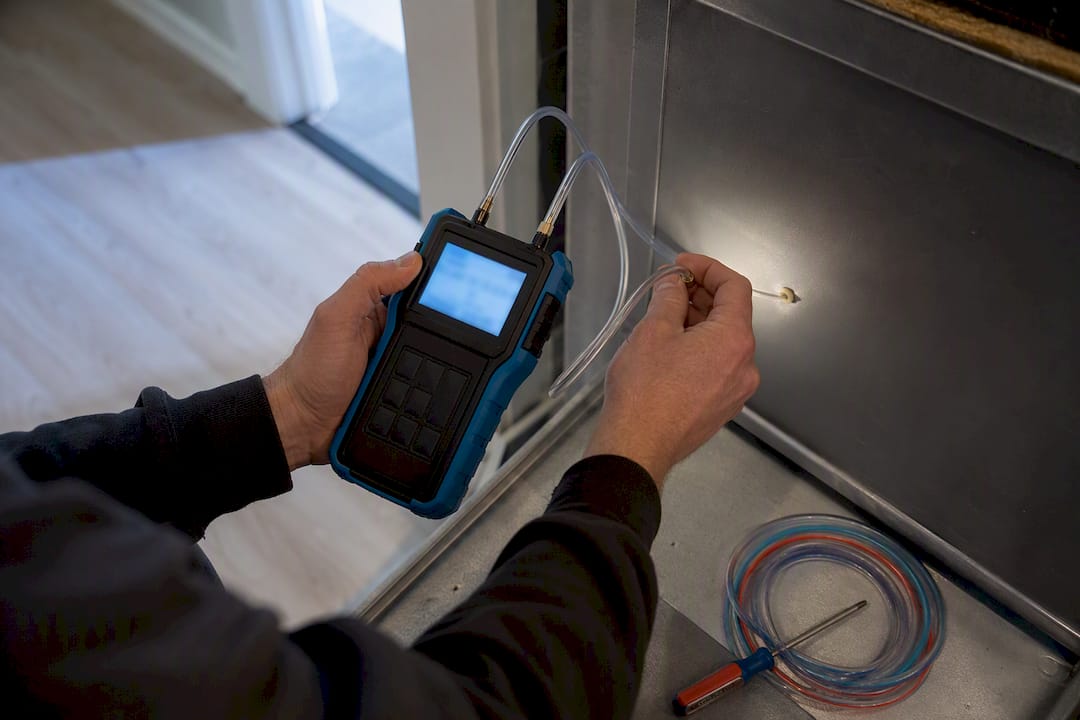
Before hiring anyone for a filtration upgrade, ask for the actual static pressure reading, a clear answer on motor compatibility, and whether a sealed cabinet option is available for your system. Those three checks separate a real assessment from a guess.
How Filtration Choices Actually Affect Air You Breathe
The efficiency numbers on a filter box matter less than what they translate to in daily exposure. Fine particulate matter, the kind both MERV 13 and HEPA target at different rates, has been linked in public health research to respiratory irritation, aggravated asthma symptoms, and cardiovascular strain with prolonged exposure. Wildfire smoke events have made this especially visible in recent years, with hospitals in smoke-affected regions reporting spikes in asthma-related visits during heavy smoke days.
A MERV 13 filter running continuously in a well-sealed HVAC system reduces the baseline particle load in every room it serves. That’s meaningfully different from a portable HEPA unit, which delivers a higher removal rate but only in the room it occupies. Neither approach eliminates indoor pollutants entirely; both reduce exposure relative to no filtration at all.
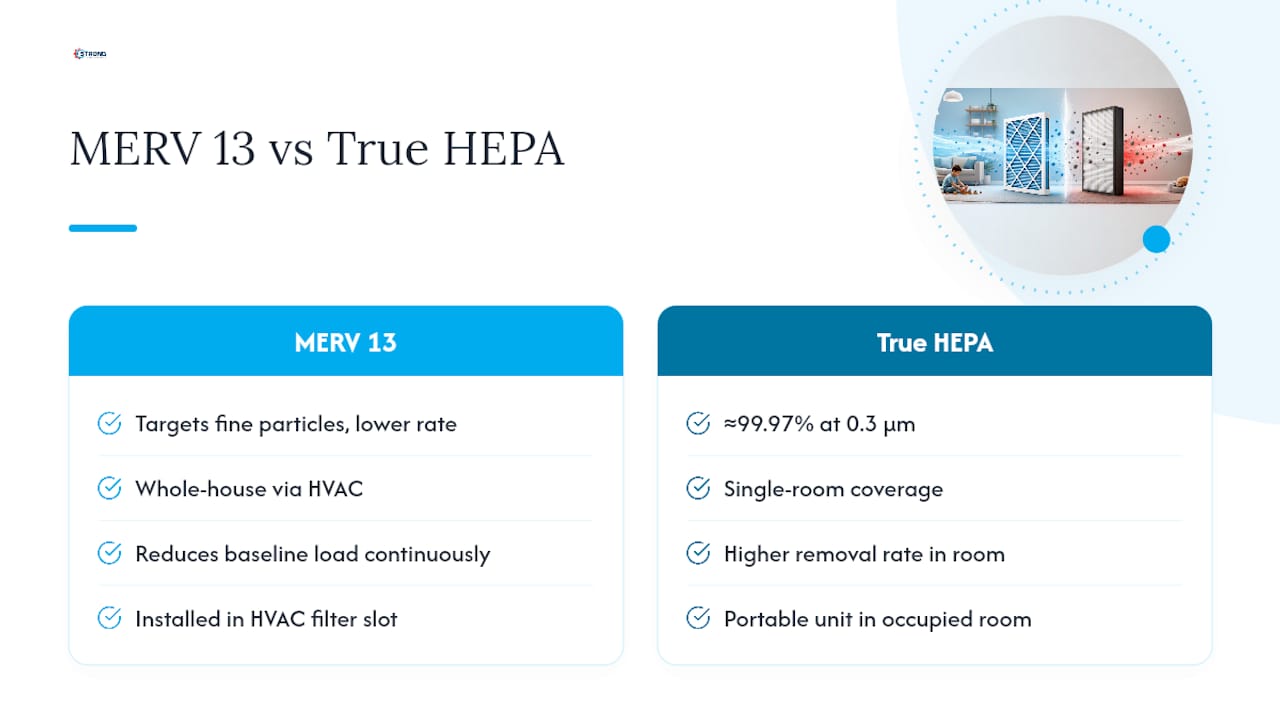
The practical takeaway for most households: consistent, properly sized filtration, whether that’s MERV 13 across the whole house or HEPA in a bedroom, matters more than chasing the single highest efficiency rating on paper. A MERV 13 filter that’s replaced on schedule and sealed properly in its housing often does more for daily air quality than a top-tier filter installed incorrectly with air bypassing its edges.
Households with occupants who have chronic respiratory conditions tend to see the most noticeable difference when combining a solid whole-house filter with a portable HEPA unit in the bedroom, where people spend roughly a third of their day.
Does Better Filtration Come at an Environmental Cost?
Filtration upgrades carry a footprint that’s worth weighing honestly. Denser filters, and HEPA media especially, require more raw material to manufacture and typically get replaced on a fixed schedule regardless of how dirty they actually are, which means more filters heading to landfills over a system’s lifetime compared to a standard filter setup.
Energy use is the other side of that equation. A clogged or overly restrictive filter forces the blower motor to run longer and harder, and that added electricity draw compounds over a heating or cooling season. Homeowners who install a filter denser than their system was designed for often trade a modest air-quality gain for a meaningful jump in energy consumption, which erases part of the benefit.
The more sustainable path usually isn’t the highest-rated filter available. It’s the filter that matches your system’s actual capacity, replaced on a schedule based on real loading rather than a calendar guess, paired with a portable HEPA unit sized correctly for the room it serves rather than oversized “just in case.” Right-sizing avoids both wasted filter material and wasted electricity, which is a better outcome for your utility bill and for what ends up in the trash.
Common Myths About MERV 13 and HEPA Filters
Myth: “HEPA filters fit standard furnace slots.” They rarely do without modification. True HEPA media is thicker and denser than what a standard 1-inch or even 4-inch furnace slot was engineered to hold, and forcing the fit usually means the filter isn’t sealed properly, which lets air bypass it entirely.
Myth: “MERV 13 equals HEPA performance.” It doesn’t. As the numbers show, MERV 13 guarantees roughly half the particle capture of true HEPA at the smallest tested size range. It’s a strong upgrade over a standard filter, not a HEPA substitute.
Myth: “Any filter labeled ‘HEPA-type’ works the same as true HEPA.” Marketing language like “HEPA-like” or “HEPA-type” has no certified standard behind it. Only “true HEPA” with a stated efficiency claim meets the actual benchmark.
Myth: “A higher MERV rating is always better for your system.” Not if your blower can’t handle the added resistance. A filter that’s too dense for your system’s design can restrict airflow enough to freeze a coil or strain a motor, undoing any air-quality benefit with an equipment repair bill.
Myth: “Portable HEPA units are just a downgrade from whole-house HEPA.” Continuous operation in a single room often outperforms a whole-house system that only filters air while the blower cycles on. Different tool, different job, not a lesser one.
The Real Question Isn’t Which Filter Wins
The technical debate over HEPA versus MERV 13 efficiency numbers is settled and has been for years. What the industry talks about far less is that the efficiency numbers barely matter if your system can’t safely run the filter you want.
Conventional advice tends to treat this like a straightforward upgrade decision: buy the better filter, install it, done. That framing skips the part that actually determines outcomes in real homes, which is whether the blower motor, the ductwork, and the filter housing were built to handle the resistance a denser filter creates. A homeowner who installs a filter their system can’t support often ends up worse off than before, dealing with frozen coils, a strained motor, or air quietly bypassing the filter at the edges.
The priority should flip. Start with a static pressure measurement, not a filter rating. Let that number, along with your blower motor type, tell you what’s actually safe to install. From there, MERV 13 handles most everyday allergy and air-quality goals, and portable HEPA units cover the situations that call for more, without betting your HVAC system’s longevity on a filter it was never designed to run.
— Owner
Schedule a Filtration Assessment With Strong Heating & Cooling
A practical alternative to guessing your way through a filter upgrade is to measure static pressure and blower compatibility first, then recommend the path that fits your home, whether that’s a media cabinet, a bypass HEPA install, or a portable HEPA unit for targeted rooms.

Colorado Springs area homeowners can request an indoor air quality assessment before spending money on the wrong filter. Our team checks your system’s actual capacity, walks you through indoor air comfort solutions suited to your household’s needs, and gives you options at different price points without pressure. If your system needs work before higher filtration is even possible, our heating installation services can get it there. Reach out today to book a static-pressure check and find out which filtration path actually fits your home.
Sources
- EPA — What MERV rating
- ASHRAE — Filtration and Disinfection FAQ
- HVAC Database — Understanding HEPA filters for your HVAC system
FAQ
Is MERV 13 Too High for Home Use?
No, most modern residential HVAC systems handle MERV 13 without issue, though a static pressure check confirms whether your specific blower and ductwork can support it safely.
What MERV Rating Equals HEPA?
No MERV rating truly equals HEPA. The MERV scale tops out below the 99.97% capture rate at 0.3 microns that defines true HEPA.
Do You Really Need a HEPA Filter on a Vacuum?
For most households, no. A HEPA vacuum filter helps most when someone in the home has severe allergies or asthma and dust exposure during cleaning is a specific concern.
Is a MERV 13 Filter Worth It?
Yes, for most homes it’s the most practical upgrade available, delivering a meaningful jump in particle capture over standard filters without requiring the equipment changes true HEPA often demands.
Can I Just Use a Portable HEPA Instead of Upgrading My HVAC Filter?
Yes, and for renters or anyone unsure about their system’s static pressure limits, a correctly sized portable HEPA unit is often the safer, faster path to better air quality in the rooms that matter most.
Recommended
Need expert HVAC help?
Colorado Springs' trusted, veteran-owned heating & cooling team — emergency service.