

HVAC Cost Reduction Strategies for Businesses
The highest-impact commercial HVAC savings come from a layered, prioritized approach: audit first, reduce load, optimize controls, handle maintenance, and only then replace equipment. HVAC accounts for a large share of commercial building energy use, and commercial buildings waste a substantial portion of their energy overall, which means the savings potential is real and substantial. The four actions that deliver the most value, in order, are:
- Run a screening audit to identify where energy is actually going (typical savings from operational changes can be significant)
- Reduce load through envelope improvements and duct sealing to achieve meaningful energy savings
- Optimize controls and building automation per ASHRAE Guideline 36 to achieve notable energy reductions
- Address maintenance gaps and low-cost energy conservation measures before replacing any equipment, which can lead to substantial savings when combined with targeted upgrades
For funding, the Section 179D commercial building energy deduction offers deductions up to $5.94 per square foot for qualifying HVAC and envelope improvements. State and utility incentives are searchable through DSIRE, the national database of state energy programs. ENERGY STAR’s Portfolio Manager tool benchmarks your building’s energy use intensity against similar properties at no cost. Strongheatingandcooling serves businesses across Colorado Springs and surrounding communities and can support audits, maintenance plans, duct sealing, and equipment replacement.
Your next 30–90 days, concisely:
- Pull over a year of utility bills and benchmark in ENERGY STAR Portfolio Manager
- Walk the building and note filter condition, coil cleanliness, belt wear, and thermostat accuracy
- Identify obvious duct leaks, disconnected runs, or uninsulated sections
- Request a screening audit or Level 1 assessment from a qualified contractor
- Document all existing equipment ages, refrigerant types, and maintenance records
Table of Contents
- 1. Start with a layered plan: what to do first, second, and third
- 2. How to audit your HVAC system before spending a dollar on upgrades
- 3. Controls, BAS, and smart strategies that cut HVAC costs
- 4. Maintenance and tune-up actions that restore efficiency
- 5. Building envelope, duct sealing, and airflow optimization
- 6. When to replace equipment, how to size it, and how to pay for upgrades
- 7. Operational changes and occupant behavior that lower HVAC bills
- 8. How to measure savings and demonstrate ROI
- 9. How Strongheatingandcooling helps businesses cut HVAC costs
- Key Takeaways
- The measure most businesses skip first
- Strongheatingandcooling’s commercial HVAC services for Colorado Springs businesses
- Useful sources and links
- FAQ
1. Start with a layered plan: what to do first, second, and third
The most common mistake businesses make is replacing equipment before addressing the building conditions that made the old equipment work so hard. A new high-efficiency chiller installed in a leaky, poorly controlled building will underperform its rated efficiency from day one. The correct sequence is load reduction first, then controls optimization, then maintenance corrections, and finally targeted equipment replacement.
A practical timeline looks like this. In the first three months, run a screening audit and capture quick wins such as fixing duct leaks, replacing filters, recalibrating sensors, and adjusting scheduling. From months three through twelve, address controls, envelope improvements, and retro-commissioning of existing BAS sequences. Within several years is the typical window for major equipment replacement and full BAS commissioning, ideally timed to coincide with natural end-of-life cycles.
Cost and payback by layer vary considerably. Operational fixes and scheduling corrections often have low costs and can pay back quickly. BAS tuning and retro-commissioning costs vary widely and typically have paybacks within a few years. Duct sealing project costs depend on building size and access but are generally moderate. Chiller or rooftop unit replacements with variable frequency drives are major investments but may qualify for significant incentives and tax deductions.
Pro Tip: Before commissioning a Level 2 energy audit, use a free AI pre-audit tool or ENERGY STAR Portfolio Manager to screen your building’s energy use intensity. This narrows the scope of paid modeling and can cut audit costs significantly.
2. How to audit your HVAC system before spending a dollar on upgrades
An energy audit is not a single thing. ASHRAE defines three levels, and choosing the right one depends on your goals, your building’s complexity, and what incentive programs require.
A Level 1 audit is a walkthrough with utility bill analysis. Facility staff can perform much of this themselves. A Level 2 audit adds detailed energy modeling, savings calculations for each measure, and a measurement and verification (M&V) plan. Level 2 audits typically identify 15–30% energy cost reduction potential and are required by most utility rebate programs and for Section 179D documentation. A Level 3 audit adds investment-grade modeling and is reserved for large, complex projects.
Self-audit checklist for facility staff:
- Benchmark energy use intensity in ENERGY STAR Portfolio Manager and compare to the national median for your building type
- Inspect air filters monthly; document replacement dates and condition at change-out
- Check coil cleanliness on air handlers and condensing units; dirty coils raise energy use measurably
- Inspect belts on fans and drives for wear, cracking, or slippage
- Verify thermostat and sensor calibration against a calibrated reference thermometer
- Look for visible duct disconnections, gaps at joints, or uninsulated duct runs in unconditioned spaces
- Download BAS trend data and look for runtimes that extend well beyond occupied hours
When to hire a professional: if your building exceeds 20,000 square feet, if you are pursuing utility rebates or Section 179D, or if your screening audit reveals complex issues, a licensed engineer should perform a Level 2 assessment. AI pre-audit tools can replace a Level 1 screening and produce a prioritized opportunity list quickly, but they cannot substitute for the certified modeling that incentive programs require.
When selecting an auditor, ask for a written scope that includes savings estimates per measure, a proposed M&V plan, and the modeling software they use. Red flags include auditors who propose equipment replacement before completing the analysis, or who cannot name the ASHRAE audit level their deliverable meets.
3. Controls, BAS, and smart strategies that cut HVAC costs
Controls upgrades are frequently the highest-value investment available to a commercial building owner, and they are consistently underused. A Building Automation System running ASHRAE Guideline 36 control sequences can reduce HVAC energy use by up to 30%, with field retrofits showing electricity savings of 11–17%. That range often exceeds what a simple equipment swap delivers, at a fraction of the capital cost.
The highest-impact control strategies, in rough order of implementation ease:
- Optimized start/stop: the BAS calculates the latest possible startup time to reach setpoint by occupancy, rather than running on a fixed schedule
- Demand-controlled ventilation (DCV): CO2 sensors modulate outdoor air based on actual occupancy rather than design-day assumptions
- ASHRAE Guideline 36 sequences: standardized, peer-reviewed control sequences for VAV systems that eliminate common energy waste from simultaneous heating and cooling
- Fault detection and diagnostics (FDD): software that flags sensor drift, stuck dampers, and sequence failures before they become expensive problems
- Zone scheduling aligned to actual occupancy patterns, not assumed ones
Occupancy sensors, smart zoning, and DCV often yield larger savings than replacing equipment when the root cause is poor control rather than aging hardware. A building running a 15-year-old rooftop unit on a properly tuned BAS with DCV will often outperform a new unit running on a poorly configured schedule.
One important caveat: superficial BAS “integration” without commissioning rarely achieves projected savings. Guideline 36 implementation requires documented sequences-of-operations, emulation testing, and ongoing monitoring. The steps are: capture baseline trend data for at least 30 days, review existing sequences against Guideline 36 targets, commission corrected sequences with a qualified controls contractor, and set up FDD monitoring to catch drift. Smart thermostat strategies for smaller commercial spaces follow a similar logic, as covered in this overview of occupancy and zoning approaches.

4. Maintenance and tune-up actions that restore efficiency
Efficiency drift is one of the most underappreciated cost drivers in commercial HVAC. Sensors lose calibration, control sequences revert after power interruptions, coils accumulate fouling, and refrigerant charge shifts over time. None of these failures announce themselves loudly; they just quietly raise your energy bill.
A structured maintenance schedule prevents most of this drift. Here are the core recurring tasks and their recommended frequencies:
- Replace or clean air filters: monthly to quarterly depending on occupancy and air quality conditions
- Clean evaporator and condenser coils: annually at minimum, semi-annually in high-dust environments
- Check refrigerant charge and inspect for leaks: annually, with superheat and subcooling measurements documented
- Inspect and tension belts on fans and air handlers: semi-annually
- Verify VFD operation and motor amp draw: annually
- Recalibrate thermostats and zone sensors against a reference standard: annually
- Inspect and clean condensate drain pans and lines: semi-annually to prevent biological growth and water damage
A maintenance technician can verify performance with straightforward field measurements: delta-T across cooling coils (typically 16–22°F for a properly charged system), fan amp draw compared to nameplate, static pressure readings at supply and return plenums, and refrigerant superheat and subcooling values. Deviations from expected ranges point directly to the problem.
Pro Tip: Bundle preventive maintenance into a contracted plan with a qualified HVAC contractor. Contracted clients typically receive priority scheduling for emergency calls and lower per-visit rates, and the documented maintenance records are often required by utility rebate programs and Section 179D auditors.
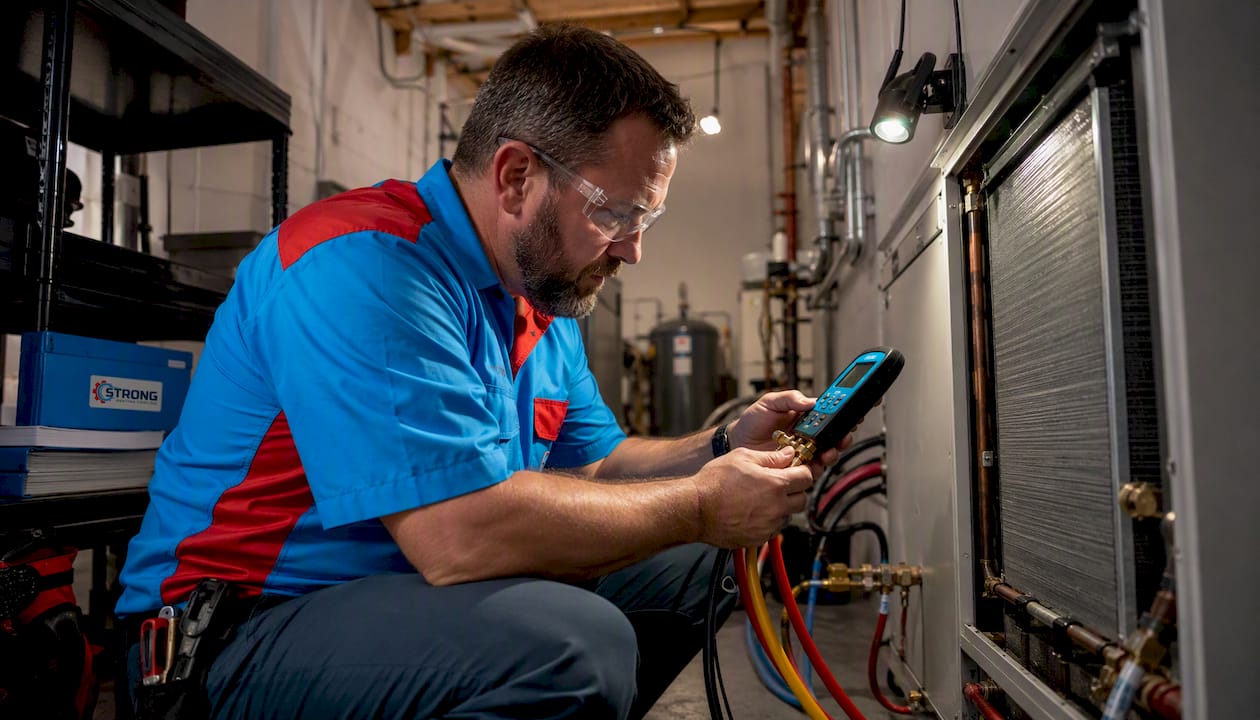
Strongheatingandcooling offers planned maintenance programs for commercial clients in Colorado Springs and surrounding areas, with documented service records that support incentive applications. Professional re-tuning every 3–5 years, combined with continuous BAS monitoring, is the standard cadence for sustaining savings long-term.
5. Building envelope, duct sealing, and airflow optimization
Reducing the load your HVAC system has to handle is almost always cheaper than upgrading the equipment that handles it. Envelope and duct improvements address the source of the problem rather than the symptom.
Duct leakage can be a significant source of heating and cooling energy loss in commercial buildings—duct leaks can account for 20–30% of heating and cooling energy loss—making duct sealing one of the highest-impact, lowest-cost measures available. Common duct issues include unsealed joints at plenums and branches, disconnected flex duct runs in attic or mechanical spaces, and uninsulated ductwork running through unconditioned areas. Aeroseal duct sealing and mastic sealant applied at joints are the two most common remediation methods; both are verifiable with duct pressurization testing before and after.
Envelope opportunities worth evaluating:
- Roof and attic insulation upgrades, particularly in older buildings with R-values below current ASHRAE 90.1 minimums
- Window film on south- and west-facing glazing to reduce solar heat gain without replacing windows
- Weatherstripping and door sweeps at loading docks, entry vestibules, and mechanical room penetrations
- Targeted wall or ceiling insulation where thermal imaging reveals consistent heat transfer
Airflow validation checklist:
- Pressurization checks: confirm supply and return are balanced; excess positive or negative pressure drives infiltration
- VAV box balancing: verify each zone is receiving design airflow at design static pressure
- Static pressure targets: confirm duct static pressure is not running above design, which wastes fan energy
Envelope and duct work should precede equipment replacement in the sequencing plan. Sealing ducts and improving insulation reduce the design load, which in turn affects right-sizing calculations for any new equipment. Replacing a unit before completing this work risks installing an oversized system that short-cycles and underperforms.
6. When to replace equipment, how to size it, and how to pay for upgrades
Equipment replacement is the most capital-intensive step, and it is also the most frequently rushed. The right time to replace is when lifecycle cost analysis favors it, not simply when a unit fails.
Clear replacement triggers include: equipment older than 12 years using phased-out refrigerants such as R-22 or R-410A (which is subject to ongoing phase-down), repeated compressor or heat exchanger failures within a 24-month window, and situations where repair costs exceed 30–40% of replacement cost. Age-based replacement decisions also need to account for refrigerant availability and the cost trajectory of older refrigerants.
Right-sizing matters as much as efficiency ratings. Oversized equipment short-cycles, which reduces dehumidification effectiveness, increases wear, and raises energy use. Load-based selection using Manual N (commercial) or equivalent software, with diversity factors applied to reflect actual occupancy patterns, produces better outcomes than rule-of-thumb replacement sizing.
Efficiency metrics for commercial equipment: IEER (Integrated Energy Efficiency Ratio) is the primary metric for commercial cooling equipment and reflects part-load performance, which is where most equipment operates most of the time. SEER2 applies to smaller commercial split systems. EER measures full-load efficiency. HSPF applies to heat pump heating performance. Federal minimum standards set floors for each metric; equipment exceeding those minimums qualifies for utility rebates and potentially Section 179D.
| Incentive Type | Typical Value | How to Access |
|---|---|---|
| Section 179D tax deduction | Up to $5.94/sq ft | IRS via licensed engineer certification and ASHRAE-compliant modeling |
| Utility HVAC rebates | — | Contact your utility directly or search DSIRE |
| Custom utility incentives | — | Requires M&V documentation; utility program application |
| State energy programs | Varies by state | DSIRE for state-level lookup |
The Section 179D deduction, expanded under the Inflation Reduction Act of 2022, covers HVAC, lighting, hot water systems, and building envelope improvements. Qualifying requires ASHRAE-compliant energy modeling and certification by a licensed engineer. Engage that engineer before the project begins, not after, to avoid costly rework on documentation.
Pro Tip: Require lifecycle cost projections covering 10–20 years of operating costs from any contractor bidding a replacement project. A unit with a lower purchase price but higher annual energy cost often costs more over its service life. Ask whether the proposed BAS scope supports ASHRAE Guideline 36 sequences.
For a detailed look at commercial HVAC upgrade options and payback framing, Strongheatingandcooling’s resource covers the most common replacement and retrofit scenarios for Colorado Springs commercial properties.
7. Operational changes and occupant behavior that lower HVAC bills
Not every cost reduction requires a capital project. Operational adjustments and occupant-facing policies can produce meaningful savings with minimal upfront cost, and they often improve the performance of any equipment upgrades that follow.
Setpoint management is the most direct lever. Cooling setpoints of 74–76°F during occupied hours and setback to 85°F or higher during unoccupied periods are reasonable starting points for most commercial spaces in Colorado’s climate. Heating setpoints of 68–70°F occupied and setback to 60°F unoccupied are similarly effective. Each degree of setback during unoccupied hours reduces HVAC runtime and energy use.
Peak-demand tactics worth implementing:
- Staggered equipment startups in the morning to avoid simultaneous demand spikes that raise peak demand charges
- Night precooling during summer months: pre-cool the building during off-peak rate hours (typically late night) and allow temperatures to drift up slightly during peak-rate afternoon hours
- Thermal mass use: in buildings with concrete floors or masonry walls, precooling takes advantage of stored thermal capacity
Occupant behavior interventions that work in practice: thermostat lockouts prevent unauthorized setpoint changes that drive up energy use; zone-occupancy scheduling aligned to actual work patterns avoids conditioning empty areas; and simple occupant communication about setpoint policies reduces complaints and workarounds. Desk-level comfort options such as personal fans or task lighting reduce the pressure to lower building-wide setpoints for individual comfort.
Low-cost behavioral and schedule changes to implement this week:
- Audit your BAS schedule against actual building occupancy hours and correct any mismatches
- Set thermostat lockout ranges on all accessible thermostats
- Communicate setpoint policies to occupants with a brief, factual explanation of the energy and cost impact
- Identify zones that are conditioned during unoccupied hours and correct the schedule
8. How to measure savings and demonstrate ROI
Claiming savings is easy. Proving them requires a baseline, a measurement plan, and consistent tracking. The International Performance Measurement and Verification Protocol (IPMVP) defines four options for verifying energy savings, ranging from stipulated savings (Option A) to whole-building billing analysis (Option D). For most commercial HVAC projects, Option B (end-use metering) or Option D (utility bill regression) are the most practical.
Key metrics to track for any HVAC efficiency project:
- Energy use intensity (EUI): total site energy per square foot per year, in kBtu/sq ft/yr
- HVAC-specific kWh: submetered electricity consumption for HVAC equipment
- Peak demand (kW): monthly peak demand, which drives demand charges on most commercial utility bills
- Runtime hours: logged from BAS or equipment controls
- Chilled water or steam ton-hours where central plant equipment is involved
A simple payback calculation illustrates the logic. If your building spends $120,000 per year on energy and HVAC accounts for 45% of that ($54,000), a 20% HVAC energy reduction saves approximately $10,800 per year. A BAS tuning project costing $25,000 would pay back in roughly 2.3 years. That same logic applies to any measure; the variables are the percentage reduction and the project cost.
| Measure | Estimated Savings | Typical Project Cost | Approximate Payback |
|---|---|---|---|
| BAS retro-commissioning | 5–20% HVAC energy | — | 1–3 years |
| Duct sealing | 20–30% of duct losses | — | 1–4 years |
| Controls/Guideline 36 tuning | 10–30% HVAC energy | — | 1–4 years |
| Equipment replacement (high-efficiency) | 15–40% vs. old unit | — | 5–12 years |
Track pre- and post-project monthly utility bills alongside BAS trend data for at least 12 months. Weather normalization, using heating and cooling degree days, removes the effect of year-to-year climate variation and produces a defensible savings number for utility rebate claims and Section 179D documentation.
Pro Tip: Set up a simple spreadsheet that logs monthly kWh, peak demand (kW), and degree days for each month. After 12 months of post-project data, a regression against degree days gives you a weather-normalized baseline comparison that most utility programs will accept.
9. How Strongheatingandcooling helps businesses cut HVAC costs
Strongheatingandcooling has served commercial and residential clients across Colorado Springs and surrounding communities for over 40 years of combined team experience. For business owners and facility managers working through the strategies in this article, the practical question is often not what to do, but who can execute it reliably and document it correctly for incentive programs.
Services Strongheatingandcooling provides that align directly with the strategies covered here:
- Commercial energy screening and walkthrough assessments to identify quick wins and prioritize capital projects
- Preventive maintenance plans with documented service records, supporting utility rebate and Section 179D applications
- Duct sealing and airflow testing for commercial properties
- Equipment replacement and commissioning, including right-sizing analysis and efficiency metric guidance
- BAS tuning support and controls evaluation for existing systems
- Incentive documentation support: service records, equipment specifications, and coordination with licensed engineers for Section 179D modeling
Colorado Springs and the surrounding region present specific conditions that affect HVAC performance: high altitude affects equipment capacity ratings, the semi-arid climate creates wide daily temperature swings that favor night precooling strategies, and local utility programs offer rebates that vary by season and equipment type. Site-specific knowledge of these factors improves both the accuracy of savings estimates and the likelihood of qualifying for available incentives.
The most practical next step for most businesses is a screening assessment: a walkthrough that identifies the three to five highest-impact measures for your specific building, with rough cost and savings estimates for each. That assessment informs whether a paid Level 2 audit is warranted and which incentive programs to pursue.
Key Takeaways
The most effective HVAC cost reduction strategy for businesses follows a layered sequence: reduce load first, optimize controls second, maintain consistently, and replace equipment only when lifecycle cost analysis supports it.
| Point | Details |
|---|---|
| Sequence matters | Seal ducts and fix controls before replacing equipment to avoid oversizing and wasted capital. |
| Controls deliver fast ROI | BAS tuning and ASHRAE Guideline 36 sequences can cut HVAC energy use by 10–30% with paybacks of 1–3 years. |
| Duct leakage is costly | Duct leaks account for 20–30% of heating and cooling energy loss; sealing is one of the highest-impact, lowest-cost measures available. |
| Fund projects with incentives | Section 179D deductions reach up to $5.94 per square foot; utility rebates run—for qualifying HVAC equipment. |
| Strongheatingandcooling | Provides commercial screening assessments, maintenance plans, duct sealing, and equipment replacement for businesses in Colorado Springs and surrounding communities. |
The measure most businesses skip first
The pattern that shows up most often in commercial buildings is straightforward: the equipment gets blamed when the controls and the ductwork are the real problem. A facility manager calls about high energy bills, and the first instinct is to look at equipment age. But when you walk the building and pull BAS trend data, you typically find that the system is running during unoccupied hours, the duct leakage is significant, and the control sequences have drifted from their original settings. Fixing those three things, before touching the equipment, usually produces faster savings at a fraction of the cost.
The other thing worth saying plainly: Section 179D and utility rebates are genuinely available and genuinely underused. Most businesses that qualify never claim them, either because they did not know the programs exist or because they did not document the project correctly from the start. Getting a qualified engineer involved early, before the audit and before the project scope is finalized, is the step that makes the difference between a project that qualifies and one that does not.
Strongheatingandcooling is available for on-site evaluations across Colorado Springs and surrounding communities. If your building has not had a professional assessment in the last three to five years, that is the right place to start.
Strongheatingandcooling’s commercial HVAC services for Colorado Springs businesses
For businesses in Colorado Springs and the surrounding region, cutting HVAC costs starts with knowing exactly where the waste is, and that requires someone who knows your building type, your local utility programs, and the specific performance conditions at altitude.

Strongheatingandcooling offers commercial clients a practical path from assessment to implementation: screening walkthroughs that identify your highest-impact measures, preventive maintenance plans that keep documented records for incentive programs, duct sealing and airflow testing, and full equipment replacement with commissioning. Bundled maintenance plans are available and lock in priority service rates for emergency calls. Financing options are available for qualifying equipment replacement projects.
To request a screening assessment or get a quote for any of these services, contact Strongheatingandcooling directly. For cooling system services specifically, the commercial cooling service page covers available options and next steps.
Useful sources and links
These are the primary resources referenced in this article. Each one serves a specific purpose in your HVAC cost reduction planning.
- ENERGY STAR Portfolio Manager: free benchmarking tool for commercial buildings; use it to establish your energy use intensity baseline and compare against similar buildings nationally
- DSIRE (Database of State Incentives for Renewables and Efficiency): the most complete national database of state and utility energy incentive programs; search by state and technology type to find rebates available in Colorado
- Section 179D deduction — IRS: the primary IRS guidance on eligibility, deduction amounts, and documentation requirements for commercial building energy improvements
- 179D overview — U.S. Department of Energy: DOE’s plain-language explanation of eligible improvements, deduction tiers, and prevailing wage requirements
- ENERGY STAR tax credits for commercial buildings: ENERGY STAR’s summary of eligible improvements and deduction amounts under Section 179D
- ASHRAE: the authoritative source for audit level definitions, Guideline 36 control sequences, and Standard 90.1 energy efficiency minimums for commercial buildings
- Strongheatingandcooling — HVAC energy efficiency services: local resource for Colorado Springs businesses seeking energy assessments, maintenance plans, and equipment replacement
FAQ
What is the $5,000 rule for HVAC?
Informal rules of thumb help screen repair versus replacement decisions based on repair costs and equipment age. They are rough screening tools, not substitutes for a full lifecycle cost analysis.
How do businesses reduce HVAC costs most effectively?
The most effective approach follows a layered sequence: run a screening audit, seal ducts and improve the building envelope, optimize controls and BAS scheduling, maintain equipment consistently, and replace units only when lifecycle cost analysis supports it. Controls upgrades and duct sealing typically deliver the fastest payback.
How much can a business save by optimizing HVAC controls?
BAS tuning and ASHRAE Guideline 36 sequences can reduce HVAC energy use by up to 30%, with field retrofits showing electricity savings of 11–17%. Payback periods for controls projects typically run one to three years.
What is Section 179D and how does it apply to HVAC upgrades?
Section 179D is a federal tax deduction for energy-efficient commercial building improvements, including HVAC systems. Deductions can reach up to $5.94 per square foot for qualifying projects and require ASHRAE-compliant energy modeling certified by a licensed engineer.
How do I find state and utility rebates for commercial HVAC equipment?
DSIRE is the most complete national database of state and utility incentive programs. Search by state and technology type to find current rebate programs in Colorado. Utility HVAC rebates vary widely for qualifying high-efficiency equipment and can provide significant savings.
Recommended
Need expert HVAC help?
Colorado Springs' trusted, veteran-owned heating & cooling team — emergency service.