

HVAC budget forecasting is the process of projecting your business’s future revenues and expenses by analyzing historical financial data, seasonal demand patterns, and known cost structures. Done well, it tells you not just what you expect to earn, but when cash will actually be available, where it will go, and how much cushion you need to stay solvent through slow months. The forecast becomes the foundation for every major decision: when to hire, when to buy equipment, how much to spend on marketing, and how aggressively to grow.
A few principles anchor every solid HVAC forecast:
- Separate fixed costs (rent, insurance, truck payments, loan payments) from variable costs (parts, overtime, fuel) so you can model different revenue scenarios accurately.
- Build a seasonal index from at least three years of monthly revenue data rather than relying on weather predictions, which are notoriously unreliable.
- Apply the 70/20/10 rule to marketing spend: allocate 70% to reliable channels like local SEO, 20% to promising new tactics, and 10% to experimental ideas allowing for controlled innovation.
- Reserve a contingency buffer, typically 10% of peak-season profit, to cover the shoulder months.
- Refresh your forecast at least quarterly, updating actuals and adjusting forward projections based on real performance.
The forecast is not a static document; it is a living plan that guides operational and financial decisions throughout the year.
Why financial planning separates thriving HVAC companies from struggling ones
HVAC businesses face a cash flow challenge that most industries do not. Revenue concentrates in summer cooling season and winter heating season, while fixed expenses run every single week of the year. Payroll, insurance, and truck payments do not pause in october or march because call volume dropped.

Without a proactive financial plan, the shoulder seasons create genuine crises. Payroll gets tight. Deferred maintenance on company vehicles becomes a liability. Growth opportunities, like adding a service technician before the busy season, get missed because there is no cash reserve to fund the hire. These are not hypothetical risks; they are the predictable result of managing an HVAC business on gut feel rather than a structured forecast.
Pro Tip: When communicating budget goals to your team, replace “that’s not in the budget” with “we can add that if we hit this performance target.” That shift turns budget conversations from dead ends into motivators, and it gives your technicians and office staff a clear line between their work and the company’s financial health.
Financial planning also enables strategic investment. A company that knows its cash position three months out can negotiate better vendor terms, time equipment purchases to avoid peak pricing, and decide confidently whether to draw on a line of credit or wait for install payments to clear.

How to build a comprehensive financial plan for HVAC operations
A complete HVAC financial plan integrates historical data, categorized expenses, seasonal buffers, and operational projections into one coherent picture. Start by pulling income statements, cash flow statements, and balance sheets from the past two to three years. These documents reveal your actual revenue seasonality, your true fixed cost base, and where variable expenses tend to spike.
Categorize every expense clearly:
- Payroll and payroll taxes
- Materials and parts
- Equipment purchases (CapEx)
- Vehicle payments and fuel
- Rent or mortgage on shop space
- Insurance (general liability, workers’ comp, vehicle)
- Marketing and advertising
- Software and administrative costs
- Taxes (quarterly estimates and annual)
- Contingency reserve
Once expenses are categorized, layer in your revenue forecast by month using your seasonal index. The difference between projected revenue and projected costs each month shows your net cash position. Any month where that number goes negative needs a funded plan, whether that is a reserve draw, a credit line, or deferred spending.
A simple monthly budget framework might look like this:
| Budget Category | Jan | Feb | Mar | Apr | May | Jun | Jul | Aug | Sep | Oct | Nov | Dec |
|---|---|---|---|---|---|---|---|---|---|---|---|---|
| Projected Revenue | Low | Low | Mod | Mod | High | Peak | Peak | Peak | Mod | Low | Mod | High |
| Fixed Costs | Fixed | Fixed | Fixed | Fixed | Fixed | Fixed | Fixed | Fixed | Fixed | Fixed | Fixed | Fixed |
| Variable Costs | Low | Low | Mod | Mod | High | Peak | Peak | Peak | Mod | Low | Mod | High |
| Net Cash Position | Negative | Negative | Neutral | Neutral | Positive | Positive | Positive | Positive | Neutral | Negative | Neutral | Positive |
The table uses directional labels because exact figures depend on your specific business. The structure, however, applies universally: fixed costs create a floor, variable costs track revenue, and the gap between them defines your cash needs each month.
Managing cash flow and profitability through seasonal swings
Annual budgets work on averages. You project annual revenue and divide evenly by 12, expecting roughly consistent monthly income. Reality looks nothing like that. A busy july might bring in $300K while october delivers $120K, yet your fixed monthly expenses remain constant at, say, $150K. That october gap is where HVAC companies get into trouble.
The most practical tool for managing this is a 13-week rolling cash flow forecast. Thirteen weeks covers one quarter, long enough to see around corners but short enough to forecast with real accuracy. The structure maps weekly cash sources and uses:
Cash inflows specific to HVAC operations:
- Service call collections (usually immediate or within one week)
- Install deposits (collected when the job is booked)
- Install progress and final payments (collected at completion)
- Financing fundings (typically 30–60 days after install)
- Maintenance agreement payments (monthly or annual)
- Commercial contract payments (net 30 or net 60 terms)
Cash outflows:
- Payroll and payroll taxes (every two weeks, non-negotiable)
- Parts and materials (COD or net 30 depending on supplier)
- Equipment purchases
- Rent, truck payments, and insurance (monthly fixed)
- Loan payments and owner draws
- Quarterly tax estimates (April 15, June 15, September 15, January 15)
Pro Tip: When summer cash is flowing, it feels like you can spend freely. The 13-week view shows you the october dip before it arrives. Reserve a portion of peak-season profit now, and you will not be scrambling to cover payroll in the shoulder months.
Monitoring key financial metrics weekly, including gross margin by job type, accounts receivable aging, and cash on hand, lets you catch problems early rather than discovering them at month-end.
HVAC system cost analysis: understanding what drives your expenses
HVAC costs fall into three distinct categories, and treating them as one undifferentiated expense is one of the most common budgeting mistakes. Capital expenses (CapEx) cover major equipment replacement, system upgrades, and infrastructure improvements that extend useful life. Operating expenses (OpEx) cover routine maintenance, minor repairs, and ongoing service agreements. Emergency or reactive costs sit in a third category that good planning works to minimize.
Factors that influence HVAC costs significantly:
- Equipment type and brand tier (residential split systems vs. commercial rooftop units vs. chillers)
- Climate zone and local utility rates
- Facility size and building age
- Equipment age and maintenance history
- Labor market conditions in your service area
- Parts availability and supplier relationships
Commercial HVAC maintenance costs typically range from $0.50 to $2.00 per square foot annually, but that range is wide for a reason. A well-maintained facility with newer equipment sits at the low end. A building running aging rooftop units with a reactive maintenance approach sits at the high end, or above it.
A rough per-unit annual maintenance cost framework:
| Equipment Type | Estimated Annual Maintenance Cost |
|---|---|
| Residential split system | $150–$350 |
| Light commercial rooftop unit | $1,200–$2,100 |
| Commercial chiller | $6,000–$14,000 |
| Building-wide preventive program | $0.50–$2.00 per sq ft |
The lifecycle cost approach changes how you budget. Rather than asking “what does this unit cost to buy,” you ask “what does this unit cost to own over its full life.” A preventive maintenance program can deliver approximately 545% ROI while cutting total maintenance costs by 50% compared to reactive approaches. Facilities running 80% or more planned maintenance also show measurably lower downtime and fewer emergency repair premiums. You can explore specific planned maintenance strategies that reduce both cost and risk over the long term.
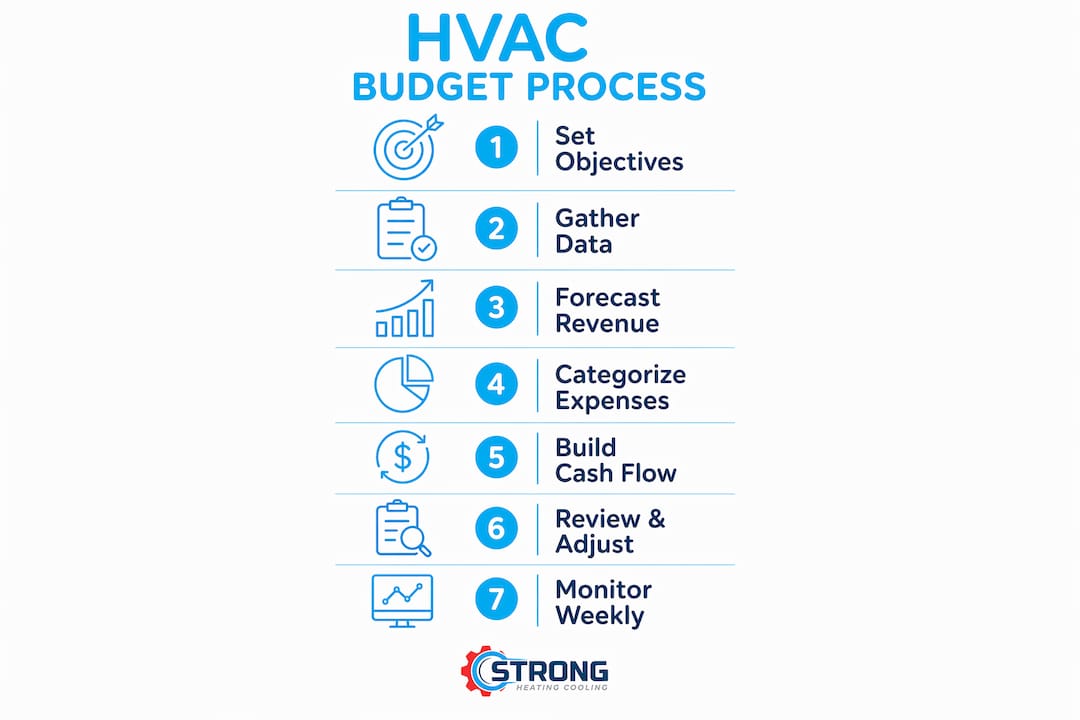
The 7-step HVAC budget forecasting process
Financial forecasting follows a structured sequence that improves accuracy and usefulness when applied consistently. Here is how each step applies specifically to HVAC operations.
-
Define your objectives. Decide what the forecast needs to answer. Are you planning for a fleet expansion? Evaluating whether to add a maintenance division? Preparing for a slow winter? The objective shapes every subsequent decision about data and method.
-
Gather historical financial data. Pull monthly revenue, job counts, gross margin by service type, and expense detail for the past two to three years. Using three or more years of financial performance data to build a seasonal index produces more reliable revenue projections than relying on weather data alone, which is distorted by seasonal anomalies.
-
Set your time horizon. Most HVAC businesses benefit from a rolling 12-month forecast updated quarterly, combined with a 13-week cash view updated weekly. Long-term capital planning may extend three to five years for major equipment replacement cycles.
-
Choose your forecasting methods. Rolling forecasts adapt continuously to actual performance. Scenario analysis lets you model a conservative case (revenue down 10%), a base case, and an optimistic case (revenue up 15%). Both methods are more useful than a single static annual projection.
-
Build pro forma statements. Translate your assumptions into projected income statements, cash flow statements, and a balance sheet. The cash flow projection is the most operationally critical document for a seasonal business.
-
Analyze the results. Look for months where cash goes negative, quarters where gross margin compresses, and years where CapEx requirements cluster. These are the pinch points your plan needs to address before they arrive.
-
Review and update regularly. A forecast that is not updated is just a historical document. Update actuals every week in your 13-week view, every month in your rolling annual forecast, and every quarter with a full review of assumptions. If heating season underperformed by 10%, adjust your summer projection only if you have concrete evidence of improvement, not wishful thinking.
Proven budgeting frameworks that work for HVAC marketing and operations
The 70/20/10 rule gives HVAC companies a practical framework for allocating marketing spend without either overcommitting to unproven channels or stagnating in familiar ones. The 70/20/10 rule guides HVAC marketing budget allocation: 70% to reliable channels like local SEO, 20% to promising new tactics, and 10% to experimental ideas allowing for controlled innovation. Best practices include building the 70% core around measurable channels, using the 20% bucket for emerging tactics such as targeted social ads, and applying the 10% for controlled experiments. Younger HVAC companies with less data might adopt a more aggressive 50/30/20 split to test and find what works effectively; mature companies might shift toward 80/15/5. The allocation should be reviewed quarterly, moving successful experiments up into larger buckets.
Pro Tip: Do not set your marketing budget as a fixed percentage of revenue and call it done. Build it from unit economics instead: your average customer value, your close rate, and the maximum you can pay to acquire a customer and still hit your margin target. The percentage is a sanity check on that number, not the starting point.
Marketing spend should be grounded in customer acquisition economics, not just industry benchmarks. A business closing $8,000 average install jobs can sustain a very different acquisition cost than one running $200 service calls.
What successful HVAC budget forecasting looks like in practice
Consider a residential HVAC company operating in a climate with distinct cooling and heating seasons. The owner pulls three years of monthly revenue data and calculates a seasonal index. July averages 14% of annual revenue. October averages 7%. With a projected annual revenue of $1.8M, that translates to roughly $252,000 in july and $126,000 in october. Fixed monthly expenses run $140,000. The october gap is immediately visible, and the plan can address it before the month arrives.
The owner sets aside 10% of summer profits into a reserve account specifically for shoulder-season coverage. When october arrives, payroll clears without stress, and the team uses the slower period for technical training and sales process work that pays dividends the following summer. That is not luck. It is the direct result of a forecast that made the dip visible months in advance.
A commercial facilities manager running a portfolio of office buildings applies a similar approach to maintenance budgeting. Rather than carrying forward last year’s maintenance spend with a small adjustment, the manager inventories every HVAC asset by age, condition, and operational importance. Each unit gets an estimated annual maintenance cost based on its actual condition. The result is a bottom-up budget that prevents both underfunding critical equipment and wasting money on low-priority assets. Understanding hidden cost drivers in HVAC systems is what makes this kind of asset-level budgeting accurate rather than approximate.
How to plan capital and operational expenditures strategically
CapEx and OpEx serve different financial purposes, and treating them the same way in a budget creates confusion and poor decisions. Capital expenditures are investments that extend equipment life or improve performance: a new rooftop unit, a system upgrade, a vehicle for a new technician. They appear on the balance sheet and depreciate over time. Operating expenditures are the ongoing costs of running the business: routine maintenance, minor repairs, service agreements, and consumables.
The strategic interplay between the two categories matters. Consistent preventive OpEx defers CapEx by extending equipment life. A rooftop unit that receives annual maintenance typically lasts 15–20 years. One that runs to failure often needs replacement at 10–12 years, and the replacement comes with emergency pricing, after-hours labor premiums, and operational disruption. Strategic capital planning forecasts replacements 5–10 years in advance, smoothing the financial impact rather than absorbing it as a surprise.
For HVAC business owners, CapEx planning means tracking the age and condition of every major asset: service vehicles, diagnostic equipment, shop tools, and any owned real estate. When a vehicle fleet averages eight years old, the forecast should include replacement costs in the next two to three years. Financing options can spread large CapEx purchases over time, preserving cash flow while still making necessary investments. The key is planning the financing decision before the equipment fails, not after.
Operational budgets should also account for efficiency upgrades that reduce ongoing costs. Commercial efficiency upgrades often pay back within a few years through lower energy and maintenance costs, making them a legitimate CapEx investment that reduces future OpEx.
Common pitfalls that undermine HVAC budget forecasts
The most damaging mistake is treating the annual budget as the primary financial management tool. Annual budgets work on averages and hide the monthly cash reality of a seasonal business. An HVAC company projecting $3M in annual revenue and $2.4M in annual expenses looks healthy on paper, but if $600,000 of that profit lands in two summer months and fixed expenses run $200,000 per month, the october and march cash positions can go deeply negative.
Other pitfalls that consistently derail HVAC financial planning:
Relying on weather data for revenue forecasts. Weather is not a reliable predictor of HVAC revenue because seasonal anomalies always happen. A cool july or a mild january disrupts weather-based projections significantly. Multi-year financial performance data produces a far more stable seasonal index.
Using “use it or lose it” budgeting for maintenance. When departments spend their full maintenance allocation regardless of actual need, budgets inflate year over year without improving outcomes. Bottom-up estimation based on actual equipment inventory and condition produces more accurate and defensible maintenance budgets.
Ignoring accounts receivable timing. Booking revenue when a job is complete and receiving cash are two different events. Financing fundings from third-party lenders can take 30–60 days to arrive. Commercial contracts often run net 30 or net 60. A forecast that does not account for collection timing will show positive income while cash is actually tight.
Underestimating contingency needs. Facilities running mostly reactive maintenance need contingency reserves of 40% or more of their base maintenance budget to cover emergency premiums. Preventive-focused operations can manage with 15%. Knowing which category your business falls into determines how much cushion your forecast needs to carry.
Skipping the weekly update. A 13-week cash forecast that is not updated weekly loses its value within days. The discipline of rolling it forward every monday, updating actuals, and adjusting projections is what makes it a decision-making tool rather than a planning exercise.
Tools and software that support HVAC budget forecasting
The right tool depends on your business size and how much financial complexity you are managing. A spreadsheet application like Microsoft Excel or Google Sheets works well for building a 13-week cash flow forecast, especially when you are starting out. The structure is simple enough that a well-organized spreadsheet reveals cash pinch points clearly without requiring specialized software.
For accounting and financial reporting, QuickBooks is the most widely used platform among small and mid-sized HVAC companies. It generates the income statements, cash flow statements, and balance sheets that feed your forecast, and it tracks actuals against projections when set up correctly. Pulling monthly revenue by service category from QuickBooks is the first step in building a reliable seasonal index.
Field service management platforms designed for HVAC businesses, such as ServiceTitan or Jobber, add job-level financial tracking that spreadsheets cannot match. They connect job revenue, parts costs, labor hours, and customer history in one system, giving you the data granularity needed for accurate variable cost forecasting. When integrated with your accounting software, they close the loop between operational activity and financial reporting.
For maintenance-specific budgeting, computerized maintenance management systems (CMMS) track planned-to-reactive work order ratios, equipment failure history, and maintenance costs per asset. Facilities using CMMS-managed maintenance report measurably lower downtime and fewer defects, both of which translate directly to lower costs and more predictable budgets.
At the enterprise level, dedicated financial planning and analysis (FP&A) platforms offer rolling forecast automation, scenario modeling, and real-time variance reporting. These tools are most valuable when your HVAC operation has grown to the point where managing multiple service lines, locations, or commercial contracts requires more structure than a spreadsheet can provide.
Whatever tools you use, the discipline of updating them consistently matters more than the sophistication of the software. A simple spreadsheet updated every week outperforms an enterprise platform that nobody maintains.
Strongheatingandcooling brings over 40 years of combined industry experience to every heating installation and service call in Colorado Springs and surrounding communities. Whether you are planning a system replacement or evaluating financing options for a major capital upgrade, the team at Strongheatingandcooling provides honest pricing and straightforward guidance so your budget decisions are grounded in real numbers, not guesswork.

Key Takeaways
Effective HVAC budget forecasting requires a seasonal cash flow view, a structured seven-step process, and consistent weekly updates to stay accurate and useful throughout the year.
| Point | Details |
|---|---|
| Use a seasonal index | Build monthly revenue percentages from three or more years of financial data, not weather predictions. |
| Run a 13-week cash view | A rolling 13-week forecast reveals cash dips weeks before they arrive, enabling proactive decisions on hiring and spending. |
| Apply the 70/20/10 rule | The 70/20/10 rule guides HVAC marketing budget allocation: 70% to reliable channels like local SEO, 20% to promising new tactics, and 10% to experimental ideas allowing for controlled innovation. |
| Preventive maintenance pays | Comprehensive preventive maintenance programs can deliver approximately 545% ROI and cut total maintenance costs by 50%. |
| Plan CapEx years ahead | Forecasting equipment replacements 5–10 years in advance eliminates emergency spending and smooths cash flow. |
FAQ
How does HVAC budget forecasting work?
HVAC budget forecasting projects future revenues and expenses by analyzing historical financial data, building a seasonal index from monthly revenue patterns, and mapping cash inflows and outflows over a defined period. The result guides decisions on hiring, marketing spend, equipment purchases, and cash reserves.
What is the 70/20/10 rule in HVAC budgeting?
The 70/20/10 rule guides HVAC marketing budget allocation: 70% to reliable channels like local SEO, 20% to promising new tactics, and 10% to experimental ideas allowing for controlled innovation. Younger HVAC companies with less data may use a more aggressive 50/30/20 split to find what works effectively.
What are the seven steps of financial forecasting?
The seven steps are: define your objectives, gather historical financial data, set the time horizon, choose forecasting methods, build pro forma statements, analyze the results, and review and update the forecast regularly. Applying all seven steps consistently improves both accuracy and usefulness over time.
How do you manage seasonal cash flow in an HVAC business?
A 13-week rolling cash flow forecast maps weekly cash sources and uses, revealing shoulder-season dips months before they arrive. Reserving a portion of peak-season profits and maintaining a business line of credit provides the buffer needed to cover fixed expenses during slow periods.
What tools do HVAC companies use for budget forecasting?
Most HVAC companies start with QuickBooks for accounting and Microsoft Excel or Google Sheets for cash flow modeling. Field service management platforms add job-level financial tracking, while CMMS tools support maintenance-specific budgeting. The consistency of weekly updates matters more than the sophistication of the software.
Recommended
Need expert HVAC help?
Colorado Springs' veteran-owned heating & cooling team — Mon–Sat, 8 AM–7 PM. Same-day service when available.