
How Central Air Conditioning Works: A Homeowner’s Guide
TL;DR:
- Central air conditioning circulates refrigerant between indoor and outdoor units to effectively remove heat and humidity from homes. Proper system functioning depends on correct sizing, thermostat placement, and duct condition to ensure consistent cooling and energy efficiency. Regular maintenance and expert installation help prevent issues like leaks, short cycling, and poor humidity control, extending system lifespan and home comfort.
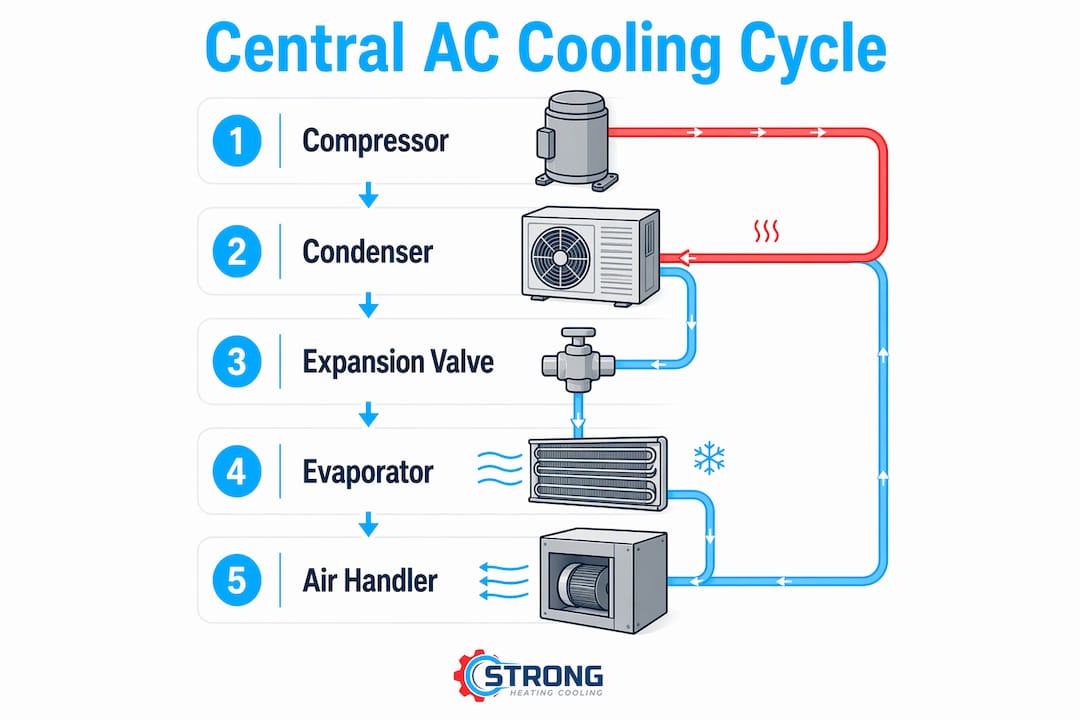
Central air conditioning is defined as a mechanical system that removes heat from your home by circulating refrigerant between indoor and outdoor units, cooling and dehumidifying your living space in the process. Most homeowners run their systems for months without understanding what actually happens inside those units. That gap matters, because knowing how central air conditioning works helps you catch problems early, make better decisions about repairs, and get more consistent comfort from a system you rely on every day. The core process involves five main components: the compressor, condenser coil, evaporator coil, expansion valve, and ductwork, all coordinated by a thermostat.
What are the main components of a central AC system?
Central air conditioning is built around five components that must work together. The system is only as effective as its weakest part, which means a failing expansion valve or a leaky duct can undermine an otherwise well-installed system.
The compressor
The compressor is the engine of the entire operation. It pressurizes refrigerant gas and pushes it through the system, enabling heat transfer from inside your home to the outdoors. Without a functioning compressor, heat cannot move, and the system produces no cooling at all. It sits in the outdoor unit and runs whenever the thermostat calls for cooling.
The condenser coil and outdoor fan
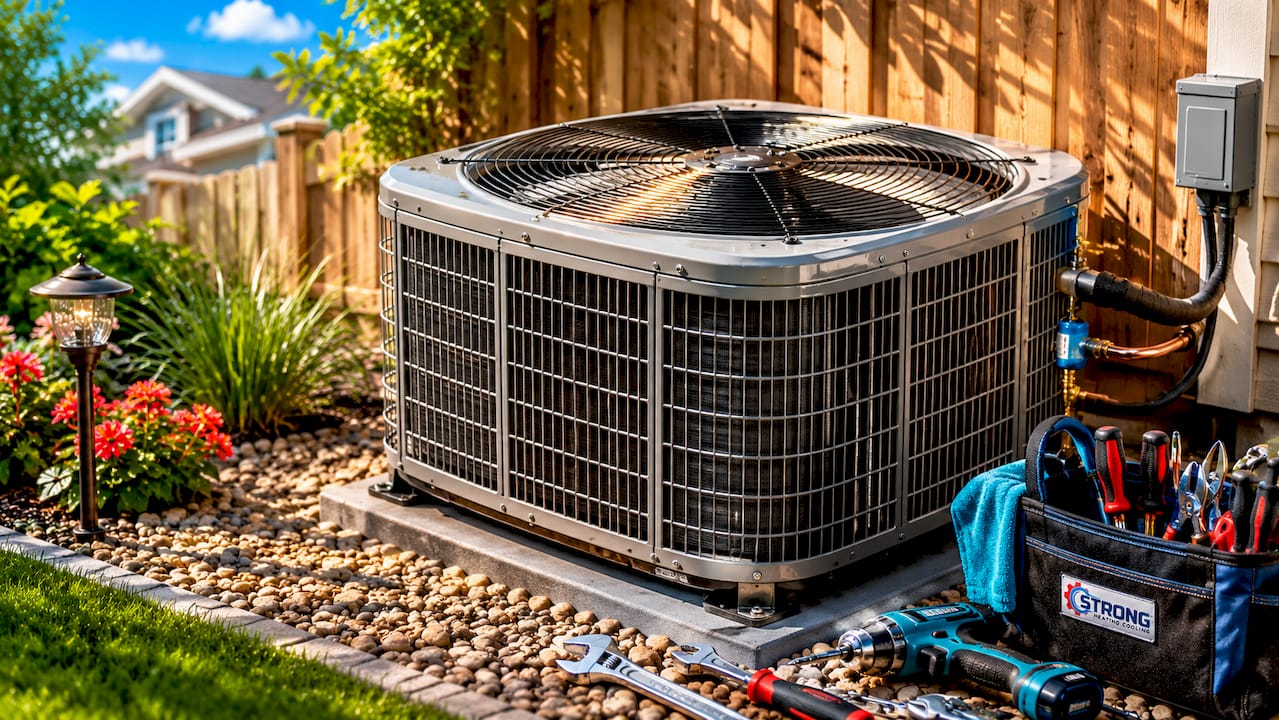
The condenser coil sits alongside the compressor in the outdoor cabinet. Hot refrigerant gas flows into the coil, and the outdoor fan blows air across it. That airflow pulls heat away from the refrigerant, cooling it back to a liquid state. The heat released here is the same heat that was inside your home moments before.
The evaporator coil
The evaporator coil lives inside your home, typically above the furnace or inside the air handler. Warm indoor air passes over the coil, and the refrigerant inside absorbs that heat as it evaporates from liquid to gas. This is the step that actually cools your air. As a bonus, moisture in the air condenses on the coil’s cold surface, which is how central AC dehumidifies your home at the same time.
The expansion valve and air handler
The expansion valve sits between the condenser and the evaporator. It drops the refrigerant’s pressure sharply, which prepares it to absorb heat again when it reaches the evaporator coil. The air handler and blower fan then push the newly cooled air through your ductwork and into each room. Ductwork integrity matters here: even a small leak in a duct run can send conditioned air into your attic or crawl space instead of your living room.
- Compressor: pressurizes refrigerant and drives the cycle
- Condenser coil: releases indoor heat to the outside air
- Evaporator coil: absorbs indoor heat and removes moisture
- Expansion valve: drops refrigerant pressure before the evaporator
- Air handler and blower: circulate cooled air through ductwork
- Thermostat: signals the system to start and stop based on your target temperature
Pro Tip: Check your air filter every 30 days during peak cooling season. A clogged filter restricts airflow over the evaporator coil, which can cause the coil to freeze and shut the system down entirely.
How does the refrigerant cycle cool and dehumidify your home?
The refrigerant cycle is the central AC working principle that makes everything possible. Refrigerant is not consumed like fuel. It circulates in a closed loop, changing between liquid and gas states to carry heat from inside your home to the outdoors. Here is how each step works.
-
Heat absorption indoors. Warm air from your home blows across the evaporator coil. The refrigerant inside the coil is cold and under low pressure, so it absorbs the heat from that air and evaporates into a gas. The air leaving the coil is noticeably cooler and drier.
-
Compression. The refrigerant gas travels to the compressor, which squeezes it under high pressure. That compression raises the refrigerant’s temperature significantly, making it hotter than the outdoor air.
-
Heat rejection outdoors. The hot, high-pressure gas flows into the condenser coil. The outdoor fan blows air across the coil, pulling heat away from the refrigerant. The refrigerant cools and condenses back into a liquid.
-
Pressure drop. The liquid refrigerant passes through the expansion valve. The sudden pressure drop cools the refrigerant further and prepares it to absorb heat again.
-
The cycle repeats. The cold liquid refrigerant returns to the evaporator coil, and the process starts over. This loop runs continuously until your thermostat reads the target temperature and signals the system to stop.
One point that surprises many homeowners: central AC does not create cold air. It moves heat out of your home. The “cold” you feel is simply air that has had its heat removed. This distinction matters for troubleshooting. If your system is not cooling well, the problem is usually that heat is not being removed efficiently, not that the system is failing to generate something.
Refrigerant systems are closed loops. If your system is low on refrigerant, there is a leak somewhere. Adding refrigerant without fixing the leak is ineffective and causes long-term equipment damage. A licensed HVAC technician must locate and repair the leak before recharging the system.
Why do sizing, thermostat placement, and duct condition matter so much?
The central air conditioning process can be technically sound and still deliver poor results if three factors are wrong: unit size, thermostat placement, and duct condition. Each one affects the others, and all three affect your comfort and energy bills.
Unit sizing and humidity control
Oversized units cool too quickly without running long enough to remove moisture from the air. The result is a home that feels cold but clammy, with higher humidity levels that can encourage mold growth over time. An undersized unit runs constantly, never quite reaching the target temperature on the hottest days. Proper sizing requires a Manual J load calculation, which accounts for your home’s square footage, insulation levels, window area, and local climate. This is not a task for guesswork.
| Sizing scenario | Cooling result | Humidity result |
|---|---|---|
| Correctly sized | Reaches target temp with full run cycles | Removes moisture effectively |
| Oversized | Cools quickly, short cycles | Poor moisture removal, clammy air |
| Undersized | Runs constantly, may not reach target | Struggles in high-humidity conditions |
Thermostat placement
The thermostat acts as the brain of the system, and its location determines how accurately it reads your home’s temperature. Placing a thermostat near a heat source or in direct sunlight causes it to read a higher temperature than the rest of the home. The system then runs longer than necessary, overcooling some rooms while others stay warm. Placing it in a drafty hallway causes the opposite problem: the system shuts off too soon. The ideal location is an interior wall in a frequently used room, away from windows, vents, and appliances.
Short cycling caused by poor thermostat placement also accelerates compressor wear. The compressor works hardest at startup, so frequent on-off cycles shorten its lifespan considerably.
Ductwork condition
Leaky or poorly sealed ductwork sends cooled air into unconditioned spaces like attics, crawl spaces, and wall cavities. A high-efficiency unit cannot compensate for ducts that leak conditioned air before it reaches your living areas. Signs of duct problems include rooms that never cool evenly, higher-than-expected energy bills, and excessive dust near registers. A professional duct inspection can identify gaps, disconnected sections, and areas where insulation has deteriorated.
Pro Tip: Ask your HVAC technician to perform a duct blaster test if you suspect leaks. This pressurizes the duct system and measures how much air escapes, giving you a clear picture of where efficiency is being lost.
What are the benefits of central AC compared to other cooling options?
Central air conditioning provides better whole-home comfort, improved humidity control, and better air quality than multiple window units or portable coolers. The advantages go beyond simple temperature control.
- Consistent comfort throughout the home. A properly sized and installed central system eliminates the hot and cold spots that window units create. Every room connected to the duct system receives conditioned air.
- Integrated air filtration. Central systems pull all return air through a filter before it reaches the evaporator coil. This removes dust, pollen, and other particles from the air supply. For Colorado homeowners, where wildfire smoke and dry air are seasonal concerns, integrated filtration makes a real difference.
- Energy efficiency. Newer central AC units are more efficient than units 15–20 years old, with quieter operation and lower operating costs per square foot cooled compared to running multiple window units simultaneously.
- Quieter operation. The compressor and condenser sit outside the home. The only indoor noise is the blower fan, which is far quieter than a window unit running in the same room.
- Home resale value. Central AC systems improve home resale value, especially in warmer climates where buyers treat air conditioning as a baseline expectation rather than an upgrade.
“Replacing old units with modern, high-efficiency models can offset installation cost via energy savings and increased resale value. Homeowners should view central AC as a long-term home investment, not just a seasonal comfort expense.”
Understanding the function of central air conditioning also helps you recognize when your system is underperforming. If your energy bills are climbing while comfort is declining, the system is working harder than it should. That is a signal worth acting on before a minor issue becomes a major repair.
Key Takeaways
A central air conditioning system moves heat out of your home using a closed refrigerant loop, and its performance depends equally on correct sizing, thermostat placement, and duct integrity.
| Point | Details |
|---|---|
| Heat removal, not cold creation | Central AC removes heat from indoor air; it does not generate cold air directly. |
| Refrigerant is a closed loop | Low refrigerant always means a leak; recharging without repair causes equipment damage. |
| Sizing affects humidity control | Oversized units short-cycle and leave indoor air clammy, increasing mold risk. |
| Thermostat placement is critical | Poor placement causes short cycling, uneven cooling, and accelerated compressor wear. |
| Duct leaks undermine efficiency | Even a high-efficiency unit underperforms when ducts lose conditioned air to unconditioned spaces. |
What I’ve learned after years of seeing central AC systems fail for the wrong reasons
After working on central air conditioning systems across Colorado Springs for years, the most common pattern I see is not equipment failure. It is a system that was never set up correctly in the first place. The unit might be a quality brand, installed by a licensed technician, and still deliver mediocre results because the sizing was off, the thermostat ended up next to a west-facing window, or the ductwork in the crawl space was never sealed properly.
The misconception I hear most often is that adding refrigerant will fix a struggling system. Homeowners call us after another company “topped off” the refrigerant, and the system is already struggling again two months later. Refrigerant does not get used up. If it is low, there is a leak, and that leak needs to be found and repaired before anything else happens. Skipping that step wastes money and shortens the life of the compressor.
The other thing I want homeowners to understand is that central AC is a long-term investment in your home’s value and livability. Replacing a 20-year-old system with a modern, properly sized unit is not just about staying cool this summer. It affects your energy costs year over year, your indoor air quality, and what a buyer sees when they walk through your home. The upfront cost is real, but so is the return. Treat the system as infrastructure, not an appliance, and maintain it accordingly.
— Owner
Strongheatingandcooling: central AC services for Colorado Springs homeowners
Strongheatingandcooling has served Colorado Springs and the surrounding communities for over 40 years of combined industry experience, helping homeowners get reliable, efficient cooling from systems that are sized and installed correctly from day one.

Whether you need a new central AC installation, a ductwork assessment, or a seasonal tune-up before summer heat arrives, Strongheatingandcooling provides honest pricing and quality workmanship on every job. The team performs Manual J load calculations to confirm proper sizing, inspects duct systems for leaks, and verifies thermostat placement before any system is commissioned. Visit the cooling services page to learn more or schedule a consultation with a technician who will give you a straight answer about what your home actually needs.
FAQ
How does central air conditioning work in simple terms?
Central AC removes heat from your indoor air using a refrigerant that cycles between the indoor evaporator coil and the outdoor condenser coil. The result is cooler, drier air circulated through your home’s ductwork.
Why is my central AC running but not cooling the house?
The most common causes are a dirty air filter restricting airflow, a refrigerant leak reducing heat transfer capacity, or a thermostat placed near a heat source that causes the system to shut off too early. A licensed technician can diagnose which factor applies.
How often should a central AC system be serviced?
Annual professional maintenance before the cooling season is the standard recommendation. Regular service catches refrigerant issues, cleans coils, and verifies that the system is operating at rated efficiency before peak demand arrives.
Does central AC also improve indoor air quality?
Yes. Central systems pull return air through a filter before recirculating it, removing dust, pollen, and airborne particles. For homes in areas with seasonal smoke or high pollen counts, this filtration benefit is significant compared to window units, which have minimal filtration.
What size central AC unit does my home need?
Unit size is determined by a Manual J load calculation, which accounts for square footage, insulation, window area, ceiling height, and local climate. Skipping this step and sizing by square footage alone frequently results in an oversized unit that short-cycles and fails to control humidity.
Recommended
Need expert HVAC help?
Colorado Springs' trusted, veteran-owned heating & cooling team — same-day service.