

HVAC Automation Benefits: Real Examples for Homes & Businesses
HVAC automation delivers measurable energy savings, steadier comfort, and lower maintenance risk across both residential and commercial settings. The core benefits fall into five groups: energy efficiency, consistent comfort, predictive maintenance, remote control, and reduced environmental impact. Here is what that looks like in practice:
- Smart HVAC systems can reduce heating and cooling energy use significantly compared to traditional systems through occupancy-based adjustments and learning schedules.
- Zoning with motorized dampers eliminates hot and cold spots without running the whole system harder.
- Automated alerts catch filter clogs and early equipment faults before they become emergency repairs.
- Remote access lets you adjust settings from anywhere, including cutting runtime when the building is empty.
- Lower energy consumption translates directly to a smaller carbon footprint.
Strongheatingandcooling installs and commissions these systems across Colorado Springs and surrounding communities, with over 40 years of combined field experience backing every project.
Table of Contents
- 1. How automation cuts energy costs for homeowners
- 2. Zoning keeps every room comfortable, not just the thermostat’s room
- 3. Automated maintenance alerts reduce emergency repair costs
- 4. How small businesses benefit from automated setbacks and zone control
- 5. The components that actually create these benefits
- 6. Realistic savings ranges and what drives payback
- 7. What to ask your contractor before installation
- 8. Common mistakes that reduce automation benefits
- 9. What Strongheatingandcooling has seen in the field
- Key Takeaways
- Why professional installation matters more than the hardware
- Strongheatingandcooling can handle the whole project
- FAQ
- Useful sources
1. How automation cuts energy costs for homeowners
Geofencing is one of the clearest examples of HVAC automation benefits in a residential setting. When your phone leaves a defined radius around the house, the system automatically shifts to an energy-saving setback. When you are 10–15 minutes away, it starts recovering to your preferred temperature. You arrive to a comfortable home without running the system all day.
Learning schedules take this further. Rather than requiring you to program every time slot manually, a learning thermostat observes your patterns over one to two weeks and builds a schedule around them. It notices you sleep in on weekends and come home late on Wednesdays. Smart thermostats automate these setbacks and provide energy reports that show exactly where runtime is being wasted.
The Department of Energy notes that programmable thermostats alone can save energy annually on heating and cooling costs. Learning systems with geofencing tend to deliver more, especially in homes where occupancy is irregular.
2. Zoning keeps every room comfortable, not just the thermostat’s room
A single thermostat placed in a hallway cannot accurately represent the temperature in a south-facing bedroom at 3 PM or a finished basement in January. Wireless room sensors paired with motorized dampers solve this by giving each zone its own feedback loop. The controller reads actual conditions in each space and adjusts airflow accordingly.
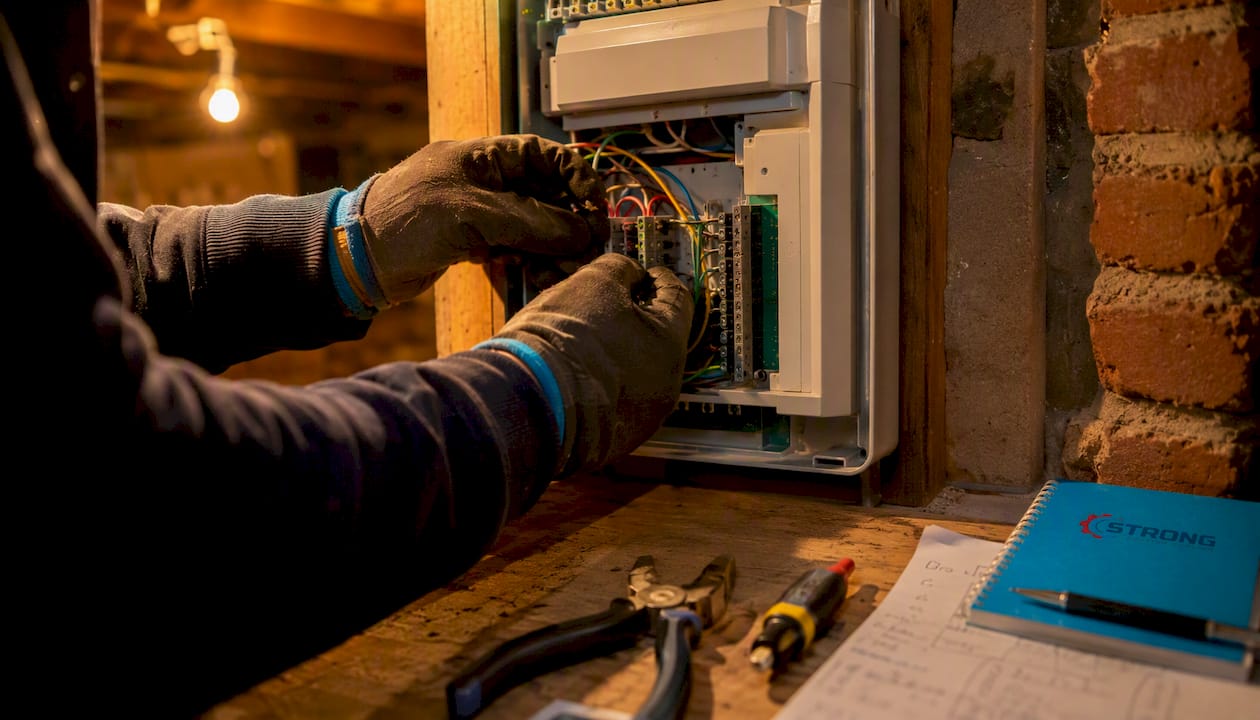
For a two-story home, this means the upstairs bedrooms stay cool at night without overcooling the ground floor. For a home with a home office, it means that room can hold a steady temperature during work hours while the rest of the house runs a lighter schedule. Targeted zoning can reduce energy use notably in larger homes where different areas have very different occupancy patterns.
3. Automated maintenance alerts reduce emergency repair costs
One of the most practical examples of HVAC automation advantages is the shift from reactive to proactive maintenance. Modern systems monitor filter pressure drop, motor current draw, and refrigerant performance in real time. When a filter starts restricting airflow, the system sends an alert to your phone rather than waiting for the equipment to strain against the restriction.
Predictive maintenance features analyze trends like rising motor temperatures or gradual airflow drops and warn of failures before they happen. Clean filters and well-maintained equipment use less energy than neglected systems, and catching a failing component early typically costs far less than an emergency service call. Pairing automation with a residential maintenance plan keeps that monitoring loop closed with professional oversight.
4. How small businesses benefit from automated setbacks and zone control
For a restaurant, retail shop, or small office, after-hours runtime is one of the most straightforward sources of wasted utility spend. Commercial HVAC automation gives owners remote access, occupancy-based setbacks, and zone control that cut this waste without requiring staff to remember to adjust the thermostat at closing.
Practical small-business scenarios include:
- A restaurant that automatically shifts dining room zones to setback at closing while maintaining a slightly warmer setpoint in the kitchen overnight to protect equipment.
- A retail store that uses occupancy sensing to reduce conditioning in stockroom areas during low-traffic hours.
- A small office with a server room that holds a tighter temperature band independently of the open workspace.
Pro Tip: For multi-zone commercial spaces, prioritize occupancy sensing and coordinated unit logic over a single smart thermostat. A thermostat in the lobby tells you nothing about the server room or the back office, and running all zones on one signal wastes both energy and equipment life.
Remote monitoring dashboards let owners manage comfort and runtime across multiple locations without traveling to each site. Facility managers consistently report that stable, automated environments reduce comfort complaints that affect customer reviews and repeat business.
5. The components that actually create these benefits
A smart thermostat is usually the entry point, but the full system includes several layers. HVAC controls use sensors, controllers, and software to optimize operation using algorithms that respond to occupancy, temperature, and energy demand. The basic flow runs: sensor reads conditions, controller processes the data, actuator (damper, valve, or fan) responds, and the result feeds back to a cloud dashboard.
Key components and their roles:
- Smart thermostat: the user interface and primary schedule manager.
- Remote sensors: provide temperature and occupancy data from individual rooms or zones.
- Motorized dampers: physically control airflow to each zone based on controller signals.
- Zone controllers: coordinate multiple dampers and thermostats across a building.
- Building automation system (BAS): integrates HVAC with lighting, access control, and other building systems for coordinated energy management.
Cross-system integration with lighting and access control can cut energy use further by deactivating ventilation in truly unoccupied zones. Smart blinds that close during peak afternoon heat reduce cooling load. Lighting systems that generate heat can signal the HVAC to adjust cooling output accordingly. Open protocols like BACnet allow these systems to communicate across different manufacturers’ equipment, which matters for long-term scalability and service.
6. Realistic savings ranges and what drives payback
Well-implemented HVAC automation typically reduces energy use by 10–25% in residential settings (thermostat-focused upgrades) and by 20–40% in well-implemented commercial systems, depending on the scope and quality of commissioning. The biggest variables are how much waste exists in the current system, how irregular occupancy patterns are, ductwork condition, and whether zoning is part of the scope.
| Upgrade | Estimated savings | Rough payback range |
|---|---|---|
| Smart thermostat only | Moderate savings on heating/cooling | Short payback range |
| Smart thermostat + remote sensors | Increased savings | Moderate payback range |
| 2-zone duct system | Higher savings | Longer payback range |
| Whole-home automation with BAS | Significant savings | Longest payback range |
One factor that surprises many owners: recovery algorithms that pre-start the system before occupancy can create short-term peak energy draws that raise costs under demand-charge utility tariffs. If your utility bills include a demand charge, discuss recovery scheduling with your contractor before commissioning. For broader efficiency context, Strongheatingandcooling’s guide on HVAC energy efficiency covers the practical steps that move the needle most.
7. What to ask your contractor before installation
A good automation installation starts with a site assessment, not a product recommendation. Before any equipment is specified, your contractor should evaluate duct condition, static pressure, airflow balance, and sensor placement options. Wiring and electrical capacity also need to be confirmed, since some zone controllers and BAS integrations require dedicated circuits.
Questions worth asking:
- Are you licensed and insured in Colorado, and do you carry manufacturer certifications for the equipment you are installing?
- Will you seal and balance the ductwork before adding dampers or sensors?
- What open protocols does the system support, and can it scale if I add zones later?
- What cybersecurity measures are in place for the connected components?
- What does commissioning include, and will you walk me through the system operation before you leave?
Pro Tip: Insist on a commissioning walkthrough, not just a hand-off. A system that is installed but not properly configured to your occupancy patterns and duct layout will underperform from day one. Commissioning is where the savings are actually set up.
Licensing matters. In Colorado, HVAC contractors must hold a state mechanical license. Ask to see it, and verify that the installer carries liability insurance and offers a warranty on both labor and equipment.
8. Common mistakes that reduce automation benefits
Adding smart vents or motorized dampers to a duct system with significant leakage is one of the most common field mistakes. Duct leaks and poor airflow balance are frequent causes of underwhelming automation returns. Dampers that close off zones increase static pressure in the remaining ducts, and if those ducts leak, the efficiency gains disappear into unconditioned spaces.
Other pitfalls to avoid:
- Expecting automation to compensate for undersized equipment. A system that cannot meet load on a hot day will not meet it with a smarter thermostat.
- Placing the primary sensor in a location that does not represent actual occupancy, such as a hallway near a heat-generating appliance.
- Skipping firmware updates on connected devices, which leaves security vulnerabilities open on your home or business network.
Pro Tip: Treat duct sealing as a prerequisite, not an optional add-on. Strongheatingandcooling’s technicians test static pressure and airflow balance before finalizing any zoning or sensor layout, because the automation is only as good as the duct system it controls.
9. What Strongheatingandcooling has seen in the field
Strongheatingandcooling’s team has installed and commissioned automation upgrades across Colorado Springs and surrounding communities, drawing on over 40 years of combined industry experience. Outcomes from these projects reflect what the research supports: homes with properly zoned and commissioned systems report fewer comfort complaints, more predictable utility bills, and a noticeable reduction in after-hours emergency calls.
Field observations from Strongheatingandcooling installations:
- Homes that added zoning with remote sensors saw hot and cold spots resolve within the first billing cycle after commissioning.
- Small businesses that implemented automated setbacks reported meaningful reductions in after-hours runtime without any impact on opening-time comfort.
- Properties where duct sealing preceded automation upgrades consistently outperformed those where dampers were added to leaky systems.
Strongheatingandcooling holds the required Colorado state mechanical licensing and carries full liability insurance. The company’s commitment to the community extends beyond service calls, including support for the Humane Society and Wounded Warrior Project and providing free heating and cooling systems to families in need.
Key Takeaways
HVAC automation delivers the strongest results when sensors, zoning, and properly sealed ductwork work together rather than relying on a single smart thermostat alone.
| Point | Details |
|---|---|
| Energy savings are real but variable | Residential upgrades typically save 10–25%; well-implemented commercial systems can reach 20–40%. |
| Duct condition determines outcomes | Seal and balance ductwork before adding dampers or sensors to avoid pressure issues and wasted savings. |
| Commissioning is not optional | A properly configured system matched to your occupancy patterns delivers far better results than a default setup. |
| Demand charges need attention | Recovery algorithms can create peak draws that raise costs under demand-charge tariffs; discuss this with your contractor. |
| Strongheatingandcooling | Installs, zones, and commissions automation systems across Colorado Springs with 40+ years of combined experience. |
Why professional installation matters more than the hardware
Most of the automation failures I see in the field come down to one thing: the system was installed but never properly commissioned. A learning thermostat set to factory defaults in a house with unbalanced ducts and no remote sensors is not delivering automation benefits. It is delivering a more expensive version of what the homeowner already had.
The hardware is largely commoditized at this point. What separates a system that pays for itself in two years from one that disappoints is the site assessment, the duct work done before the sensors go in, and the commissioning session where the system is tuned to actual occupancy patterns. That is where the 10–25% residential and 20–40% commercial energy savings figures come from. They are not from the thermostat alone.
Homeowners and business owners who invest in professional installation and commissioning, and who pair that with a regular maintenance plan, consistently see better returns than those who treat automation as a DIY project. The technology is accessible, but the results are professional.
Strongheatingandcooling can handle the whole project
Families and business owners in Colorado Springs who want reliable comfort without the guesswork of self-installation get a clear advantage with Strongheatingandcooling: a licensed, experienced team that handles site assessment, duct sealing, zoning, and commissioning as a complete package rather than selling hardware and leaving setup to you.

Strongheatingandcooling offers heating installation and replacement, cooling services, zoning upgrades, and maintenance plans designed to keep automated systems performing as intended year after year. Whether you are starting with a single smart thermostat or planning a full multi-zone system for a commercial property, the team brings the same honest pricing and quality workmanship to every job. Contact Strongheatingandcooling to schedule a site assessment and find out which upgrades make the most sense for your home or business.
FAQ
What are the main examples of HVAC automation benefits?
The most concrete examples include geofencing-based setbacks that cut runtime when a home is empty, zone control that eliminates hot and cold spots, automated filter and fault alerts that reduce emergency repairs, and remote monitoring that lets owners manage comfort from anywhere.
How much can HVAC automation realistically save on energy bills?
Residential thermostat-focused upgrades typically deliver 10–25% savings on heating and cooling costs, while well-implemented commercial systems with full zoning and a building automation system can reach 20–40%.
Do I need to seal my ducts before adding smart vents or dampers?
Yes. Adding motorized dampers to a duct system with significant leakage increases static pressure and can reduce efficiency rather than improve it. Duct sealing and airflow balancing should come before any zoning hardware is installed.
What credentials should I look for in an HVAC automation contractor?
Look for a Colorado state mechanical license, liability insurance, manufacturer certifications for the equipment being installed, and a clear commissioning process that includes a walkthrough before the job is closed out.
Can HVAC automation integrate with other building systems?
Yes. Systems using open protocols like BACnet can connect HVAC controls with lighting, access control, and security systems, allowing coordinated energy management that deactivates conditioning in truly unoccupied zones.
Useful sources
- Smart HVAC Energy Savings Guide, Automivo — supports occupancy-based savings ranges and geofencing examples.
- Smart Thermostat Benefits for Homeowners, Paragon Service Pros — residential comfort and remote control examples.
- What Are HVAC Controls, Trane Commercial — controls definition, open protocols, and BACnet guidance.
- Key Features of a Modern Building HVAC Automation System, ISS Mechanical — predictive maintenance, cross-system integration, and real-time monitoring.
- Smart HVAC System Automation Guide, SmartHomeHQ — savings ranges and ROI context for residential and commercial settings.
- Smart Building HVAC Technology Trends, HVAC Database — duct sealing prerequisites and airflow balancing requirements.
- Smart Thermostats and HVAC Automation for Small Businesses, The Small Business Blog — commercial setbacks, remote monitoring, and customer experience outcomes.
- HVAC Recovery and Grid Impacts, ScienceDirect — demand charge cautions related to recovery algorithms.
Recommended
Need expert HVAC help?
Colorado Springs' trusted, veteran-owned heating & cooling team — emergency service.