
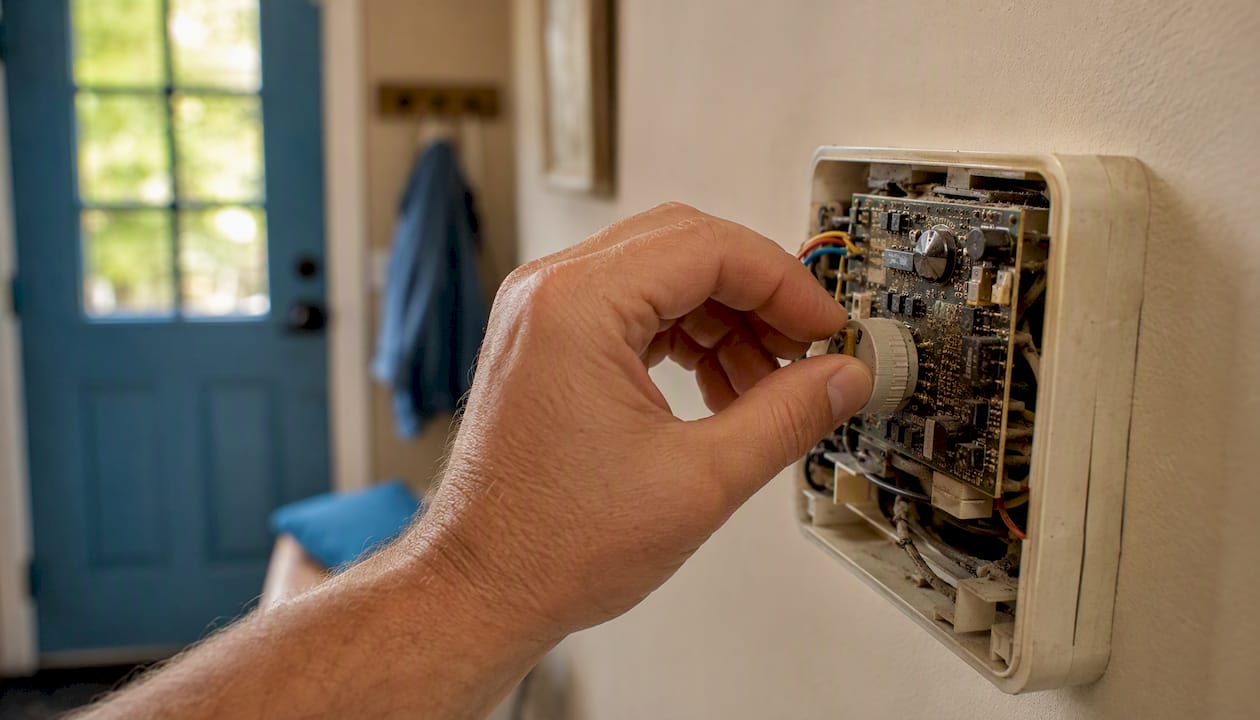
Why a Failing Thermostat Can Look Like an HVAC Breakdown
Yes, a failed thermostat can convincingly mimic a broken HVAC system. The thermostat sends low-voltage 24VAC control signals to your equipment, so when those signals go missing or go wrong, the furnace or air conditioner simply stops responding, exactly as it would if the mechanical components had failed. Before you assume the worst, try these four checks first:
- Confirm the thermostat is set to the correct mode (heat or cool) and that the setpoint is adjusted appropriately relative to the current room temperature.
- Replace the batteries, even if the display looks fine. Weak batteries can cause erratic behavior without always triggering a low-battery warning.
- Check the breaker for your furnace or air handler and confirm the power switch on the unit itself is in the “on” position.
- Wait up to 10 minutes after any change. Most modern HVAC systems have a built-in time delay to protect the compressor.
Pro Tip: If you smell burning, detect a gas odor, or see visible damage to wiring or equipment, stop all checks immediately and call a professional. These are not thermostat problems.
Key Takeaways
A failing thermostat can produce every symptom of a broken HVAC system because it controls the 24VAC signal that tells the equipment to run.
| Point | Details |
|---|---|
| Thermostat as control signal | The thermostat sends 24VAC commands; a failed signal stops the equipment just as a mechanical fault would. |
| First checks to try | Replace batteries, confirm mode and setpoint, check the breaker and furnace power switch, and wait up to 10 minutes for the time delay. |
| When the display goes blank | A blank screen usually means lost power, not a dead thermostat; check the breaker and the low-voltage fuse at the air handler first. |
| Red flags requiring a pro | Ice on coils, burning odors, repeated breaker trips, loud mechanical noises, and standing water all indicate equipment-level faults. |
| Strongheatingandcooling | Serving Colorado Springs and surrounding areas with diagnostic visits, thermostat replacement, wiring repair, and emergency HVAC service. |
Table of Contents
- Why thermostat failure mimics HVAC breakdown: what homeowners see first
- How a thermostat fault produces HVAC-like symptoms
- Step-by-step homeowner checks before calling a technician
- What a professional technician checks to find the real fault
- What causes thermostats to fail and how to prevent it
- Red flags that point to a true HVAC equipment failure
- The misdiagnosis problem is more common than homeowners realize
- Strongheatingandcooling serves Colorado Springs homeowners with honest diagnostics
- Sources
- FAQ
Why thermostat failure mimics HVAC breakdown: what homeowners see first
The symptoms of a failing thermostat and a failing HVAC system overlap more than most homeowners expect. According to Trane’s manufacturer guidance, a failing thermostat can cause the system to run nonstop, short cycle, display incorrect temperatures, or become completely unresponsive, all of which increase energy use and can shorten equipment life if left unresolved. Here is what each symptom looks like from where you are standing:
- Blank or unresponsive display. The screen shows nothing and pressing buttons does nothing. Carrier’s troubleshooting guidance confirms this usually points to lost power, whether from dead batteries, a tripped breaker, or a switch turned off at the furnace or air handler.
- No response to setpoint changes. You raise the temperature by 5 degrees and nothing happens. No click, no fan, no airflow.
- System runs nonstop. The furnace or AC never shuts off, even when the room reaches the target temperature. This can look like a failed limit switch or a refrigerant issue.
- Short cycling. The system starts, runs for a minute or two, then shuts off before the space is conditioned. Short cycling is a symptom shared by thermostat faults and mechanical problems like restricted airflow or refrigerant loss.
- Incorrect temperature reading. The thermostat reads 74°F but the room feels noticeably warmer or cooler. Thermostats that appear to work but deliver wrong temperatures often have failed or uncalibrated internal sensors, a condition that can be misread as ductwork or airflow problems.
- Forgotten settings or schedule reversions. A smart thermostat that keeps losing its programmed schedule may have a firmware bug, a power interruption, or a failing internal memory.
Many of these symptoms overlap with true mechanical failures. The next section explains why, and the troubleshooting checklist that follows helps you tell them apart.
How a thermostat fault produces HVAC-like symptoms
Think of the thermostat as the brain and the HVAC equipment as the muscle. The brain does not move anything on its own. It sends a low-voltage command, typically 24 volts AC, through a control circuit to the furnace or air conditioner’s control board, which then activates the blower, compressor, or burner. When the brain sends the wrong signal, or no signal at all, the muscle sits idle. From the outside, that looks identical to a broken compressor or a failed inducer motor.
Several internal thermostat failure modes produce this effect. Dead or weak batteries can cut power to the control circuit entirely. A failed temperature sensor sends the wrong reading, so the system never receives a call for heat or cool. A stuck relay inside the thermostat can hold the system in a continuous call, forcing the equipment to run without stopping. Corrupted firmware in a smart thermostat can cause it to send conflicting commands. And a lost C-wire connection, the wire that supplies continuous 24VAC to modern thermostats, will make the display go blank even when the thermostat itself is perfectly fine, because the actual fault is a blown low-voltage fuse or a tripped breaker at the air handler.
Pro Tip: Modern smart thermostats introduce software failure modes that older models never had. If your smart thermostat is behaving oddly, a firmware update or a factory reset sometimes resolves the issue. Document your current schedule and settings before resetting so you do not lose your programming.
The table below maps the most common symptoms to their likely origin so you can narrow the field before calling a technician.
| Symptom | Likely thermostat origin | Likely equipment origin |
|---|---|---|
| Blank display, no response | Dead batteries, blown low-voltage fuse, lost C-wire power | Tripped main breaker, failed transformer |
| System will not start | No 24VAC signal from thermostat, failed relay | Failed contactor, bad capacitor, locked-out control board |
| Runs nonstop | Stuck relay sending continuous call | Failed limit switch, refrigerant overcharge |
| Short cycling | Faulty sensor, incorrect anticipator setting | Clogged filter, low refrigerant, oversized equipment |
| Wrong temperature reading | Failed or uncalibrated internal sensor | Duct leaks, blocked registers, refrigerant loss |
Step-by-step homeowner checks before calling a technician
These steps are ordered from simplest to most involved. Work through them in sequence and stop the moment you reach a safety warning.
- Replace the batteries and inspect the terminals. Even if the display is on, weak batteries cause erratic behavior. While the batteries are out, look at the terminals. Corrosion on battery contacts can block power flow even after fresh batteries are installed. A pencil eraser or a dry cloth clears light corrosion.
- Confirm mode and setpoint. Set the mode to “heat” in winter or “cool” in summer. Set the target temperature at an appropriate difference from the current room reading. A thermostat set to “fan only” or “auto” with an incorrect setpoint will appear dead.
- Listen for the thermostat click. When you change the setpoint past the current room temperature, most thermostats produce an audible click as the relay closes. No click often means the thermostat is not sending a call to the equipment.
- Check the breaker and the furnace or air handler power switch. A tripped breaker or a power switch accidentally turned off at the unit will make the thermostat go blank. Carrier’s common-issues resource lists this as one of the first practical checks homeowners should make.
- Inspect and replace the air filter. A severely clogged filter triggers safety shutoffs that can look like thermostat or equipment failure. Hold the filter up to a light source. If you cannot see light through it, replace it before continuing.
- Wait for the time delay. After any power cycle or setpoint change, allow up to 10 minutes before concluding the system is not responding. Most modern systems include a compressor protection delay that prevents rapid restarts.
- Observe the outdoor unit and check airflow at vents. If the thermostat display is active and shows “cool on” or “heat on” but no air comes from the vents and the outdoor unit is silent, the problem is likely equipment-level rather than a control issue.
Stop and call a professional if any of the following occur:
- You smell burning or melting plastic near the thermostat or air handler.
- You detect a gas odor anywhere in the home.
- The breaker trips again immediately after you reset it.
- You see ice forming on the indoor or outdoor coils.
- There is standing water around the indoor unit.
These are not situations where continued DIY troubleshooting is safe or productive. For guidance on when a situation crosses into emergency territory, the warning signs your HVAC needs emergency repair resource covers the specific thresholds clearly.
What a professional technician checks to find the real fault
When a technician arrives, the diagnostic process follows a logical sequence that moves from the control side to the equipment side. Understanding that sequence helps you know what to expect and why the visit takes the time it does.
Confirming the thermostat call
The first step is verifying that the thermostat is actually sending a call for heat or cool. The technician sets the thermostat to call for conditioning and then moves to the air handler or furnace to observe the control board. If the board’s indicator lights show no incoming signal, the fault is on the control side.
Measuring 24VAC at the thermostat terminals
Using a multimeter, the technician measures voltage at the thermostat’s R and C terminals. Contractor-level guidance from Al Marino Inc. notes that technicians prefer to show homeowners this check because it visually proves whether the issue is control-side or equipment-side, which avoids unnecessary parts replacement. If 24VAC is present at the thermostat but the system does not respond, the thermostat is the likely culprit. If 24VAC is absent, the technician traces the fault back toward the transformer, the low-voltage fuse on the control board, or the breaker. A blown 3A or 5A low-voltage fuse on the furnace control board is a common finding that makes the thermostat look completely dead.
Tracing wiring and testing the control board
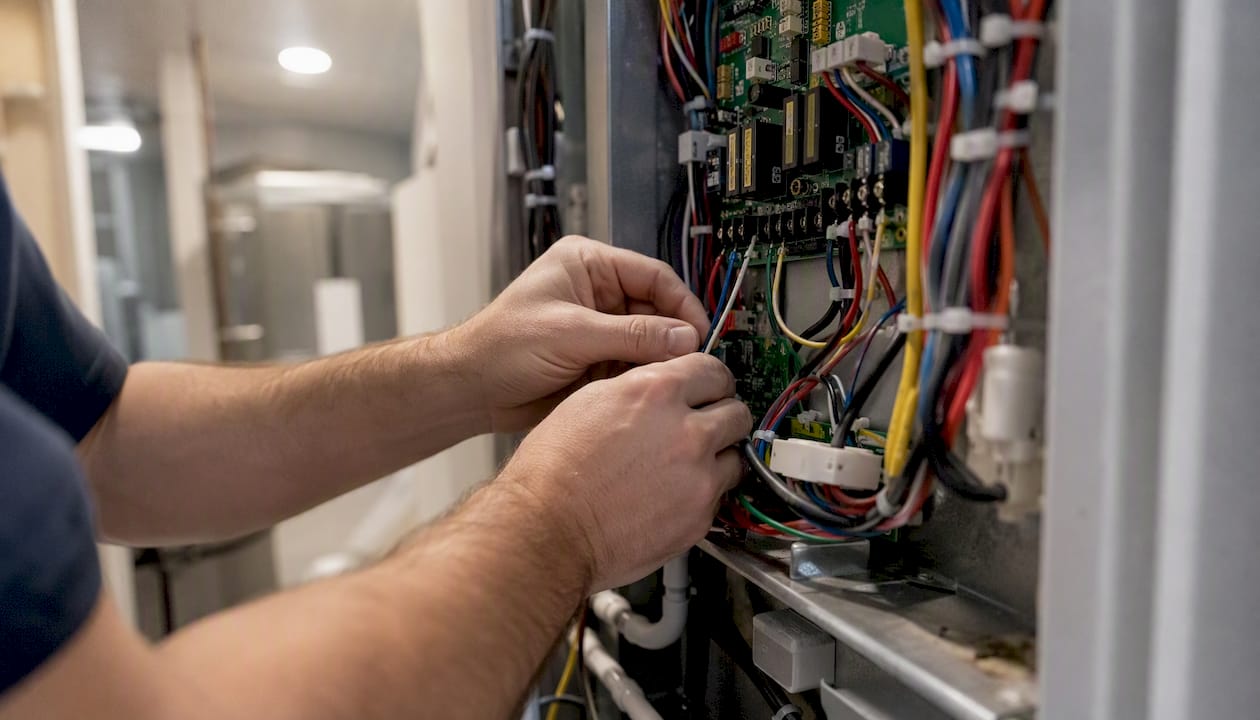
The technician inspects the low-voltage wiring from the thermostat to the control board for loose connections, corrosion, or damage. At the control board, they test output voltages to confirm the board is responding to the incoming call. If the board receives the signal but does not activate the equipment, the fault has moved to the high-voltage side.
Testing high-voltage components
At this stage, the technician uses a clamp meter to check current draw at the compressor contactor and capacitors. Many HVAC manufacturers also provide diagnostic software or error-code readouts through the control board that identify specific component failures. A proper technician uses voltage checks, continuity tests on wiring, and controlled equipment activation at the control board to safely confirm whether the HVAC responds to a direct call, which isolates a faulty thermostat from failed equipment.
What causes thermostats to fail and how to prevent it
Thermostats typically last multiple years, but several conditions shorten that lifespan or cause premature failure.
- Age. A thermostat approaching or past 15 years is statistically more likely to develop sensor drift, relay wear, or display failure.
- Dead or weak batteries. The most common and most overlooked cause. Replace batteries annually, regardless of whether a low-battery warning appears.
- Corroded battery terminals. Corrosion blocks power flow even after fresh batteries are installed. Inspect the contacts each time you change batteries.
- Dust and debris accumulation. Dust on internal components affects sensor accuracy. A gentle cleaning with compressed air every year or two helps.
- Poor placement. A thermostat mounted near an oven, a supply vent, a drafty window, or in direct sunlight reads ambient temperature incorrectly and sends the wrong commands to the equipment.
- Wiring wear. Low-voltage wiring degrades over time, especially in older homes. Loose or corroded connections at the thermostat backplate are a frequent cause of intermittent faults.
- Lost C-wire power. Modern smart thermostats require a continuous power supply through the C-wire. Homes without a C-wire, or with a C-wire that has lost continuity, will experience frequent display blanks and erratic behavior.
- Software or firmware bugs. Smart thermostats can develop glitches after updates. Keeping firmware current and performing a factory reset when behavior becomes erratic resolves many of these issues.
When replacing a thermostat, confirm compatibility with your system type. Heat pump systems require a thermostat with an “O/B” reversing valve wire, which conventional gas furnace thermostats do not support. If your home lacks a C-wire, a C-wire adapter kit or a new wire run may be necessary before a smart thermostat will function reliably. For a deeper look at how modern thermostats interact with your system, the smart thermostat HVAC trends resource covers compatibility and sensor calibration in practical detail.
Red flags that point to a true HVAC equipment failure
Once you have confirmed the thermostat is calling correctly and the system still does not perform, the problem has moved to the mechanical side. These symptoms reflect equipment-level faults rather than control faults, and several of them require you to act quickly.
| Symptom | Immediate homeowner action |
|---|---|
| Loud grinding, banging, or screeching from the unit | Turn the system off at the thermostat and call for service |
| Warm air during a confirmed cooling call | Turn the system off; check for AC failure signs and call a technician |
| No airflow from vents despite an active thermostat call | Check filter; if clean, turn off the system and call for service |
| Visible ice on indoor or outdoor coils | Turn the system off immediately; do not run it until a technician inspects it |
| Frequent main breaker trips | Do not reset repeatedly; call for emergency service |
| Standing water around the indoor unit | Turn the system off; check the condensate drain; call if water persists |
| Burning odor from vents or the unit | Turn off power at the breaker and call for emergency HVAC repair |
Ice on the coils deserves a specific note. A thermostat stuck in a continuous call position can force the air conditioner to run without stopping, which eventually causes coil icing. That scenario looks like compressor failure but is actually a control issue. If the thermostat is confirmed to be cycling normally and ice still forms, the cause shifts to low refrigerant or restricted airflow, both of which require a technician.
The misdiagnosis problem is more common than homeowners realize
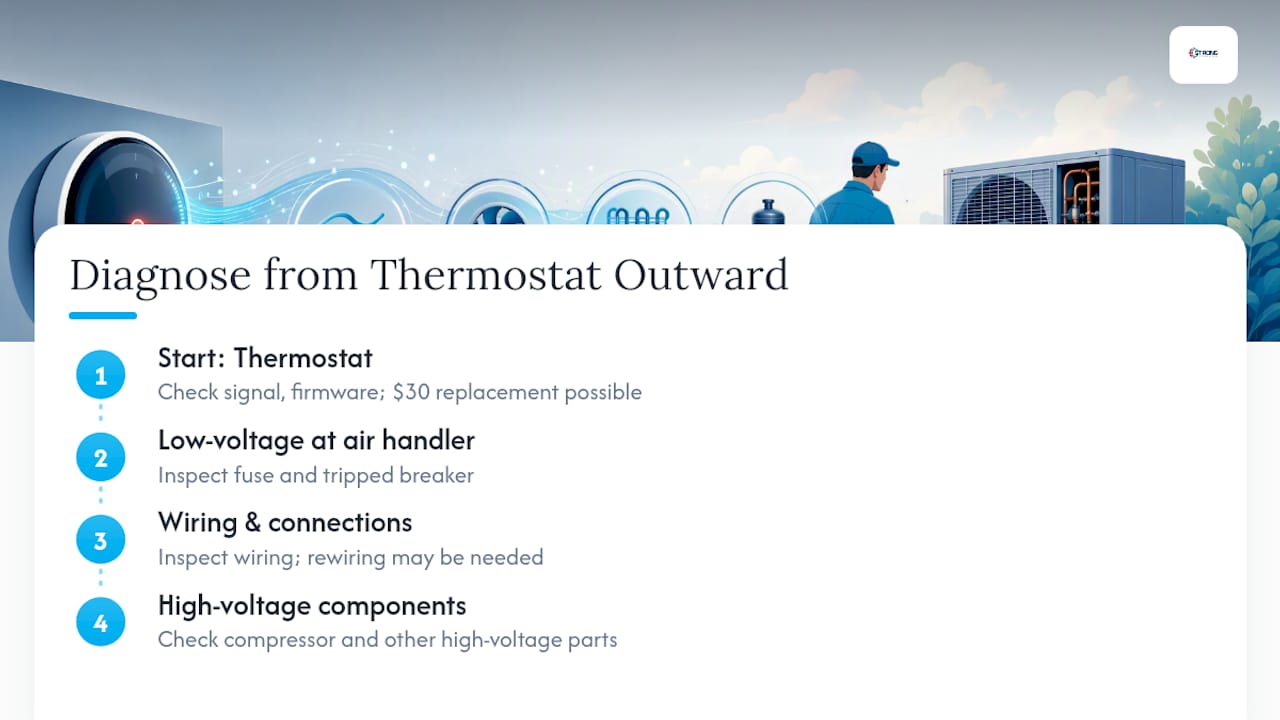
From a contractor’s perspective, thermostat misdiagnosis runs in both directions. Homeowners sometimes replace a perfectly functional thermostat because the system is not responding, when the real fault is a blown low-voltage fuse or a tripped breaker at the air handler. The opposite happens just as often: a technician is called for what sounds like a compressor failure, and the fix turns out to be a $30 thermostat replacement or a firmware reset.
The diagnostic sequence matters more than the assumption. A systematic check from the control side outward, starting with the thermostat signal and working toward the high-voltage components, is the only reliable way to avoid unnecessary parts replacement. Broad cost ranges for a diagnostic visit and thermostat replacement vary depending on the system type, the thermostat model, and whether wiring work is needed. Precise pricing follows an on-site assessment, but starting with the thermostat is almost always the lower-cost path.
Strongheatingandcooling serves Colorado Springs homeowners with honest diagnostics
When the checks in this article point toward a problem you are not comfortable diagnosing or fixing yourself, Strongheatingandcooling is ready to help. With over 40 years of combined experience serving Colorado Springs and surrounding communities, the team handles everything from a single thermostat replacement to full wiring repairs and HVAC system diagnostics. Pricing is straightforward, and the goal is always to find the real fault before recommending any parts or equipment.

Strongheatingandcooling offers HVAC repair in Colorado Springs for both routine diagnostic visits and urgent situations. Emergency service is available for the red-flag scenarios described above. If cost is a concern, financing options are available for larger repairs or system replacements. Schedule online or call to get a technician on-site and a clear answer on what is actually wrong.
Sources
These resources provide additional technical detail for homeowners who want to go deeper on specific symptoms or system types.
FAQ
What is the most common cause of thermostat failure?
Dead or weak batteries are the most frequent cause, followed by corroded battery terminals and dust accumulation on internal components. Thermostats typically last 10–15 years, so age-related sensor drift and relay wear become more likely as the unit approaches that range.
Can a faulty thermostat affect the AC?
Yes. A faulty thermostat can prevent the air conditioner from starting, cause it to run nonstop, or trigger short cycling. Carrier’s guidance notes that short cycling in particular can indicate either a thermostat fault or a mechanical issue like a clogged filter or refrigerant loss, so systematic checks are needed to tell them apart.
Will a furnace run with a dead thermostat?
No. A furnace requires a 24VAC call signal from the thermostat to activate the control board. Without that signal, the furnace will not start, regardless of how well the mechanical components are functioning.
Can a thermostat fail intermittently?
Yes, and intermittent failures are among the harder problems to diagnose. Loose wiring connections, corroded battery terminals, and early-stage relay wear can all cause a thermostat to work correctly some of the time and fail at others, which is why a technician’s voltage check at the terminals is more reliable than observing behavior alone.
Recommended
Need expert HVAC help?
Colorado Springs' trusted, veteran-owned heating & cooling team — same-day service.