TL;DR:
- Replacing your furnace and air conditioner at the same time ensures system compatibility, maximizes energy efficiency, and saves on installation costs.
- A matched system upgrade prevents efficiency drag caused by mixing old and new components, extending equipment lifespan and improving indoor air quality.
- Planning ahead during off-peak seasons allows homeowners to leverage incentives, avoid emergency prices, and achieve reliable long-term performance.
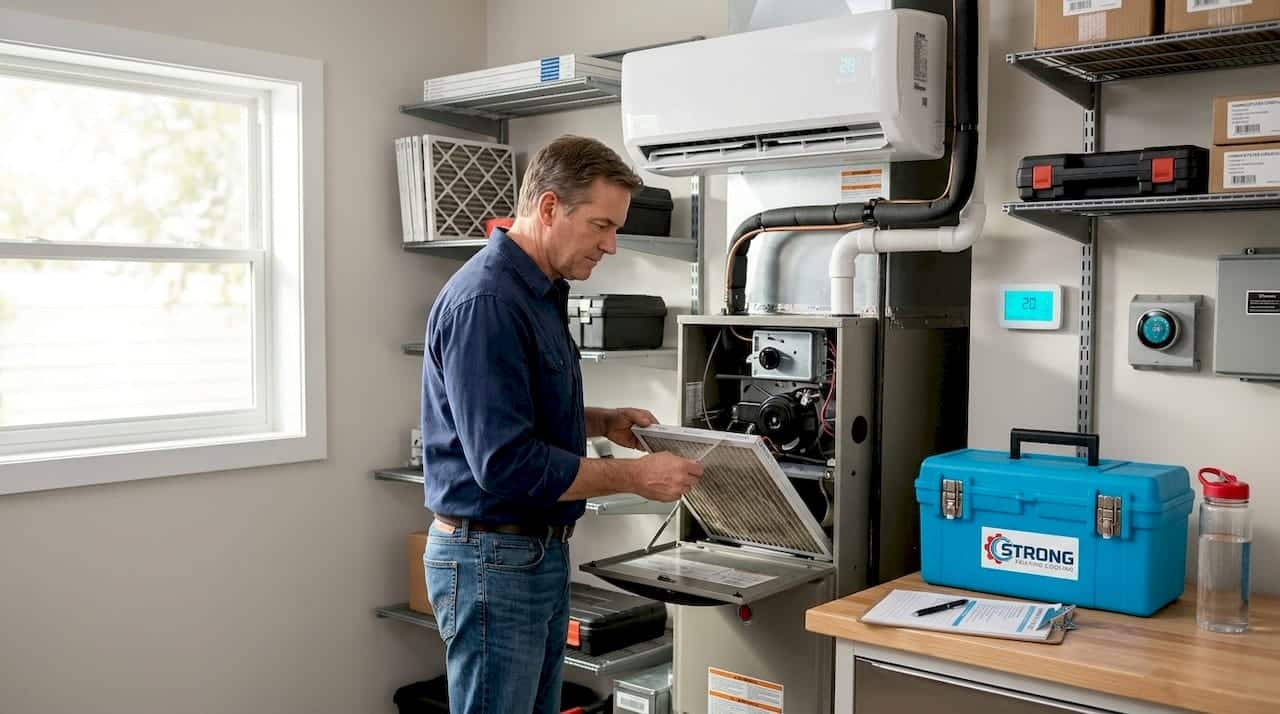
Replacing your furnace and air conditioner together is the most cost-effective and efficient HVAC decision a homeowner can make. A furnace and central AC are not independent appliances. They share a blower motor, ductwork, air filter, and thermostat controls, which means the performance of one directly affects the other. When you replace both units at the same time, a process the industry calls a matched system replacement or simultaneous HVAC upgrade, you get equipment designed to work as a coordinated unit. The result is better energy efficiency, lower installation costs, and far fewer surprises down the road. Understanding why replace furnace and AC together comes down to three things: system compatibility, financial savings, and long-term reliability.
Why replace furnace and AC together: the shared system problem
Your furnace and air conditioner are more connected than most homeowners realize. The furnace blower motor circulates air for both heating and cooling. The ductwork carries conditioned air throughout your home in both seasons. The air filter protects both systems. Even your thermostat communicates with both units simultaneously. Combining new equipment with old shared components can undercut efficiency gains, which means installing a brand-new high-efficiency AC onto a 15-year-old furnace blower may deliver far less than its rated performance.
This is what HVAC professionals call efficiency drag. A new AC unit is rated for a specific airflow volume delivered at a specific static pressure. If the furnace blower is worn, undersized, or calibrated for older equipment, it cannot meet those specifications. The result is a system that runs longer cycles, uses more electricity, and still fails to cool your home evenly. You paid for a high-efficiency unit and received average performance.
The same logic applies when you replace only the furnace. A new variable-speed furnace blower paired with an aging AC coil creates airflow mismatches that cause the system to work harder than necessary. Comfort suffers, utility bills stay elevated, and both units wear out faster than they should. The matched system benefits become clear when you see how much efficiency is lost by mixing old and new components.
Pro Tip: Before any HVAC replacement, ask your contractor to measure existing static pressure in your ductwork. High static pressure is a sign your current blower is already struggling, and it confirms that replacing only one unit will leave real performance on the table.
The shared component issue also affects indoor air quality. An old furnace heat exchanger or a worn blower motor can introduce uneven pressure zones in your ductwork, pulling in dust and contaminants from unconditioned spaces. A matched replacement addresses the entire air delivery system at once, giving you cleaner, more consistent airflow throughout your home.
What are the financial benefits of replacing both units at once?
The cost of a dual furnace and AC replacement looks large on paper, but the math favors bundling when you account for what separate replacements actually cost over time. Combined jobs typically save $500 to $5,000 compared to replacing each unit separately. That savings comes from eliminating duplicated labor, permits, and commissioning fees that you would pay twice if you staggered the replacements.
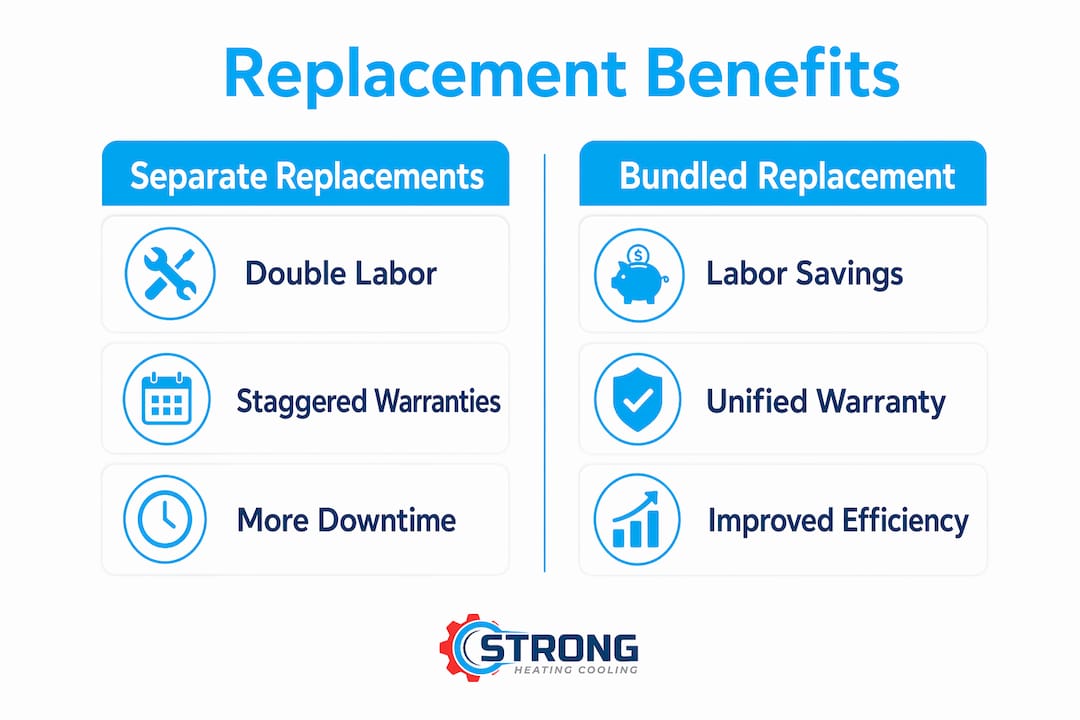
Here is how the cost comparison breaks down in practice:
| Cost Factor | Separate Replacements | Bundled Replacement |
|---|---|---|
| Labor fees | Paid twice, two separate visits | Paid once, single installation crew |
| Permit fees | Two permits, two inspections | One permit, one inspection |
| Commissioning | Two separate system startups | One integrated commissioning session |
| Emergency pricing risk | High if second unit fails unexpectedly | Eliminated with planned replacement |
| Warranty alignment | Staggered expirations, harder to track | Synchronized coverage on both units |
Staggered warranty expirations create a budgeting problem that most homeowners do not anticipate. If you replace your AC in 2024 and your furnace fails in 2027, you are managing two separate warranty timelines, two service agreements, and two sets of maintenance records. A simultaneous HVAC upgrade synchronizes everything, making future maintenance and warranty claims straightforward.
Note: the federal Energy Efficient Home Improvement Credit (Section 25C) ended for equipment installed after December 31, 2025, so it no longer applies to new HVAC installations. For the rebates still available to Colorado Springs homeowners, see our 2026 Colorado HVAC rebates guide.
Planning the replacement in advance also protects you from emergency pricing. When a furnace fails in January or an AC dies in July, contractors charge premium rates for urgent service, and equipment availability is limited. Scheduling a bundled replacement during the off-peak seasons of spring or fall gives you better scheduling flexibility and the possibility of seasonal discounts.
- Schedule a system assessment when either unit reaches 12 to 15 years of age.
- Request quotes for bundled replacement alongside individual unit quotes so you can compare total costs directly.
- Plan the replacement for spring or fall to avoid peak-season pricing and limited contractor availability.
- Confirm that your new equipment qualifies for any utility company rebates available in your area.
How does equipment compatibility affect system longevity?
Not all furnaces and air conditioners work equally well together. Modern HVAC equipment comes in single-stage, two-stage, and variable-speed configurations, and the pairing requirements are specific. A two-stage AC pairs with a two-stage or variable-speed furnace, while a variable-speed AC requires a variable-speed furnace to avoid efficiency loss. Mixing stages or technologies without verified compatibility causes short cycling, uneven temperatures, and premature equipment failure.
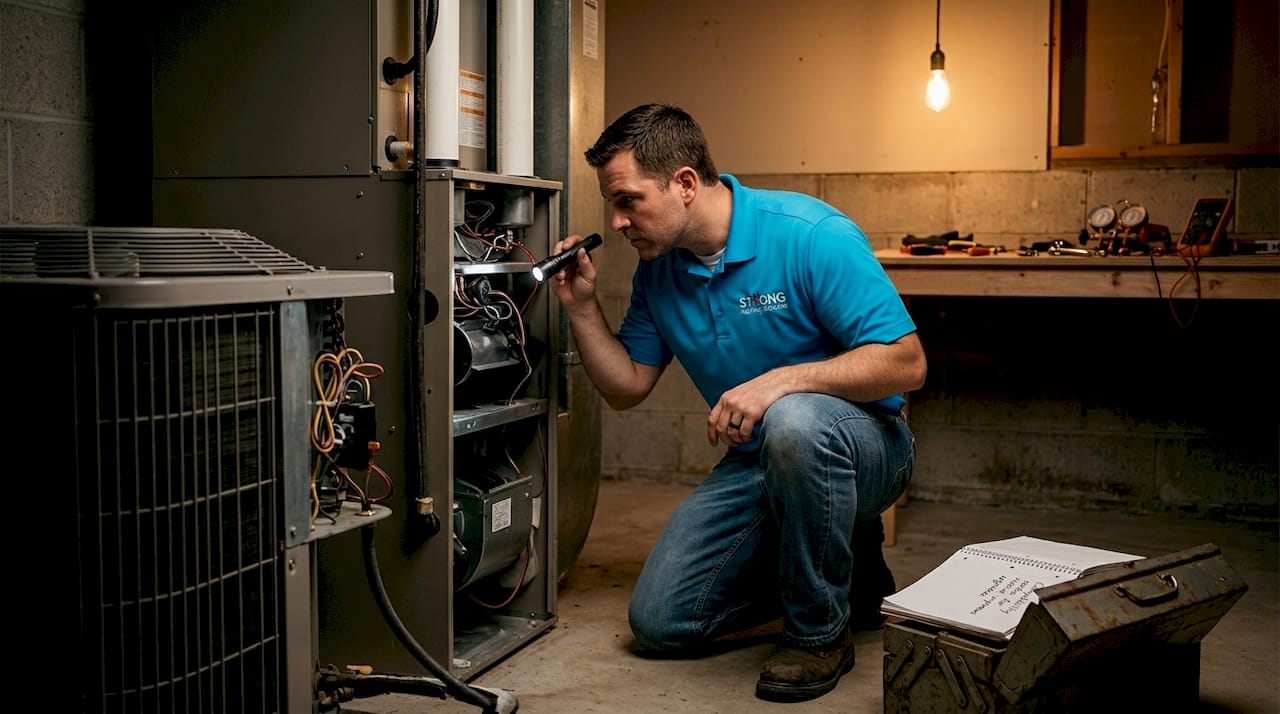
Short cycling is particularly damaging. It occurs when a system turns on and off more frequently than designed because the equipment cannot properly modulate its output. Each startup cycle puts stress on the compressor, blower motor, and heat exchanger. A mismatched system that short cycles can fail years before its rated lifespan, turning what should have been a 15-year investment into a 7-year problem.
The verification tool that protects you from this outcome is the AHRI certificate. The Air-Conditioning, Heating, and Refrigeration Institute maintains a database of certified matched equipment pairs. Requesting and verifying AHRI match sheets is a vital step during any replacement. An AHRI certificate confirms that your specific indoor coil, outdoor condenser, and furnace have been tested together and meet the efficiency ratings printed on the equipment label. Without it, those ratings are theoretical, not guaranteed.
- Variable-speed AC units require a variable-speed furnace blower to modulate airflow correctly.
- Two-stage AC units work with two-stage or variable-speed furnaces but not single-stage furnaces.
- Single-stage equipment can be paired more flexibly, but still requires duct and airflow compatibility checks.
- Mismatched staging causes the system to operate outside its design parameters, increasing wear on both units.
- Mixing brands without AHRI certification can void manufacturer warranties and disqualify equipment from rebate programs.
Pro Tip: Always ask your contractor to provide the AHRI certificate number for your specific equipment combination before installation begins. You can verify it yourself at the AHRI directory online. If a contractor cannot produce this certificate, that is a clear signal to ask more questions before signing anything.
The energy efficiency of AC systems is only fully realized when the indoor and outdoor components are certified as a matched set. A high-SEER rating on the outdoor condenser means nothing if the indoor coil and furnace blower are not part of the same certified combination.
When is the right time to plan a simultaneous replacement?
Timing a bundled replacement correctly is as important as deciding to do one. The typical furnace lifespan runs 15 to 20 years, while a central AC system generally lasts 10 to 15 years. When either unit approaches the end of that range, the other is likely not far behind. Replacing both systems when either approaches end-of-life avoids the scenario where you invest in one unit only to face an emergency replacement of the other within two or three years.
Frequent repairs are a reliable signal that a system is declining. A furnace that has needed two or more repairs in a single heating season, or an AC that has required refrigerant recharging more than once, is telling you something. Wear tends to spread across connected components. When the inducer motor on a furnace starts failing, the added strain often accelerates wear on the blower motor, which is the same component your AC depends on for airflow.
Coordinated HVAC maintenance programs that inspect both systems together identify this kind of linked wear early. A technician checking both units at the same visit can spot patterns that would be invisible if heating and cooling were serviced separately. That early warning gives you time to plan a replacement on your schedule rather than reacting to a breakdown.
- A furnace older than 15 years paired with an AC older than 10 years is a strong candidate for bundled replacement.
- Repair costs exceeding 50% of the replacement cost of either unit signal that replacement is the better financial choice.
- Rising utility bills without a change in usage habits indicate declining system efficiency and support the case for replacement.
- Uneven temperatures, excessive humidity, or persistent noise complaints from either unit often point to system-wide performance decline.
- Check the system age and replacement timing to understand how age affects the decision.
Replacing both units during off-peak seasons improves scheduling flexibility, opens the door to potential discounts, and eliminates the premium pricing that comes with emergency replacements. Spring and fall are the ideal windows. Contractors have more availability, equipment is in stock, and you are not replacing a furnace during a cold snap or an AC during a heat wave.
Does proper sizing and commissioning really matter that much?
Proper sizing and commissioning are not optional steps. They are the difference between a matched system that delivers its rated efficiency and one that underperforms for its entire lifespan. If a Manual J load calculation is not performed, oversized or poorly matched equipment causes short cycling, higher bills, and early failure. Manual J is the industry-standard method for calculating the exact heating and cooling load your home requires based on square footage, insulation, window area, and local climate.
Oversized equipment is a common and costly mistake. A furnace or AC that is too large for your home reaches its target temperature quickly, shuts off, and restarts frequently. Each restart cycle consumes more energy than steady-state operation. The equipment also fails to run long enough to properly dehumidify the air, leaving your home feeling clammy even when the temperature reads correctly on the thermostat.
| Commissioning Step | What It Checks | Why It Matters |
|---|---|---|
| Airflow measurement | CFM delivered at each register | Confirms blower is moving the right volume of air |
| Static pressure test | Resistance in ductwork | Identifies restrictions that reduce system efficiency |
| Refrigerant charge verification | Refrigerant level in AC circuit | Incorrect charge reduces cooling capacity and damages compressor |
| Temperature rise check | Heat output across furnace | Confirms furnace is operating within safe and rated parameters |
| Thermostat calibration | Control signal accuracy | Ensures system responds correctly to temperature demands |
Proper commissioning steps including airflow measurement, refrigerant charge verification, and static pressure checks are critical to achieving rated system efficiency. Without these verifications, a new high-SEER system may run under conditions that negate the efficiency gains you paid for. This is particularly true for variable-speed systems, which require precise calibration to operate correctly across their full range of output.
Pro Tip: Ask your contractor for a written commissioning report after installation. This document should include airflow readings, static pressure measurements, and refrigerant charge verification. If a contractor does not offer this, ask for it specifically. It protects your warranty and confirms the system was set up correctly.
Key takeaways
Replacing your furnace and AC together is the most reliable way to maximize efficiency, reduce total costs, and avoid premature equipment failure.
| Point | Details |
|---|---|
| Shared components create dependency | Furnace and AC share blower, ducts, and controls, so replacing one without the other limits performance. |
| Bundling saves real money | Combined replacements eliminate duplicate labor and permits, saving homeowners $500 to $5,000. |
| Equipment staging must match | Two-stage and variable-speed systems require certified paired components to avoid short cycling and early failure. |
| Timing protects your investment | Replacing both units when either approaches end-of-life prevents costly emergency replacements within a few years. |
| Commissioning confirms performance | Manual J sizing and post-installation verification are required to achieve rated efficiency and protect warranty coverage. |
Why I always recommend planning this replacement together
From my experience working with homeowners across Colorado Springs, the ones who replace their furnace and AC separately almost always call back within three to five years facing the second replacement under worse circumstances. The first replacement felt like the responsible choice at the time. The second one feels like an emergency, because it usually is.
The contractors I trust most are the ones who perform Manual J load calculations before recommending any equipment. That calculation takes 30 to 60 minutes and changes the entire conversation. It tells you exactly what your home needs, not what is sitting in a warehouse. Homeowners who skip that step often end up with oversized equipment that short cycles, wears out early, and never quite keeps the house comfortable.
My honest advice is this: if your furnace is over 12 years old or your AC is over 10 years old, get a professional assessment now. Not because failure is imminent, but because planning gives you options. You can choose the right equipment, schedule the replacement at a favorable time, and take advantage of every financial incentive available. That is a much better position than making a major decision under pressure in January.
— Owner
Strong Heating And Cooling makes bundled replacement straightforward

What Does This Mean for Colorado Springs Homeowners?
Addressing Unique Local Challenges with a Matched System
Living at Colorado Springs' altitude (roughly 6,000–7,500 ft) presents specific challenges for HVAC systems. Thinner air, with about 20% less oxygen, requires gas appliances like furnaces to be altitude-corrected during installation. A matched system ensures both your new furnace and AC are properly calibrated for these conditions, preventing performance loss and ensuring safe operation. When you upgrade both units together, our veteran-owned team, led by Jeff Jennings with 12 years in HVAC and a Master Mechanical License, ensures precise setup for Colorado's unique atmospheric pressure. Additionally, the dry climate and significant day-night temperature swings mean your HVAC system works hard year-round to maintain comfort. A compatible, high-efficiency system handles these demands more effectively than mismatched components.
Maximizing Efficiency and Durability Against Local Conditions
Colorado Springs homeowners understand the long heating season and the potential for severe weather. Hail storms can damage outdoor AC coils, leading to premature failure. Replacing both units at once allows for a comprehensive assessment of your entire system's resilience. A new, matched system ensures optimal performance even when outdoor temperatures fluctuate wildly. By addressing potential weaknesses in both your heating and cooling components simultaneously, you’re investing in a more durable and reliable solution that stands up to Colorado’s extreme weather, from freezing winters to intense summer heat. This approach also simplifies future maintenance, as our $300/year membership covers both AC and furnace checkups, ensuring both units perform at their best.
Navigating Permits and Rebates in Colorado Springs
Most HVAC replacements in our area, including furnaces, ACs, heat pumps, and boilers, require a Pikes Peak Regional Building Department (PPRBD) permit. When replacing both your furnace and AC together, Strong Heating And Cooling handles the necessary PPRBD permit process (our license #26745). This streamlines the installation and ensures all work meets local codes. Furthermore, Colorado Springs Utilities offers valuable rebates that can significantly offset the cost of upgrading to energy-efficient equipment. A matched system replacement often qualifies for more comprehensive savings:
- Qualifying furnace rebates from Colorado Springs Utilities
- Heat pump rebates (under 3 tons/ENERGY STAR, or NEEP 3+ tons)
- Boiler rebates
- Smart thermostat rebates
By planning a bundled replacement, you can ensure your new system is optimized for local conditions, compliant with regulations, and takes full advantage of available financial incentives, maximizing your return on investment.
Ready to explore a matched system upgrade for your Colorado Springs home? Call us at (719) 960-7208 or request service on our contact page to learn more about our local rebate options.
FAQ
Why should I replace furnace and AC at the same time?
How much does a dual furnace and AC replacement cost?
The total cost of a simultaneous furnace and AC replacement varies by equipment tier and home size, but bundling typically saves $500 to $5,000 compared to two separate installations due to shared labor, permits, and commissioning fees.
What happens if I replace only the AC and keep the old furnace?
Installing a new AC with an aging furnace blower creates airflow mismatches that reduce the new unit’s efficiency below its rated performance. It can also cause short cycling and accelerated wear on both units, shortening the lifespan of your new investment.
What is an AHRI certificate and why does it matter?
An AHRI certificate confirms that your specific furnace, indoor coil, and outdoor AC condenser have been tested together as a certified matched set. Without it, the efficiency ratings on your equipment are not guaranteed, and your warranty coverage may be voided.
When is the best time of year to replace both HVAC units?
Spring and fall are the best seasons for a simultaneous HVAC upgrade. Contractor availability is higher, equipment is in stock, and you avoid the emergency pricing that comes with mid-season failures during peak heating or cooling demand.
Recommended
Need expert HVAC help?
Colorado Springs' veteran-owned heating & cooling team — Mon–Sat, 8 AM–7 PM. Same-day service when available.