
TL;DR:
- Planned HVAC maintenance involves scheduled inspections and tune-ups that prevent costly failures and extend system lifespan. It reduces emergency repairs by 65%, improves energy efficiency by up to 25%, and delays expensive replacements by 5 to 8 years. Regular service also protects warranty coverage and ensures optimal system performance year-round.
Planned HVAC maintenance is the scheduled practice of professional inspections, cleaning, and tune-ups designed to keep your heating and cooling system running efficiently before problems develop. This proactive approach, known in the industry as preventive maintenance or a PM program, is the single most reliable method for reducing emergency repairs and controlling long-term system costs. Homeowners and property managers who skip routine service often face compressor failures, motor burnouts, and refrigerant leaks that a trained technician would have caught months earlier. Understanding why planned HVAC maintenance reduces repairs starts with knowing what happens inside a system when routine care is deferred. The short answer is that small problems compound quickly, and the costs follow.
How does planned HVAC maintenance prevent costly repairs?
Planned maintenance prevents costly repairs by interrupting the cycle of compounding wear before it reaches a critical point. HVAC systems undergo cascading failures where a minor overlooked issue increases mechanical stress on surrounding components, eventually triggering a major breakdown. A dirty air filter strains the blower motor. A strained blower motor overheats the heat exchanger. An overheated heat exchanger cracks. Each step in that sequence is preventable with a scheduled inspection.
Routine checks catch the specific conditions that drive most failures. Dirty evaporator and condenser coils force the system to run at maximum capacity for extended periods. Dirty coils and low refrigerant cause HVAC systems to operate near max capacity for 18 to 20 hours daily, which almost guarantees compressor or fan motor failure. Compressor replacements typically cost $1,200 to $2,500 on their own. Catching a refrigerant issue during a scheduled tune-up costs a fraction of that.
Here is what a standard preventive maintenance visit addresses before those issues escalate:
- Coil cleaning to restore heat transfer efficiency and reduce compressor load
- Refrigerant level checks to prevent high-pressure cycling and motor strain
- Belt and bearing inspection to catch wear before a mid-season snap
- Electrical connection tightening to prevent arcing and control board damage
- Condensate drain clearing to prevent water damage and mold growth
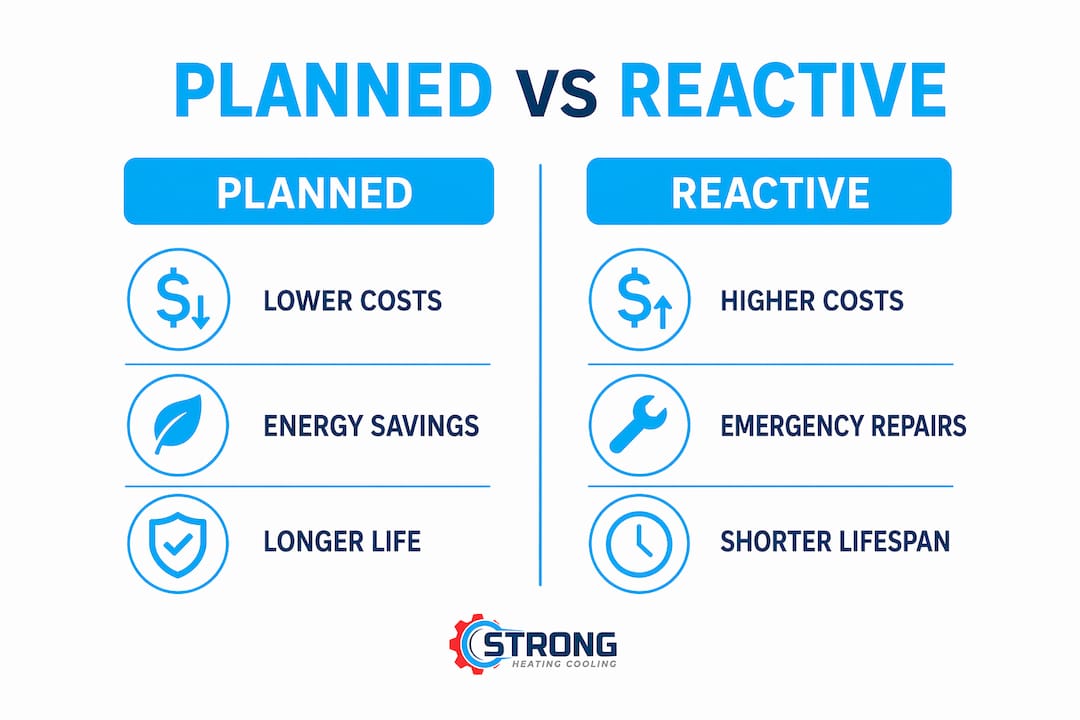
Preventative maintenance programs reduce emergency repair call-outs by 65%. That figure reflects how effectively routine service eliminates the conditions that cause unplanned failures. Emergency repair bills range from $300 to $2,500 per incident, so even one avoided call-out often covers the cost of an entire year of scheduled service.
Well-maintained systems also run more efficiently, which directly reduces mechanical wear. Routine maintenance reduces energy consumption by 15% to 25%, meaning the system cycles less frequently to reach the same temperature. Fewer cycles mean less wear on the compressor, fan motors, and control components. Efficiency and repair frequency are directly connected, not separate concerns.
Pro Tip: Ask your technician to document every finding during a maintenance visit, including refrigerant pressure readings and motor amperage draws. That record creates a baseline that makes it far easier to spot deterioration trends before they become failures.
What are the financial benefits of planned HVAC maintenance?
The financial case for scheduled HVAC service is built on four measurable advantages: avoided repair costs, lower utility bills, delayed system replacement, and preserved warranty coverage. Each one represents real money, and together they make planned maintenance one of the highest-return decisions a homeowner or property manager can make.
On the repair side, the math is straightforward. A typical annual maintenance plan costs $150 to $300 per year. A single emergency service call costs $300 to $2,500, and that is before parts. Skipping maintenance leads to 15% to 25% higher energy bills in year one, with increasing component failures by years two and three. The financial damage from deferred maintenance compounds annually, not linearly.
The table below compares the two approaches across a five-year window:
| Cost Category | Planned Maintenance | Reactive Repairs |
|---|---|---|
| Annual service cost | $150 to $300/year | $0 (until failure) |
| Emergency repair calls | Rare, often 0 to 1 | 2 to 4 per year average |
| Energy bills | Baseline or lower | 15% to 25% higher |
| System lifespan | 15 to 20 years | 8 to 12 years |
| Replacement timeline | Delayed 5 to 8 years | Accelerated |
Energy savings alone often offset the cost of a maintenance plan. Homeowners save $360 to $600 annually on utility bills through routine upkeep, which exceeds the typical cost of a maintenance agreement. That means the plan effectively pays for itself before a single repair is avoided.
System lifespan is where the largest financial impact lives. Well-maintained systems last 15 to 20 years versus 8 to 12 years for neglected ones. Delaying a full system replacement by five to eight years means postponing a $7,000 to $12,000 expense. For a property manager overseeing multiple units, that math multiplies significantly.
Warranty protection is a less obvious but equally important benefit. Most manufacturers require documented annual maintenance to honor warranty claims. Skipping tune-ups may void $5,000 or more in parts coverage. If a heat exchanger or compressor fails and you cannot produce maintenance records, the manufacturer has grounds to deny the claim entirely. Scheduled service with a reputable provider creates the paper trail that protects that coverage. You can learn more about how warranty and service records interact when emergency repairs arise.
Pro Tip: Keep a digital folder with every maintenance invoice and technician report. If a warranty claim ever comes up, that documentation is the difference between a covered repair and a bill you pay out of pocket.
How does planned maintenance differ from reactive repairs?
Planned maintenance and reactive repairs are not two versions of the same service. They represent fundamentally different relationships with your HVAC system, and the cost difference between them is substantial.
Reactive repair is the approach most homeowners default to without realizing it. The system runs until something fails, then a technician is called. That call typically happens during peak season, when demand for HVAC service is highest and emergency labor rates apply. Parts that would cost $80 during a scheduled visit can cost $200 or more when ordered urgently. The repair itself may fix the immediate failure while leaving the underlying cause untreated, setting up the next breakdown.
Planned maintenance operates on a different logic entirely. The technician visits on a schedule, before the system is under peak load, and addresses wear before it becomes failure. There is no emergency premium on labor. Parts are ordered without urgency. The technician has time to evaluate the full system rather than just the component that stopped working.
The contrast becomes clearest when you look at what reactive repairs miss. A technician responding to a failed blower motor fixes the motor. A technician performing a scheduled tune-up finds the dirty filter and restricted airflow that caused the motor to overheat in the first place. One approach treats the symptom. The other removes the cause.
It is also worth distinguishing planned maintenance from home warranties and HVAC insurance products. Home warranties typically cover component replacement after failure, not the preventive work that stops failures from occurring. They do not clean coils, check refrigerant levels, or test electrical connections. A maintenance plan and a home warranty serve different purposes, and relying on the warranty alone leaves the system vulnerable to the exact failures the warranty is meant to cover.
Structured preventive maintenance programs extend commercial HVAC equipment life by 30% to 40% and reduce emergency call frequency by 65%. For property managers, that combination of extended life and fewer emergency calls directly reduces operating costs across a portfolio. The impact of deferred maintenance on system age accelerates replacement timelines in ways that reactive repair budgets rarely account for.
How often should HVAC systems be maintained to minimize repairs?
The standard recommendation for residential HVAC maintenance is two service visits per year: one in spring before the cooling season begins, and one in fall before the heating season starts. This schedule aligns service with the periods of highest system demand, so the equipment is inspected and tuned before it faces its greatest workload.
Timing matters more than most homeowners realize. Failure to perform pre-season maintenance increases system downtime risk significantly during peak summer, and 22% of HVAC outages in critical sectors cause losses exceeding $1,000. Scheduling a spring tune-up in March or April, before temperatures climb, gives the technician time to address any issues without the pressure of an already-hot home.
For higher-use systems or commercial properties, two visits per year may not be enough. Properties with continuous occupancy, high square footage, or older equipment often benefit from quarterly service. The logic is simple: more operating hours mean faster wear, and faster wear means more frequent inspection intervals to catch problems at the same early stage.
Filter replacement is a separate consideration from full tune-ups, and the timing should not be fixed arbitrarily. Condition-based monitoring using pressure readings optimizes filter replacement timing better than calendar-based schedules. A filter in a home with pets and high dust levels may need replacement every 30 days. The same filter in a lightly occupied vacation property might last 90 days. Replacing by condition rather than by calendar improves airflow and prevents unnecessary motor strain.
Here is a practical framework for setting your maintenance schedule:
- Residential systems with standard use: two visits per year, spring and fall
- Residential systems with pets, allergies, or heavy use: add a mid-season filter check
- Commercial or multi-unit properties: quarterly service visits minimum
- Systems over 10 years old: increase inspection frequency regardless of use level
- New installations: follow manufacturer-specified intervals to protect warranty coverage
Pro Tip: Schedule your spring HVAC tune-up before Memorial Day and your fall tune-up before the first expected frost. Booking early avoids the rush when everyone else realizes their system is not working, and you get the technician’s full attention rather than a hurried emergency visit.
The residential maintenance guide from Strongheatingandcooling outlines what each seasonal visit should include, which helps you verify that your service provider is covering the full checklist rather than just a surface-level inspection. Knowing what to expect from a visit makes it easier to hold your technician accountable and get full value from the service.
Key takeaways
Planned HVAC maintenance reduces repairs by catching small problems before they trigger cascading failures, extending system life, and preserving warranty coverage that reactive repair approaches consistently forfeit.
| Point | Details |
|---|---|
| Maintenance prevents cascading failures | Routine inspections stop minor wear from escalating into compressor or motor failures. |
| Emergency repairs drop by 65% | Scheduled service eliminates the conditions that cause unplanned breakdowns and premium labor costs. |
| Energy savings offset plan costs | Well-maintained systems save $360 to $600 annually, often exceeding the cost of a maintenance agreement. |
| System lifespan extends 5 to 8 years | Maintained systems last 15 to 20 years versus 8 to 12 years for neglected ones, delaying costly replacements. |
| Warranty requires documented service | Most manufacturers void coverage without annual maintenance records, putting $5,000 or more at risk. |
Why I think most homeowners underestimate what deferred maintenance actually costs
After working in HVAC for over 40 years combined across the Strong Heating And Cooling team, the pattern I see most often is not neglect. It is optimism. Homeowners assume that because the system is running, it is running well. That assumption is what makes deferred maintenance so expensive.
The compressor does not announce that it is struggling. The heat exchanger does not send an alert when it starts to crack. By the time a symptom appears, the damage is usually weeks or months old. What I have found is that the homeowners who call us for emergency repairs in July almost always had warning signs during their last heating season that went uninspected.
The other thing I want to address directly is the idea that a maintenance plan is an upsell. It is not. The math on avoided repairs, energy savings, and delayed replacement is straightforward, and it consistently favors scheduled service over waiting. A technician who finds a worn capacitor during a spring tune-up saves you a $400 emergency call in August. That is not a sales pitch. That is arithmetic.
My practical advice is to choose a certified technician, keep every service record in one place, and pay attention to what your technician tells you during each visit. If they flag something as a developing concern, take it seriously. The systems that last 20 years are the ones where the homeowner treated maintenance as a priority, not an afterthought.
— Owner
Keep your system running with Strongheatingandcooling’s maintenance plans
Strong Heating And Cooling offers maintenance plans built specifically for Colorado Springs homeowners and property managers who want fewer surprises and lower repair costs year over year. Each plan includes priority scheduling, seasonal tune-ups, and service from technicians with over 40 years of combined experience in the field.

Scheduling before peak season means your system gets a full inspection when it matters most, not a rushed visit after something has already failed. Strong Heating And Cooling’s HVAC maintenance plan in Colorado Springs covers the full checklist that protects your equipment, your warranty, and your budget. You can also review the residential maintenance guide to understand exactly what each visit includes and what to expect from a thorough seasonal service.
FAQ
What does planned HVAC maintenance actually include?
A standard planned maintenance visit includes coil cleaning, refrigerant level checks, electrical connection inspection, belt and bearing assessment, condensate drain clearing, and filter evaluation. The goal is to identify and correct wear before it causes a failure.
How much money does HVAC maintenance save per year?
Routine maintenance saves homeowners $360 to $600 annually on energy bills alone, and that figure does not include avoided repair costs. A single prevented emergency call can save an additional $300 to $2,500 depending on the component involved.
Does skipping maintenance void my HVAC warranty?
Most manufacturers require documented annual maintenance to honor warranty claims, and skipping tune-ups may void $5,000 or more in parts coverage. Keeping service records from a certified technician is the most reliable way to protect that coverage.
How often should I schedule HVAC maintenance?
Residential systems benefit from two visits per year, one in spring and one in fall, timed before peak cooling and heating seasons. Higher-use or commercial systems often require quarterly service to maintain the same level of protection.
Can routine maintenance extend my HVAC system’s lifespan?
Well-maintained systems last 15 to 20 years, while neglected systems typically fail within 8 to 12 years. Regular maintenance extends equipment life by 5 to 8 years, which delays a $7,000 to $12,000 replacement and represents significant long-term savings.
Recommended
Need expert HVAC help?
Colorado Springs' veteran-owned heating & cooling team — Mon–Sat, 8 AM–7 PM. Same-day service when available.