
Why HVAC Impacts Your Business Energy Bill
TL;DR:
- HVAC systems account for 40 to 60 percent of a business’s total energy use, making them the largest operational expense. Regular maintenance, operational improvements, and government incentives can significantly reduce energy costs and improve system efficiency over time. Monitoring energy use through benchmarking and data analysis helps sustain savings and prevents efficiency decline.
HVAC systems are the single largest driver of commercial energy costs, accounting for 40–60% of total energy consumption in U.S. businesses. That figure alone explains why your utility bill moves the way it does. Whether you run a medical office, a retail space, or a multi-tenant building, your heating and cooling system works harder and longer than any other piece of equipment on the property. Understanding why HVAC impacts your business energy bill is the first step toward controlling it. The factors at play include system condition, maintenance history, operational scheduling, and equipment age, and each one compounds the others.
Why HVAC impacts business energy bills more than any other system
HVAC is not simply one expense among many. It is the dominant energy load in nearly every commercial building type. Offices typically land in the 40–50% range, hospitals average around 44%, and certain retail formats push past 60%. That concentration of energy demand in a single system means any inefficiency there has an outsized effect on your monthly costs. No other building system comes close to that level of impact on your utility bill.

The reason HVAC consumes so much energy is straightforward. It must condition air continuously across large, variable spaces while fighting outdoor temperatures, internal heat loads from equipment and people, and the thermal properties of the building envelope. Unlike lighting or plug loads, HVAC cannot simply be switched off without affecting occupant comfort, product integrity, or regulatory compliance in certain industries.
Commercial HVAC also operates at a scale that amplifies small inefficiencies. A 5% drop in system efficiency across a 20,000-square-foot building translates into a meaningful dollar amount every single month. That is why energy management in HVAC systems is not a niche concern for facilities engineers. It is a core financial issue for any business owner reviewing an operating budget.
What components drive the most HVAC energy consumption?
The energy load inside a commercial HVAC system is not evenly distributed. Chillers, boilers, air handlers, fans, and pumps each consume energy at different rates depending on building type, climate, and how the system is configured.
| Component | Primary function | Energy impact |
|---|---|---|
| Chillers | Cool water for air distribution | Highest single load in large buildings |
| Boilers | Heat water for heating systems | Major load in colder climates |
| Air handlers | Circulate conditioned air | Continuous fan energy draw |
| Fans and pumps | Move air and water through the system | Significant in multi-zone buildings |
| Controls and thermostats | Regulate system operation | Low direct use, high indirect impact |
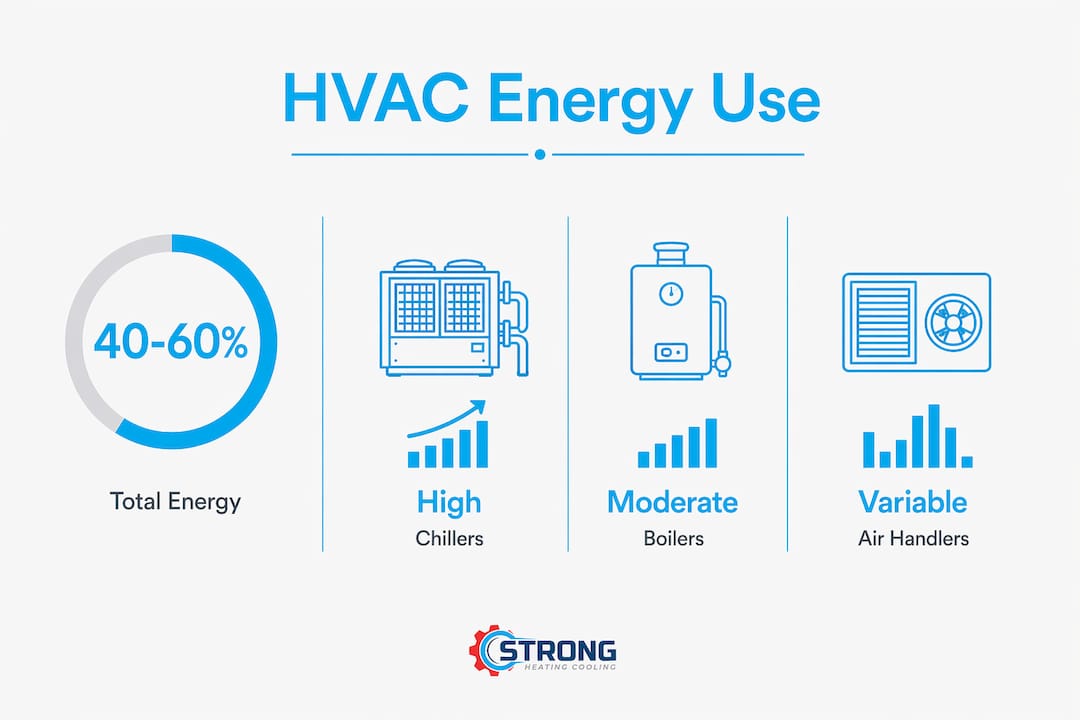
Building type and climate shape which components dominate. A Colorado Springs office building running through a cold winter relies heavily on its boiler and air handlers. A retail space with high foot traffic and significant internal heat gain leans on its cooling equipment even in moderate weather.
Multi-zone buildings add another layer of complexity. When different areas of a building have different occupancy schedules, temperature requirements, or heat loads, the system must respond to all of them simultaneously. That constant adjustment increases runtime and energy draw. Buildings with poor zoning design often condition spaces that do not need it, which pushes energy costs higher without any corresponding benefit to occupant comfort.
How does HVAC maintenance affect your energy costs?
Maintenance is the most direct lever a business owner has over HVAC energy costs. A well-maintained system runs at the efficiency it was designed for. A neglected system does not.
Deferred maintenance reduces HVAC efficiency by 5–7% per year. A system that has gone three years without proper service can waste 15–20% more energy than a properly maintained unit running the same workload. That waste shows up directly on your utility bill every month.
The most common culprits are also the most preventable:
- Clogged or dirty air filters restrict airflow, forcing fans and air handlers to work harder to move the same volume of air.
- Refrigerant leaks reduce cooling capacity, causing the system to run longer to reach setpoint temperatures.
- Duct leaks allow conditioned air to escape into unconditioned spaces, wasting energy before it ever reaches the occupied area.
- Dirty coils reduce heat transfer efficiency, increasing the energy required to cool or heat air to the target temperature.
- Failing capacitors and worn belts cause motors to draw more power and increase the risk of sudden equipment failure.
Preventive maintenance programs can reduce annual energy consumption by 15–25% and cut emergency breakdowns by up to 70%. The financial return is significant. Many maintenance programs pay for themselves within six months through energy savings and avoided repair costs alone.
The cost comparison between reactive and planned maintenance is stark. Emergency repairs cost 3–9 times more than scheduled service when you factor in overtime labor, expedited parts, and revenue lost during downtime. A restaurant that loses its cooling system on a Friday night or a medical office that loses heat in january faces costs that go well beyond the repair invoice.
Pro Tip: Treat your HVAC maintenance contract the same way you treat business insurance. You pay for it consistently, and the value shows up in the costs you never incur.
What operational factors increase HVAC energy use?
Equipment condition is only part of the picture. How a system is operated day to day has an equally significant effect on energy costs. Operational inefficiencies such as poor scheduling, simultaneous heating and cooling, and occupancy misalignment are among the most common sources of unnecessary energy expense in commercial buildings.
The most frequent operational problems include:
- Running HVAC at full capacity during unoccupied hours, such as overnight or on weekends, when no one is in the building.
- Conditioning spaces that are rarely or never used, such as storage rooms, unused conference rooms, or seasonal areas.
- Simultaneous heating and cooling in adjacent zones, which forces both systems to work against each other.
- Thermostat setpoints that do not reflect actual occupancy patterns or seasonal conditions.
- No setback programming, meaning the system never reduces output during low-demand periods.
Smart controls and zoning address most of these problems directly. A programmable or connected thermostat can reduce HVAC runtime during unoccupied periods without any manual intervention. Zoning allows different areas of a building to be conditioned independently, so you are not heating an empty warehouse to the same temperature as a customer-facing showroom.
Energy Use Intensity benchmarking, known as EUI, gives business owners a standardized way to measure how much energy their building uses per square foot per year. Tracking EUI over time reveals whether operational changes are actually reducing consumption or simply shifting costs around. Buildings with higher ENERGY STAR scores consistently show lower energy costs, and the correlation runs directly through HVAC performance.
For businesses with multiple locations or complex facilities, best practices for facility managers include monthly runtime reporting, zone-by-zone consumption tracking, and scheduled reviews of scheduling programs to catch drift before it becomes expensive.
What strategies reduce HVAC-driven energy costs?
The most effective approach to reducing HVAC energy costs combines equipment upgrades, operational improvements, and available financial incentives. No single action delivers the full benefit. The combination does.
Commercial buildings waste approximately 30% of their total energy consumption. HVAC optimization consistently delivers 10–30% energy reductions and the highest return on investment among all efficiency strategies. Payback periods for HVAC upgrades typically run 2–5 years, and that timeline shortens considerably when incentives are applied.
| Strategy | Expected benefit | Typical payback |
|---|---|---|
| Equipment replacement | 15–30% energy reduction | 3–5 years |
| Controls and scheduling upgrades | 10–20% energy reduction | 1–2 years |
| Duct sealing and insulation | 5–15% energy reduction | 2–3 years |
| Preventive maintenance program | 15–25% energy reduction | Under 1 year |
| EUI benchmarking and monitoring | Identifies savings opportunities | Immediate |
Under 2025 IRS guidelines, Section 179D tax deductions for HVAC efficiency upgrades range from $0.58 to $5.81 per square foot. For a 10,000-square-foot building, that represents a meaningful reduction in the net cost of an upgrade project. Businesses that meet prevailing wage requirements qualify for the higher deduction tiers.
State-level utility rebate programs add another layer of savings on top of federal deductions. Many Colorado utilities offer rebates for high-efficiency equipment installations, smart thermostat upgrades, and verified energy audits. Stacking these incentives with a planned maintenance program produces the fastest path to a lower utility bill.
Pro Tip: Before purchasing new equipment, request an energy audit. Audits identify which upgrades will produce the greatest return for your specific building, so you spend money where it actually moves the needle.
HVAC efficiency upgrades that cut costs quickly tend to focus on controls first, then equipment. Controls are less expensive and deliver results immediately. Equipment replacement follows when the existing system is too old or too degraded to respond to operational improvements.
How can business owners monitor HVAC efficiency over time?
Reducing HVAC energy costs is not a one-time project. It requires consistent monitoring and periodic adjustment. Successful energy management depends on continuous, data-driven oversight of runtimes and occupancy patterns, not just equipment upgrades.
A practical monitoring approach follows these steps:
- Establish a baseline by pulling 12 months of utility data and calculating your current EUI. This gives you a reference point for measuring future improvements.
- Install submetering or use your building management system to track HVAC energy use separately from lighting and plug loads. Isolating the HVAC load makes it easier to spot problems.
- Set monthly targets based on your EUI baseline and track actual consumption against those targets. Deviations signal either operational drift or equipment issues.
- Schedule professional inspections at least twice per year, ideally before the heating season and before the cooling season. Catching problems in the off-season avoids peak-demand repair costs.
- Review scheduling programs quarterly. Occupancy patterns change, and HVAC schedules that made sense six months ago may no longer match how the building is actually used.
EUI benchmarking connects your building’s performance to national standards, giving you a clear picture of where you stand relative to similar facilities. Buildings that track EUI consistently and act on the data reduce energy costs faster than those that rely on annual reviews alone.
For businesses that also manage plumbing infrastructure alongside HVAC, commercial building system management follows similar principles: baseline measurement, routine inspection, and early intervention before minor issues become expensive failures.
Integrating HVAC monitoring into a broader energy strategy also positions your business for sustainability reporting, which is increasingly relevant for businesses with corporate clients, government contracts, or ESG commitments.
Key Takeaways
HVAC systems drive business energy costs more than any other building system, and the gap between a well-managed system and a neglected one shows up directly on every utility bill.
| Point | Details |
|---|---|
| HVAC dominates energy costs | HVAC accounts for 40–60% of commercial energy use, making it the largest operational expense. |
| Maintenance reduces waste | Preventive maintenance cuts energy consumption by 15–25% annually and pays back within six months. |
| Operations matter as much as equipment | Poor scheduling and occupancy misalignment waste energy regardless of equipment quality. |
| Incentives lower upgrade costs | Section 179D deductions and utility rebates reduce the net cost of HVAC efficiency projects. |
| Monitoring sustains savings | EUI benchmarking and monthly tracking prevent efficiency gains from eroding over time. |
What I’ve learned after 40 years of watching energy bills
The business owners who control their energy costs best are not the ones with the newest equipment. They are the ones who treat their HVAC system as a managed asset rather than a fixed cost.
The most common mistake I see is waiting for a problem before calling for service. By the time a system is noticeably underperforming, it has already been wasting energy for months. A compressor that is struggling, a filter that has not been changed, a duct connection that has worked loose: none of these announce themselves loudly. They just quietly push your utility bill higher every month until something finally fails.
The second mistake is treating an equipment upgrade as the complete solution. New equipment installed into a building with poor scheduling, unaddressed duct leaks, and no monitoring plan will underperform its rated efficiency within a year or two. The equipment is only as effective as the system around it.
What actually works is a combination of consistent maintenance, honest benchmarking, and a willingness to act on what the data shows. Business owners who review their EUI quarterly, keep their maintenance contracts current, and make incremental control improvements year over year consistently outperform those who wait for a crisis. The savings compound over time, and the equipment lasts longer.
Partnering with a service provider who understands both the technical side and the financial side of HVAC management makes that process significantly easier. The right provider does not just fix what is broken. They help you understand what your system is doing and what it should be doing, so you can make informed decisions about where to invest.
— Owner
Strongheatingandcooling serves Colorado Springs businesses with expert HVAC care
Strongheatingandcooling brings over 40 years of combined experience to commercial heating and cooling across Colorado Springs and surrounding communities. Whether your building needs a maintenance program to protect efficiency, an equipment upgrade to reduce energy costs, or a full system replacement, the team at Strongheatingandcooling delivers honest assessments and quality workmanship at every step.

Businesses in the region trust Strongheatingandcooling for commercial heating services and cooling solutions that are built to perform season after season. If your utility bills have been climbing and you are not sure why, a professional inspection is the fastest way to find out what your system is actually costing you. Contact Strongheatingandcooling to schedule a service visit and get a clear picture of where your energy dollars are going.
FAQ
What percentage of a business energy bill comes from HVAC?
HVAC systems account for 40–60% of total commercial energy consumption in U.S. buildings. The exact share depends on building type, climate, and system condition.
How much can preventive maintenance reduce HVAC energy costs?
Preventive maintenance reduces annual HVAC energy consumption by 15–25%. Most maintenance programs pay for themselves within six months through energy savings and avoided emergency repairs.
Does HVAC affect electricity costs differently than gas costs?
Yes. Electric-driven components like chillers, fans, and pumps show up on your electricity bill, while boilers and furnaces typically drive gas costs. Both are affected by system efficiency and maintenance quality.
What is Energy Use Intensity and why does it matter for businesses?
Energy Use Intensity, or EUI, measures how much energy a building uses per square foot per year. Tracking EUI helps business owners identify HVAC inefficiencies and measure whether improvements are actually reducing consumption.
Are there tax incentives for upgrading commercial HVAC systems?
Under 2025 IRS guidelines, Section 179D deductions for qualifying HVAC efficiency upgrades range from $0.58 to $5.81 per square foot. State utility rebates may also apply, reducing the net cost of upgrades further.
Recommended
Need expert HVAC help?
Colorado Springs' trusted, veteran-owned heating & cooling team — same-day service.