
Why Commercial HVAC Preventive Maintenance Matters
TL;DR:
- Commercial HVAC preventive maintenance involves regular inspections and servicing to ensure efficiency and avoid costly breakdowns. It reduces energy costs, extends equipment lifespan, and maintains regulatory compliance, saving significant expense over reactive repairs. Proper documentation of maintenance tasks is essential to meet industry standards and avoid penalties during audits.
Commercial HVAC preventive maintenance is the proactive practice of regularly inspecting, cleaning, and servicing HVAC systems to maintain optimal performance and avoid costly breakdowns. In the industry, this practice is formally defined under ANSI/ASHRAE/ACCA Standard 180, which sets the baseline for what a compliant maintenance program must include. For business owners and facility managers, understanding why commercial HVAC preventive maintenance matters goes beyond keeping occupants comfortable. It directly affects energy costs, equipment lifespan, regulatory compliance, and the financial health of your building operations. The difference between a scheduled maintenance visit and an emergency repair call is often measured in thousands of dollars.
Why commercial HVAC preventive maintenance matters for energy costs
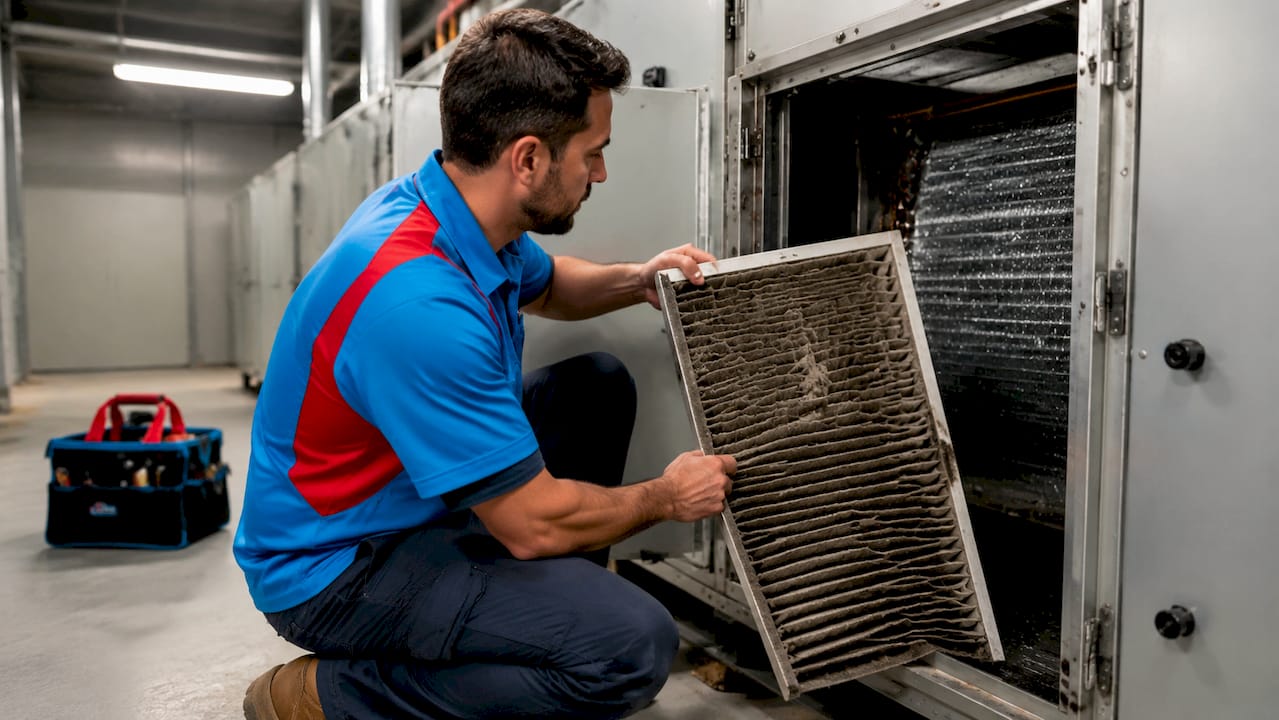
Dirty filters and clogged evaporator coils are the two most common causes of wasted energy in commercial HVAC systems. When airflow is restricted and heat exchange capacity drops, the system runs longer and harder to reach the same temperature setpoints. The U.S. Department of Energy advises that filters should be cleaned or replaced every one to two months during cooling seasons to maintain efficiency and protect system longevity.
The financial impact is significant. Proper HVAC operation aligned with ASHRAE Standard 180 reduces annual energy costs by 5% to 20%. To put that in concrete terms: a 100,000 square foot office building spending $150,000 per year on energy could avoid $15,000 in annual costs through a compliant maintenance program. That is money recovered without replacing a single piece of equipment.
Neglected maintenance creates a compounding problem. Dirty filters raise fan energy consumption and increase the frequency of repairs over time. Each month without a filter check pushes the system further from its design efficiency, and the utility bills reflect that drift before the equipment ever fails visibly.
Pro Tip: Track your energy bills month over month. A steady increase in consumption without a corresponding change in occupancy or weather is often the first sign that your HVAC system needs a maintenance visit, not a replacement.
Coil cleaning is equally critical. Evaporator and condenser coils transfer heat between refrigerant and air. When coil surfaces are coated with dust and debris, that transfer slows down. The compressor compensates by running longer cycles, which accelerates wear and raises operating costs simultaneously. Routine coil cleaning, typically performed quarterly or semi-annually depending on the environment, restores that heat exchange capacity and brings energy use back in line with design specifications.
What does a commercial HVAC maintenance schedule actually look like?
A structured preventive maintenance program follows a tiered schedule built around monthly, quarterly, semi-annual, and annual tasks. 2026 industry guidelines recommend aligning these schedules to seasonal demand to keep systems dependable year-round. The specific tasks at each interval serve different purposes, and skipping any tier creates gaps that accumulate into larger problems.
Monthly tasks form the foundation of commercial HVAC upkeep:
- Inspect and replace air filters as needed
- Check thermostat calibration and setpoints
- Verify airflow at supply and return registers
- Inspect condensate drain lines for blockages
- Review system controls for error codes or fault logs
Quarterly tasks go deeper into mechanical and electrical components:
- Clean evaporator and condenser coils
- Inspect electrical connections and tighten as needed
- Lubricate motors and moving parts
- Test safety controls and shutoff switches
- Check refrigerant levels and inspect for leaks
Semi-annual and annual tasks focus on performance validation and full system review:
- Conduct seasonal startup and shutdown procedures
- Verify airflow and refrigerant charge against design specifications
- Inspect heat exchangers for cracks or corrosion
- Test economizer operation and damper function
- Calibrate building automation system controls
Pro Tip: Assign each task in your maintenance schedule to a specific technician and log the completion date. Undocumented maintenance is treated as non-compliant under ASHRAE Standard 180, regardless of whether the work was actually done.
A structured preventive maintenance program works best when it integrates documented tasks and schedules rather than ad hoc cleaning. The schedule is not just an operational tool. It is also your compliance record. Facility managers who treat the maintenance log as a living document protect themselves during audits and insurance reviews. For a detailed breakdown of what a professional program covers, Strongheatingandcooling’s maintenance plan overview outlines the standard tasks included at each service visit.
| Interval | Key tasks | Primary purpose |
|---|---|---|
| Monthly | Filter inspection, thermostat check, airflow review | Sustain baseline efficiency |
| Quarterly | Coil cleaning, electrical inspection, refrigerant check | Prevent component wear |
| Semi-annual | Seasonal startup/shutdown, safety tests | Prepare for peak demand |
| Annual | Full performance validation, heat exchanger inspection | Confirm design compliance |
Preventive maintenance vs. reactive repairs: what does the cost difference look like?
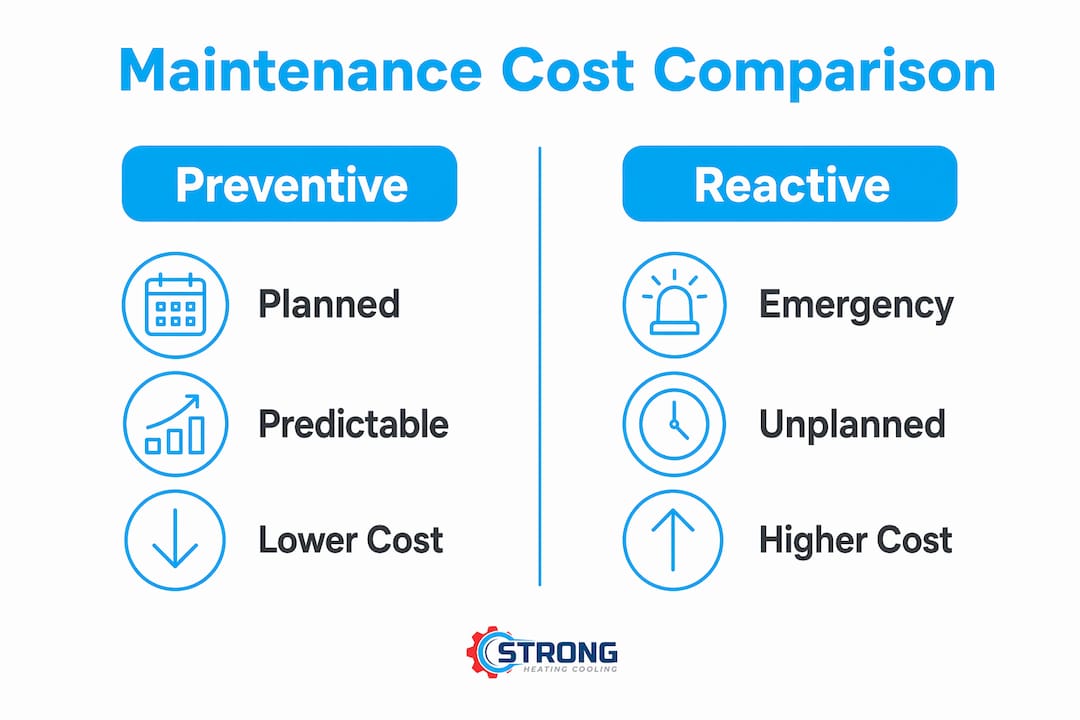
Reactive HVAC repairs cost 3 to 9 times more than planned preventive maintenance. That figure accounts for emergency labor rates, expedited parts shipping, and the operational losses that come with unexpected downtime. Industry analysis from 2026 confirms that a reactive-only approach carries significant financial and operational risk for commercial buildings.
The cost gap becomes even clearer when you factor in emergency shutdown scenarios. Emergency shutdown costs run 4 to 8 times higher than planned preventive maintenance costs. A rooftop unit that fails on a Friday afternoon in july does not get repaired at standard rates. It gets repaired at overtime rates, with parts sourced from wherever they are available, while your building sits at an uncomfortable temperature and your tenants or employees lose productivity.
Preventive maintenance programs reduce emergency service call frequency by 65% and extend major equipment life by 30% to 40%. Those two outcomes together represent the core financial argument for scheduled upkeep. Extending a rooftop unit’s life by even three to five years defers a capital replacement that can cost $15,000 to $40,000 or more depending on unit size and building configuration.
The comparison below illustrates the operational difference between the two approaches:
| Factor | Preventive maintenance | Reactive repairs |
|---|---|---|
| Cost per incident | Planned, predictable | 3–9x higher due to emergency rates |
| Equipment lifespan | Extended 30%–40% | Shortened by cumulative stress |
| Emergency call frequency | Reduced by ~65% | Frequent and unpredictable |
| Operational disruption | Minimal, scheduled | High, unplanned downtime |
| Budget predictability | High | Low |
The operational disruption point deserves emphasis. A retail store, medical office, or school that loses HVAC function mid-day faces consequences beyond repair costs. Customers leave. Appointments get canceled. Staff productivity drops. In some facilities, health and safety regulations require evacuation if indoor temperatures exceed certain thresholds. Preventive maintenance does not eliminate all failures, but it reduces their frequency and severity in ways that protect both the building and the business operating inside it. Strongheatingandcooling’s resource on planned maintenance and cost reduction explains this relationship in practical terms for facility managers.
What compliance and documentation requirements apply to commercial HVAC maintenance?
ASHRAE Standard 180 transforms HVAC preventive maintenance from an optional best practice into a mandatory, audit-ready compliance requirement. The 2024 International Mechanical Code references Standard 180 directly, which means many jurisdictions now require commercial buildings to maintain documented HVAC maintenance programs. Facility managers who treat maintenance as informal or undocumented face real regulatory exposure.
Documentation aligned with Standard 180 must include written maintenance plans, task frequency schedules, and maintenance records tied to a specific equipment inventory. Undocumented maintenance activities are not considered compliant, regardless of whether the physical work was completed. An auditor reviewing your building’s HVAC records will look for three things: a written plan, a schedule with assigned frequencies, and completed records showing who did what and when.
OSHA’s indoor air quality standards add another layer of accountability. Poor indoor air quality linked to neglected HVAC maintenance can expose building owners to liability if occupants experience health effects. Filters, coils, and drain pans that are not maintained regularly become sources of mold, bacteria, and particulate matter that circulate through the building. Compliance with ASHRAE Standard 180 addresses most of these risks by design.
Pro Tip: Build your equipment inventory before you build your maintenance schedule. Standard 180 compliance requires records linked to each specific asset. A spreadsheet listing every air handling unit, rooftop unit, and exhaust fan by location and model number is the foundation of a compliant program.
The practical steps for building a compliant documentation system are straightforward:
- Create a written maintenance plan that identifies all HVAC assets and assigns maintenance tasks to each
- Set task frequencies in writing, aligned to manufacturer recommendations and Standard 180 minimums
- Log every completed maintenance activity with the date, technician name, and findings
- Store records in a format that can be produced quickly during an audit or insurance review
- Review and update the plan annually or whenever equipment changes
Strongheatingandcooling’s guide on commercial HVAC best practices covers the documentation requirements that facility managers need to meet industry standards and protect their buildings from compliance risk.
Key Takeaways
Commercial HVAC preventive maintenance reduces energy costs, extends equipment life, and prevents the expensive disruptions that reactive repairs create.
| Point | Details |
|---|---|
| Energy savings are measurable | Aligned maintenance programs reduce annual energy costs by 5% to 20% per ASHRAE Standard 180 guidance. |
| Reactive repairs cost far more | Emergency repairs run 3–9 times higher than planned maintenance due to labor, parts, and downtime losses. |
| Schedules must be documented | Undocumented maintenance does not count as compliant under ASHRAE Standard 180 audit requirements. |
| Equipment life extends significantly | Preventive programs extend major equipment life by 30%–40%, deferring costly capital replacements. |
| Emergency calls drop sharply | Structured maintenance programs reduce emergency service call frequency by approximately 65%. |
What I’ve learned from watching facilities skip preventive maintenance
After years of working with commercial buildings across Colorado Springs, the pattern is consistent. Facilities that treat HVAC maintenance as a line item to cut during budget reviews end up spending far more within two to three years. The costs do not disappear. They shift from predictable service visits to unpredictable emergency calls, accelerated equipment wear, and eventually full system replacements that could have been deferred by a decade.
The insight that most facility managers miss is the difference between completing maintenance tasks and verifying system performance. Practitioners consistently stress that seasonal testing, airflow checks, and refrigerant verification are what confirm a system is actually operating within its design parameters. A technician who changes a filter and leaves without checking airflow or refrigerant charge has completed a task but not verified performance. Those are two different things, and only one of them actually protects your equipment.
The other pattern worth noting is how cascading failures develop. One neglected component puts strain on adjacent components. A dirty coil forces the compressor to work harder. A stressed compressor runs hotter. A hot compressor degrades refrigerant oil faster. By the time the compressor fails, the root cause was a coil that needed cleaning six months earlier. Treating HVAC maintenance as a building system operation rather than a collection of isolated tasks is what prevents these chains from developing.
My honest recommendation: build your maintenance program around a documented schedule, assign performance verification as a separate step from task completion, and treat the maintenance log as a financial record rather than a paperwork obligation. The buildings that do this consistently spend less, replace equipment less often, and face fewer compliance problems.
— Owner
Strongheatingandcooling’s commercial HVAC maintenance services
Strongheatingandcooling serves business owners and facility managers across Colorado Springs with scheduled HVAC inspections, maintenance programs, and repair services built around ASHRAE Standard 180 requirements.

Our team brings over 40 years of combined experience to commercial HVAC upkeep, with maintenance schedules customized to your equipment inventory, building size, and seasonal demands. Every service visit is documented, and every finding is communicated clearly so you know exactly what was done and why. Whether you need a one-time inspection or an ongoing maintenance agreement, our commercial HVAC services are structured to protect your equipment investment and keep your operating costs predictable. Contact Strongheatingandcooling to schedule a maintenance assessment for your building.
FAQ
What is commercial HVAC preventive maintenance?
Commercial HVAC preventive maintenance is a scheduled program of inspections, cleaning, and servicing designed to keep HVAC systems operating efficiently and prevent unplanned failures. It is formally defined under ANSI/ASHRAE/ACCA Standard 180.
How often should commercial HVAC systems be serviced?
Commercial HVAC systems require monthly filter and airflow checks, quarterly coil cleaning and electrical inspections, and semi-annual or annual performance validation aligned to seasonal demand cycles.
How much can preventive maintenance save on energy costs?
Proper maintenance aligned with ASHRAE Standard 180 reduces annual energy costs by 5% to 20%. A building spending $150,000 per year on energy could save $15,000 annually through a compliant program.
Why is HVAC maintenance documentation required?
ASHRAE Standard 180, referenced in the 2024 International Mechanical Code, requires written maintenance plans, task frequency schedules, and completed maintenance records. Undocumented work is not considered compliant during audits.
What happens if commercial HVAC maintenance is neglected?
Neglected maintenance leads to reactive repairs that cost 3 to 9 times more than planned servicing, reduced equipment lifespan, higher energy bills, and potential OSHA indoor air quality liability for building owners.
Recommended
Need expert HVAC help?
Colorado Springs' trusted, veteran-owned heating & cooling team — emergency service.