
TL;DR:
- Predictive HVAC maintenance uses real-time sensors and AI analytics to identify equipment issues before failures occur. It enhances system reliability, reduces emergency repairs by up to 72%, and extends equipment lifespan for homeowners and property managers. Implementing it involves establishing baselines, using smart thermostats, and integrating technician feedback for optimal results.
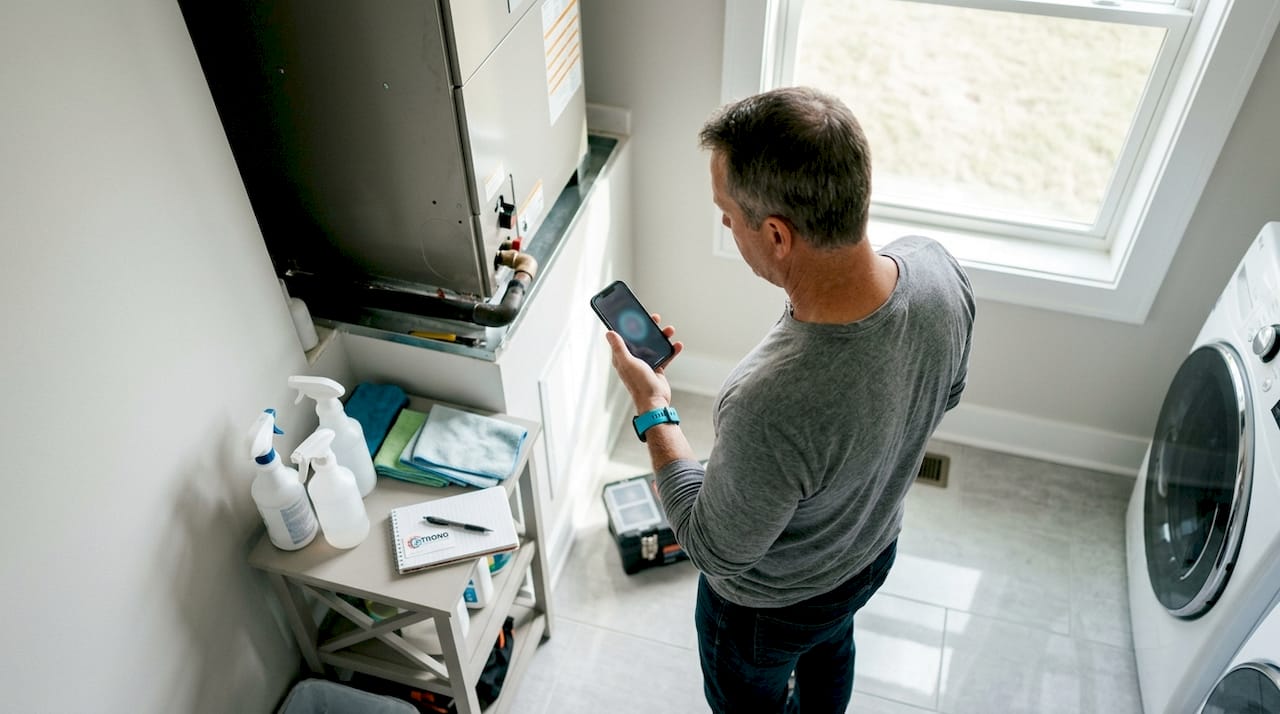
Predictive HVAC maintenance is defined as a condition-based strategy that uses real-time sensor data and analytics to identify equipment problems before they cause a breakdown. Unlike scheduling service by the calendar, this approach monitors what your system is actually doing, tracking signals like temperature, pressure, vibration, and electrical current to catch developing faults early. The industry term for this practice is condition-based maintenance, though predictive maintenance for HVAC has become the widely used phrase among homeowners and property managers. For anyone managing a home or property in Colorado Springs, where heating and cooling systems work hard across extreme seasonal swings, understanding this strategy can mean the difference between a planned repair and an emergency call in January.
What is predictive HVAC maintenance and how does it differ from the norm
Predictive HVAC maintenance is defined as condition-based maintenance that monitors actual operating parameters to guide timely interventions before failures happen. The core idea is straightforward: instead of waiting for something to break or following a fixed service schedule, you let the equipment tell you when it needs attention. Sensors collect data continuously, analytics software identifies patterns that signal wear or degradation, and a technician acts on that information before a minor issue becomes a costly failure.
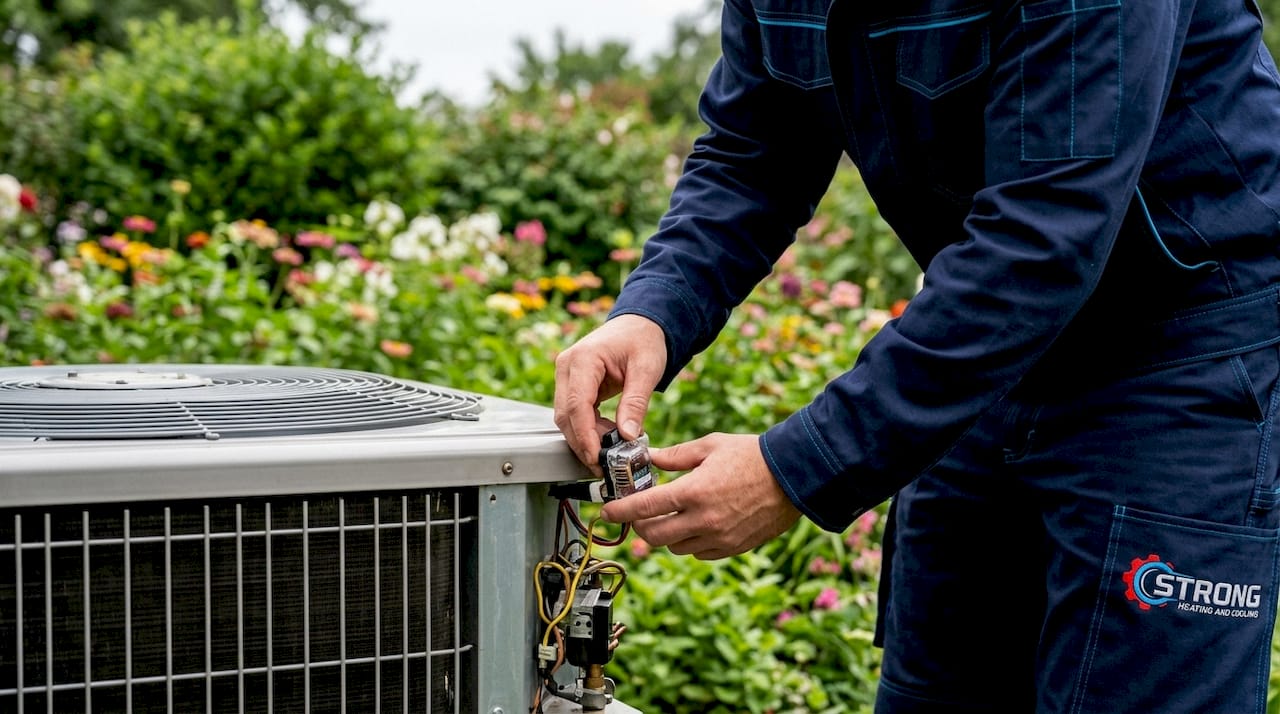
Think of it like health monitoring for your HVAC system. A routine physical catches problems before symptoms appear, and predictive maintenance works the same way, catching system drift early before you notice reduced comfort or a spike in your utility bill. The value is not just in preventing breakdowns. It is in improving the quality of every maintenance decision your technician makes.
This approach is particularly relevant for property managers overseeing multiple units, where one unplanned system failure can displace tenants and generate significant repair costs. For homeowners, the appeal is simpler: fewer surprises, lower bills, and a system that lasts longer.
How predictive HVAC maintenance works: technologies and data involved
The foundation of any predictive maintenance program is sensor data. Modern HVAC systems can be equipped with sensors that track a range of operating signals, and the data those sensors produce is what drives every decision in the process.
Typical monitored signals include:
- Supply and return air temperature
- Refrigerant pressures
- Motor current draw
- Vibration levels in compressors and fan motors
- Humidity readings
- Filter pressure drop
These signals are analyzed over time to detect anomalies that indicate wear or developing faults. A motor drawing slightly more current than its baseline, for example, may signal bearing wear weeks before the motor fails outright. That kind of early warning is invisible to a technician doing a standard seasonal checkup.
The role of AI and machine learning
Artificial intelligence and machine learning are what separate predictive maintenance from simple alert systems. Rather than triggering an alarm when a reading crosses a fixed threshold, machine learning models learn what normal operation looks like for your specific equipment and flag deviations from that pattern. AI can detect equipment degradation weeks before failure with accuracy approaching 99% in some documented cases, using methods like Bayesian networks to reason about which component is most likely causing an anomaly.
This matters because HVAC components affect each other. A refrigerant leak changes pressures, which changes compressor load, which changes current draw. A system that only monitors one signal in isolation will miss the full picture. Truly effective HVAC predictive analysis combines forward prediction with probabilistic diagnostic reasoning to account for these interdependencies.
Smart thermostats and connected devices
Smart thermostats like the Ecobee SmartThermostat and Google Nest Thermostat serve as entry points for residential predictive monitoring. They track runtime patterns, temperature recovery times, and short-cycling behavior, all of which can indicate developing problems. Pairing a smart thermostat with smart monitoring technology gives homeowners a practical starting point without requiring a full commercial sensor installation.
Pro Tip: Before any predictive system can work reliably, your technician needs to establish a baseline for your specific equipment under normal operating conditions. Without that reference point, the system cannot distinguish a genuine anomaly from normal variation, and you will receive alerts that mean nothing.
Predictive vs preventive HVAC: which approach fits your situation
Understanding the differences between maintenance strategies helps you make better decisions about your own system. The three main approaches are reactive, preventive, and predictive, and each has a distinct cost and risk profile.
| Approach | Timing | Cost profile | Outcome |
|---|---|---|---|
| Reactive maintenance | After failure occurs | High emergency repair costs | Unplanned downtime, potential system damage |
| Preventive maintenance | Fixed calendar schedule | Moderate, predictable costs | Reduces some failures, may over-service or miss developing issues |
| Predictive maintenance | Based on actual equipment condition | Higher upfront, lower long-term | Targets interventions precisely, reduces emergency repairs |
Reactive maintenance is the default for most homeowners who do not have a service plan. Something stops working, you call a technician, and you pay whatever the repair costs at that moment. This approach consistently produces the highest costs over time because failures tend to cascade. A failed capacitor that goes unaddressed can burn out a compressor, turning a $150 repair into a $1,500 one.
Preventive maintenance, which includes scheduled filter changes, coil cleaning, and seasonal tune-ups, is a significant improvement. The limitation is that calendar-based tasks cannot account for how your specific system is actually performing. A filter may need changing after six weeks in a dusty environment or after four months in a clean one. A fixed schedule misses that nuance.
Predictive maintenance complements preventive tasks rather than replacing them. Scheduled tasks like coil cleaning and refrigerant checks remain necessary. What predictive data adds is the ability to prioritize and time those tasks based on what the equipment actually needs. You can review the full picture of planned maintenance strategies to understand how these approaches work together in practice.
What are the benefits of predictive HVAC maintenance for homeowners
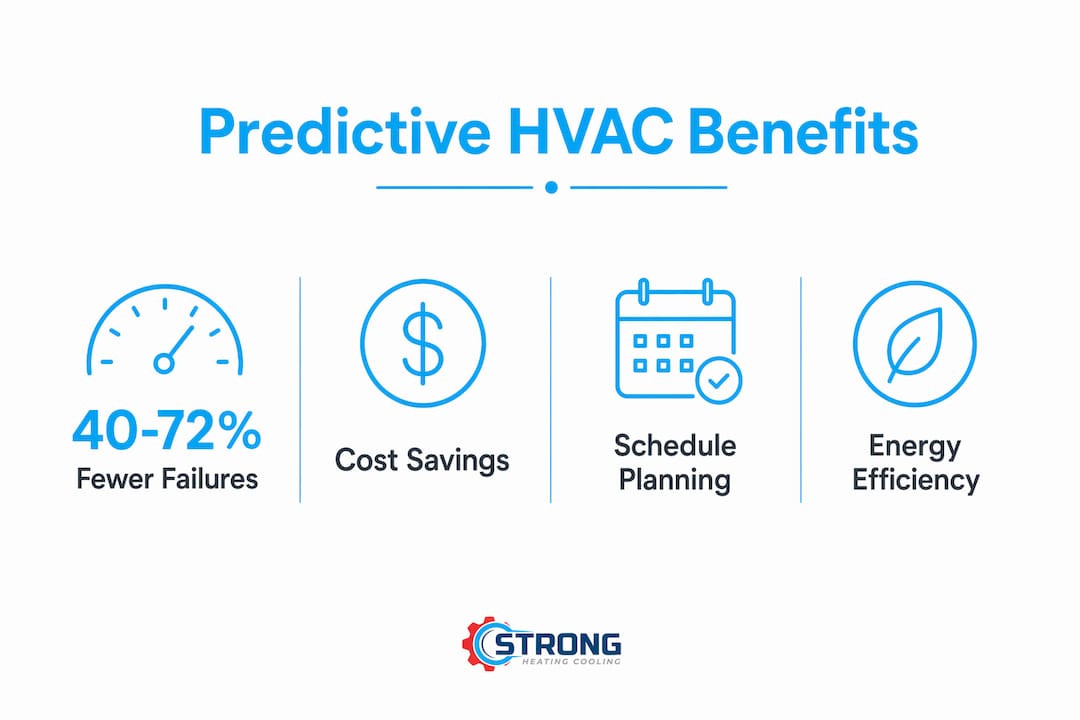
The practical benefits of predictive maintenance fall into four categories: reliability, cost, planning, and energy efficiency.
On reliability, the numbers are significant. Predictive maintenance reduces emergency HVAC failures by 40 to 72% compared to reactive and calendar-based approaches. That reduction means fewer calls to an emergency technician on a Saturday night in February, and fewer situations where your family is without heat or cooling for an extended period.
On cost, the savings come from two directions. First, catching a developing fault early almost always costs less to repair than addressing a full failure. Second, a system running within its optimal parameters uses less energy. An air conditioner with a partially blocked coil or low refrigerant charge works harder to deliver the same cooling, and that extra effort shows up on your utility bill every month. Consistent monitoring supports lower energy bills by keeping the system operating efficiently.
On planning, predictive maintenance gives property managers and homeowners the ability to schedule repairs during convenient windows rather than reacting to crises. Maintenance planning artifacts that identify affected assets, recommend maintenance windows, and predict failure modes allow you to schedule labor and parts during low-occupancy periods, avoiding rush charges and tenant disruption.
On equipment lifespan, a system that is never pushed to the point of catastrophic failure simply lasts longer. Most residential HVAC systems are rated for 15 to 20 years of service life. Systems that experience repeated emergency failures or extended periods of degraded operation rarely reach that ceiling. Predictive monitoring helps protect that investment by addressing wear before it compounds.
Key benefits at a glance:
- Fewer emergency breakdowns and unplanned repair costs
- Lower utility bills through consistent operating efficiency
- Extended equipment lifespan by preventing cascading failures
- Better scheduling flexibility for repairs and technician visits
- Improved comfort through early detection of performance drift
How to implement predictive HVAC maintenance at your home or property
Getting started with predictive maintenance does not require a commercial-grade sensor network. For most homeowners, a practical implementation follows a clear sequence.
-
Start with a smart thermostat. Devices like the Ecobee SmartThermostat or Google Nest Thermostat provide runtime data, temperature recovery tracking, and short-cycling alerts. This is the lowest-cost entry point and provides meaningful data immediately.
-
Schedule a baseline assessment with a qualified HVAC technician. Before any monitoring system can identify anomalies, it needs to know what normal looks like for your specific equipment. A technician measures supply and return temperatures, refrigerant pressures, motor current draw, and airflow to establish those reference points.
-
Choose a monitoring platform or service plan that fits your situation. Some HVAC service providers offer connected monitoring as part of a maintenance contract. Others install dedicated sensors on compressors, air handlers, and furnaces. Review HVAC service contract options to understand what different plans include.
-
Integrate technician feedback into the process. When a technician performs a repair, the findings should be recorded and fed back into the monitoring system. Technician feedback and repair outcomes refine predictive models over time, reducing false alarms and keeping predictions aligned with actual equipment behavior.
-
Act on alerts rather than filing them away. The most common failure point in predictive maintenance programs is treating alerts as informational rather than operational. When the system flags an anomaly, schedule a technician visit. Ignoring alerts defeats the entire purpose.
Pro Tip: Without accurate baselines, predictive maintenance systems generate noise that causes alerts to be ignored. Insist that your technician documents baseline readings at the start of any monitoring program, and update those baselines after any major repair or equipment replacement.
Common pitfalls to avoid include skipping the baseline calibration step, choosing a monitoring platform that only sends raw alerts without recommending specific actions, and failing to update the system after repairs. Predictive models should provide recommendations with maintenance windows and likely failure modes, not just raw data, to support real operational decisions.
Key takeaways
Predictive HVAC maintenance reduces emergency failures by 40 to 72% by using real-time sensor data and AI analytics to identify equipment degradation before it causes a breakdown.
| Point | Details |
|---|---|
| Core definition | Predictive maintenance monitors actual equipment condition, not calendar dates, to time interventions precisely. |
| Technology required | Sensors, smart thermostats, and AI analytics platforms work together to detect anomalies early. |
| Complements prevention | Scheduled tasks like coil cleaning remain necessary; predictive data improves their timing and prioritization. |
| Baseline is critical | Accurate equipment baselines are required before any monitoring system can reliably detect anomalies. |
| Cost and reliability gains | Facilities report 40 to 72% fewer emergency failures and measurable energy savings after adoption. |
Why predictive maintenance is worth taking seriously, even for a single home
I have spent enough time in the field to know that most homeowners do not think about their HVAC system until it stops working. That is understandable. These systems are designed to run quietly in the background, and when they do their job well, there is no reason to pay attention to them. But that invisibility is exactly what makes predictive maintenance so valuable.
The technology has matured significantly. What used to require commercial-grade infrastructure and a dedicated facilities team is now accessible through smart thermostats, connected sensors, and service plans that handle the monitoring for you. The barrier to entry for a homeowner in Colorado Springs is lower than most people realize.
What I would caution against is treating predictive maintenance as a set-and-forget solution. The technology is only as good as the data it receives, and that data quality depends on proper installation, accurate baselines, and a technician who understands how to interpret what the system is telling them. A predictive alert that gets ignored is no better than no alert at all.
The other thing worth saying plainly: predictive maintenance does not eliminate the need for preventive tasks. You still need to change filters, clean coils, and have a technician inspect refrigerant levels on a regular schedule. What predictive monitoring adds is the ability to catch the things that scheduled maintenance misses, the slow bearing wear, the gradual refrigerant loss, the compressor that is drawing more current than it should. Those are the failures that turn into expensive emergencies, and they are exactly what this approach is designed to prevent.
If you manage multiple rental units or a commercial property, the case is even stronger. One unplanned system failure during a Colorado summer can generate tenant complaints, emergency service fees, and potential liability. The investment in monitoring pays for itself quickly in that context.
— Owner
How Strongheatingandcooling supports your HVAC maintenance strategy
Strongheatingandcooling brings over 40 years of combined experience to HVAC maintenance across Colorado Springs and surrounding communities. The team works with homeowners and property managers to move beyond reactive repairs and toward maintenance strategies that protect equipment and reduce long-term costs.

Whether you need a baseline assessment to start a predictive monitoring program, a comprehensive cooling service that includes condition monitoring, or expert air conditioner services tailored to your home’s specific equipment, Strongheatingandcooling provides honest recommendations and quality workmanship at every visit. Contact the team today to schedule a predictive maintenance evaluation and find out what your system is actually telling you.
FAQ
What is predictive HVAC maintenance in simple terms?
Predictive HVAC maintenance is a condition-based approach that uses sensors and data analytics to monitor your system’s actual performance and identify problems before they cause a failure. It differs from standard scheduled maintenance by acting on real equipment data rather than fixed calendar intervals.
How does predictive maintenance differ from preventive maintenance?
Preventive maintenance follows a fixed schedule regardless of equipment condition, while predictive maintenance acts based on what sensors and analytics reveal about actual system health. The two approaches complement each other, with predictive data improving the timing and prioritization of scheduled tasks.
Can homeowners use predictive HVAC maintenance, or is it only for commercial buildings?
Homeowners can adopt predictive maintenance through smart thermostats, connected sensors, and service plans offered by qualified HVAC providers. The technology has become accessible enough for residential use, particularly when paired with a technician who can establish proper baselines and interpret the data.
How much can predictive maintenance reduce HVAC repair costs?
Facilities using AI-based predictive maintenance report 40 to 72% fewer emergency failures compared to reactive and calendar-based approaches, which directly reduces unplanned repair costs and emergency service fees.
What are the first signs that your HVAC system needs attention?
Early warning signs include longer-than-normal run times to reach the set temperature, unusual sounds from the compressor or air handler, and higher utility bills without a change in usage. Predictive monitoring catches these early warning signs before they escalate into full system failures.
Recommended
Need expert HVAC help?
Colorado Springs' veteran-owned heating & cooling team — Mon–Sat, 8 AM–7 PM. Same-day service when available.