
Water Heater Leaking? Here’s the Fix or Replace Verdict
Shut off the water supply and power (or the gas control) the moment you spot water pooling near your water heater. Once the unit is safe to approach, run a quick diagnostic to find the source: a wet fitting or valve is usually a repair, while moisture coming from the tank body itself means the heater needs to be replaced.
- Turn off the cold-water inlet valve above the heater, then flip the breaker or set the gas control to “pilot.”
- Wipe every surface dry and place paper towels at each suspect point to pinpoint the leak in a few hours.
- If you smell gas or see water touching electrical parts, leave the area and call your gas utility or a technician immediately.
Roughly 8 to 12 years is the typical working lifespan for a residential tank water heater, and that number matters more than it seems. Past that window, a leak is far more likely to come from corrosion inside the tank than from a $15 fitting.
Key Takeaways
A leaking water heater is repairable when the leak comes from a valve, fitting, or drain valve, but a leak from the tank body itself always means replacement.
| Point | Details |
|---|---|
| Act fast on safety | Shut off water and power (or gas) first, then contain water with towels or a drain hose. |
| Diagnose before deciding | Use the paper-towel test for 2 to 4 hours to pinpoint whether the leak is a fitting, valve, or tank failure. |
| Know the replacement red line | A leak from the tank body or seam always means replacement; no repair holds reliably. |
| Apply the 50% rule | Replace if repair cost approaches half the price of a new unit, especially past 8 to 10 years old. |
| Call Strong Heating And Cooling for certainty | Strong Heating And Cooling diagnoses the leak on-site and gives a straight repair-or-replace recommendation with transparent pricing. |
Table of Contents
- What To Do the Moment You Notice a Water Heater Leaking
- How Do You Find Where a Water Heater Is Leaking?
- What Causes a Water Heater To Leak?
- Can You Fix a Water Heater Leak Yourself?
- Should You Repair or Replace a Leaking Water Heater?
- How Do You Stop a Water Heater From Leaking Again?
- When Should You Call a Professional for a Water Heater Leak?
- Why Local Experience Matters for Water Heater Repairs
- What Homeowners Get Wrong About a Leaking Water Heater
- Get Professional Help With Your Leaking Water Heater
- Helpful Resources on Water Heater Leaks
- Sources
- FAQ
What To Do the Moment You Notice a Water Heater Leaking
Speed matters here more than perfection. The first five minutes after you spot water on the floor determine whether you’re dealing with a mop and a phone call or a flooded basement and a insurance claim.
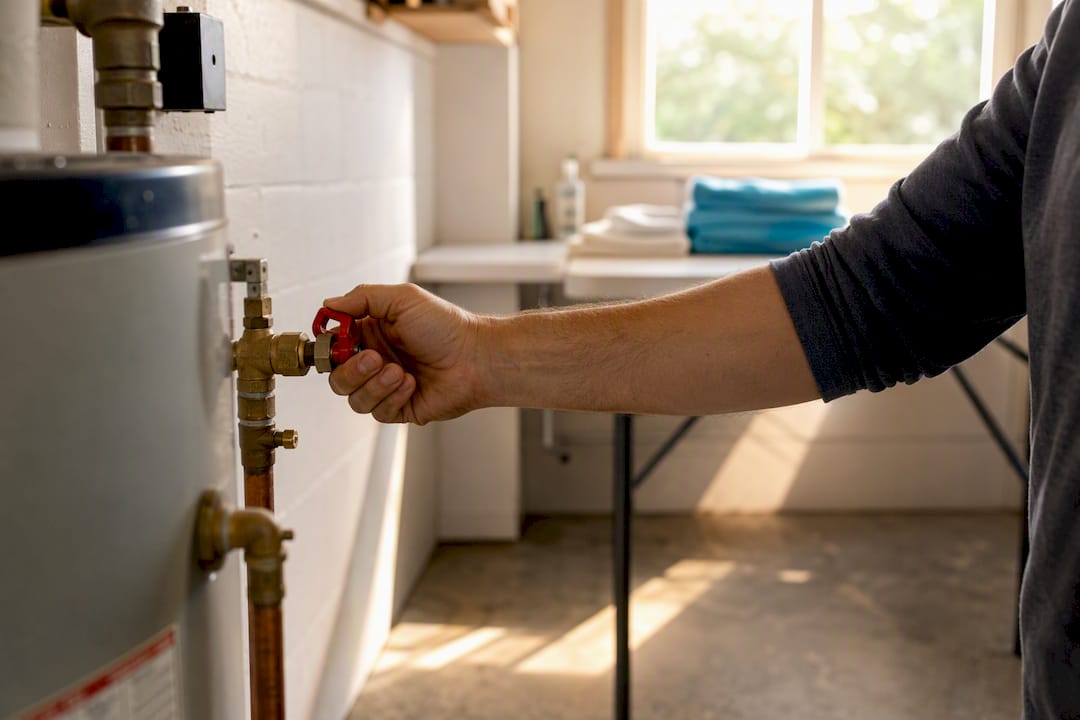
- Cut the water supply. Find the cold-water shutoff valve on the pipe entering the top of the tank and turn it clockwise until it stops. If that valve is corroded or won’t budge, shut off the main water valve for the house.
- Kill the power source. For an electric water heater, flip the dedicated breaker in your electrical panel. For a gas unit, turn the gas control knob to “pilot” or “off,” never yank the gas line itself.
- Address gas smell immediately. If you smell sulfur or rotten eggs, stop everything, leave the house, and call your gas utility or 911 from outside. Do not flip light switches or search for the source yourself.
- Contain what’s already on the floor. Towels, a wet/dry vacuum, and a few buckets handle most residential leaks. If the drain valve at the bottom of the tank still works, attach a garden hose and route the remaining water outside or into a floor drain.
- Photograph the scene. Before you clean up, snap a few pictures of the leak location and any water damage. It helps if you end up filing an insurance claim or calling a plumber for a quote.
Keep a small emergency kit near your water heater: a wrench that fits the shutoff valve, a flashlight, old towels, and a garden hose long enough to reach a drain or the outdoors. Five dollars in supplies can save you from a five-figure flooring repair.
Pro Tip: Label your main water shutoff and your water heater’s dedicated shutoff with a bright tag now, before there’s an emergency. Fumbling to identify the right valve while water spreads across your basement floor costs you time you don’t have.
How Do You Find Where a Water Heater Is Leaking?
Water travels. A puddle near the base of the tank doesn’t always mean the tank itself is failing. The most reliable homeowner diagnostic is the wipe-dry, paper-towel test, and it takes patience more than skill.
- Turn off power and water first, using the steps above, so you’re working safely.
- Wipe every surface around the heater completely dry, including the top fittings, the T&P valve discharge pipe, the drain valve, and the visible seams of the tank.
- Lay a dry paper towel directly beneath each of those points.
- Wait two to four hours (overnight works even better) without touching the unit.
- Come back and inspect each towel for moisture, staining, or mineral deposits.
What you find tells you almost everything:
- A wet towel only under the T&P valve discharge pipe usually points to pressure or thermal expansion issues, not a tank failure.
- Moisture at the top fittings or unions typically means a loose connection or worn seal, an easy fix.
- Dampness pooling at the drain valve near the bottom often traces back to a cheap plastic valve that’s simply failed with age.
- A towel wet along a seam or the tank’s outer shell is the one result you don’t want. That almost always means the tank has corroded through and needs replacement.
Condensation confuses a lot of homeowners, especially on humid days or when the unit sits in an unheated garage. To rule it out, turn the heater off completely overnight and recheck the towels in the morning. If they’re still dry, what you saw before was condensation, not a leak. One more clue worth watching: does the water only show up while the burner or heating element is running, or does it drip constantly regardless of use? Leaks tied to the heating cycle often point to expansion-related pressure, while constant drips point more toward a physical failure in a valve or seal.
What Causes a Water Heater To Leak?
Every leak traces back to one of four locations, and each one carries a different risk level and price tag.
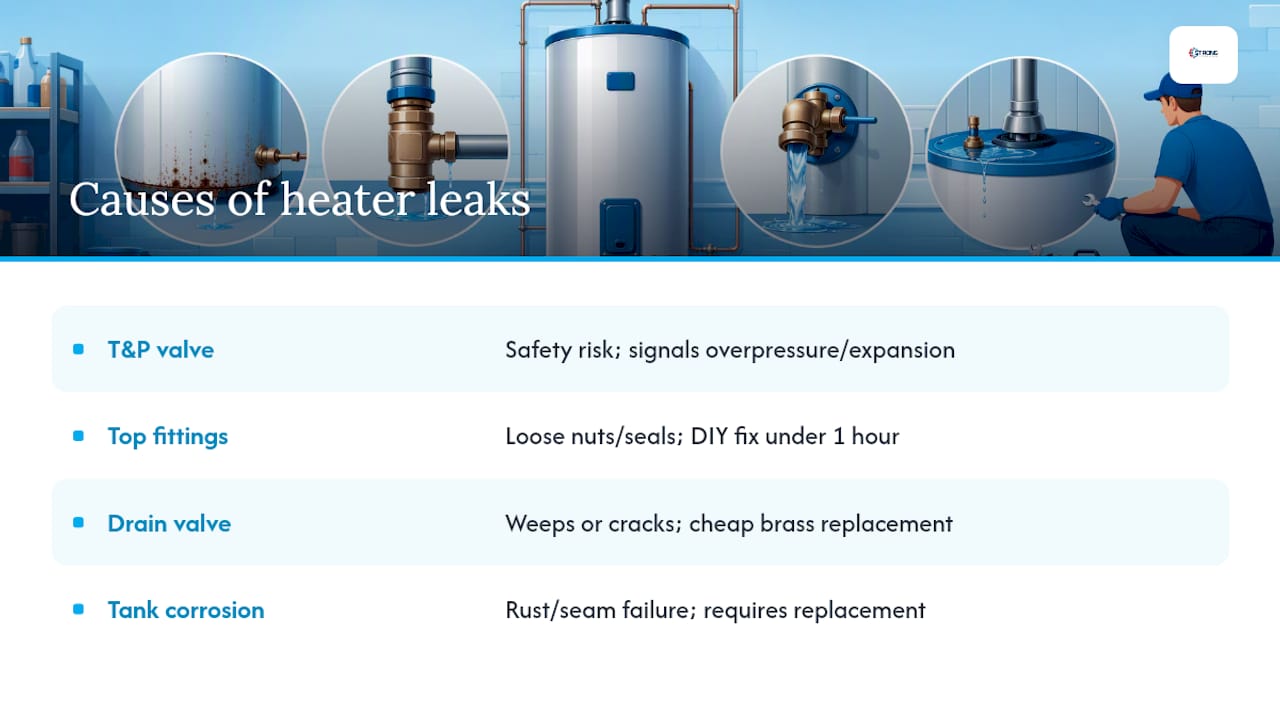
The T&P (temperature and pressure) relief valve discharges water when internal pressure or temperature climbs too high. That’s the valve doing its job, but if it discharges often, the real culprit is usually thermal expansion in a closed plumbing system, high water pressure, or a valve that’s stuck partway open. Ignoring repeated discharge is a genuine safety risk, since it signals pressure the tank isn’t built to hold indefinitely.
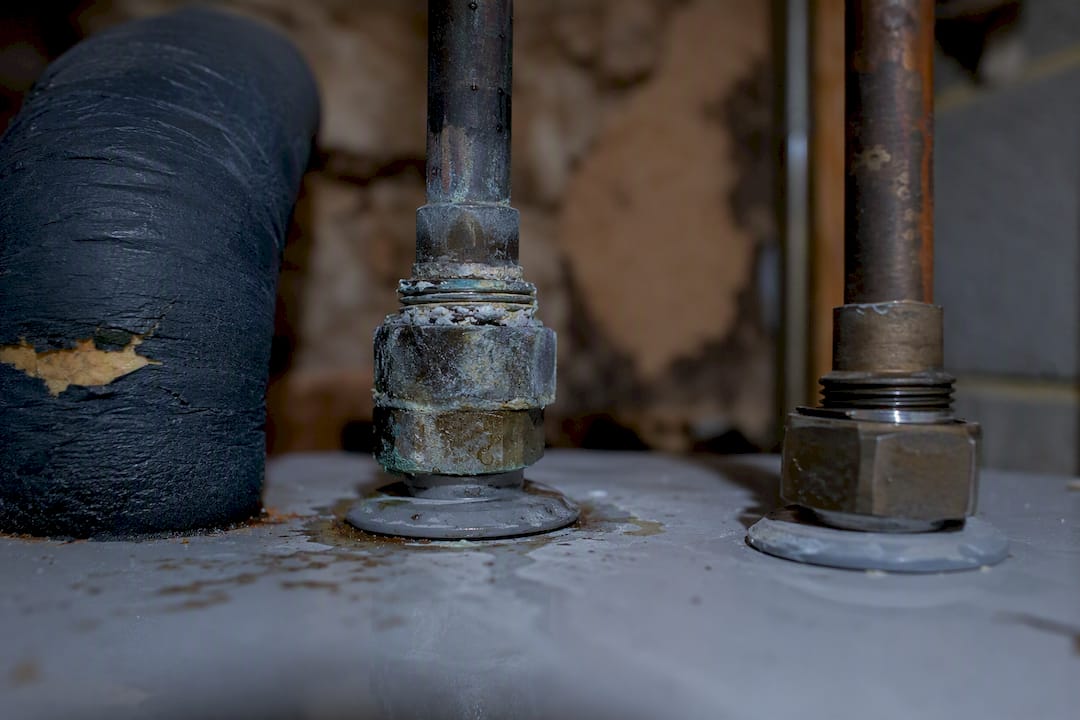
Top fittings and unions, where the cold inlet and hot outlet pipes connect to the tank, loosen over time from thermal cycling. A loose nut, a degraded seal, or a corroded dielectric union (the fitting that separates copper pipe from the steel tank to slow galvanic corrosion) accounts for a large share of the leaks homeowners can fix themselves in under an hour.
Drain valves, especially the plastic ones many manufacturers install as standard equipment, are notorious for weeping or cracking within a few years. Swapping one for a brass ball valve is one of the cheapest upgrades available for a water heater.
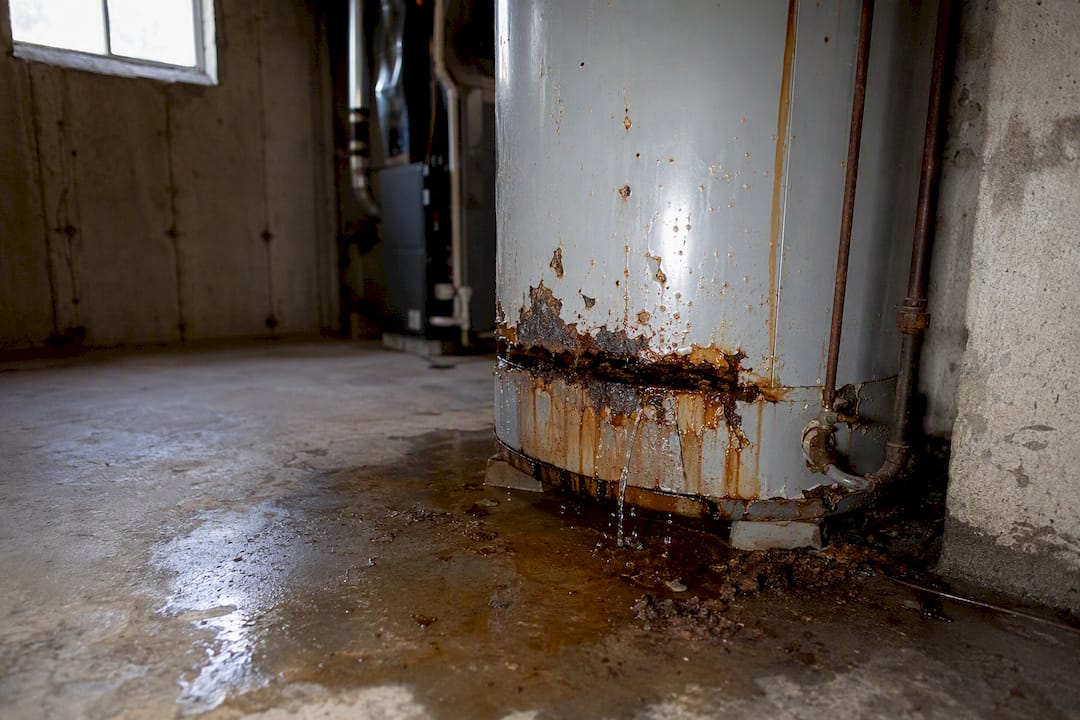
Tank corrosion and seam failure sit in a different category entirely. Once rust perforates the steel tank or a factory seam gives way, no patch, sealant, or epoxy holds reliably under sustained pressure and heat. A tank-body leak is a replacement situation, full stop.
Can You Fix a Water Heater Leak Yourself?
Several water heater leak repairs fall well within reach of a homeowner with basic tools and a free afternoon. Others don’t, and knowing the line between them protects both your safety and your warranty.
- Tighten loose fittings with the two-wrench technique. Hold the pipe steady with one wrench while you turn the fitting nut with the other, so you’re not twisting the pipe itself out of alignment. Wrap fresh Teflon tape around threaded connections, or swap the rubber washer if the fitting uses one, before you retighten.
- Replace a leaking drain valve. Drain the tank down below the valve’s level using the existing valve or a garden hose, unscrew the old valve, and thread in a brass ball valve using pipe dope or Teflon tape on the threads. Run water briefly to confirm the new valve seats tight.
- Test the T&P valve before assuming it’s bad. Lift the small lever on top of the valve halfway and let it snap back. Water should flow out through the discharge pipe and then stop completely. If it keeps dripping after the test, or won’t discharge at all, the valve needs replacement, which most manufacturers document as a straightforward homeowner or plumber task.
Pro Tip: Buy a brass ball valve rather than another plastic replacement drain valve. It costs a few dollars more but holds up for years longer under the same mineral buildup that kills plastic valves fast.
Stop and call a professional the moment gas lines, electrical wiring, or the inside of the tank itself are involved. Those repairs carry real safety consequences if done wrong, and in most areas, gas work legally requires a licensed technician anyway.
Should You Repair or Replace a Leaking Water Heater?
Age is the single most useful number in this decision. A water heater under 8 years old with a leak at a valve or fitting is usually worth repairing. Past 10 years, most manufacturers and plumbers recommend leaning toward replacement even for a moderate repair, since the tank itself is approaching the end of its expected service life.
A few signals should push you toward replacement regardless of age:
- Water leaking from the tank body, a seam, or visible rust perforation. There’s no dependable repair for this.
- Rumbling or popping noises during heating, which usually means heavy sediment buildup baking against the steel tank wall.
- Rusty or discolored hot water, a common sign the tank’s interior lining has broken down.
- Multiple repair calls within the past year or two, since repeated failures often signal the unit is entering its decline phase.
Check your manufacturer’s warranty before committing to either path; some tank warranties cover parts for 6 to 12 years, which changes the math on a borderline repair decision.
How Do You Stop a Water Heater From Leaking Again?
Most leaks are preventable with maintenance that takes less than an hour a year.
- Flush the tank annually. Draining a few gallons through the drain valve clears sediment that traps heat against the tank wall and accelerates corrosion from the inside out.
- Inspect the anode rod every 3 to 6 years. This sacrificial rod corrodes on purpose so your tank doesn’t, and swapping it out when it’s worn thin extends tank life meaningfully, especially in areas with hard water.
- Install an expansion tank on closed systems. If your home has a check valve or pressure-reducing valve, an expansion tank absorbs the pressure spikes that otherwise force the T&P valve to discharge repeatedly.
- Confirm your house water pressure sits between 50 and 80 psi. Anything higher stresses every fitting and valve on the unit continuously.
Small efficiency habits, like reducing overall hot water use, also ease the daily strain on the tank and its components.
Pro Tip: Swap plastic OEM parts for brass equivalents any time you’re already servicing the unit. It’s a small upcharge that pays for itself the first time you avoid an emergency call.
When Should You Call a Professional for a Water Heater Leak?
Some situations don’t leave room for a DIY attempt. Call a licensed technician right away if you find a tank-body leak, water in contact with live electrical components, the smell of gas, or a leak source you simply can’t pin down after the paper-towel test.
- Gas appliance repairs and most water heater replacements require a licensed plumber, and many jurisdictions require a permit for the replacement itself.
- A typical service visit includes diagnosis, a repair or replacement quote, and confirmation of the unit’s remaining warranty coverage.
- Reasonable questions for the technician: what caused the leak, whether the fix addresses the root cause, and what warranty covers the labor and parts.
- Ask about expected timeline and permit handling up front, since replacement jobs often take longer than a same-day repair.
If your unit is showing early warning signs before a full failure, scheduling an inspection before the leak starts saves you the emergency call entirely.
Why Local Experience Matters for Water Heater Repairs
Strong Heating And Cooling brings over 40 years of combined industry experience to water heater diagnosis and repair, and that experience shows up in realistic expectations, not just faster fixes.
- Most fitting and valve repairs are completed same-day, often for a fraction of replacement cost.
- Full replacements typically involve a scheduled install window and any required local permits handled by the technician.
What Homeowners Get Wrong About a Leaking Water Heater
The conventional advice treats every leak as an emergency requiring immediate replacement, and that’s where most homeowners waste money. A dripping fitting or a failed drain valve is not the same crisis as a corroded tank seam, and treating them identically pushes people into premature replacements they didn’t need.
What the diagnostic evidence actually supports is a two-step discipline: contain the water fast, then take the time to properly locate the source before deciding anything. The paper-towel test isn’t a nice-to-have step; it’s the difference between a $40 valve swap and a $1,500 replacement decision made on guesswork. Too many homeowners skip it because they’re anxious to “just fix it,” and that anxiety leads to either overpaying for an unnecessary new unit or underestimating a real tank failure.
The age-and-cost framework matters more than brand loyalty or sentimental attachment to a unit that’s “still working fine otherwise.” If your heater is past 10 years and the repair quote creeps toward half of replacement cost, the math has already made the decision. Trust the numbers over the instinct to patch one more time.
— Owner
Get Professional Help With Your Leaking Water Heater
Strong Heating And Cooling gives Colorado Springs homeowners a faster path to a fixed leak than trial-and-error DIY parts runs: one visit, an honest diagnosis of whether you’re looking at a repair or a replacement, and pricing that doesn’t sacrifice quality to hit a low number.

If your paper-towel test points to a fitting or valve issue, our technicians can usually resolve it in a single visit. If it points to the tank body itself, we’ll walk you through replacement options and installation warranties so you know exactly what you’re paying for and why. Every estimate comes with straightforward pricing before any work begins, and we handle permit requirements as part of the job rather than leaving you to figure that out alone.
Reach out to schedule a water heater inspection or repair visit, and we’ll help you settle the repair-versus-replace question with a technician on-site rather than a guess from the internet.
Helpful Resources on Water Heater Leaks
- Water heater lifespan: When to repair vs replace — Rheem
- Water Heater Leak Diagnosis & Repair — InspectApedia
- How to diagnose and repair a leaking water heater — This Old House
- Pool heater lifespan: How long do they really last? — R&R Swimming Pools
Sources
- Water heater lifespan: When to repair vs replace — Rheem
- Water Heater Leak Diagnosis & Repair — InspectApedia
- How to diagnose and repair a leaking water heater — This Old House
- Water Heater leaking — WaterClue
FAQ
What should I do if my hot water heater is leaking?
Shut off the water supply and the power or gas source immediately, then use the paper-towel test to find the leak’s source before deciding whether it needs a repair or a replacement.
Can I still use water if the water heater is leaking?
Avoid using hot water until you’ve shut off the supply and diagnosed the leak, since continued use with a compromised valve or tank can worsen the leak or create a safety hazard.
How long will a hot water heater last once it starts leaking?
A leak from a fitting or valve can often be repaired and won’t shorten the unit’s life, but a leak from the tank body itself can progress from a slow drip to a major flood within 24 to 72 hours, so drain and address it promptly.
Why would a water heater leak from underneath?
A leak underneath the tank usually comes from a failed drain valve, loose bottom fitting, or, in older units, corrosion that has eaten through the tank floor, which is the one cause that requires replacement rather than repair.
Is it cheaper to repair or replace a leaking water heater?
Repair is usually cheaper when the unit is under 8 years old and the fix costs well under half the price of a new system; past that threshold, replacement typically offers better long-term value.
Recommended
- Water Heater Repair Colorado Springs Tips | Strong Heating And Cooling
- Signs Your Water Heater Is About to Fail (Before It Floods) | Strong Heating And Cooling
- 9 Signs You Need a New Water Heater | Strong Heating And Cooling
- Boiler Repair Versus Replacement: How to Decide | Strong Heating And Cooling
Need expert HVAC help?
Colorado Springs' trusted, veteran-owned heating & cooling team — same-day service.