
Transitioning Commercial HVAC to Electric: A Facility Manager’s Roadmap
Electrify strategically using a phased, replace-on-burnout approach that targets hot water systems and end-of-life equipment first. That is the core recommendation, and it holds whether you manage a 20,000-square-foot office building or a multi-tenant retail strip. Transitioning commercial HVAC to electric does not require a single, disruptive overhaul. Done in sequence, it reduces capital risk, avoids stranded assets, and positions your building ahead of tightening Building Performance Standards.
Four actions you can take this week to size the project and avoid costly delays:
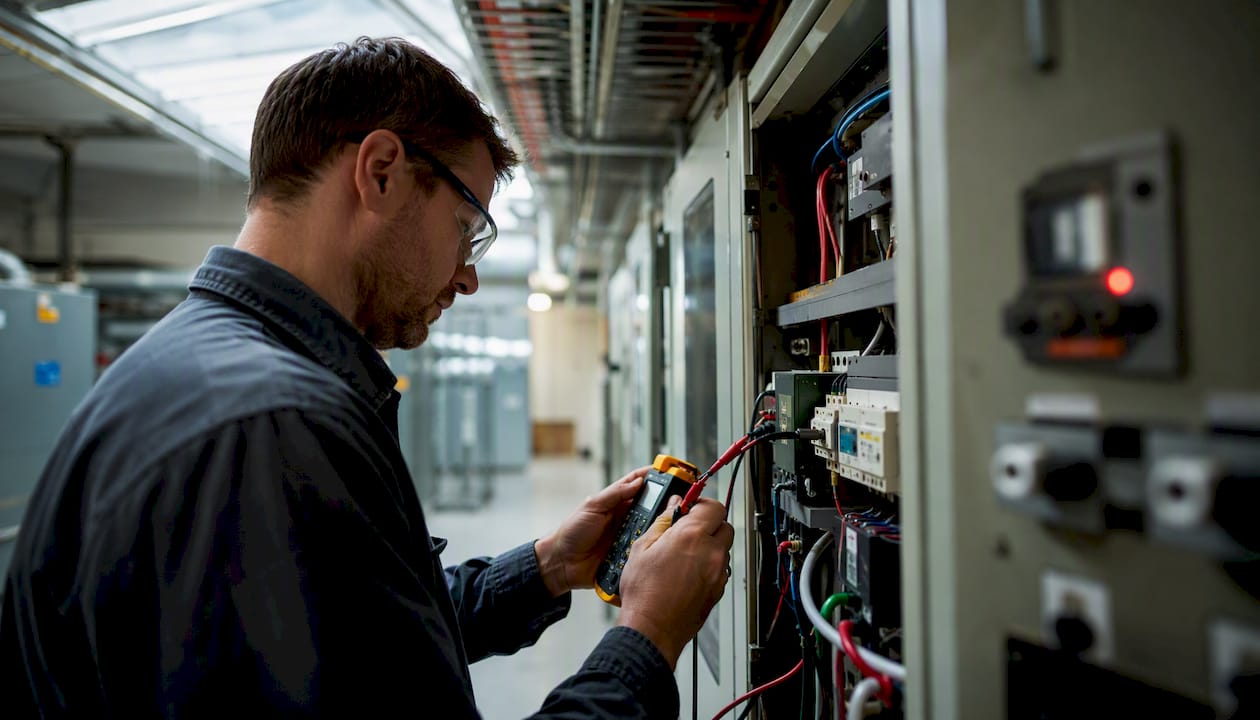
- Run an electrical service assessment to identify panel, riser, and transformer capacity before committing to any equipment.
- Inventory every gas-fired asset in the building with its age, expected replacement year, and estimated replacement cost.
- Search DSIRE for state and utility incentives in your area; available programs can materially change payback periods.
- Contact Strongheatingandcooling for a local feasibility review covering Colorado Springs and surrounding communities.
Deep energy retrofits, which bundle HVAC electrification with building shell and ventilation upgrades, can reduce greenhouse gas emissions by 40% or more and may unlock additional incentive tiers beyond standard equipment rebates.
Pro Tip: Start the electrical study and utility conversation at the same time you begin equipment inventory. Utility interconnection upgrades routinely take 6–18 months or longer, and that timeline, not equipment lead time, is usually the critical path.
Key Takeaways
Transitioning commercial HVAC to electric is most cost-effective when sequenced around equipment end-of-life, starting with hot water and end-of-life units, and supported by an early electrical assessment and utility interconnection inquiry.
| Point | Details |
|---|---|
| Start with the electrical study | Utility interconnection upgrades can take 6–18 months; begin this work at project scoping, not after design. |
| Sequence by end-of-life | Replace hot water and end-of-life equipment first to minimize incremental capital and avoid stranded assets. |
| Bundle upgrades for maximum incentives | Deep energy retrofits combining electrification with envelope and ventilation upgrades can reduce GHG emissions by 40% or more and unlock additional incentive tiers. |
| Manage tariff risk | Winter demand charges can erase projected savings without thermal storage, smart controls, or demand-response enrollment. |
| Strongheatingandcooling | Provides on-site electrical assessments, commercial heat pump installation, and phased retrofit planning for Colorado Springs area buildings. |
Table of Contents
- Why should you electrify commercial HVAC now?
- What electric HVAC technologies work best for commercial retrofits?
- How do you assess feasibility and sequence the transition?
- What does the transition actually cost, and where do incentives come from?
- What engineering tradeoffs should you plan for?
- Who does what, and what should your RFP require?
- What does a realistic 12–36 month project timeline look like?
- A practitioner’s perspective on what actually surprises owners
- Strongheatingandcooling can help you plan and execute the transition
- Sources
- FAQ
Why should you electrify commercial HVAC now?
The business case for commercial HVAC electrification has shifted from aspirational to financial. Building Performance Standards at the city and state level are setting carbon intensity limits with penalty structures that make inaction expensive. The BOMA Electrification Study 2023 found that timing and incremental capital cost drive the business case at the portfolio level, which means owners who align replacements with end-of-life schedules pay far less than those who retrofit mid-life equipment under compliance pressure.
Modern commercial heat pumps deliver coefficient of performance (COP) values of 3.0–4.5 under moderate conditions, compared to the effective COP of roughly 0.8–0.95 for a gas boiler or furnace. That gap translates directly to lower operating costs when electricity rates are reasonable and the building’s load profile is well-managed.
Tenant demand is also shifting. Corporate occupants with Scope 1 and Scope 2 emissions targets increasingly prefer electrified buildings, and that preference is beginning to show up in lease negotiations. On the incentive side, the ACEEE research on building electrification programs confirms that program budgets are growing and that administrators are increasingly pairing heat pump rebates with efficiency, storage, and demand-response measures, which means the financial case only improves when you bundle upgrades.
What electric HVAC technologies work best for commercial retrofits?
Commercial electrification is not a single technology decision. The right system depends on building size, existing distribution infrastructure, climate, and available electrical capacity.
Air-to-water (A2W) hydronic heat pumps replace gas boilers in buildings with existing hydronic distribution. They work well in moderate climates and in buildings where the distribution system can be rebalanced for lower supply temperatures (typically 120–140°F rather than 180°F). Retrofit complexity is moderate to high.
Variable refrigerant flow (VRF/VRV) systems suit mid-size commercial buildings with diverse simultaneous heating and cooling loads. They offer zone-level control, high part-load efficiency, and relatively compact equipment footprints. Electrical capacity requirements are significant, but the systems avoid the hydronic distribution mismatch problem entirely.
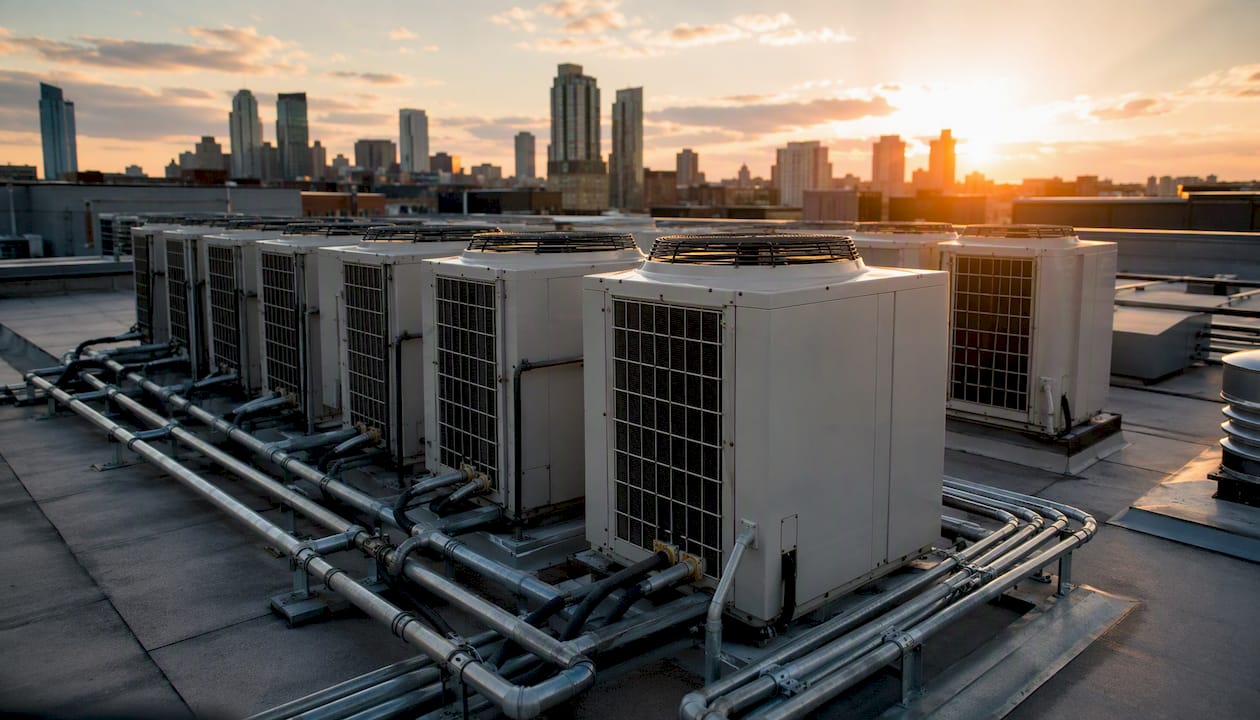
Heat recovery chillers are the right choice for larger buildings with year-round simultaneous heating and cooling demand, such as hotels, hospitals, or mixed-use towers. They can deliver both chilled water and hot water from a single refrigerant circuit, which improves overall system efficiency.
Packaged terminal heat pumps (PTHPs) are the lowest-complexity option for perimeter zones, hotels, and smaller commercial spaces. They require minimal distribution changes and can replace gas PTACs unit by unit.
Electric boilers are a transitional or backup technology. They carry lower capital cost than heat pumps but offer no efficiency advantage over combustion, so they are best used as a bridge or peak supplement rather than a primary heating source.
| Technology | Best for | Capital vs. lifecycle cost | Electrical capacity risk | Climate suitability | Retrofit complexity | Incentive availability |
|---|---|---|---|---|---|---|
| A2W hydronic heat pump | Mid-to-large buildings with existing hydronic systems | Higher capital, lower lifecycle | Moderate | Moderate climates; performance drops below 15°F | High (distribution redesign likely) | Strong; often qualifies for deep-retrofit bonuses |
| VRF/VRV system | Mid-size buildings, diverse zone loads | Moderate capital, low lifecycle | Moderate to high | Good in most U.S. climates | Moderate | Good; heat pump rebates widely available |
| Heat recovery chiller | Large buildings with simultaneous heating and cooling | High capital, lowest lifecycle | High | All climates | High | Moderate; project-specific |
| PTHP (packaged terminal) | Hotels, perimeter zones, smaller spaces | Low capital, moderate lifecycle | Low | Most climates; check low-temp ratings | Low | Good; unit-level rebates common |
| Electric boiler | Bridge/backup or peak supplement | Low capital, high lifecycle | Moderate | All climates | Low | Limited |
Pro Tip: Before specifying an A2W heat pump, confirm your existing terminal units (fan coil units, radiators, or VAV coils) can deliver adequate heat at 130°F supply water. Oversizing the heat pump to compensate for a mismatched distribution system is a common and costly mistake.
How do you assess feasibility and sequence the transition?
The DOE Large Building Boiler Electrification Guidance and the BOMA study both point to the same starting point: a complete inventory of gas-fired assets mapped against replacement years and compliance deadlines.
A practical feasibility checklist covers these areas:
- List every gas-fired piece of equipment (boilers, furnaces, water heaters, unit heaters) with installation year, expected remaining life, and nameplate capacity.
- Map replacement years against any applicable BPS compliance deadlines in your jurisdiction.
- Commission an electrical assessment covering service entrance capacity, main distribution panel ratings, riser capacity, and transformer sizing.
- Identify utility interconnection requirements and request a preliminary upgrade timeline from your utility.
- Evaluate building envelope and insulation conditions, since a tighter envelope reduces the heating load and allows smaller, less expensive heat pump equipment.
- Review commercial HVAC efficiency upgrades that reduce load before electrification, which lowers equipment sizing and capital cost.
Sequencing priorities follow a clear logic. Replace domestic hot water heating first: it is the simplest conversion, carries strong incentives, and removes a meaningful gas load. End-of-life space heating equipment comes next, replaced with heat pumps rather than like-for-like gas equipment. Central plant conversions, which require the most electrical capacity and the longest utility lead times, come last. Where a central plant cannot be replaced immediately, a hybrid dual-fuel configuration, retaining gas backup while adding electric primary capacity, is a practical and widely used bridge.
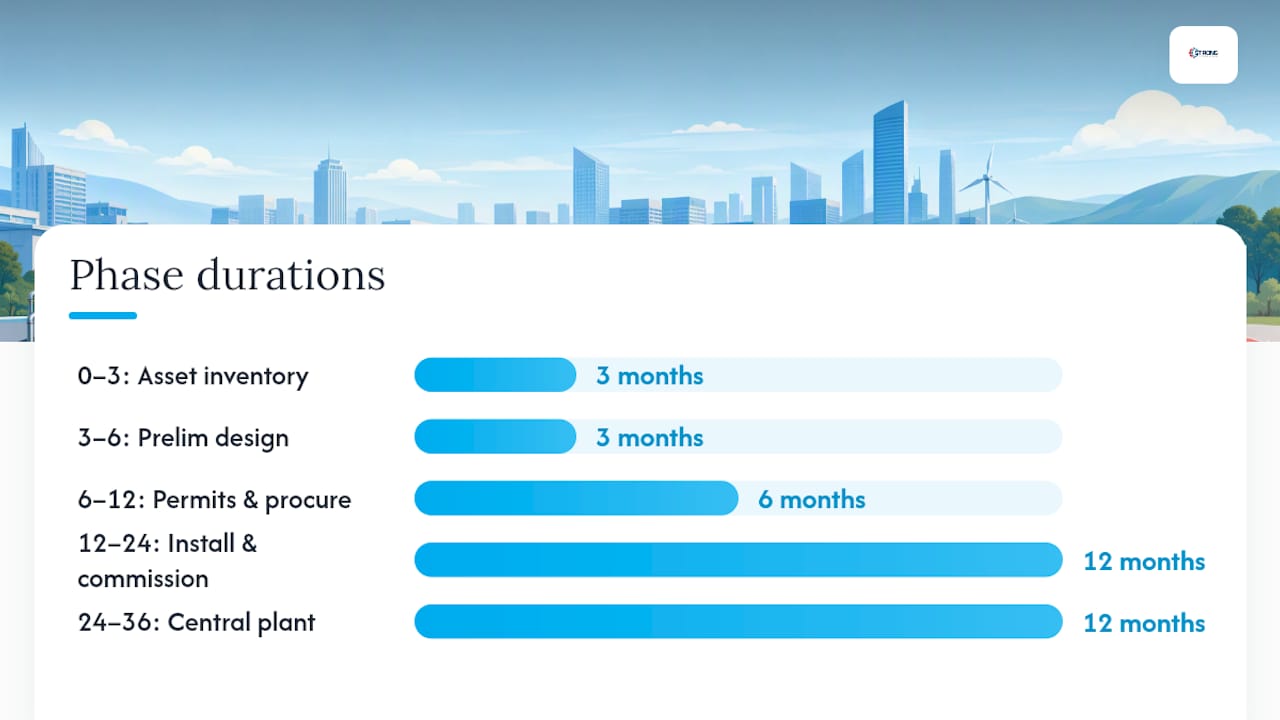
A 12–36 month sequencing example:
- Months 0–3: Complete asset inventory, commission electrical study, submit utility interconnection inquiry, search DSIRE for available incentives.
- Months 3–6: Receive electrical study results, engage mechanical and electrical engineers for preliminary design, apply for incentive pre-approval where required.
- Months 6–12: Permit applications, utility upgrade work begins (if required), procure long-lead equipment.
- Months 12–24: Install and commission first-phase equipment (hot water, end-of-life units), verify performance.
- Months 24–36: Central plant or remaining equipment conversions, final commissioning, demand-response enrollment.
What does the transition actually cost, and where do incentives come from?
Cost framing matters here. The right comparison is not electric heat pump versus gas boiler in isolation. It is the lifecycle cost of the electric system, including avoided BPS penalties, lower fuel costs, and available incentives, versus the lifecycle cost of a like-for-like gas replacement.
Electrical service upgrades are frequently the largest unexpected cost. The AEECenter engineering guide provides example calculations showing that service upgrades are often required and can add significantly to project budgets, particularly for larger buildings converting central heating plants. Getting that number early, before equipment selection, prevents budget surprises.
Tariff structure is the other major variable. Switching to electric heat shifts peak demand toward winter mornings. Without mitigation, demand charges can erode projected savings. Thermal storage, smart controls, and demand-response enrollment are the primary tools for managing that exposure. Ask your utility about time-of-use rates and demand charge structures before finalizing system design.
Electrification programs across the country typically take the form of heat pump rebates, but program budgets are rising and administrators increasingly pair incentives with efficiency, storage, and demand-response measures. Bundling upgrades is the most reliable way to maximize total incentive value.
Incentive sources to check:
- DSIRE for state and utility programs specific to your location and equipment type.
- Federal commercial programs under the Inflation Reduction Act’s Section 179D energy-efficient commercial building deduction and investment tax credits for qualifying equipment.
- Utility-specific rebate programs, which often carry the largest per-unit dollar values for commercial heat pumps.
- State energy office programs, which vary widely but can include low-interest financing, technical assistance, and bonus incentives for deep retrofits.
Review financing options for HVAC replacement to understand how to structure capital alongside rebates and tax incentives.
What engineering tradeoffs should you plan for?
Commercial electrification requires system-level redesign, not a one-for-one equipment swap. The AEECenter engineering guide is explicit: electrical service upgrades, load profile changes, HVAC redesign, and envelope improvements are all common requirements.
The most frequent distribution mismatch is supply water temperature. Existing high-temperature hydronic systems designed for 180°F supply water cannot extract full capacity from a heat pump running at 130°F. Solutions include replacing terminal units with larger fan coil units, increasing flow rates, or adding supplemental electric resistance for peak conditions. Each option carries a different cost and complexity profile.
Smart electrification pairs efficiency measures, demand response, and controls so buildings can shift load during grid stress and potentially participate in flexibility markets, which can generate revenue or bill credits that improve project economics.
Controls sequencing deserves attention early. Heat pumps, thermal storage, and demand-response systems need coordinated control logic. Specifying a building automation system (BAS) upgrade or integration as part of the HVAC scope, rather than as a separate later project, avoids costly rework.
Commissioning requirements belong in the RFP. Acceptance tests should verify COP at design conditions, supply temperature at design load, and demand response functionality. A commissioning agent independent of the installing contractor is worth the cost on any project above $500,000 in equipment value.
Pro Tip: Avoid oversizing heat pumps to compensate for distribution or envelope deficiencies. An oversized unit short-cycles, degrades efficiency, and wears out faster. Fix the root cause first, then size the equipment to the corrected load.
Who does what, and what should your RFP require?
Clear role definition prevents scope gaps. A typical project team includes an owner or owner’s representative, a licensed mechanical engineer, a licensed electrical engineer, a commissioning agent, and a qualified HVAC contractor with documented heat pump experience.
Your RFP should require responses to these specific questions:
- Provide a preliminary electrical interconnection plan identifying required service upgrades and estimated utility timeline.
- Include a tariff impact analysis showing projected demand charge exposure under the proposed system and mitigation measures.
- Describe the load modeling methodology and provide design-day heating and cooling load calculations.
- Submit a staged implementation plan showing which equipment is replaced in which phase and why.
- Identify the commissioning scope and confirm whether a third-party commissioning agent is included or excluded from the bid.
Any bid that lacks a utility interconnection plan, omits lifecycle cost analysis, or guarantees COP performance without site-specific load data should be treated as under-scoped. Those omissions predict cost overruns and performance shortfalls more reliably than any other single indicator.
Red flags to watch for in contractor responses:
- No mention of electrical service capacity or utility coordination.
- COP guarantees stated without reference to design-day outdoor temperatures or building load data.
- A single-phase implementation plan with no provision for hybrid staging.
- Commissioning described as “startup and checkout” rather than performance verification against design targets.
What does a realistic 12–36 month project timeline look like?
| Milestone | Responsible party | Typical lead time |
|---|---|---|
| Asset inventory and electrical study | Owner / mechanical engineer | 4 weeks |
| Utility interconnection inquiry | Owner / electrical engineer | 2–4 weeks to submit; 6–18 months for utility response |
| Incentive pre-approval applications | Owner / owner’s rep | 4–12 weeks depending on program |
| Preliminary design and permitting | Mechanical and electrical engineers | 8 weeks |
| Equipment procurement | Contractor | 12 weeks for commercial heat pumps |
| Electrical service upgrade construction | Utility / electrical contractor | 3–12 months after approval |
| Phase 1 installation and commissioning | HVAC contractor / commissioning agent | 4–12 weeks per phase |
| Demand-response enrollment | Owner / utility | 4 weeks after commissioning |
The utility interconnection timeline is the most common reason projects slip. Submit the inquiry at the same time you commission the electrical study, not after design is complete.
Pro Tip: Order long-lead commercial heat pump equipment as soon as the preliminary design is approved, before permits are finalized. Permit revisions rarely require equipment changes, and the lead time risk is real.
A practitioner’s perspective on what actually surprises owners
What catches most facility managers off guard is not the equipment cost. It is the electrical infrastructure gap. Buildings that were designed around gas heating often have electrical services sized for lighting and plug loads only. When you add electric heating, the service entrance, main switchgear, and sometimes the utility transformer all need upgrading. That work takes time and money that rarely appears in early budget estimates.
In the Colorado Springs area, altitude and cold-snap temperatures matter for equipment selection. Heat pump performance ratings are typically published at 47°F and 17°F outdoor conditions. At elevations above 6,000 feet and during extended cold snaps, you need to verify rated capacity at actual design-day temperatures, not just the standard test points. Hybrid staging, retaining a gas backup for the coldest days while running the heat pump as the primary source, is a practical answer for this climate and reduces the electrical upgrade scope.
Tenant scheduling is the other underestimated challenge. Phased retrofits in occupied buildings require careful coordination. Replacing a rooftop unit during a shoulder season, when neither heating nor cooling is critical, reduces tenant impact and gives the commissioning team time to tune the system before peak demand arrives.
The commercial HVAC retrofit case study results from Strongheatingandcooling show what careful sequencing and thorough commissioning actually deliver in practice.
Strongheatingandcooling can help you plan and execute the transition
Replacing gas-fired commercial HVAC with electric systems is a significant investment, and the difference between a smooth project and a costly one usually comes down to how well the electrical assessment, equipment selection, and utility coordination are handled before any equipment is ordered.

Strongheatingandcooling serves commercial property owners and facility managers throughout Colorado Springs and surrounding communities. The team provides on-site scoping, preliminary electrical baseline assessments, commercial heat pump installation, phased retrofit project management, and commissioning support. When you call, you get a clear picture of what your building needs, what it will cost, and how to phase the work to fit your capital plan and tenant schedule. Strongheatingandcooling also guides clients through available financing and rebate programs so incentives are captured, not missed. Call or request a consultation online to get a phased implementation proposal specific to your building.
Sources
These resources are the most authoritative starting points for commercial HVAC electrification planning in the United States:
- Large Building Boiler Electrification Guidance (DOE)
- Electrification in Commercial Buildings: Engineering the Transition (AEECenter)
- BOMA Electrification Study 2023
- Mass Save | Deep Energy Retrofit
- Database of State Incentives for Renewables & Efficiency® (DSIRE)
- ACEEE research report on building electrification programs
This article is general information, not a substitute for advice from a qualified financial advisor. Consult a qualified financial professional about your own circumstances before acting on anything here.
FAQ
What is the first step in transitioning commercial HVAC to electric?
Commission an electrical service assessment and complete a gas-asset inventory simultaneously. Utility interconnection upgrades can take 6–18 months, so starting both tasks at project scoping prevents schedule delays.
Which electric heating technology suits most commercial retrofits?
VRF systems suit mid-size buildings with diverse zone loads, while A2W hydronic heat pumps work well in buildings with existing hydronic distribution, provided the terminals can operate at lower supply temperatures.
How do demand charges affect the economics of electric commercial HVAC?
Switching to electric heat shifts peak demand toward winter mornings, which can increase demand charges significantly. Thermal storage, smart controls, and demand-response enrollment are the primary tools for managing that exposure.
Where can facility managers find incentives for commercial HVAC electrification?
DSIRE is the canonical database for state and utility programs. Federal programs under Section 179D and utility-specific heat pump rebates are also worth reviewing before finalizing project budgets.
Can Strongheatingandcooling help with commercial heat pump projects in Colorado Springs?
Yes. Strongheatingandcooling provides on-site electrical assessments, commercial heat pump installation, phased retrofit project management, and financing guidance for commercial properties throughout Colorado Springs and surrounding communities.
Recommended
Need expert HVAC help?
Colorado Springs' trusted, veteran-owned heating & cooling team — emergency service.