
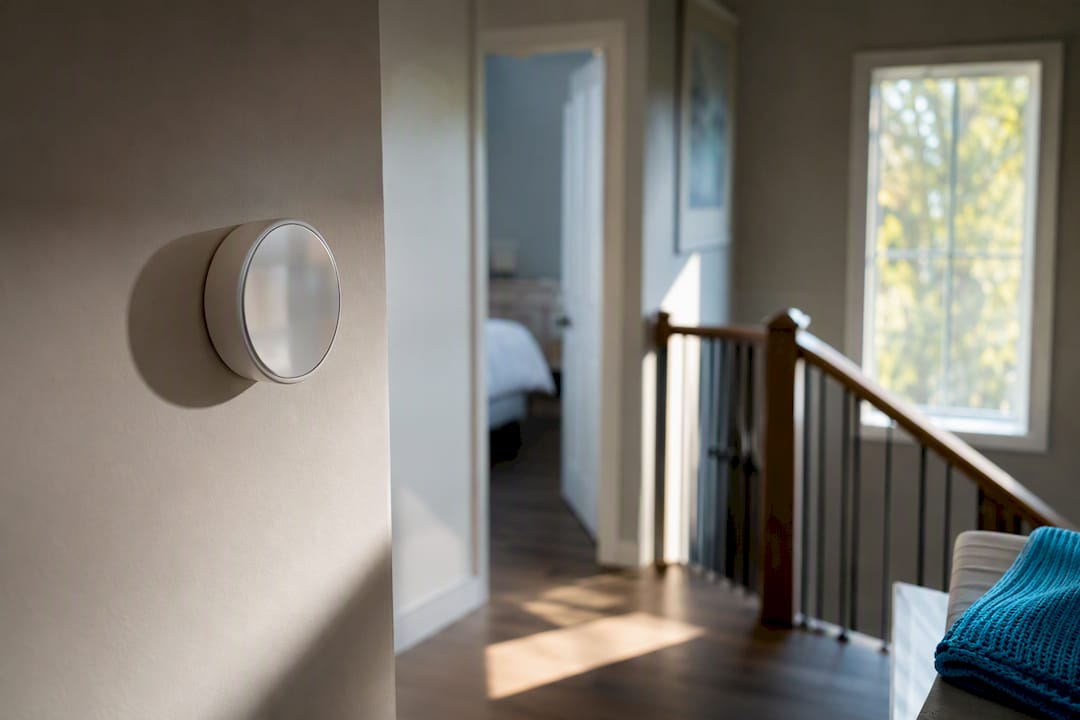
Homeowners: 4 Quick Checks to Verify Thermostat Placement
Put the thermostat on an interior wall in a central, frequently used room, mounted about 52 to 60 inches from the floor. Keep it several feet from supply vents, exterior walls, windows, and kitchens, and away from direct sunlight. If your home has stubborn hot or cold spots after that, remote sensors or zoning usually fix what relocation alone can’t.
TL;DR:
- A central hallway or main living area on an interior wall 52 to 60 inches above the floor is ideal, avoiding exterior walls, vents, sunlight, and rarely used rooms.
- Placing a thermostat near windows, supply registers, heaters, or in direct sunlight can cause inaccurate readings that lead to inefficient HVAC cycles and increased wear.
- In multi-story homes, a single thermostat often cannot account for temperature differences caused by heat rising or sun exposure, so zoning or additional sensors may be necessary.
- Using remote sensors with smart thermostats helps average or prioritize room temperatures, especially when ideal placement is not feasible, but good site selection remains important.
- Simple testing with independent thermometers can identify placement issues, as a consistent difference over 3°F indicates the thermostat may be providing faulty signals.
Table of Contents
- Where Is the Best Placement for a Thermostat?
- Which Locations Distort a Thermostat’s Reading?
- What Height Should a Thermostat Be Mounted At?
- Does a Multi-Story Home Need More Than One Thermostat?
- How Do Smart Thermostats Change Placement Strategy?
- How Do You Test Whether Your Thermostat Placement Is Accurate?
- What We See Most Often on Thermostat Placement Calls
- Ready to Fix Persistent Hot or Cold Spots?
- Sources
- FAQ
Where Is the Best Placement for a Thermostat?
The thermostat’s job is to sample the air and act like it represents your whole home, so the room you pick matters more than most homeowners realize. A central hallway or main living area, the kind of space you walk through several times a day, tends to give the most honest reading because it captures the air that’s actually circulating through the house.
That’s a slightly different rule than “put it in the geometric center.” A hallway that sees real airflow from the return grille and daily foot traffic often beats a formal center-of-the-house spot that’s boxed in by closed doors, according to Hvac. Bedrooms and guest rooms are poor candidates for the same reason: they sit closed off for hours, so their air temperatures drift away from the rest of the house.
In a two-story or three-story home, the first floor is usually the better call unless the system is already zoned. Heat rises, so a thermostat mounted upstairs often reads warmer than the living spaces below it, triggering shutoffs before the first floor actually catches up.
Good candidates include:
- A central hallway with steady air movement and no door separating it from the main living space
- A living room or family room where the household spends the most waking hours
- Any first-floor interior wall in a multi-story home without zoning
Pro Tip: Stand in the spot you’re considering for a full day and notice if it ever feels noticeably warmer or cooler than the rest of the house. If it does, that’s your thermostat’s final answer too.
Which Locations Distort a Thermostat’s Reading?
A thermostat can only respond to what it feels, so a bad spot doesn’t just misread the temperature. It tells your furnace or air conditioner to run when it shouldn’t, and skip cycles when it should be running. HVAC professionals sometimes call the thermostat the “brain” of the system, and a brain fed bad signals makes bad decisions, cycling early and adding wear to the equipment, according to HVAC.com.
Here’s what consistently throws readings off:
- Exterior walls and window-adjacent walls. Outdoor temperature swings and drafts bleed through, so the thermostat reacts to weather instead of your indoor comfort.
- Near supply registers or return grilles. A blast of conditioned air hits the sensor directly and creates a false spike, shutting the system off long before the rest of the room catches up.
- Close to furnaces, fireplaces, ovens, or large electronics. Heat sources like these push local temperature up several degrees, tricking the thermostat into thinking the house is warmer than it is.
- In direct sunlight. A sunbeam on the thermostat’s casing can raise its internal reading well past actual room temperature.
- Narrow stairway shafts or rarely used rooms. These spaces trap unrepresentative air pockets that don’t reflect how the rest of the home feels.
ENERGY STAR’s own installation guidance echoes this list almost point for point, recommending thermostats stay clear of registers, appliances, doorways, fireplaces, skylights, and windows for exactly these reasons, per its heating and cooling guide.
What Height Should a Thermostat Be Mounted At?
Mount the thermostat between 52 and 60 inches above the finished floor, which lands roughly at chest height for most adults. That range matters because air stratifies: cooler air settles low, warmer air collects near the ceiling, and a thermostat placed too high or too low samples the extremes instead of the temperature people actually feel while standing or sitting in the room.
A few clearances are worth measuring rather than eyeballing:
- Keep at least 4 feet of horizontal distance from any supply vent
- Leave roughly 18 inches of clearance from exterior walls where your layout allows it
- Avoid mounting directly over an uninsulated exterior wall cavity, since cold seeping through the wall can skew the sensor low
- Never install behind furniture, bookcases, or curtains that block normal airflow to the unit
Poor placement doesn’t just annoy homeowners with an inconsistent house. It can create multi-degree discrepancies between what the thermostat reads and what a room actually feels like, which is enough to send a perfectly good HVAC system into short, inefficient cycles all day long.
Does a Multi-Story Home Need More Than One Thermostat?
Sometimes, yes. Stack effect, the tendency for warm air to rise and settle upstairs while cooler air pools near the ground floor, means a single thermostat in one location can never fully represent a two-story house. Add strong afternoon sun through west-facing windows, and you get room-to-room load differences that no amount of clever placement can correct on its own.
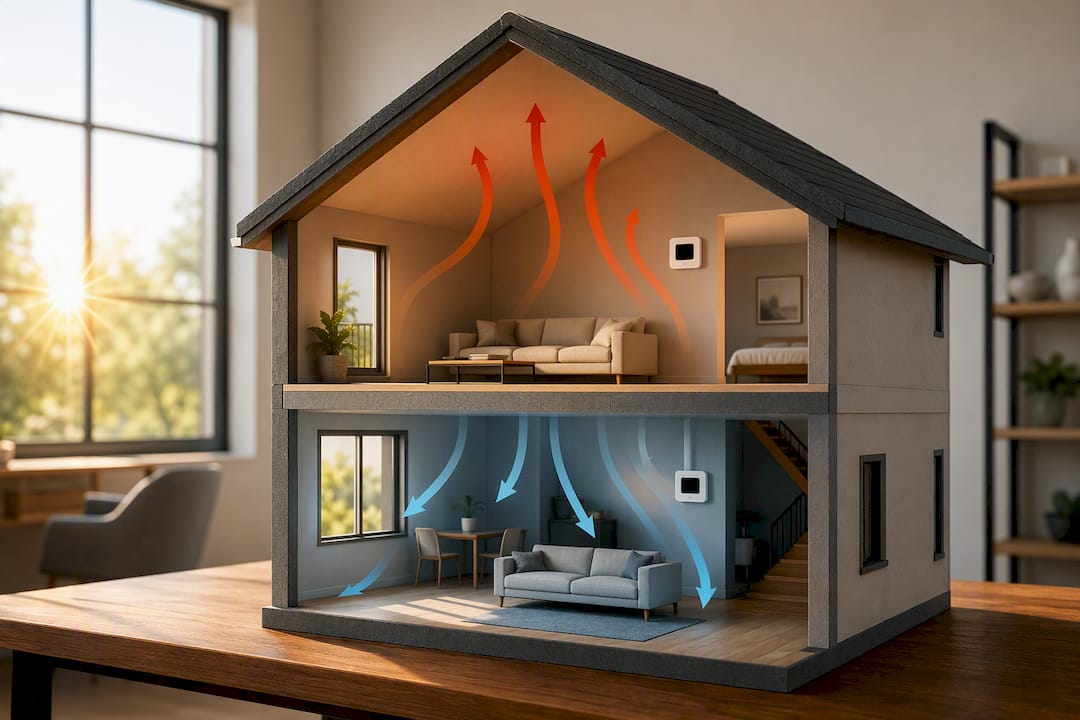
Modeling from the Department of Energy’s Building America program, run through IBACOS, found that low-load and multi-story homes in sunny climates often see better comfort and fewer uncomfortable hours when the system uses two thermostats or true zoning instead of one, since a single sensor leaves some rooms overcooled or overheated depending on the home’s shape and sun exposure, according to DOE Building America’s research.
A few signs it’s time to consider zoning:
- Rooms on different floors consistently run 2 to 3°F apart no matter where the single thermostat sits
- One side of the house always needs more cooling than the other during sunny afternoons
- Moving the thermostat to a “better” spot has already been tried and didn’t solve the imbalance
Zoning adds cost and complexity, so it’s worth a conversation with a contractor using HVAC software before committing, especially if the discomfort is seasonal rather than year-round.
How Do Smart Thermostats Change Placement Strategy?
A smart thermostat with remote sensor support doesn’t eliminate the need for good placement, but it gives you a workaround when the ideal spot isn’t available. Remote sensors let the system average temperature across multiple rooms or prioritize whichever room matters most at a given time of day, which is genuinely useful in homes where the “correct” central location is also a bad one for wiring or aesthetics, per ENERGY STAR’s smart thermostat guidance.
Look for these features when you’re shopping or upgrading:
- Remote sensors that let you average or prioritize specific rooms instead of relying on the main unit alone
- Adaptive recovery, which starts heating or cooling early enough to hit your target temperature exactly at the scheduled time, rather than overshooting
- Heat pump compatibility, since heat pumps often need different staging logic than a standard furnace or AC setup
Two practical notes before you install one yourself. Many full-featured smart thermostats need a dedicated C-wire for continuous power, and older systems may not have one already run, according to Consumer Reports. And because these units connect to Wi-Fi, avoid mounting them inside deep hallway alcoves or against metal ductwork that can weaken the signal. Our guide to smart thermostat trends covers which features are worth paying for.
Pro Tip: If you’re already running setbacks with a programmable thermostat, pairing it with a remote sensor in your main living space often closes the gap between “technically working” and “actually comfortable.”
How Do You Test Whether Your Thermostat Placement Is Accurate?
Before you assume your thermostat is lying to you, run a simple check over a few days rather than guessing.
- Set an independent thermometer next to the thermostat and another in your main living space, then compare readings over 24 to 72 hours.
- Set the system fan to “on” instead of “auto” for a few hours and watch whether the two readings converge as air mixes through the house.
- Judge the result: a difference within about 1 to 2°F is normal and expected. A gap larger than 3°F points to a placement problem or a house that needs zoning.
- If the readings never converge even with the fan running constantly, or if you notice short cycling, uneven room temperatures, or a thermostat that seems unresponsive, that’s a sign the issue is wiring, sensor calibration, or system commissioning, not just location.
That last category is where testing stops being a homeowner project. If your numbers point to a control or wiring issue, our residential HVAC maintenance guide walks through what a technician typically checks first.
What We See Most Often on Thermostat Placement Calls
Most thermostat complaints we get called out for turn out to be placement problems wearing a “broken system” disguise. Someone’s furnace is short cycling, or one bedroom never gets comfortable, and the fix ends up being a relocation, a sealed draft behind the mounting plate, or a $60 remote sensor rather than a new unit.
The pattern we watch for is simple: if the complaint is about one room or one time of day, it’s usually a placement or airflow issue we can solve on the spot. If it’s the whole house, every season, that’s when we start talking about zoning or checking whether the equipment itself is undersized for the square footage. Homes built into a hillside or facing heavy afternoon sun, common around here, tend to need that conversation sooner than flatter, more evenly shaded properties.
Wiring is the other place we draw a hard line for homeowners. Adding a C-wire or troubleshooting low-voltage connections is not a great DIY project, since a wiring mistake can damage the control board on a furnace or heat pump. When a placement fix requires new wiring, that’s the point where it’s worth having a technician handle it instead of guessing.
— Owner
Ready to Fix Persistent Hot or Cold Spots?
If you’ve relocated the thermostat, run the mixing test, and you’re still fighting a room that never feels right, the issue is usually bigger than placement. An experienced local HVAC company has spent many years helping Colorado Springs homeowners diagnose whether the fix is a sensor, a zoning setup, or equipment that’s simply aged out. They offer flat-rate upfront pricing, certified technicians, and fast response when a diagnosis turns into a same-day repair.
If a technician determines your system itself needs attention rather than just a control fix, our cooling services and heating services cover everything from AC repair to furnace tune-ups, and our full services overview includes indoor air quality and zoning-adjacent solutions for homes that need more than a single thermostat can deliver.
Sources
- Hvac
- A Guide to Energy-Efficient Heating and Cooling (ENERGY STAR)
- The Impact of Thermostat Placement in Low Load Homes in Sunny Climates (IBACOS / DOE Building America)
- How to install a smart thermostat | Consumer Reports
FAQ
Where Is the Best Placement for a Thermostat?
An interior wall in a central, frequently used room, such as a hallway with good air circulation or a main living area, mounted 52 to 60 inches above the floor and away from vents, sunlight, and exterior walls.
Where Should You Never Place a Thermostat?
Avoid exterior walls, spots near supply vents or returns, areas close to ovens, fireplaces, or large electronics, anywhere in direct sunlight, and rarely used rooms that don’t reflect the rest of the house.
Should the Thermostat Be in the Coldest Room?
No. Placing it in an unusually cold or hot room causes the system to overcorrect for that one space, leaving the rest of the house overheated or overcooled; choose a room that represents the home’s average conditions instead.
What Temperature Should You Keep Your Thermostat Set At?
There’s no single right number since comfort preference varies, but pairing correct placement with programmable setbacks and adaptive recovery is what actually produces savings, with ENERGY STAR citing potential savings of about $180 per year from proper programmable thermostat use.
Do I Need More Than One Thermostat in a Multi-Story Home?
Not always, but if rooms on different floors consistently run 2 to 3°F apart despite good placement, Building America’s modeling suggests zoning or a second thermostat usually solves it better than relocation alone.
Recommended
Need expert HVAC help?
Colorado Springs' trusted, veteran-owned heating & cooling team — emergency service.