A swamp cooler cools your home by evaporating water, which suits dry Front Range summers and keeps electricity use low. A heat pump cools with refrigerant and also heats in winter, so one system can do the work of both your air conditioner and your furnace. Which one fits depends on how you want to use the house across all four seasons, how much you want to spend up front, and what your ductwork and utility rebates allow. We install and service both at Strong Heating And Cooling, so this comparison is meant to help you match the equipment to the home, not push one answer for every address.
TL;DR
- A swamp cooler (evaporative cooler) cools with water and a fan. A heat pump moves heat with refrigerant and works in both directions, cooling in summer and heating in winter.
- Evaporative cooling performs best in dry air. The U.S. Department of Energy points to summer wet-bulb temperatures below 70°F as the range where direct systems do well, and much of the Front Range summer fits that profile.
- Swamp coolers cost less to buy and run. Heat pumps cost more up front but replace the air conditioner and can take over much of the heating load.
- Colorado Springs Utilities offers heat pump rebates that can change how the price compares, so check the current program before you decide.
- Our flat-rate heat pump pricing starts at $6,500 for a 15 SEER2 single-stage unit, and we can walk your house and recommend the right fit.
Table of Contents
- How each system actually cools your home
- Why the Front Range is swamp cooler country
- Swamp cooler vs heat pump on cost
- Heating is the real dividing line
- Comfort, humidity and air quality day to day
- Maintenance and water
- Rebates can change the math
- How to choose for your own house
- Our perspective
- Get a flat-rate quote for your home
- FAQ
- Sources
How each system actually cools your home
The two systems solve the same problem in very different ways, and that difference drives everything else in this article: cost, comfort, maintenance and climate fit.
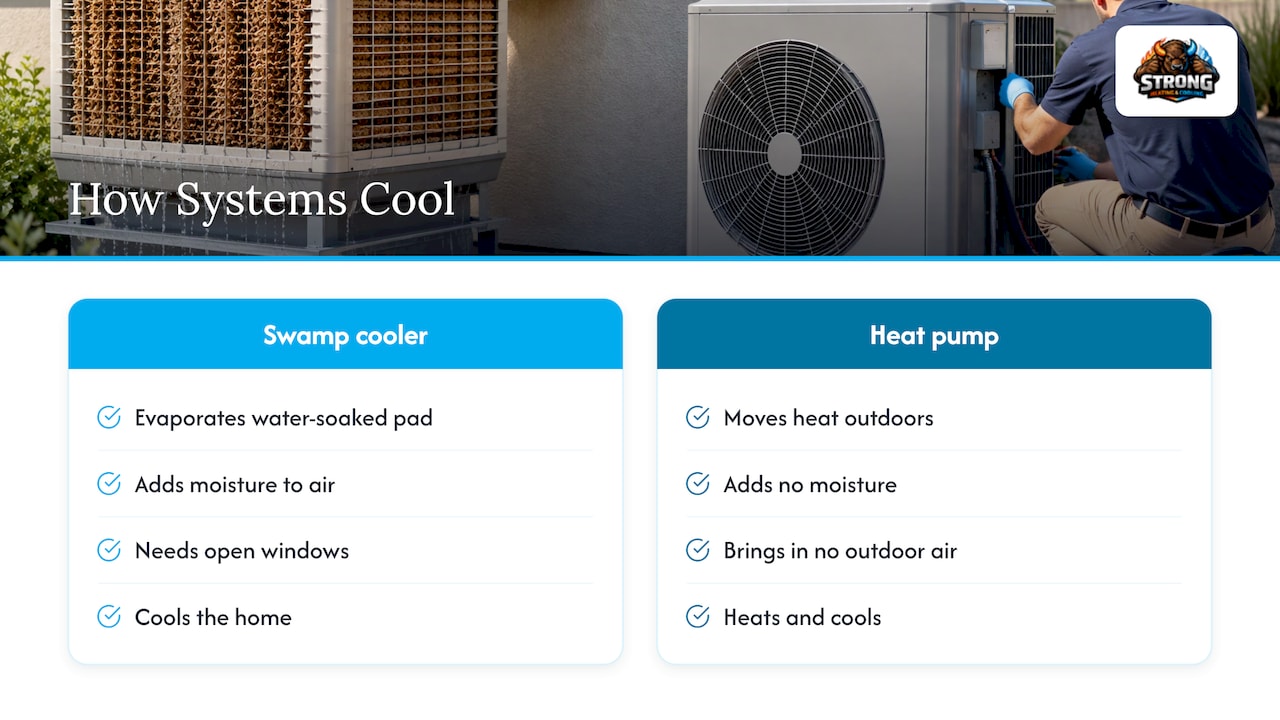
A swamp cooler draws warm, dry outdoor air through a water-soaked pad. As the water evaporates, it absorbs heat from the air, and a fan pushes the cooler air into the house. AHRI explains that this lowers the air temperature while adding moisture to it. Because it brings in fresh outdoor air constantly, the house needs an exit path for that air. Xcel Energy’s Colorado guide notes that windows in the rooms being cooled should be opened to direct the airflow.
A heat pump works like an air conditioner, with one important addition. The U.S. EPA describes a heat pump as a device that transfers thermal energy rather than generating heat. In cooling mode it removes heat from inside your home and releases it outdoors. In heating mode it reverses direction and moves heat from outdoors to indoors. A central system with an indoor coil then distributes that cooled air through your ducts, with no outdoor air brought in and no water added.
In plain terms, a swamp cooler makes air colder by adding water to it. A heat pump makes your house colder by taking heat out of it. That is why one adds humidity and the other does not, and why only one of them can also warm your home in January.
Why the Front Range is swamp cooler country
Evaporative cooling depends on air that can still absorb moisture. The more humid the outdoor air, the less the water can evaporate and the less cooling you get. The Department of Energy’s Building America Solution Center says direct evaporative cooling performs best where the summer design wet-bulb temperature is below 70°F, and that humidity reduces performance.
Colorado Springs sits comfortably in that zone for most of the summer. Xcel Energy’s guide says evaporative cooling can lower indoor air temperature by about 30°F and works best in dry climates such as Colorado. That is the reason so many older homes in the Springs were built with a roof or window unit rather than ductwork for refrigerant-based cooling.
The tradeoff is comfort rather than capacity. AHRI points out that direct swamp coolers add humidity, which can feel good in very dry air and uncomfortable outside it. Two-stage designs add less moisture than traditional single-stage units. On a typical dry afternoon, the added moisture is welcome. During a monsoon-pattern stretch in July or August, when the air is damper, the cooling effect is smaller and the house can feel stickier.
We wrote a 60-second dew point test that helps you judge how your own summer days measure up. A heat pump does not depend on the outdoor humidity in this way, because it cools by removing heat from the house itself.
Swamp cooler vs heat pump on cost
Cost is where most homeowners start, and it needs two lenses: what you pay to install the system and what you pay to run it. Published figures come from different years and different sources, so treat them as ranges for comparison rather than a quote for your house.
Installation
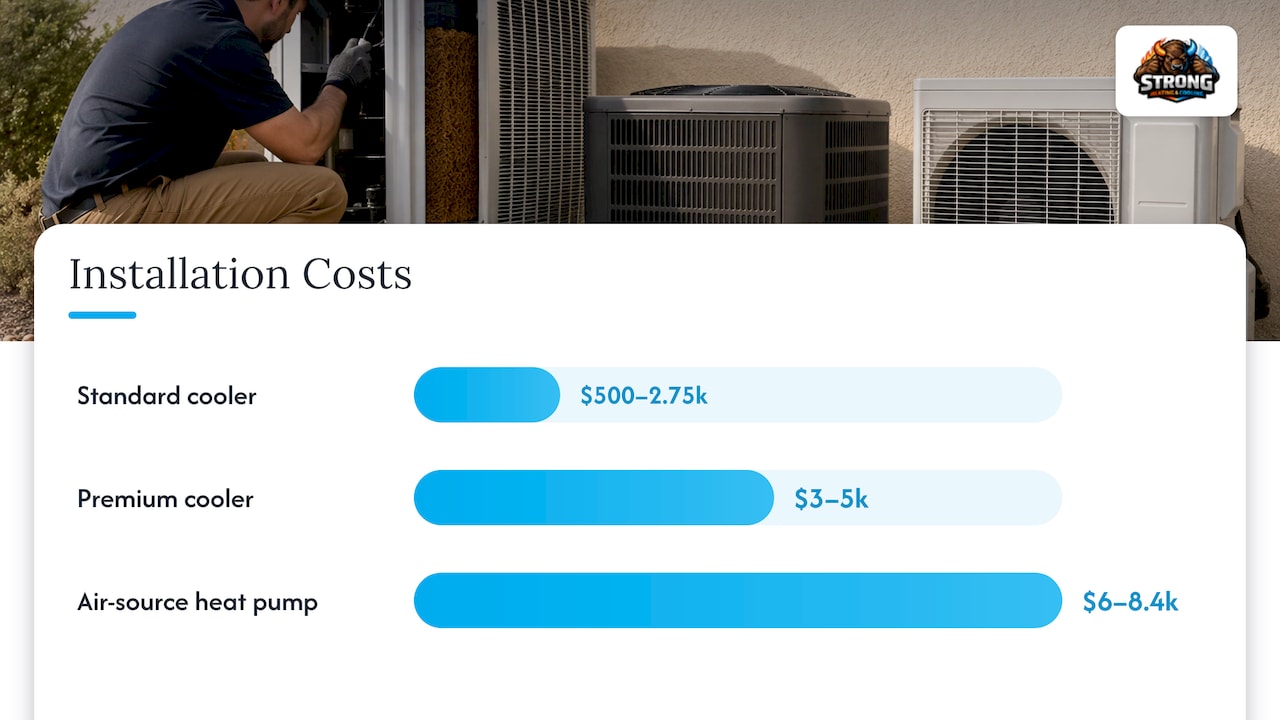
The Building America Solution Center says evaporative coolers can cost less than half as much as central air conditioners to install and operate, though site conditions matter. Xcel Energy’s Colorado guide lists whole-house evaporative cooler costs of $500 to $2,750 for standard models and $3,000 to $5,000 for premium models. It lists air-source heat pump upfront costs of $6,000 to $8,400. Those figures come from a 2019 publication, and equipment and labor costs have moved since then.
The National Renewable Energy Laboratory’s 2022 report on cold-climate heat pumps gives broader project ranges of $7,000 to $20,000, including equipment, labor and any home upgrades. Those are national ranges, not Colorado Springs estimates.
Our own published heat pump prices, which are flat-rate and one-off, are:
| System | Starting price |
|---|---|
| 15 SEER2 single-stage heat pump | $6,500 |
| 17 SEER2 three-stage heat pump | $8,500 |
| 18 SEER2 variable heat pump | $10,000 |
You can see the full list on our air conditioner and heat pump pricing page. Swamp cooler installs are quoted for the specific home, since the right unit depends on the roof, the duct layout and the square footage you want to cool.
Running costs
A swamp cooler’s low electric use comes mostly from the fan, and the water pump uses very little. The Building America Solution Center says evaporative coolers can use about one-fourth the energy of central air conditioners. Smarter House, a research-based homeowner resource, says they can save as much as 75% on summer cooling costs.
Heat pumps save in a different place: the winter. The EPA says a heat pump typically uses about half the energy of other electric home-heating sources because it moves heat rather than creating it. The NREL report puts annual savings from cold-climate heat pumps at $150 to $900 depending on the project and the fuel displaced, with higher savings generally reported when replacing propane, oil or electric resistance heat than natural gas. Most Colorado Springs homes heat with natural gas, so the savings picture depends on your gas and electric rates and on how you use the system.
One way to see the whole picture is lifespan. Xcel’s guide estimates a standard evaporative cooler at a 15-year average life with $224 in annual savings, and an air-source heat pump at an 18-year life with $91 in annual savings. The U.S. Energy Information Administration’s 2023 equipment cost appendix lists a representative residential swamp cooler at a $1,360 installed cost in 2022 dollars, a $330 annual maintenance cost and a 12-year life, based on a sample of window-mounted units. These numbers use different assumptions, so compare the pattern rather than the totals: a swamp cooler is an inexpensive way to cool, and a heat pump is a larger investment that also takes on heating.
Heating is the real dividing line
This is the point most swamp cooler versus heat pump searches skip. A swamp cooler does nothing in winter. Your furnace or boiler still does all the heating. A heat pump handles both seasons.
That means the real choice is often between these two setups:
- A swamp cooler for summer plus a furnace for winter.
- A heat pump that cools in summer and heats in winter, sometimes paired with a furnace as backup.
The second setup puts everything on one piece of equipment and one maintenance schedule. The first keeps your existing furnace doing the heating it already does. If your furnace is relatively new and efficient, keeping it and adding or replacing a swamp cooler can be sensible. If both your furnace and your cooling are near the end of their lives, a heat pump replaces two aging systems at once, and that is where its price makes the most sense.
How heat pumps handle Colorado cold
The EPA says air-source heat pumps are now more effective space-heating options in colder climates, including at 5°F and colder. Xcel’s guide describes the low-temperature effectiveness of air-source heat pumps as around -5°F and notes that an alternate heat source might be needed in extremely cold weather.
The NREL report adds the key engineering point: capacity and efficiency fall as outdoor temperature drops, and cold-weather performance is a question of capacity against your home’s heat loss rather than a simple on-off temperature threshold. A properly designed system may include supplemental or backup heat for the coldest hours. In practice, that is a sizing and design conversation, and it is why we look at your insulation, duct layout and existing furnace before recommending a heat pump. Our article on how far cold-climate heat pump technology has come explains the newer equipment, and are heat pumps worth it in Colorado’s climate walks through the decision in more depth.
Comfort in winter is not only about the equipment. Cold floors make a heated room feel cooler than the thermostat says. If you are weighing a heat pump for heating, the surface under your feet matters too, and this guide to the warmest flooring options shows how different materials feel in cold weather.
Comfort, humidity and air quality day to day
A swamp cooler brings in outdoor air constantly, which many homeowners like because the house feels fresh rather than closed up. It also means the house is never fully sealed during operation, and pollen, smoke from wildfire season and dust can come in with that air unless the pads and filtration are kept up. A heat pump circulates the air already in your house through a filter, so it pairs naturally with better filtration and, if you want it, a whole-home air purifier. We offer indoor air quality services for exactly this.
Humidity runs in opposite directions. A swamp cooler raises indoor humidity slightly, which in the Springs’ dry air is often a plus. A heat pump lowers humidity as it cools, and in winter the dry air inside a heated home is often an issue for skin, wood floors and sinuses, which is why some homeowners add a humidifier to a heat pump or furnace setup.
Temperature control also differs. A swamp cooler’s output depends on the day: the drier and hotter the air, the more it can cool. A heat pump holds a thermostat setting regardless of outside conditions, and variable-speed models adjust output gradually rather than cycling on and off.
Maintenance and water
Both systems need regular attention, just different attention.
The Building America Solution Center advises servicing an evaporative cooler at least twice a year. In spring, that means a start-up cleaning with a check of the pads and belt. In winter, it means a shutoff: draining and cleaning the pan and installing a cover. It also says standing water in an idle cooler’s pan should be emptied when the unit will sit unused for more than a few days, to prevent mosquito and bacteria growth, including Legionella.
An evaporative cooler also uses water. Local installers commonly cite roughly 3 to 15 gallons per hour of operation depending on size and heat, which is worth knowing in a region where water conservation is part of daily life.
For heat pumps, the EPA says filters should be cleaned or changed monthly or as needed, and recommends professional service at least annually, following manufacturer instructions. That annual visit covers both cooling and heating seasons because it is the same equipment.
We provide swamp cooler services in Colorado Springs for spring start-ups and winter shutdowns, and our HVAC maintenance plans cover heating and cooling equipment. If you already own a swamp cooler and wonder whether to keep it, our swamp cooler buying guide for Colorado homes lays out what to look for in a replacement.
Rebates can change the math
Colorado Springs Utilities publishes HVAC and heat pump rebates for qualifying equipment. The program page states that, effective January 1, 2026, customers approved for rebates on qualifying heat pumps under three tons, including NEEP cold-climate models and ENERGY STAR rated units, receive a $1,500 electric bill credit. It also says the equipment must be installed through a contractor or owner with an approved permit from the Pikes Peak Regional Building Department, and that you should keep your receipts.
Incentive amounts and eligible models change over time, so confirm the current program on the utility’s page before you budget. The point for comparison is simple: a rebate narrows the up-front price gap between a heat pump and a lower-cost cooling option, and it applies to the heat pump only.
How to choose for your own house
It helps to work through a handful of questions in order.
What is the age of your furnace?
If your furnace is working well and under about 15 years old, a swamp cooler replacement or upgrade handles summer and leaves heating alone. If the furnace is also aging, replacing both with a heat pump, or a heat pump with a high-efficiency furnace for backup, may be the better long-term spend. Our furnace pricing page shows the options, from a 3,900 dollar 80% AFUE single-stage unit up to a 98% AFUE modulating gas furnace starting at $8,250.
Do you have ductwork for refrigerant-based cooling?
A home with existing supply ducts is straightforward for a central heat pump. A home with a swamp cooler on the roof and large drop vents may need duct changes, since those vents are sized for high-volume outdoor air. Our article on converting a swamp cooler home to AC describes what that conversion involves, and if ducts are not practical, the comparison of a swamp cooler and a mini split covers the ductless route.
How do you use the home in the hot months?
If you are comfortable opening windows, spend most summer days in dry heat and want the lowest operating cost for cooling, a swamp cooler matches that pattern. If you want to keep the house closed up for wildfire smoke days, keep a steady indoor temperature, work from home in humid stretches or need cooling for someone sensitive to heat, a heat pump gives the same indoor result in any weather.
What is your budget horizon?
If you want the lowest cost to get cooling in place this year, a swamp cooler is the more modest purchase. If you plan to stay in the house and want one system doing both jobs, a heat pump gives more for the money over its life, particularly with a utility rebate.
Is this a home or a small commercial space?
Small offices, shops and rental properties follow the same logic with a few extra factors: how many people are in the space, whether windows can stay open during business hours and how much maintenance you can schedule. We also handle commercial HVAC work, and property managers often prefer a heat pump because the equipment and the service calendar are the same all year.
Our perspective
We install both swamp coolers and heat pumps in Colorado Springs, so our view comes from putting each into real houses along the Front Range. Both are good answers when they match the home.
The mistake we see people make is treating this as a cooling-only decision. The dry climate makes evaporative cooling a natural fit for summer, and for a homeowner with a sound furnace, a well-installed swamp cooler is a smart, economical choice. But when a furnace and an air conditioner are both reaching the end of their lives, one heat pump covering both seasons simplifies the system, the maintenance and the monthly bills.
What we want you to have is a clear price and a plan that fits your house. Our pricing is flat-rate with no hidden fees, our technicians are NATE-certified, and our work carries a workmanship guarantee. Heat pump sizing in a high-altitude climate is a design job, not a catalog pick, and we do it with Colorado’s cold nights in mind. Bring us the age of your furnace, the state of your ducts and how you want to live in the house, and we will tell you which system we would put in our own homes.
Owner
Get a flat-rate quote for your home
If you are replacing a furnace and air conditioner, or deciding whether a heat pump fits your Colorado Springs home, we can look at the house and give you a flat-rate price with no hidden fees. Our heat pump options start at $6,500 for a 15 SEER2 single-stage model, and our team is NATE-certified, with same-day service available when you need it.
See the full heat pump and air conditioner pricing or reach us through our website to schedule a visit.
FAQ
Do swamp coolers work in 100 degree weather?
Yes, in dry air they often cool best when it is hottest, because hot, dry air can absorb the most moisture. The cooling effect shrinks as humidity rises, so a 100°F dry day is a good swamp cooler day and a 90°F humid one is not. A swamp cooler can lower air temperature by about 30°F in the right conditions, per Xcel Energy’s Colorado guide.
Can a heat pump cool a house?
Yes. In cooling mode a heat pump works like an air conditioner, pulling heat out of your indoor air and releasing it outside. The same equipment reverses to heat your home in winter, which is why people choose it to replace both an AC and a furnace.
Is a heat pump better than an electric furnace?
For most homes, yes on efficiency. The EPA says a heat pump typically uses about half the energy of other electric heating sources because it moves heat instead of creating it. Most Colorado Springs homes heat with natural gas, so the comparison that matters locally is a heat pump against a gas furnace, and that depends on your utility rates and your home’s heat loss.
Can I keep my swamp cooler and add a heat pump?
It is possible, though a heat pump is designed to replace the cooling side of the system as well as the heating side. In most homes with ducts, a heat pump takes over both jobs. We can look at your existing equipment and tell you whether keeping the swamp cooler for dry-season use makes sense alongside it.
How often does a swamp cooler need service compared with a heat pump?
A swamp cooler needs attention at least twice a year, a spring start-up and a winter shutdown, according to the Building America Solution Center. A heat pump needs monthly filter checks and a professional service visit at least once a year, per the EPA.
Sources
- Heat Pumps, U.S. EPA
- Swamp Coolers, AHRI
- Colorado Home Cooling Options, Xcel Energy
- Types of Cooling Systems, Smarter House
- Evaporative Cooling Systems, Building America Solution Center
- Cold Climate Air Source Heat Pumps Technology, NREL
- HVAC and heat pump rebates, Colorado Springs Utilities
Recommended
Need expert HVAC help?
Colorado Springs' veteran-owned heating & cooling team — Mon–Sat, 8 AM–7 PM. Same-day service when available.