
$250–$350/yr: Swamp Cooler Maintenance Cost for Colorado Homes
Routine swamp cooler maintenance runs $50 to $500 a year, with a typical professional tune-up landing around $197, and winterization adding another $100 to $150. Hiring a pro for at least the seasonal startup and fall shutdown is the safer budget move, since neglected pumps and undrained water lines tend to cause repairs that can cost significantly more than routine maintenance. Set aside roughly $250 to $350 a year and you’ll rarely be caught off guard.
TL;DR:
- Routine maintenance for swamp coolers can range from $50 to $500 annually, with professional tune-ups averaging around $200 and winterization costing $100 to $150.
- Most maintenance visits include pad inspection or replacement, pump testing, belt adjustment, damper inspection, pan descaling, and electrical checks, often bundled into a flat-rate service.
- Hard water areas require more frequent descaling of water pumps and pads, which can significantly increase maintenance costs and shorten equipment lifespan if neglected.
- DIY tasks like pad replacement and pan cleaning can save $75 to $150 annually, but critical work such as electrical repairs and hard-to-access maintenance should be done by professionals.
- Regular seasonal scheduling—spring startup, midseason check, and fall winterization—helps prevent breakdowns, with a well-maintained cooler lasting 10 to 15 years.
Table of Contents
- How Much Does Swamp Cooler Maintenance Cost?
- What Does a Professional Maintenance Visit Include?
- What Do Replacement Parts Typically Cost?
- Why Do Swamp Cooler Service Quotes Vary So Much?
- Can You Maintain a Swamp Cooler Yourself?
- How Should You Schedule Maintenance Throughout the Year?
- What Experience Actually Teaches About Swamp Cooler Upkeep
- Get an Accurate Swamp Cooler Maintenance Quote
- Sources
- FAQ
How Much Does Swamp Cooler Maintenance Cost?
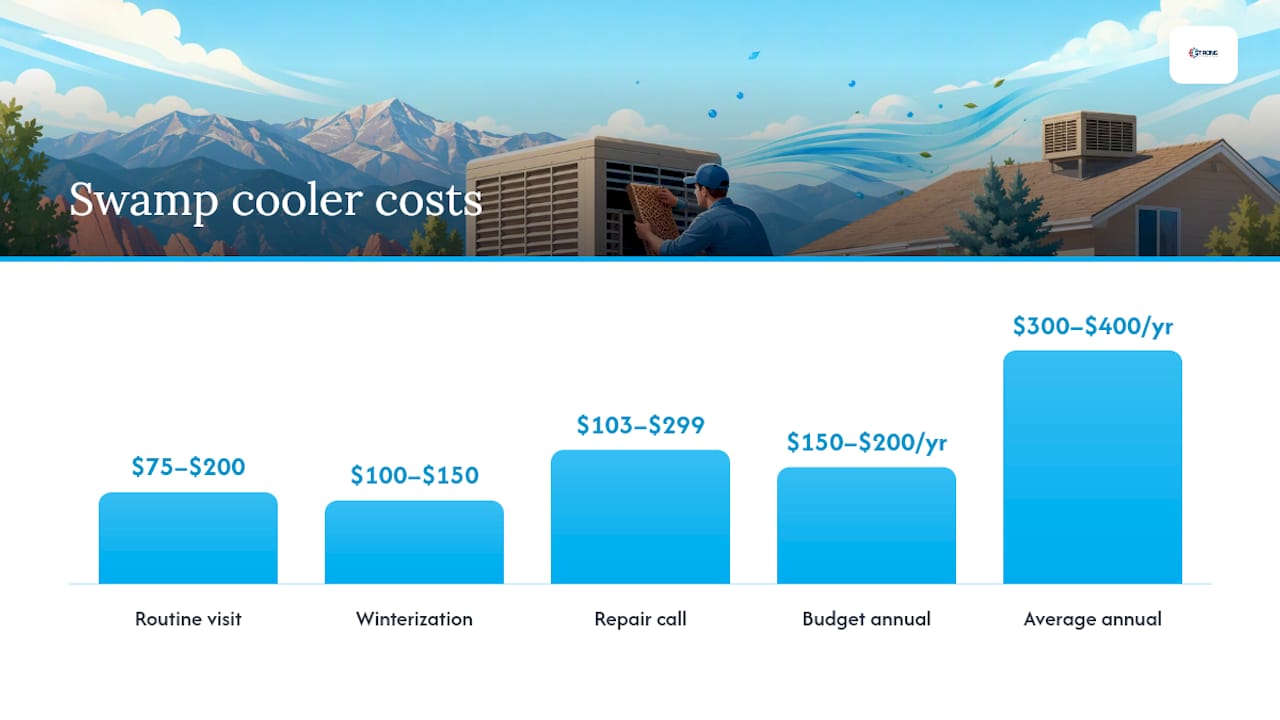
A single routine maintenance visit for an evaporative cooler typically costs between $50 on the low end and $500 on the high end for a full year of care, according to Angi’s cost data. A standalone tune-up or repair call averages about $197, with most jobs falling between $103 and $299. Where you land in that range depends on how much cleaning, pad replacement, and part inspection the visit involves.
Here’s how the costs typically break down across the season:
- Routine maintenance visit (spring startup or midseason check): $75 to $200, covering pump testing, belt inspection, and basic pad and pan cleaning.
- Seasonal winterization: $100 to $150, which includes draining the unit, removing or covering pads, and disconnecting the water supply to prevent freeze damage, per Angi.
- Repair calls (pump, motor, or belt issues): $103 to $299 on average, though a full motor swap can push toward the higher end.
- Labor rate alone: commonly $50 to $75 per hour, according to HomeAdvisor’s repair cost data, separate from parts.
Put those pieces together and you get three realistic annual scenarios. A budget-minded homeowner who does light DIY cleaning and hires a pro only for winterization might spend $150 to $200 a year. An average household running full-service startup, a midseason check, and professional winterization lands closer to $300 to $400. A premium scenario, factoring in pad upgrades or a pump replacement, can climb to $500 or more in a given year.
These numbers track with what property managers see across multiple units: the spread is wide because “maintenance” covers everything from a five-minute pad check to a motor swap. Evaporative coolers cost less to run than refrigerant-based air conditioners, but they demand more frequent attention to pads and water systems, which is exactly where that ongoing cost comes from. Homeowners weighing a swamp cooler maintenance plan against paying per visit usually find the plan pays for itself once you factor in avoided $80 to $200 emergency service calls.
What Does a Professional Maintenance Visit Include?
A thorough swamp cooler service visit follows a fairly consistent checklist, whether it happens in spring, midseason, or fall. Knowing what’s supposed to happen helps you spot a quote that’s padded with unnecessary line items, or one that’s skipping steps that matter.
- Pad inspection or replacement. Technicians check aspen pads for buildup and swap them if they’re brittle or clogged; rigid media pads get inspected but usually only replaced every 3 to 5 seasons.
- Pump test and cleaning. The water pump is run under load to check for weak flow, then descaled if mineral buildup is slowing it down.
- Belt tension check. A loose or cracked belt gets adjusted or replaced before it snaps mid-season.
- Damper inspection. Technicians confirm the damper opens and seals fully, since a stuck damper wastes conditioned air.
- Pan descaling and line flush. Mineral scale gets scraped or dissolved out of the water pan, and the supply line gets flushed to clear sediment.
- Electrical and motor inspection. Wiring connections, the motor housing, and the float valve all get checked for wear or corrosion.
- Distribution line check. The lines that route water to the pads are inspected for leaks or clogs.
Most of these tasks are bundled into a single flat-rate visit, described in more detail in this swamp cooler maintenance guide. Add-ons like upgrading from aspen to rigid media pads, or replacing an aging motor before it fails, typically add $50 to $200 on top of the base visit.
Pro Tip: Ask your technician to show you the float valve and pump before they leave. A five-second visual check twice a season can catch a slow leak before it turns into a pan replacement.
What Do Replacement Parts Typically Cost?
Parts wear out on very different timelines, and that timeline drives a big chunk of your annual cost. Aspen pads are cheap but need replacing every single season, usually running $15 to $40 per set. Rigid honeycomb media costs more upfront but can last 3 to 5 years before it needs swapping, which is why many hard-water households eventually switch to rigid media to cut long-term pad spending.
Common part costs break down like this:
- Aspen pads: $15 to $40 per set, replaced annually.
- Rigid media pads: higher upfront cost, replaced every 3 to 5 years.
- Water pump: replacement generally falls within the $103 to $299 repair range; a simple descaling is far cheaper and often restores function.
- Drive belt: a low-cost part, usually replaced during a routine visit rather than as its own service call.
- Float valve: inexpensive to replace but easy to overlook until it causes overflow or a dry pan.
Regular maintenance can stretch a swamp cooler’s working life to roughly 10 to 15 years, compared to units that get skipped winterizations or ignored pump noise and fail well before that. A weak pump or worn belt almost always signals itself: rattling, reduced airflow, or water pooling where it shouldn’t. Catching those signs early usually means a $100 to $200 repair. Ignore them and you risk a motor failure that can cost more than half the price of a new unit, at which point replacement makes more financial sense than another repair.
Why Do Swamp Cooler Service Quotes Vary So Much?
Two homeowners with the same brand of cooler can get quotes $150 apart, and it’s rarely because one technician is overcharging. A handful of variables move the price up or down.
- Hard water and mineral scale. Areas with hard water force more frequent pad and pump service, since scale buildup accelerates wear on both.
- Cabinet material. Plastic cabinets resist rust but can turn brittle under years of sun exposure, while galvanized steel holds up structurally but corrodes if mineral deposits aren’t cleared regularly.
- Unit age and condition. An older unit with a rusting pan or a sealed, non-serviceable motor often costs more to maintain than it’s worth, pushing the conversation toward replacement.
- Accessibility and local labor rates. A rooftop-mounted cooler on a steep roof costs more to service than a ground-level or window unit, and labor rates of $50 to $75 an hour vary by region and by how tricky the access is.
If your water is hard, budgeting for a midseason descaling isn’t optional, it’s cheaper than replacing a scaled-out pump every couple of years. Property managers overseeing several units should expect the widest cost swings on the oldest units in their portfolio, since pan and motor condition matter more than brand at that point.
Can You Maintain a Swamp Cooler Yourself?
Some tasks are genuinely safe and cheap to do yourself. Others are worth paying a technician for, even if it stings a little to write the check.
- Pad replacement. Swapping aspen pads takes 20 to 30 minutes and costs $15 to $40 in materials, no special tools required.
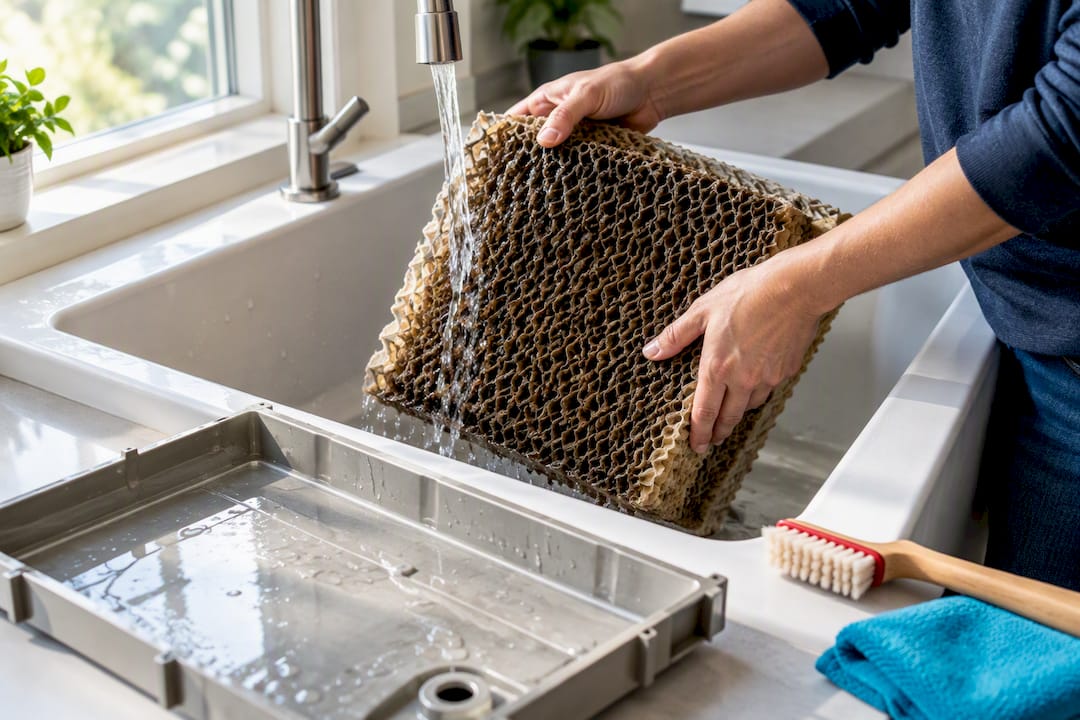
- Pan cleaning. Scrubbing out sediment and mineral scale from the water pan takes about 30 minutes and needs only a stiff brush and basic cleaner.
- Belt tension checks. A quick visual and manual check of belt tightness takes a few minutes and can be done during any pad swap.
- Pump and motor work. Diagnosing a weak pump or replacing a motor involves electrical components and water lines close together, which is exactly the combination that calls for a licensed technician.
- Rooftop or hard-to-access units. Anything requiring a ladder onto a roof carries real fall risk, and it’s not worth the savings.
DIY pad swaps and pan cleaning can save you $75 to $150 a year in labor compared to paying a technician for every basic task. But skipping professional startup and winterization to save money is often the false economy, since a single missed drain before a freeze can cause $200 to $500 in pan or line damage, and DIY electrical work on a pump can void any warranty coverage still active on the unit.
Pro Tip: If you’re comfortable with pads and pan cleaning, do those yourself and put the savings toward a professional startup and winterization visit each year. That split gets you the best of both without cutting corners on the parts that actually risk damage.
How Should You Schedule Maintenance Throughout the Year?
A seasonal plan beats reactive fixes because it catches pump and motor stress before it becomes a repair bill. The rhythm is simple: a spring startup, a midseason check during peak heat, and a fall winterization before the first freeze.
- Spring startup: pad inspection, pump test, belt check, damper function. Budget $75 to $200.
- Midseason check (peak summer): pan descaling, quick pump and pad inspection. Budget $50 to $100, more if hard water demands extra descaling.
- Fall winterization: drain, pad removal or covering, water line disconnect. Budget $100 to $150.
| Budget scenario | What’s included | Estimated annual cost |
|---|---|---|
| Minimal | DIY pads and pan cleaning, professional winterization only | $150 to $200 |
| Average | Full-service startup, midseason check, professional winterization | $300 to $400 |
| Premium | Full service plus pad upgrade or pump/motor work | $500+ |
Any of those is usually the point where continuing to repair costs more, over time, than replacing.
What Experience Actually Teaches About Swamp Cooler Upkeep
An experienced HVAC service provider in Colorado’s high-altitude climate notes a few patterns that show up again and again. Mineral scale is the most common silent killer of pumps and pans here, since even moderately hard water leaves deposits fast when a cooler runs all summer. The second most common issue isn’t a part failure at all: it’s a skipped winterization. A cooler left un-drained through even one hard freeze can crack a pan or split a line, turning a $150 fall visit into a spring repair bill several times that size.
The pattern that separates a cooler that lasts 15 years from one that dies at 7 usually isn’t the brand or the price paid upfront. It’s whether someone drained it every fall and cleared scale before it built up. That’s not a complicated standard to meet, but it does require someone actually doing it on schedule rather than waiting for a warning sign.
— Owner
Get an Accurate Swamp Cooler Maintenance Quote
Compared to guessing your way through pad swaps and hoping the winterization gets done before the first cold night, working with a local team that already knows Colorado’s water and climate conditions is the more budget-safe route. Strong Heating & Cooling handles swamp cooler startup, midseason checks, and winterization as part of its regular swamp cooler service offerings, built specifically around the hard-water and altitude conditions that wear down units faster than in milder climates.
Getting an accurate estimate is straightforward: have your cooler’s age, cabinet material, and any current symptoms (weak airflow, water pooling, unusual noise) ready when you call, since those details determine whether your visit is a standard tune-up or something closer to a repair. If you’re also weighing whether an aging unit still makes sense to maintain versus replace, Strong Heating & Cooling’s team can walk through that math with you during the same visit, alongside its broader lineup of heating and cooling services. Schedule a swamp cooler maintenance visit before the next seasonal shift and lock in your rate before peak season demand pushes wait times out.
Sources
The cost ranges and maintenance schedules in this guide draw from a handful of established industry sources:
- How to use and maintain an evaporative cooler
- How Much Does Swamp Cooler Repair Cost? 2025 Data
- How Much Does Swamp Cooler Repair Cost in 2025?
- Evaporative cooler vs. air conditioner
FAQ
What Is the Average Lifespan of a Swamp Cooler?
A well-maintained evaporative cooler typically lasts 10 to 15 years. Units that miss winterization or run with scaled-up pumps tend to fail closer to the low end of that range, sometimes well before it.
What Maintenance Does a Swamp Cooler Need?
A swamp cooler needs seasonal startup and winterization, regular pad inspection or replacement, and periodic cleaning of the water pan and pump to clear mineral buildup, according to Home Depot’s maintenance guidance. Aspen pads need yearly replacement, while rigid media pads can go 3 to 5 years between swaps.
How Much Does It Cost to Run a Swamp Cooler Per Month?
Running costs vary by climate and unit size, but evaporative coolers use meaningfully less electricity than refrigerant air conditioners since they rely on water evaporation instead of a compressor, per Bob Vila’s comparison. The tradeoff is that they need more frequent pad and water system attention to keep running efficiently.
Is It Okay to Run a Swamp Cooler 24/7?
Running a swamp cooler continuously during peak season is generally fine as long as the water pan, pads, and pump are clean and functioning, since the system is designed for extended daily use in dry climates. Continuous operation without regular pad and pan maintenance accelerates mineral buildup, though, which is why a midseason check matters if you’re running it around the clock.
How Much Does Swamp Cooler Servicing Cost With a Professional?
A typical professional maintenance visit costs $75 to $200, while a full-year maintenance budget including winterization generally falls between $150 and $500 depending on what’s included. Strong Heating & Cooling provides current pricing for swamp cooler services directly on request.
Recommended
Need expert HVAC help?
Colorado Springs' trusted, veteran-owned heating & cooling team — emergency service.