
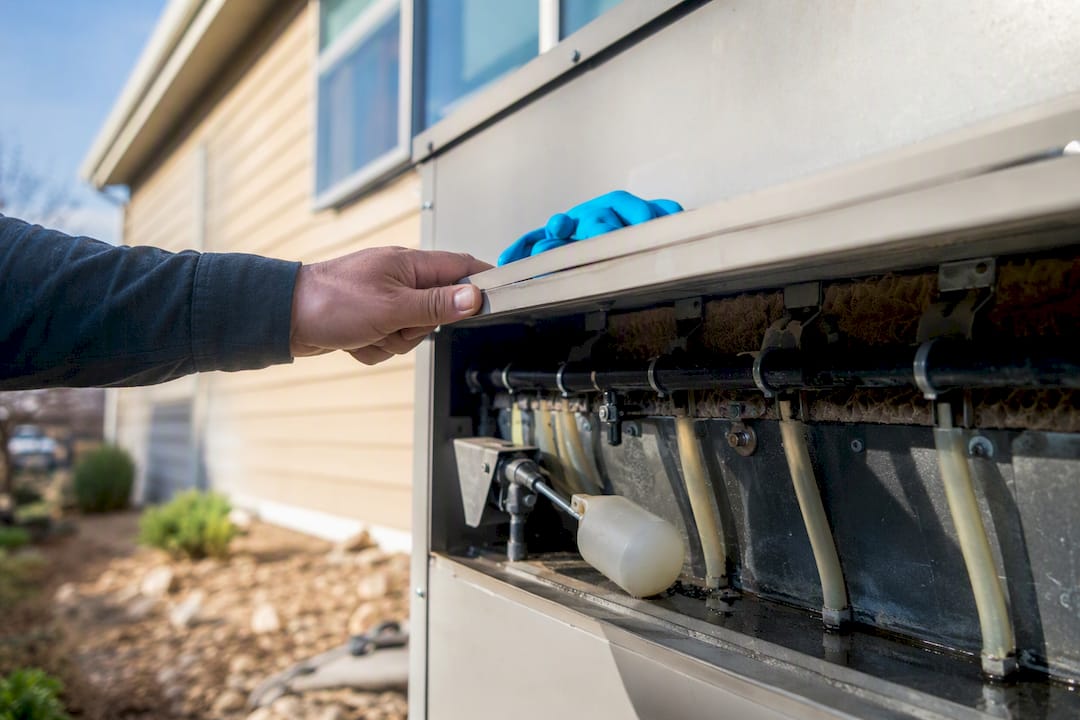
A reliable swamp cooler comes down to four habits: a thorough spring startup, quick monthly checks through summer, fast troubleshooting when something acts up, and a proper winterization before the first freeze. Replace the pads, confirm the pump and float valve are working, check belt tension, and oil the bearings if your unit has oil ports. Anything involving electrical wiring, rooftop access, or a seized motor is a job to hand off to a professional.
TL;DR:
- Regular monthly checks help detect issues like mineral buildup, water leaks, and belt wear before they cause system failure.
- Spring startup is critical and involves cleaning, pad replacement, inspecting tubes, and priming the pump for optimal performance.
- Water-wise operation techniques, such as priming pumps each time and waiting for outdoor heat, extend pad life and reduce mineral scale buildup.
- Costs for maintenance range from $15 for pads to over $200 for full service, with DIY checks recommended monthly and professional service for repairs.
- Proper winterization prevents freeze damage and rust, requiring draining, cleaning, and covering the unit, especially for roof-mounted systems.
Table of Contents
- Swamp Cooler Maintenance Checklist for Spring Startup
- What Should You Check Every Month During Cooling Season?
- Why Is My Swamp Cooler Not Working Right?
- How Do You Winterize a Swamp Cooler?
- Swamp Cooler Maintenance Schedule and What It Costs
- Field-Tested Tips from HVAC Technicians
- Our Take on Swamp Cooler Upkeep
- Book Swamp Cooler Service Before the Next Heat Wave
- Sources
- FAQ
Swamp Cooler Maintenance Checklist for Spring Startup
Spring startup is the single most important service window of the year. Skip it, and you’re troubleshooting blind all summer.
Work through these steps in order:
- Remove covers and panels. Clear out leaves, dust, and nesting debris before you touch anything mechanical.
- Drain and scrub the reservoir. Mineral scale builds up over winter even in a dry pan, so scrape it loose or work it off with vinegar before refilling.
- Replace the pads. Aspen pads need swapping every season; rigid media pads run longer, so follow the manufacturer’s replacement schedule instead of guessing.
- Inspect the distributor and manifold tubes. Look for cracks, clogs, or tubes that have popped loose from the manifold.
- Prime the pump before starting the fan. Run the pump alone for 5 to 10 minutes so the pads soak through completely before air starts moving across them.
- Adjust the float valve. Water should sit about a short distance below the overflow line. Too high and you’re feeding the overflow tube constantly; too low and the pads starve.
- Check the supply line for leaks. A slow drip at a fitting is easy to miss until it’s rotted a fascia board.
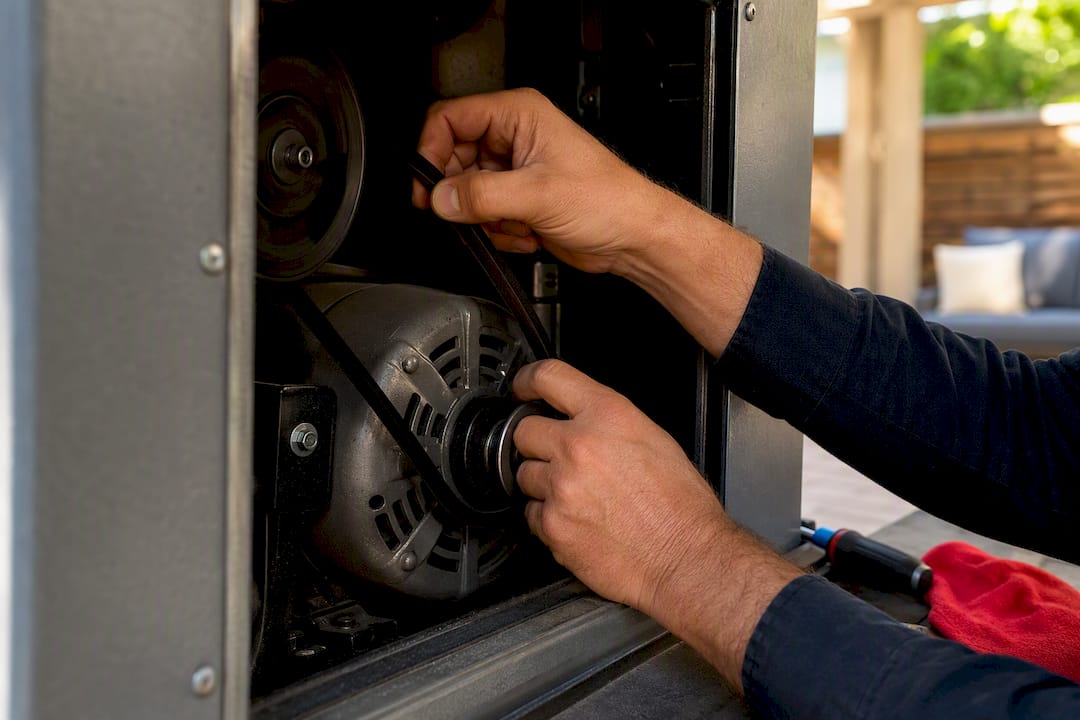
- Inspect the motor and belt. Look for cracking, glazing, or fraying on the belt, and confirm the motor spins freely by hand with the power off.
- Lubricate only if your unit has oil ports. Use SAE 20 non-detergent oil, a few drops per port. Sealed-bearing motors need none at all, and adding oil to a sealed unit does nothing but attract dust.
Pro Tip: Press the belt at its midpoint with moderate finger pressure. It should give a small amount of play. Tighter than that stresses the bearings; looser than that lets it slip and squeal on hot afternoons.
If any of this feels beyond your comfort level, especially the belt and motor inspection, a swamp cooler service visit covers the full startup in under an hour.
What Should You Check Every Month During Cooling Season?
A five-minute walk-around once a month catches most problems before they turn into a breakdown on a 95-degree afternoon.
- Pad condition. Look for gray, crusty patches, which signal mineral buildup starving that section of airflow.
- Water level. Confirm it still sits at the float line; a sudden drop points to a leak, and a level that won’t stop rising means the float valve is sticking.
- Pump output. Listen for the pump running but pushing weak or uneven flow to the distributor tubes, a sign the intake screen is clogging.
- Belt wear and tension. Recheck that half inch to one inch of deflection; belts stretch with use and heat cycling.
- Distribution tubes. Pull them and flush with water if flow to any pad looks thin compared to the others.
Hard water areas benefit from a bleed-off valve, which continuously drains a small amount of concentrated water and replaces it with fresh supply, cutting down on the scale that otherwise clogs pads and tubes mid-season. Before running the unit each time, start the pump alone, let the pads saturate, then switch on the fan. It’s the same priming sequence as spring startup, and it wastes far less water than running fan and pump together from a dry start. Only run the cooler once outdoor temperatures climb into the mid-80s or higher, since that single habit can cut water use dramatically according to water conservation guidance from university extension programs.
Why Is My Swamp Cooler Not Working Right?
Most swamp cooler complaints trace back to one of a handful of causes, and diagnosing them usually takes less time than fixing them.
- No water reaching the pads. Check for a clogged pump intake screen first, then inspect the distributor tubes for cracks or blockages, and confirm the pump itself is actually running.
- Motor hums but the fan won’t spin. Cut power, then try spinning the fan blade by hand. If it moves freely, suspect a failed start capacitor. If it’s stiff or grinding, the bearings have likely seized.
- Weak airflow. Confirm the pads are fully saturated, the belt isn’t slipping, vents inside the house are open, and there’s an exhaust path for air to actually leave the room.
- Overflow running constantly, or water level too low. Clean the float valve of scale buildup, and if that doesn’t fix it, replace the valve outright.
- Musty or mildew smell. Drain and disinfect the pan, replace the pads, and consider a zinc anode or cooler-tablet treatment to slow algae growth between cleanings.
A humming motor with a stuck bearing or a bad capacitor requires professional repair due to electrical risks or replacement needs, so scheduling a technician visit is recommended.
How Do You Winterize a Swamp Cooler?
Winterizing prevents two things: freeze-cracked lines and a rusted-out pan that ruins your spring startup before it even begins.
- Shut off the water supply and the electrical breaker to the unit before touching anything.
- Disconnect the water line and blow out any water left inside it, since standing water that freezes will crack copper or plastic tubing.
- Drain the pan completely and let it dry out.
- Scrub out mineral deposits, and if the pan shows early rust, apply a marine-grade sealer once it’s fully dry.
- Remove the pads, or leave them out entirely if you’re not planning to reuse them next season.
- Leave the drain plug out over winter so any stray moisture has somewhere to go.
- Fit a breathable cover over the unit to keep out snow, ice, and nesting rodents without trapping condensation underneath.
Pro Tip: If your cooler sits on the roof, don’t climb up there yourself in cold or icy conditions. A fall from a residential roof causes far more damage than a swamp cooler ever will, and a technician handles winterizing safely as part of a fall service call. While you’re weatherproofing the exterior, it’s also worth checking that nearby doors and window seals are ready for winter, since drafty entry points undercut the same efficiency you just spent all season protecting.
Swamp Cooler Maintenance Schedule and What It Costs
Here’s the yearly rhythm in one place, plus what to expect if you’re paying for parts or a service call.
| Task | Frequency | Typical cost range |
|---|---|---|
| Spring startup and pad replacement | Once a year | $15 in pads (DIY), $200 for a service call |
| Monthly checks during season | Monthly | Free (DIY, 5 to 10 minutes) |
| Rigid media pad replacement | Every 3 to 5 years | $50 per set |
| Pump replacement | Roughly every 3 years | $80 for the pump |
| Motor and belt replacement | Every 5 to 7 years | $80 to $250 installed |
| Winterize and shutdown | Once a year, fall | $80 to $200 for a service call |
Costs climb fast when the job involves roof access, electrical diagnosis, or a pan corroded past the point of a simple sealer job. Booking an annual professional inspection before peak cooling season catches those bigger problems while they’re still cheap fixes instead of mid-July emergencies.
Field-Tested Tips from HVAC Technicians
With extensive field experience, technicians often see the same three things homeowners miss every year: cracked roof flashing around the cooler base, a bleed-off valve left unadjusted for years of water hardness changes, and a start capacitor that’s degrading long before it fully fails.
A motor that hums instead of spins almost never fixes itself. Nine times out of ten it’s a capacitor that’s lost its charge or a bearing that’s seized from lack of oil where oil ports actually exist. Both are five-minute diagnoses for a technician and both involve enough electrical or mechanical risk that we don’t recommend homeowners open that panel themselves.
Stick to the pads, the float valve, and the belt tension yourself. Leave capacitors, sealed motors, and roof access to a scheduled visit.
Our Take on Swamp Cooler Upkeep
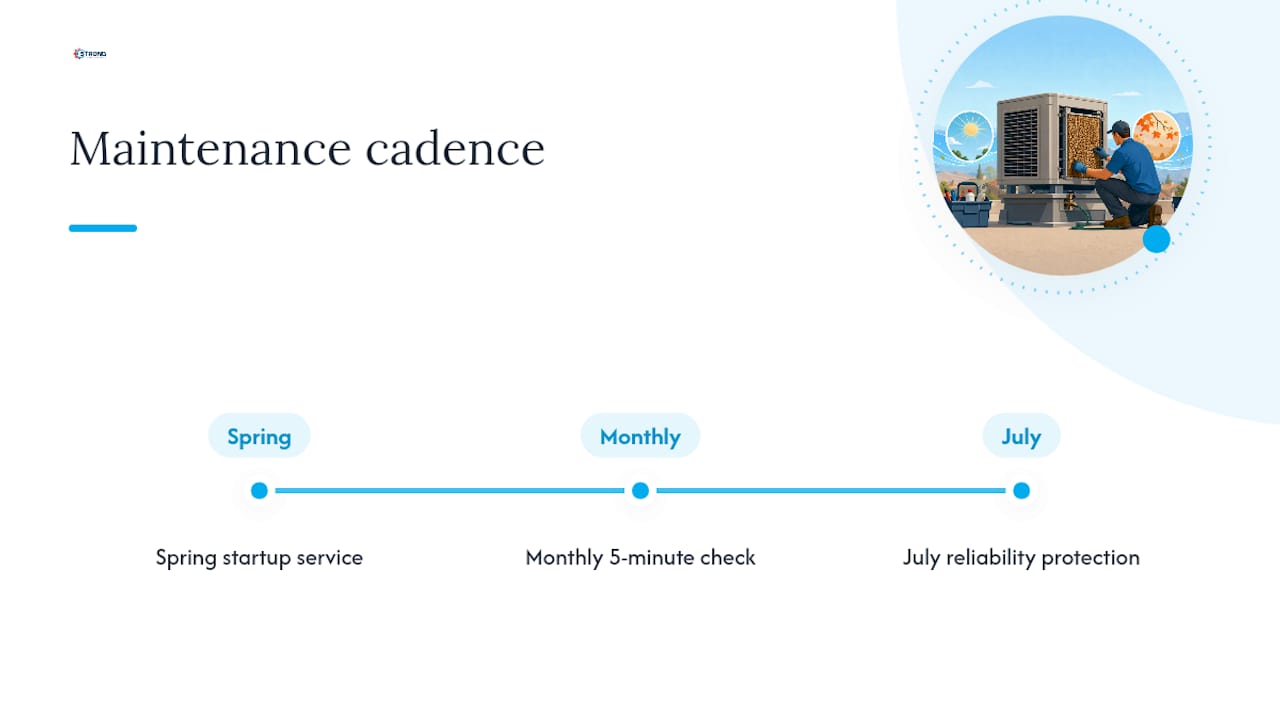
Most swamp cooler advice online treats maintenance like a once-a-year event, and that’s the biggest gap in the conventional wisdom. A unit that only gets attention every spring is a unit that fails in July, right when you need it most. The monthly five-minute check is the part almost nobody actually does, and it’s the cheapest insurance available against a midseason breakdown.
The other overlooked piece is water-wise operation. Priming the pump before the fan and waiting for genuine heat before running the unit aren’t just efficiency tips. They directly extend pad life and cut down how often you’re fighting mineral scale, which is the root cause behind most of the problems in this guide.
If we had to rank priorities for a homeowner with limited time: get the float valve and belt tension right first, since those two measurements catch the most common failures early. Everything else, including capacitors and sealed motors, belongs to a professional the moment it shows up.
**
Book Swamp Cooler Service Before the Next Heat Wave
Professional HVAC companies handle the parts of swamp cooler upkeep that carry real risk, so you’re not the one testing a capacitor with the power on or climbing onto a roof in July heat.

A typical seasonal visit covers a full safety check, a pump test under load, belt and motor inspection with proper tensioning, and pad installation using the right media for your unit. We also handle repairs when a float valve, distributor tube, or motor has already failed, and full winterize service so your pan and lines make it through the cold months without cracking. If your system needs more than a tune-up, ask about financing options that spread out the cost of bigger repairs or replacements. Schedule your swamp cooler service now, before the next stretch of 90-degree days puts your system to the real test.
Sources
- Swamp Cooler Maintenance - Water Wise
- Evaporative Cooler Maintenance - MSWD / University Extension content
- How to Use a Swamp Cooler and Maintain One - Lowe’s
FAQ
How should I lubricate my swamp cooler?
Only lubricate if your unit has designated oil ports; sealed-bearing motors and pumps need no oil at all. Where ports exist, use a few drops of SAE 20 non-detergent motor oil per port, and avoid over-oiling.
How much does it cost to service a swamp cooler?
A standard spring startup or fall winterize service call typically runs $80 to $200, depending on access and whether pads or minor parts need replacing. Bigger repairs, like a motor or pump swap, generally add another $80 to $250 in parts and labor.
What are the most common problems with swamp coolers?
The most frequent issues are no water reaching the pads, weak airflow, a humming motor that won’t spin, and a float valve that either overflows or runs the water level too low. Most trace back to a clogged pump screen, blocked distributor tubes, a slipping belt, or a failing start capacitor.
What is the typical lifespan of a swamp cooler?
A well-maintained swamp cooler unit typically lasts 15 to 20 years, though individual parts wear out much sooner. Aspen pads need replacing every season, rigid media pads last 3 to 5 years, and the pump and motor typically need replacement every 3 to 7 years depending on use and water hardness.
Recommended
Need expert HVAC help?
Colorado Springs' veteran-owned heating & cooling team — Mon–Sat, 8 AM–7 PM. Same-day service when available.