

Static Electricity in House: Why It Happens and How to Stop It
Most static electricity in your house comes down to one thing: low indoor humidity. When relative humidity drops below 30%, your carpet, clothing, and furniture hold onto electrical charge instead of letting it dissipate, and every doorknob becomes a landmine. The fix starts with a $10 hygrometer and a humidifier.
Check your indoor humidity level first.
- Target range: relative humidity indoors in the moderate range typically recommended for comfort and static control
- Shocks typically taper off above roughly 40% RH.
- At lower relative humidity levels, static can become a frequent nuisance
Pro Tip: Place a hygrometer in the room where shocks happen most, not just near your thermostat. Humidity can vary by 10 percentage points or more between a drafty bedroom and a warm kitchen.
Key Takeaways
Static electricity in a house is almost always a humidity problem, and raising indoor relative humidity toward 40% resolves most shocks within days.
| Point | Details |
|---|---|
| Check humidity first | Use a hygrometer to measure RH; below 30% strongly predicts frequent static shocks. |
| Target 30% to 50% RH | Shocks taper above roughly 40% RH and mostly disappear near 55%, per Keyence. |
| Try low-cost fixes tonight | Portable humidifiers, natural fibers, moisturized skin, and dryer sheets reduce shocks immediately. |
| Watch the mold trade-off | Keep RH under 50% to avoid condensation and mold risk while still cutting static. |
| Consider whole-home humidification | Strongheatingandcooling installs humidistat-controlled whole-home humidifiers for houses where static is a problem in every room. |
Table of Contents
- What Causes Static Electricity in a House?
- Why Does Low Humidity Make Static Worse?
- What Are the Fastest Fixes for Static Shocks?
- Should You Get a Whole-Home Humidifier?
- When Is Static Electricity a Real Safety Risk?
- Static Troubleshooting: What To Check First
- A Working HVAC Perspective on Static and Humidity
- Get Your Home’s Humidity Under Control for Good
- Sources
- FAQ
What Causes Static Electricity in a House?
Static builds up through something physicists call the triboelectric effect: when two materials rub against each other, electrons transfer from one surface to the other. Walk across a wool rug in socks, and your body picks up a surplus of electrons. Touch a metal doorknob, and those electrons jump back all at once. That jump is the shock.
Certain combinations charge up faster than others. Common culprits include:
- Walking on carpet or synthetic rugs
- Wearing polyester, fleece, or other synthetic fabrics
- Rubber-soled shoes on vinyl or laminate flooring
- Sliding across car seats or upholstered furniture
The voltage involved can be surprisingly high, sometimes several thousand volts, but the current is tiny and lasts a fraction of a second. That’s why a static shock stings but doesn’t hurt you the way household electrical current would. Static won’t happen in isolation, either. Dry winter air, detailed here, makes any surface that generates charge far more likely to hold onto it.
Why Does Low Humidity Make Static Worse?
Moisture in the air isn’t just comfortable. It’s electrically conductive. Water molecules in humid air form microscopic pathways that let built-up charge drain away before it can accumulate, according to Princeton researchers studying static shock. Dry air has no such escape route, so charge just sits there waiting for you to touch something grounded.
That’s why the season matters as much as the material. Static tends to taper off above roughly 40% relative humidity and largely disappears near 55%, though anything above 50% starts to raise mold risk in most homes.
- Buy an inexpensive digital hygrometer (many run $10 to $15)
- Place it at chest height, away from vents and exterior walls
- Check readings at different times of day; a swing of more than a few points usually means a draft or a heating cycle nearby
What Are the Fastest Fixes for Static Shocks?
You don’t need a contractor to get relief tonight. Start with whichever of these fits your budget and your patience level.
- Run a portable humidifier in the room where you spend the most time
- Leave the bathroom door open after a hot shower to let steam spread
- Add a few houseplants or a shallow water pan near a heating register
- Switch synthetic clothing and blankets for cotton, wool, or other natural fibers
- Wear leather-soled slippers instead of rubber or synthetic soles
- Keep skin moisturized, since dry skin holds a charge more readily
- Carry a metal key or coin and touch it to a doorknob first to discharge gradually
- Spray furniture and carpets with a fabric-safe anti-static spray, or wipe them with a used dryer sheet
None of these solve a whole-house humidity problem permanently, but they buy you comfort while you work on the bigger fix.
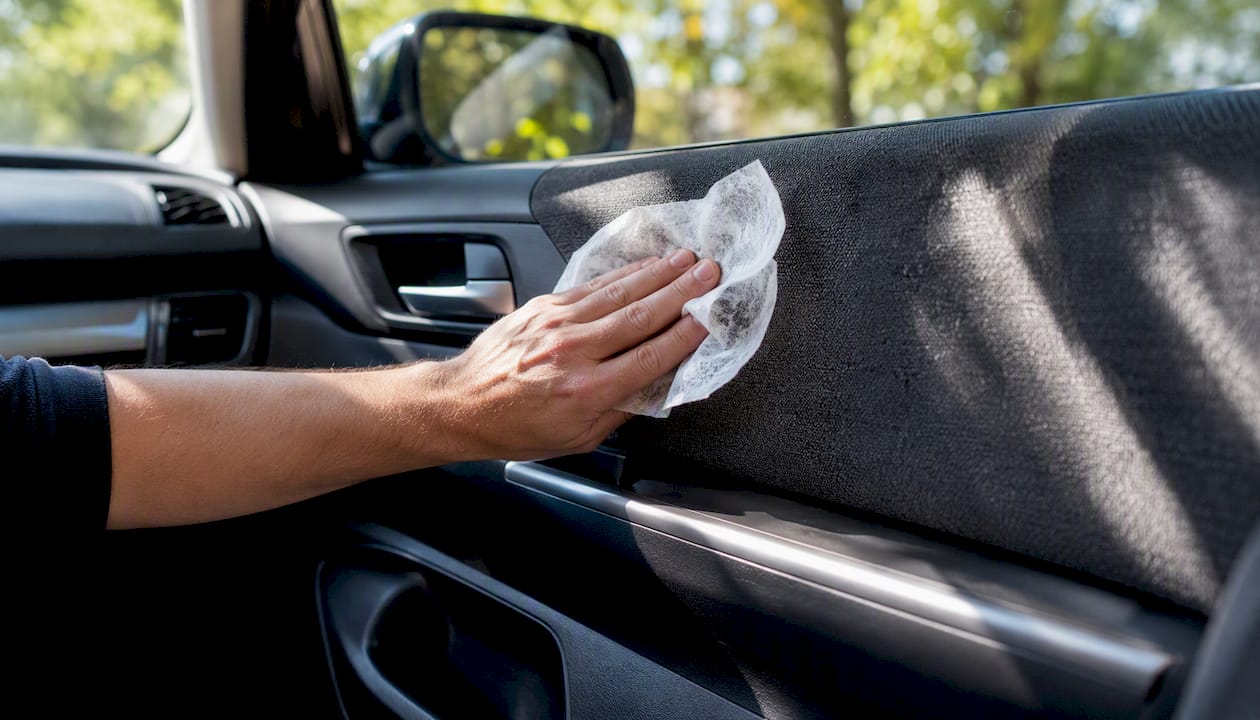
Pro Tip: Rub a dryer sheet directly on your car’s seat fabric and floor mats. It’s a five-second fix that stops the classic “grab the door handle and get zapped” routine.
Should You Get a Whole-Home Humidifier?
Portable humidifiers work for one room, but they need daily refilling, regular cleaning to prevent mold and mineral buildup, and they can’t touch the humidity in the rest of your house. If static shocks are a problem in every room, not just the bedroom where you run a small unit, that’s a signal you’re fighting a whole-house issue with a single-room tool.
Whole-home humidifiers connect directly to your HVAC system and distribute moisture through the same ductwork that already heats your home, controlled by a humidistat that holds a steady target instead of the swings you get from a portable unit. Installation costs more upfront than a $40 tabletop humidifier, but the coverage and consistency are the trade-off, along with far less day-to-day maintenance than refilling a tank every night.
A few other HVAC factors affect indoor humidity, too:
- Leaky ducts pull in dry outside air and waste the moisture you’re already adding, so sealing them improves any humidifier’s efficiency
- Dirty filters restrict airflow and can make your furnace run longer than necessary, drying out the air further
- A humidistat paired with a whole-home unit prevents over-humidification, which is how mold problems start
That’s the point where a whole-home solution usually pays for itself in comfort alone.
Pro Tip: Before you invest in a humidifier, check your door and window seals. Drafts pull in cold, dry outside air and undo a lot of the humidity work your HVAC system is doing. Weatherizing your doors closes that gap for cheap.
When Is Static Electricity a Real Safety Risk?
Static is usually just annoying, not dangerous. But there are real exceptions worth knowing.
Static discharges can damage sensitive electronic components, and in environments with flammable vapors or fine combustible dust, a spark from static buildup can serve as an ignition source.
That’s according to background research on static electricity’s physical mechanics. In a typical house, this mostly matters in specific spots:
- Near a garage workbench with solvents, gasoline cans, or aerosol cleaners
- Around a furnace or water heater’s fuel lines during maintenance
- In workshops or hobby areas with fine sawdust or other combustible dust
If you’re filling a fuel container, ground it against metal first. If shocks happen constantly in a garage or utility room where fuel or solvents are stored, that’s worth a call to an HVAC or safety professional to check ventilation and grounding, not something to shrug off as a quirky house.
Static Troubleshooting: What To Check First
Work through this in order before assuming you need professional help.
- Measure RH in two or three rooms. Below 30% means static is likely, 30% to 40% means it’s borderline, and above 40% usually means humidity isn’t your main problem.
- Try a quick fix for a few days. Run a portable humidifier or switch out synthetic clothing, then note whether shocks slow down or stop.
- If shocks persist house-wide, inspect ductwork for leaks and check whether your thermostat cycles the furnace unusually often. Persistent low RH despite portable humidifiers is the clearest sign it’s time to call a contractor.
A Working HVAC Perspective on Static and Humidity
Chasing static electricity to zero isn’t the goal, and trying too hard backfires. In winter, aim for the mid 30s to 40% RH range. That’s usually enough to knock out most shocks without fogging up your windows or inviting condensation into your window frames, which is where mold problems actually start.
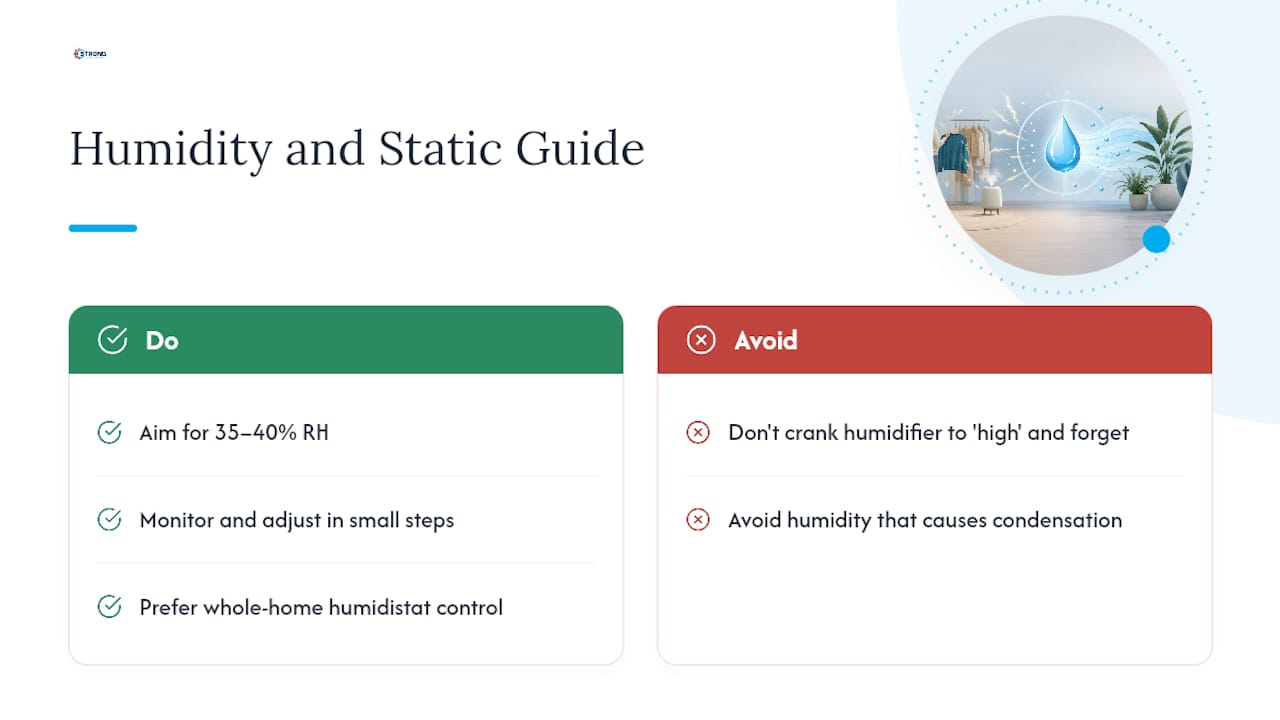
Monitor, adjust in small steps, and resist cranking a humidifier to “high” and forgetting about it. For a house that’s staticky in every room, we lean toward whole-home, humidistat-controlled humidification over a fleet of portable units. It’s more predictable, and it’s easier to keep in the safe zone without babysitting it daily.
Get Your Home’s Humidity Under Control for Good
Strongheatingandcooling installs whole-home humidifiers that solve static at the source instead of treating it room by room with a portable unit you have to refill every night. If dry winter air is turning your house into a static trap, a properly sized humidifier tied into your existing ductwork gets every room to a comfortable, consistent humidity level automatically.

We serve Colorado Springs and the surrounding communities, and our technicians can evaluate your ductwork, furnace run-time, and existing humidity levels in one visit to tell you honestly whether a whole-home unit makes sense for your house or whether smaller fixes will do. If duct leaks are undermining your comfort, we handle that too as part of a full system checkup. Reach out to schedule a whole-home humidifier assessment and get a straightforward quote before the next cold snap hits.
Sources
- Science of static shock (Princeton Engineering)
FAQ
Why do I have so much static electricity in my house?
How do I stop my house from being so staticky?
Raise indoor humidity toward 40% with a portable or whole-home humidifier, switch to natural fiber clothing, and keep your skin moisturized; whole-home humidifiers solve the problem house-wide rather than room by room.
How do I stop static electricity from shocking me?
Touch a metal object like a key or coin before touching a doorknob or appliance, since it lets charge discharge gradually instead of all at once through your fingertip.
Should I be worried about static electricity?
For most households it’s just a nuisance, but static can damage electronics and pose an ignition risk near flammable vapors or fine dust, so treat garages and workshops with stored fuel or solvents differently than living spaces.
Recommended
- HVAC Capacitor Failure: What Homeowners Need to Know | Strong Heating And Cooling
- Why HVAC Short Cycles: Causes, Effects, and Fixes | Strong Heating And Cooling
- Cooling That Hot Upstairs Room Without New Ductwork | Strong Heating And Cooling
- Why Your AC Isn’t Blowing Cold Air — and Why It’s Not a DIY Fix | Strong Heating And Cooling
Need expert HVAC help?
Colorado Springs' trusted, veteran-owned heating & cooling team — same-day service.