

Contractor Choice Beats Brand: Rheem vs Goodman for Homeowners
Choose Goodman if the top priority is the lowest upfront price or the home will change hands within a few years. Choose Rheem for coastal or humid climates, quieter operation, or a longer ownership horizon. Either way, installation quality matters more than the badge on the cabinet, so get 2 to 3 quotes and insist on a Manual J load calculation before signing anything.
TL;DR:
- The total cost of installation is more influenced by labor, permits, and ductwork than by the brand, often adding more than the $500 difference between Goodman and Rheem units.
- Proper installation, including a Manual J load calculation and warranty registration, significantly impacts equipment performance and longevity regardless of the brand chosen.
- Rheem units offer slightly higher efficiency ratings up to SEER2 20, which can reduce energy bills for long-term owners in hot or humid climates, compared to Goodman’s peak SEER2 19.
- Goodman typically provides the lowest upfront prices and a lifetime compressor warranty on high-tier models, making it ideal for short-term ownership or rental properties.
- The longevity of a system depends more on installation quality and maintenance than on the brand, with Rheem systems lasting about 14 to 17 years and Goodman around 12 to 15 years when properly cared for.
Table of Contents
- Rheem vs Goodman: Quick Answer for Your Situation
- How Do Upfront and Installed Costs Compare?
- What Warranty Coverage Do You Actually Get?
- Is Rheem More Efficient Than Goodman?
- Which Brand Lasts Longer and Costs Less to Repair?
- Does Climate or Noise Level Change the Decision?
- What Should You Ask a Contractor Before Signing?
- What We See in the Field With Both Brands
- Why Contractor Choice Beats Brand Choice Every Time
- Get a Straight Quote Before You Decide
- Sources
- FAQ
Rheem vs Goodman: Quick Answer for Your Situation
Homeowners rarely need a spec sheet to make this call. They need to know which scenario they’re in.
Pick Goodman when:
- You want the lowest upfront cost on a comparable system.
- You’re outfitting a rental property or plan to sell within 5 to 7 years.
- You want the reassurance of a lifetime compressor limited warranty on select high-tier models.
- Parts availability and low repair costs matter more than shaving a few decibels off the outdoor unit.
Pick Rheem when:
- You live near the coast or in a humid climate where corrosion shortens equipment life.
- A quiet outdoor unit matters because the condenser sits near a bedroom window or home office.
- You want smart-home control through EcoNet and might replace a water heater around the same time.
- You’re staying in the home 10-plus years and want a slightly better long-term durability track record.
A landlord replacing a rooftop package unit on a rental duplex usually leans Goodman. A retiree upgrading a forever home two miles from the Gulf usually leans Rheem.
How Do Upfront and Installed Costs Compare?
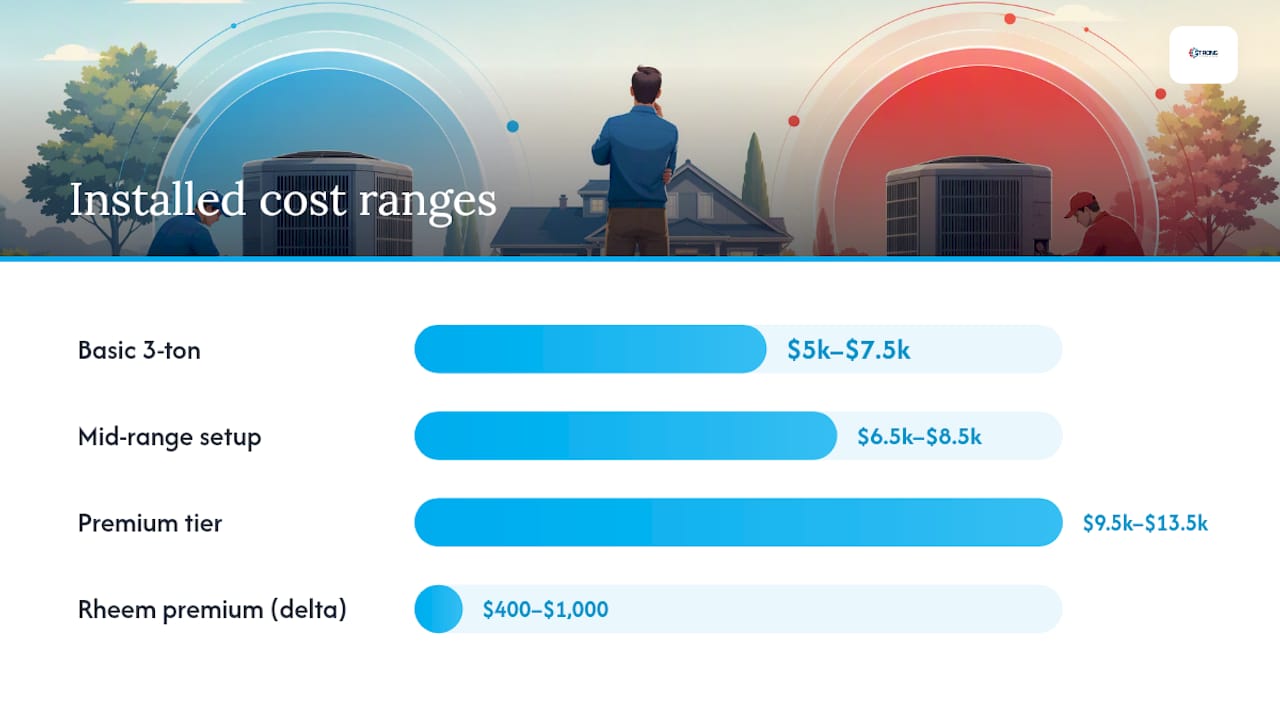
Goodman consistently wins on sticker price. A basic 3-ton system typically installs for $5,000 to $7,500, with mid-range setups running $6,500 to $8,500 and premium tiers reaching $9,500 to $13,500. Rheem systems usually add $400 to $1,000 on a comparable unit, mostly reflecting build quality and efficiency gains rather than markup.
The bigger swing in your total bill rarely comes from the brand at all. Labor, permits, ductwork modifications, and electrical upgrades often move the final number more than the $500 gap between manufacturers.
Before comparing quotes side by side, check that each one includes:
- The exact model numbers for matched indoor and outdoor units.
- Labor coverage terms tied to warranty registration.
- An itemized breakdown, not a single lump-sum number.
What Warranty Coverage Do You Actually Get?
Both brands ship 10-year parts warranties when you register within the manufacturer’s window, typically 60 to 90 days after installation. Skip registration and coverage often drops to a shorter default, sometimes as little as 5 years. Goodman sweetens the deal on select high-tier models with a lifetime compressor limited warranty, which carries real value if you plan to own the system for a decade or more. Parts coverage is only half the equation, though. Labor isn’t always included, and a “free” compressor swap can still cost several hundred dollars if the contractor charges for the visit.
Pro Tip: Ask your installer, in writing, who is responsible for registering the warranty and get a confirmation email or screenshot once it’s done. Losing that paperwork is the single most common reason homeowners lose coverage they already paid for.
- Confirm the registration deadline before the contractor leaves.
- Keep the model and serial numbers with your closing documents.
- Save the itemized invoice in case a warranty claim needs proof of installation date.
Is Rheem More Efficient Than Goodman?
Rheem’s flagship units reach SEER2 ratings up to 20, compared to Goodman’s ceiling near 19. That 1 to 2 point gap sounds small, but stretched across 10 to 15 years of summers in a hot climate, it adds up to a meaningful dent in cooling costs.
The math changes based on how long you’ll own the house:
- Long-term owners in hot or humid regions usually recoup the efficiency premium through lower energy bills.
- Short-term owners or landlords rarely stay long enough to see the payback, so a mid-tier Goodman often makes more financial sense.
- Mild climates shrink the gap either way, since the compressor runs fewer hours per year.
Which Brand Lasts Longer and Costs Less to Repair?
Field data puts Goodman’s typical lifespan at 12 to 15 years, while Rheem systems often reach 14 to 17 years with proper maintenance. That 2 to 3 year edge tracks with Rheem’s build quality, but neither number holds up without annual tune-ups and correct installation.
Parts tell a different story. Goodman components typically run 10% to 20% cheaper and sit on more supply-house shelves nationwide, which shortens repair wait times. Rheem parts are widely stocked too, but some proprietary components cost more and take longer to source in rural areas.
- Ask your technician how often they service each brand locally.
- Confirm whether replacement parts are stocked nearby or special-ordered.
- Factor labor time into repair cost comparisons, not just the part price.
Does Climate or Noise Level Change the Decision?
Rheem’s Coastal Protection option adds corrosion-resistant coatings that matter near salt air, where standard cabinets can pit and rust within a few seasons. Goodman offers corrosion treatments too, but availability varies by model, so verify the exact spec sheet rather than assuming it’s standard.
Noise is where the brands separate most clearly. Mid-tier Rheem units commonly run 3 to 5 dB quieter than equivalent Goodman base models, though Goodman’s step-up tiers close most of that gap.
- Coastal or humid regions favor Rheem’s corrosion resistance.
- Bedroom-adjacent or home-office installs benefit from the quieter Rheem tiers.
- Moderate inland climates with no noise-sensitive rooms nearby make either brand a reasonable fit.
What Should You Ask a Contractor Before Signing?
The brand on the unit matters less than what happens during installation. A poorly commissioned Rheem system will underperform a properly installed Goodman system every time.
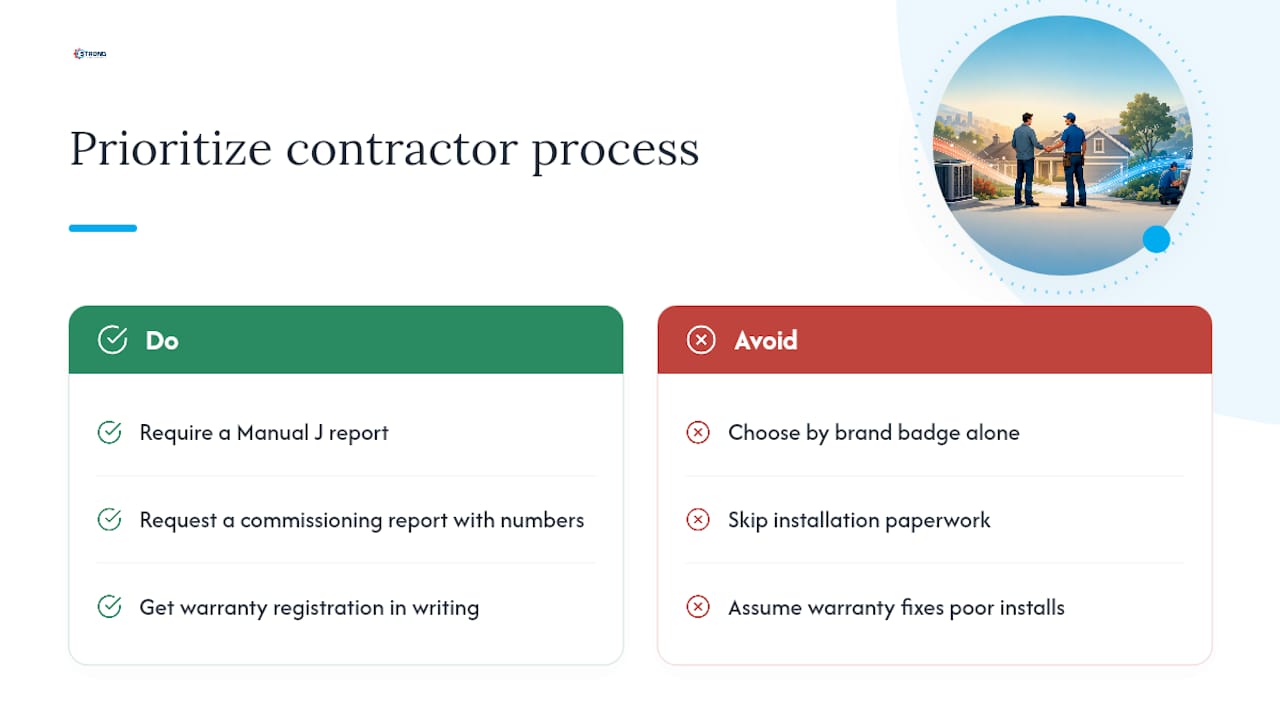
- Require a written Manual J load calculation before any equipment gets selected. Guessing at tonnage is the single most common reason new systems run inefficiently.
- Ask who registers the warranty and get that confirmed in writing.
- Confirm the contractor carries NATE certification or EPA 608 credentials for refrigerant handling.
- Request a commissioning report showing measured refrigerant charge and airflow verification, not just a verbal “it’s running fine.”
- Ask for references or photos from at least two past installs similar to your home.
- Get a demo of any smart thermostat or ComfortBridge controls before the crew leaves.
Pro Tip: If a quote skips line-item detail or comes in far below every other bid, that’s usually a sign the contractor is cutting corners on refrigerant charge, ductwork, or commissioning, not offering you a deal. A reputable contractor’s online reviews and reputation are worth checking before you compare a single dollar figure.
Reference our HVAC brand selection criteria guide and our replacement question checklist before your next contractor call.
What We See in the Field With Both Brands
With more than 40 years of combined experience installing and servicing residential systems, our technicians have replaced far more units due to bad installations than bad equipment. A correctly sized Goodman system with proper commissioning routinely outlasts an oversized Rheem system installed on a rushed schedule.
Annual maintenance preserves both warranty coverage and equipment life. Our residential maintenance guide covers the tune-up schedule that keeps registration valid and catches small issues before they become compressor failures.
Why Contractor Choice Beats Brand Choice Every Time
The comparison most homeowners want is Rheem versus Goodman on paper. The comparison that actually determines whether you’re happy in year 3 is contractor versus contractor.
Conventional advice treats this decision like buying a car, where the badge tells you most of what you need to know. HVAC doesn’t work that way. Reliability ratings and warranty terms matter, but they assume the installer did the job right in the first place. That assumption fails more often than manufacturers would like to admit.
If there’s one thing worth prioritizing above brand loyalty, it’s proof of process: a Manual J on paper, a commissioning report with measured numbers, and a contractor willing to put warranty registration responsibility in writing. Homeowners who demand that paperwork rarely end up disappointed with either brand. Homeowners who skip it sometimes regret the “premium” choice just as often as the budget one.
— Owner
Get a Straight Quote Before You Decide
Comparing spec sheets only gets you so far. What actually protects your investment is a contractor who runs the Manual J calculation, itemizes every line of the quote, and commissions the system correctly instead of eyeballing it. Installation quotes are built around exactly that process, regardless of equipment brand.

Expect an itemized quote that separates equipment, labor, permits, and warranty registration, with no vague “package price” hiding the details. We also walk homeowners through financing options so a higher-efficiency system doesn’t have to strain the budget in one lump payment. If your current system is on its last legs or you’re just comparing options for a future replacement, schedule a heating installation assessment and get a written quote before you commit to either brand.
Sources
- Goodman vs Rheem HVAC systems | HVAC Database
- Goodman vs Rheem HVAC: 2026 Comparison Guide | HVAC Compared
- Goodman vs Rheem comparison | BTU Size
FAQ
What Is the Most Reliable AC Unit Brand?
Reliability depends more on installation quality than brand, but field data shows Rheem systems averaging 14 to 17 years versus Goodman’s 12 to 15 years when both are properly maintained.
Where Does Rheem Rank Among HVAC Brands?
Rheem consistently ranks near the top for efficiency and durability, with flagship SEER2 ratings up to 20 and stronger corrosion resistance for coastal climates.
What AC Brands Should You Avoid?
Neither Rheem nor Goodman appears on lists of brands to avoid. Problems almost always trace back to poor installation, skipped commissioning, or an undersized system rather than the manufacturer itself.
Where Does Goodman Rank for HVAC?
Goodman ranks well for value, offering the lowest typical installed costs and a lifetime compressor limited warranty on select high-tier models, making it a strong option for budget-conscious buyers.
Which Is Better, Rheem or Goodman?
Neither brand is universally better. Rheem fits coastal climates, quieter homes, and long-term ownership, while Goodman fits tight budgets, rentals, and shorter ownership timelines.
Recommended
Need expert HVAC help?
Colorado Springs' trusted, veteran-owned heating & cooling team — emergency service.