
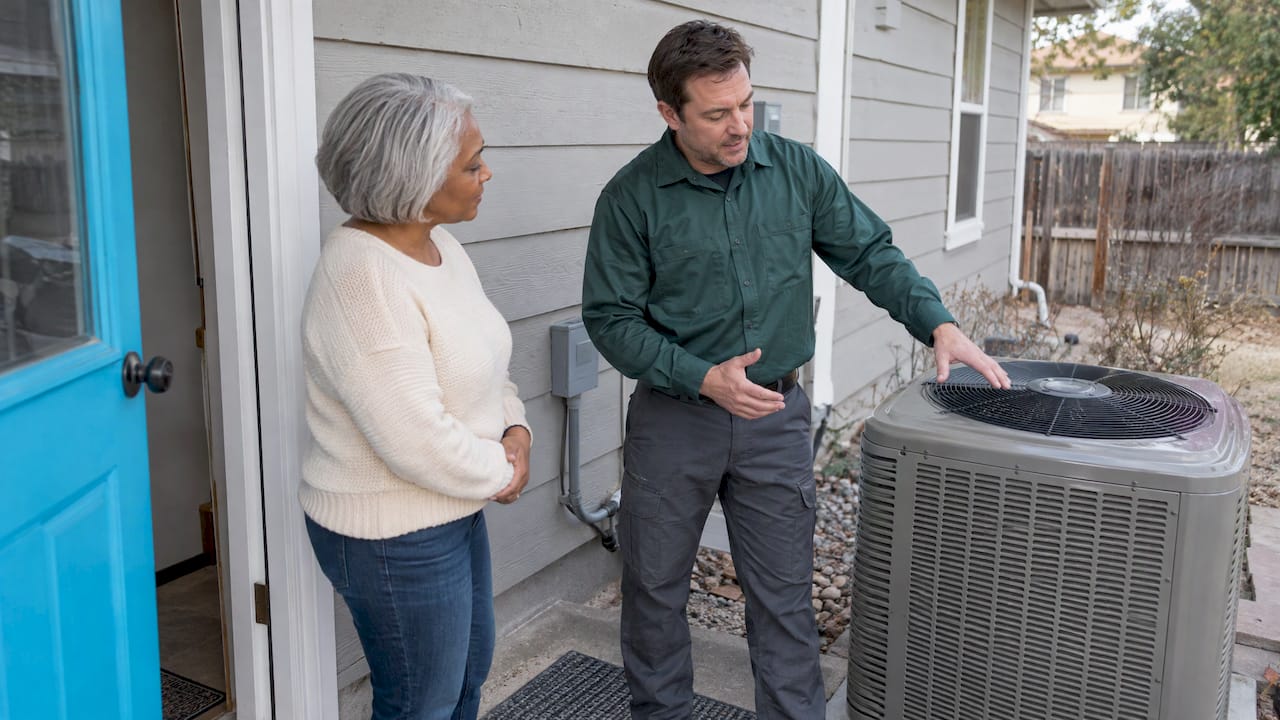
R-410A is the refrigerant most existing home air conditioners and heat pumps run on today. R-32 is one of the newer, lower-impact refrigerants that manufacturers now build equipment around. The two are close cousins chemically, but they are not interchangeable: R-32 goes only into equipment designed for it, and new residential systems are no longer built around R-410A. If you are replacing an AC or heat pump, the practical question is less “which gas is better” and more “which correctly designed, correctly installed system fits my home.” That is a decision we help Colorado Springs homeowners make every day, with flat-rate pricing and NATE-certified technicians.
TL;DR
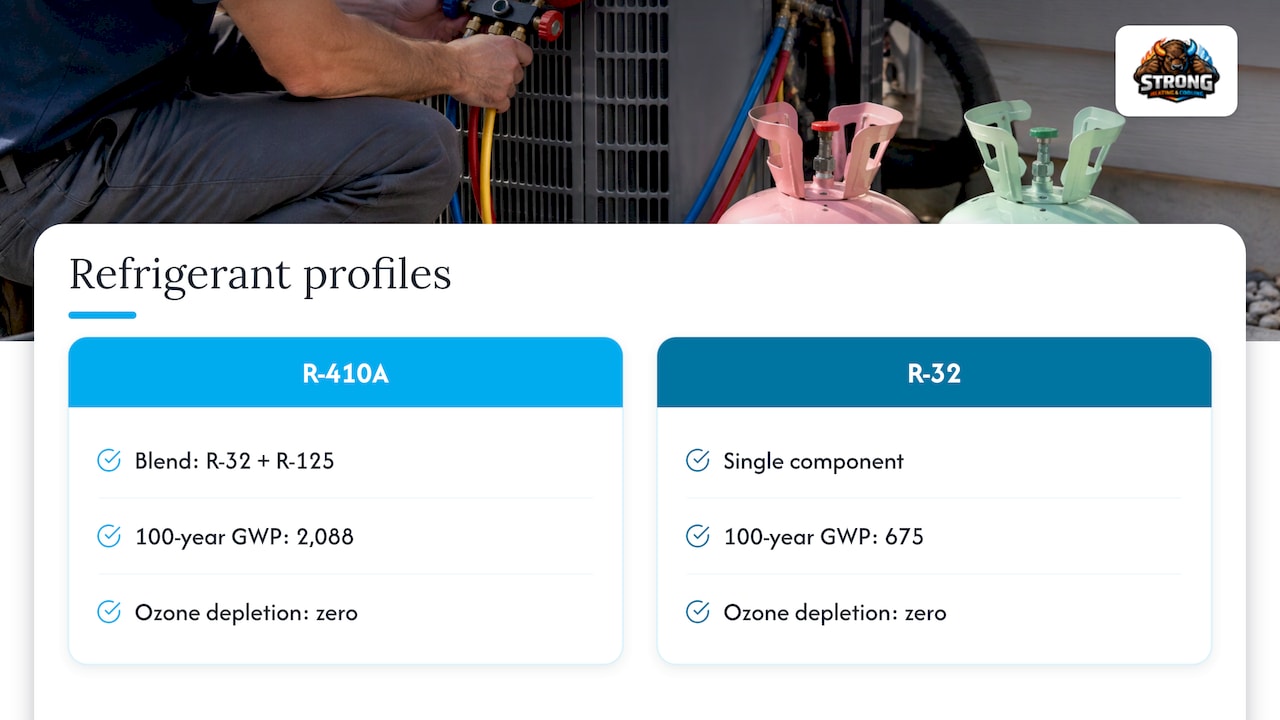
- R-410A is a 50/50 blend of R-32 and R-125. R-32 is a single refrigerant with a global warming potential (GWP) of 675, about two-thirds lower than R-410A’s 2,088.
- R-32 can deliver a little more capacity and, in systems built for it, a little more efficiency. Real-world gains depend on the whole system design, not the refrigerant alone.
- R-32 is mildly flammable (class A2L), so it is used only in equipment engineered for it. It cannot be put into an existing R-410A system.
- If your R-410A system still works, you can keep repairing it. When you replace the outdoor unit and indoor coil together, you are buying a new system under the current EPA rules.
- Get a written, flat-rate quote that names the refrigerant, the efficiency rating and the installed price before you decide.
Table of Contents
- What R-410A and R-32 actually are
- Efficiency and capacity: what the testing shows
- Safety: what the A2L rating means in your home
- Can you use R-32 in an R-410A system?
- What the EPA rules mean for your replacement
- Repair or replace: where R-410A and R-32 meet your budget
- How to compare two quotes fairly
- Replacing your system with Strong Heating And Cooling
- Our perspective
- Frequently asked questions
- Sources
What R-410A and R-32 actually are
R-410A has been the standard residential air conditioning refrigerant for about two decades. It is a blend, an even mix of two refrigerants: R-32 and R-125. According to ASHRAE’s safety classifications as summarized in this comparison, R-410A is rated A1, which means lower toxicity and no flame propagation.
R-32 is one of the two ingredients of that blend, used on its own. It is a single-component hydrofluorocarbon (HFC), and the same source classes it A2L: lower toxicity and lower flammability. The “2L” part means it burns only with difficulty and very slowly, which is why equipment, installation practices and charge limits are designed around it.
The single-component difference matters to the technician more than to the homeowner. A blend can separate slightly when it leaks, a behavior called fractionation, and the remaining mixture may no longer have the right proportions. ACHR News notes that R-32 has no glide or fractionation concerns, can be topped off in either gas or liquid form without changing its composition, and is easy to reclaim and recycle.
Both refrigerants have zero ozone-depletion potential, according to this refrigerant GWP table, which also lists their 100-year global warming potentials: 2,088 for R-410A and 675 for R-32. That GWP gap is the reason the industry is moving, and it is what the federal rules are built around.
Efficiency and capacity: what the testing shows
Efficiency is the part of this comparison people search for most, and the honest answer is that the refrigerant is one ingredient. The compressor, coils, expansion valve and controls decide how a system performs. Even so, R-32 has a few properties that help.
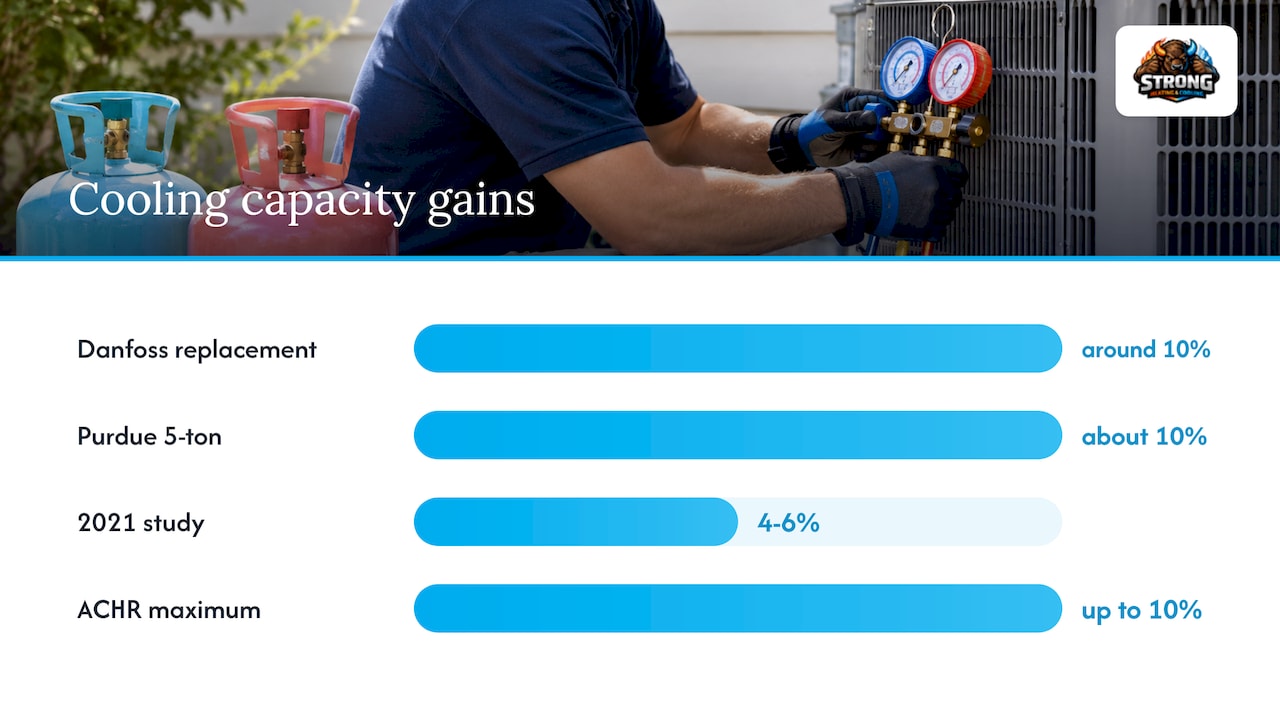
According to Danfoss, R-32 has around 10% more capacity than R-410A as a straight replacement, so a new R-32 system can deliver more cooling or use a smaller compressor. Danfoss adds that efficiency gains are expected when the system and its components are optimized for R-32.
A few studies put numbers on this:
- A Purdue University study of a 5-ton heat pump found R-32 delivered about 10% more cooling capacity, similar cooling efficiency and 10 to 17% higher heating efficiency than R-410A in the same unit.
- A DOE and Oak Ridge National Laboratory design-model study found a redesigned R-32 heat pump reached a SEER of 13.85 Btu/Wh against 13.21 for R-410A, with a compressor 10% smaller.
- A 2021 simulation study in Sustainability found R-32 gave 4 to 6% higher cooling capacity in a 5-ton two-speed heat pump, while seasonal cooling efficiency across all the alternatives stayed in a narrow band.
- ACHR News reports that, depending on equipment design, R-32 can provide capacity gains of up to 10% and efficiency gains of over 8%, and that charge can be up to 40% lower in new systems optimized for it.
What does that mean at your house? A system designed around R-32 can be a bit more compact in its refrigerant circuit and can hold less refrigerant by weight. Typically the charge is roughly 20 to 30% lower than a comparable R-410A system. The efficiency rating printed on the new unit’s label (SEER2 for cooling, HSPF2 for heat pump heating) is what captures the combined effect of all those design choices, so that rating is the number to compare, not the refrigerant name.
Cooling performance also depends on far more than refrigerant. Compressor design, for example, shapes real-world results in any cooling appliance, as this look at compressor versus thermoelectric cooling shows in a different kind of equipment. For a home system, our heat pump energy efficiency guide walks through how to read those ratings.
A note on heat and pressure
R-32 runs at slightly higher pressure than R-410A. At a 115°F condensing temperature, ACHR News puts R-32 at 416 psia and R-410A at 407 psia, a difference of just 9 psi. It also leaves the compressor hotter: in the Purdue drop-in test, discharge temperatures were about 20°C higher at standard rating conditions. Oak Ridge National Laboratory saw 12 to 21°C higher discharge temperatures in a high-ambient mini-split evaluation while also finding R-32 the only alternative with consistently better capacity and efficiency.
This is one reason R-32 equipment is engineered as a complete system: the compressor, the oil and the controls are chosen to handle those conditions. It is also one more reason a homeowner should never see R-32 as something you add to an older machine.
Safety: what the A2L rating means in your home
The A2L class sounds more dramatic than it is in daily life. Mildly flammable means the refrigerant is hard to ignite and burns slowly, with a burning velocity of 10 cm per second or less. Manufacturers meet this with design and standards instead of asking you to change how you live with the equipment.
Under the EPA’s use conditions, covered in a service-practice summary from Heat & Air News, equipment using these refrigerants must meet the UL 60335-2-40 (3rd edition) standard. Charge limits are tied to room size, units carry a warning label about flammable refrigerant, and service ports are marked red, according to this A2L requirements overview.
On the service side, A2L work involves:
- A2L-rated leak detectors and recovery machines
- Left-hand-threaded cylinders for A2L refrigerants
- Gauges scaled for R-32 pressures
- Dedicated recovery cylinders for each refrigerant
- Checks for ignition sources near the work area
- Updated technician training
That is exactly why installation and service should go to trained, certified technicians. Refrigerant work is also federally regulated: anyone who handles refrigerants must hold EPA Section 608 certification, and a trained crew treats A2L handling as part of the routine, not an exception.
Can you use R-32 in an R-410A system?
No. This is the most common question on this topic, and the answer is firm. The EPA’s HFC phasedown FAQ explains that the SNAP program and industry standards prohibit using mildly flammable refrigerants like R-32 in systems not designed for them. Arkema, a refrigerant producer, says in its Forane 32 technical digest that R-32 should be used only in systems designed for it, because the safety features for A2L refrigerants are built in by the manufacturer.
There are practical reasons too. An older R-410A system was built for different pressures, different compressor discharge temperatures and equipment that may contain ignition sources. Changing the refrigerant could also put your warranty and insurance coverage at risk.
So the choice is made when you buy the system, not afterward. That is a good reason to treat the replacement decision carefully.
What the EPA rules mean for your replacement
The rules sit on two pillars. The American Innovation and Manufacturing (AIM) Act directs the EPA to phase down HFC production and consumption. According to this timeline summary, the cap steps down to 60% of the baseline for 2024 to 2028, 30% from 2029, 20% in 2034 to 2035 and 15% from 2036. The Technology Transitions rule then limits which refrigerants new equipment can use.
Under 40 CFR 84.54, since January 1, 2025, manufacturing or importing self-contained residential and light-commercial AC and heat pump products with refrigerants of 700 GWP or higher is prohibited. Installing residential or light-commercial systems at or above that threshold is also prohibited, with exceptions for VRF systems and certain systems whose components were made or imported before that date.
A final EPA rule published May 26, 2026 and effective July 27, 2026 changed one piece of this. According to BRIX’s summary, it removed the January 1, 2026 installation deadline for systems built from components manufactured before 2025, while installing new R-410A equipment made after January 1, 2025 remains prohibited. Rules like this can be adjusted, so the EPA’s page is the place to confirm the current status before a big purchase.
What this means in plain terms
- Your existing R-410A system can stay in service. Per the EPA FAQ, homeowners can keep repairing existing R-410A systems for their useful life, including replacing a faulty condensing unit with a similar R-410A component.
- If you replace the outdoor unit and indoor coil together, or build a new home, that counts as a new system, and the new-system rules apply.
- New equipment sold today is built around lower-GWP refrigerants. R-32 is one of them. R-454B is another, as the ACHR and Danfoss sources note.
Our own write-up on the R-410A phase-out for homeowners goes through the timeline from the homeowner’s side.
Colorado is also one of twelve states with its own laws or regulations restricting HFC use in specific applications, according to the EPA FAQ, so a local contractor who works in your area every day keeps your project aligned with both federal and state requirements.
Repair or replace: where R-410A and R-32 meet your budget
Most homeowners do not face a refrigerant decision in isolation. It arrives with a repair bill, a system that is 12 to 15 years old, or an AC that no longer keeps up in July. A few questions sort the decision.
First, is the system leaking? A refrigerant leak on an older R-410A unit is a reason to look at the whole picture, not only at the next top-up. Our refrigerant leak checklist covers the symptoms to note before a technician arrives.
Second, how old is the equipment, and what does the repair cost against a new system? We explain why system age triggers replacement decisions in a separate guide.
Third, is the new unit sized for the house? A 10% capacity advantage from a refrigerant does not replace a proper load calculation. Our AC replacement sizing guide explains how sizing is done.
On price, new A2L systems have typically cost more than the R-410A systems they replace, according to Glacvent’s 2026 comparison. EPA also noted that installing remaining R-410A inventory could be a lower-cost option for consumers, as this summary of the rules records, but that inventory is finite and shrinking. Planning a replacement on your schedule, before a heat wave or a cold snap forces the timing, keeps more options open.
What a replacement costs with us
Our published prices on the air conditioner and heat pump pricing page start at $5,500 for a 14 SEER2 single-stage air conditioner and $6,500 for a 16+ SEER2 single-stage air conditioner. Heat pumps start at $6,500 for a 15 SEER2 single-stage model, $8,500 for a 17 SEER2 three-stage model and $10,000 for an 18 SEER2 variable model. Furnaces are on the furnace pricing page: from $4,500 for an 80% AFUE two-stage variable speed furnace, from $6,500 for a 96% AFUE variable speed condensing gas furnace and from $8,250 for a 98% AFUE modulating gas furnace, plus a single-stage 80% AFUE furnace at $3,900. We price flat-rate, with no hidden fees.
For a heat pump specifically, our Colorado Springs heat pump replacement guide covers how the choice plays out along the Front Range.
How to compare two quotes fairly
When two contractors quote you, the refrigerant name is one line among several. These are the lines that decide whether the quotes are comparable:
The efficiency rating of the outdoor unit and the indoor coil as a matched pair, in SEER2 for cooling and HSPF2 for heat pump heating. The size in tons, backed by a load calculation for your home. The stages of the compressor: single-stage, two-stage, three-stage or variable. The scope of work, including the line set, the thermostat, the pad, the permit and the disposal of the old equipment. And the warranty on parts and on the labor.
Ask that every one of these be written into a single flat price. A quote that lists the refrigerant but leaves out the permit, or one that gives a low number with add-ons to follow, is not the same quote as one that is complete.
Commercial owners and property managers can apply the same checklist to rooftop and split units. Daikin Applied’s 2026 presentation on preparing buildings for A2L refrigerants notes that R-32’s charge-adjusted GWP of about 435 is comparable to R-454B’s about 419 despite the higher nominal figure, and for building-wide planning, room volume and charge limits are part of the design conversation.
Replacing your system with Strong Heating And Cooling
When the refrigerant question becomes a replacement project, we handle the whole job: the sizing, the equipment, the installation, the startup and the follow-up. Our NATE-certified technicians bring more than 40 years of combined experience, and we offer same-day service when you need it. You get a flat-rate price up front, and our work is backed by a workmanship guarantee.

See the equipment options and starting prices on our AC and heat pump pricing page, or look at our heat pump replacement service if you are weighing a switch from a furnace and AC to a heat pump. If your current system is acting up, our AC repair page is the place to start, and our maintenance plans keep any system, old or new, running reliably between replacements.
Our perspective
Homeowners often arrive asking whether R-32 or R-410A is “better.” We understand why. The names are on the label and the internet is full of charts. But after more than 40 years of combined experience in Colorado Springs, we think the better question is whether the whole system suits the house.
Refrigerant is a design input. A system built around R-32 can offer higher capacity and a smaller refrigerant charge. A system built around any other approved refrigerant can perform very well too. What decides your comfort and your utility bills is correct sizing, a proper installation, airflow, and a maintenance routine that catches small problems early. Those are the parts we control, and we do them carefully.
The Front Range is not an easy climate for equipment. Cold winters, strong sun, dry air and high altitude all ask a lot of a system. That is why we put so much weight on matched equipment and on technicians who are NATE-certified and trained on the current refrigerant classes, including A2L handling.
We also believe in saying the price before the work starts. Our flat-rate pricing means the number you approve is the number you pay. If you are trying to decide between keeping an R-410A system running and replacing it, we will walk through it with you honestly, with the age, the repair history and the efficiency of the equipment on the table.
Owner
Frequently asked questions
Is R-32 better than R-410A?
R-32 has a lower GWP (675 versus 2,088) and, in systems designed for it, can offer a bit more capacity and efficiency with less refrigerant by weight. R-410A is the established refrigerant in the millions of systems already installed. For a new purchase, the efficiency rating and the quality of installation matter more than the refrigerant name.
Can I use R-32 in my R-410A system?
No. The EPA’s SNAP program and industry standards prohibit using mildly flammable refrigerants in equipment not designed for them. R-32 equipment has pressure, temperature and safety features built in that an older R-410A system lacks.
Will R-410A be phased out, and do I have to replace my system now?
You do not have to replace a working system. The EPA allows homeowners to keep repairing existing R-410A equipment for its useful life. What changed is that new residential systems built after 2024 can no longer use R-410A, and HFC supply is scheduled to step down under the AIM Act through 2036. Check the EPA’s HFC pages for the current rule status before a major purchase.
Is R-32 safe in a home?
R-32 is classed A2L, meaning low toxicity and mildly flammable, with a very low burning velocity. Equipment built for it must meet UL 60335-2-40, carries warning labels and uses charge limits tied to room size. Installation and service by trained, certified technicians is how those safeguards are put into practice.
Sources
- ACHR News: Examining R-32’s validity as an R-410A replacement
- HVAC PT Charts: R-32 vs R-410A
- HVAC PT Charts: Refrigerant GWP rankings
- Danfoss: R-32 for A/C systems and heat pumps
- Purdue IRACC: Drop-in performance of low-GWP refrigerants in a heat pump
- Purdue IRACC: HVAC systems with low global warming potential refrigerants
- MDPI Sustainability: Comparative performance of low-GWP refrigerants
- Oak Ridge National Laboratory: Alternative refrigerant evaluation
- Heat & Air News: R-454B and R-32 service
- The HVAC Brief: A2L refrigerant requirements
- EPA: Frequent questions on the phasedown of hydrofluorocarbons
- Arkema: Forane 32 technical digest
- eCFR: 40 CFR 84.54
- BRIX: EPA removes the R-410A installation deadline
- How House Works: R-410A after 2025
- Glacvent: R-410A vs R-32 key differences
- Daikin Applied: Preparing buildings for A2L refrigerants
- Dunn Luxury Selections: Compressor vs thermoelectric cooling
Recommended
Need expert HVAC help?
Colorado Springs' veteran-owned heating & cooling team — Mon–Sat, 8 AM–7 PM. Same-day service when available.