
R-410A Phase-Out: What Homeowners Need to Know in 2026
Your existing R-410A air conditioner or heat pump is legal to keep running, legal to repair, and legal to recharge for as long as the equipment holds up mechanically. What changed on January 1, 2025, is that manufacturers stopped producing new residential and light-commercial systems that use R-410A, and a May 2026 EPA final rule confirmed that pre-2025 units already in distributor inventory can still be installed until that stock runs out. The R-410A phase-out is real and ongoing, but it does not require any immediate action from most homeowners.
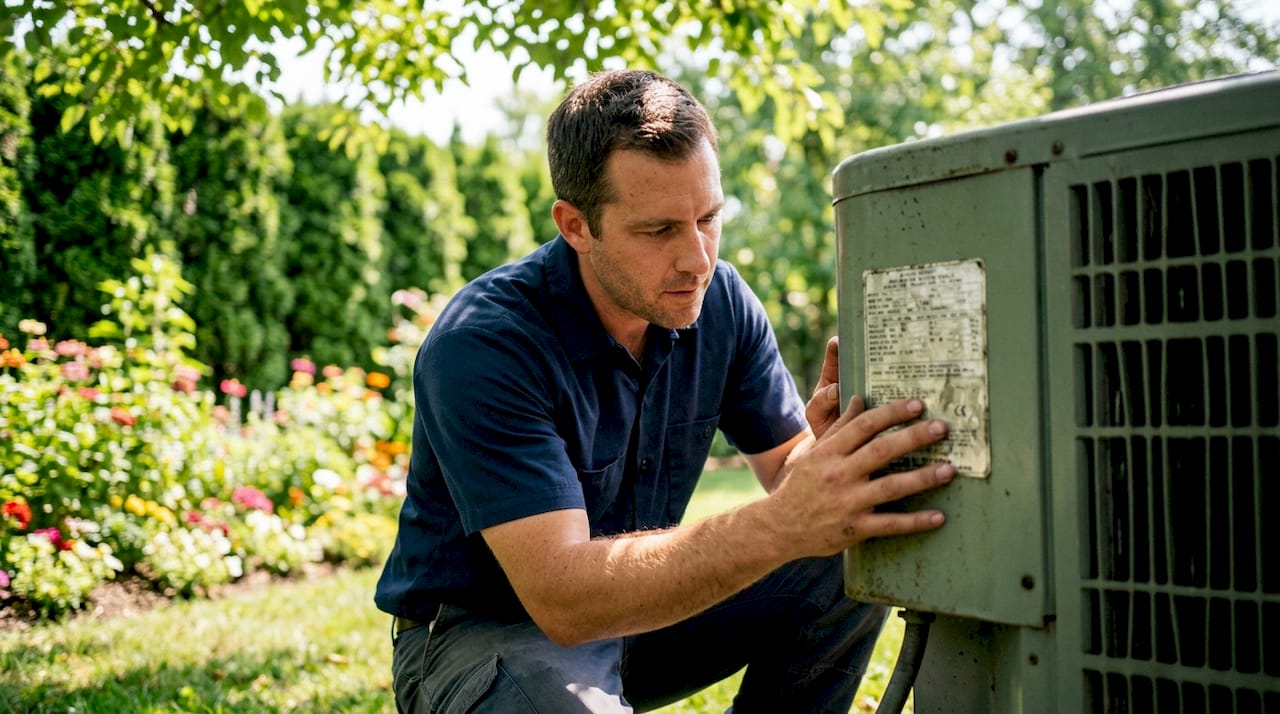
Three things are worth doing right now. First, find the data plate on your outdoor unit and note the manufacture or first-charge date (a four-digit year is required on all labeled equipment). Second, keep up with routine maintenance so your system runs efficiently while R-410A service refrigerant is still widely available. Third, if your system is more than 10 years old or has a known refrigerant leak, ask your technician to walk you through the repair-versus-replace numbers before the next service call, because the economics are shifting.
Pro Tip: The label on your outdoor condenser unit tells you everything you need to know about your system’s regulatory status. A manufacture or first-charge year of 2024 or earlier means the unit predates the new-equipment restriction and can be serviced with R-410A for its remaining life.
Key Takeaways
The R-410A phase-out restricts new equipment manufacturing but leaves existing systems fully legal to service, repair, and recharge for their remaining mechanical life.
| Point | Details |
|---|---|
| Existing systems stay legal | R-410A systems can be serviced and recharged indefinitely; the phase-out targets new production, not existing equipment. |
| Manufacturing cutoff was January 1, 2025 | New residential systems using refrigerants with GWP above 700 (including R-410A) cannot be manufactured after this date. |
| Pre-2025 units can still be installed | The May 2026 EPA final rule allows installation of pre-1/1/2025 R-410A units from existing inventory until stock is depleted. |
| A2L refrigerants are the new standard | R-454B and R-32 replace R-410A in new equipment; they require A2L-trained technicians and code-compliant installations. |
| Strongheatingandcooling can help | EPA 608-certified technicians serving Colorado Springs handle R-410A service and A2L system installation with honest repair-vs-replace guidance. |
Table of Contents
- What is the R-410A phase-out timeline, and which dates matter most?
- What do the rules actually control — and what stays legal?
- How will R-410A availability and service costs change over time?
- What refrigerants replace R-410A, and are they safe?
- Should you repair your R-410A system or replace it?
- What should you ask your HVAC contractor before signing anything?
- A local installer’s perspective on what we’re seeing in the field
- Strong Heating & Cooling is ready to help you through this transition
- Sources
- FAQ
What is the R-410A phase-out timeline, and which dates matter most?
The R-410A phase-out is part of a broader federal effort to reduce hydrofluorocarbon (HFC) emissions under the American Innovation and Manufacturing (AIM) Act, signed into law in 2020. The EPA’s AIM Act phasedown framework schedules HFC production and consumption allowances to fall progressively, reaching just 15% of the historical baseline by 2036.
Here are the specific dates that affect homeowners directly:
| Date | Regulatory Action | What It Means for You |
|---|---|---|
| January 1, 2025 | New residential/light-commercial AC and heat-pump equipment restricted from using refrigerants with GWP above 700 | No new R-410A systems manufactured for residential use after this date |
| 2025 onward | Manufacturers ship A2L-refrigerant systems (R-454B, R-32) as standard | New replacement equipment uses different refrigerant than your current system |
| May 2026 | EPA final rule allows continued installation of pre-1/1/2025 units until inventory depletes | Pre-2025 R-410A units in distributor stock can still be legally installed |
| July 27, 2026 | EPA final rule effective date | Installation flexibility for pre-2025 units formally codified |
| 2036 | HFC allowances reach 15% of baseline | Service refrigerant supply for existing systems significantly constrained |
The EPA’s technology transitions rule is what drove the January 1, 2025, manufacturing cutoff. R-410A has a global warming potential (GWP) of approximately 2,088, well above the 700 threshold that now applies to new residential equipment. Every new central air conditioner or heat pump rolling off an assembly line today uses an A2L refrigerant instead.
One point that confuses many homeowners: the manufacture date and the installation date are two different regulatory triggers. A unit built before January 1, 2025, is a pre-restriction unit regardless of when it gets installed. The EPA’s proposed reconsideration rule removed a hard installation deadline for those pre-2025 units, meaning a contractor can legally install one from existing inventory even now.
To read your equipment label: look for a sticker on the outdoor unit’s data plate that shows the ASHRAE refrigerant designation (e.g., “R-410A”) and a manufacture or first-charge year. EPA labeling rules require at minimum a four-digit year. If that year is 2024 or earlier, your unit is pre-restriction.
What do the rules actually control — and what stays legal?
The AIM Act regulates production and consumption allowances for HFCs, not the use of refrigerant already in your system. That distinction matters for homeowners. Here is how the regulated activities break down:
Production and import of high-GWP HFCs like R-410A are subject to declining allowances. Manufacturers and importers must hold sufficient allowances to cover what they produce or bring into the country. As allowances shrink toward the 2036 target, the total volume of virgin R-410A entering the market decreases each year.
Sale and installation of new equipment using restricted refrigerants is what the January 1, 2025, rule addresses. Selling a brand-new, freshly manufactured R-410A residential system after that date is not permitted. However, selling or installing a pre-2025 unit from existing inventory remains legal under the flexibility provisions confirmed by the May 2026 final rule.
Service and recharge of existing systems is not restricted. A certified technician can legally add R-410A refrigerant to your current system today and for the foreseeable future. The practical constraint is supply economics, not legality.
Reclamation is increasingly important in this picture. Reclaimed refrigerant — R-410A recovered from decommissioned systems, cleaned to AHRI 700 purity standards, and resold — does not consume production allowances the same way virgin refrigerant does. As virgin supply tightens, reclaimed R-410A will supply a growing share of the service market. The EPA’s reconsideration rule also clarified how reclaimed refrigerant counts against allocations, which helps service shops plan their inventory.
EPA 608 certification is the credential that matters for homeowners hiring a technician. Under Section 608 of the Clean Air Act, any technician who purchases refrigerant in containers larger than two pounds or who services refrigerant-containing equipment must hold an EPA 608 certification. Asking for that credential before a technician touches your system is a straightforward way to verify you are working with someone qualified.
Pro Tip: When a contractor quotes a refrigerant recharge, ask them to show you the invoice line item for refrigerant pounds added and the source (virgin vs. reclaimed). Reclaimed R-410A is legal and meets the same purity standards — but the price difference between virgin and reclaimed can be significant, and you deserve to know what you are paying for.
How will R-410A availability and service costs change over time?
Service refrigerant for existing R-410A systems is still available, but the supply picture will tighten over the coming years as AIM Act allowances continue to fall. Manufacturers stopped producing new R-410A residential systems after the 2024 model year, which means the only R-410A entering the market now is for servicing existing equipment. That demand is real: tens of millions of R-410A systems are currently installed across the United States.
Price pressure is already visible in some markets. Virgin R-410A costs have risen compared to pre-phasedown levels, and regional variability is significant. Areas with higher concentrations of older housing stock or limited distributor competition tend to see steeper price increases. Reclaimed refrigerant is helping buffer supply in many markets, but availability depends on how many systems are being decommissioned and recovered in a given region.
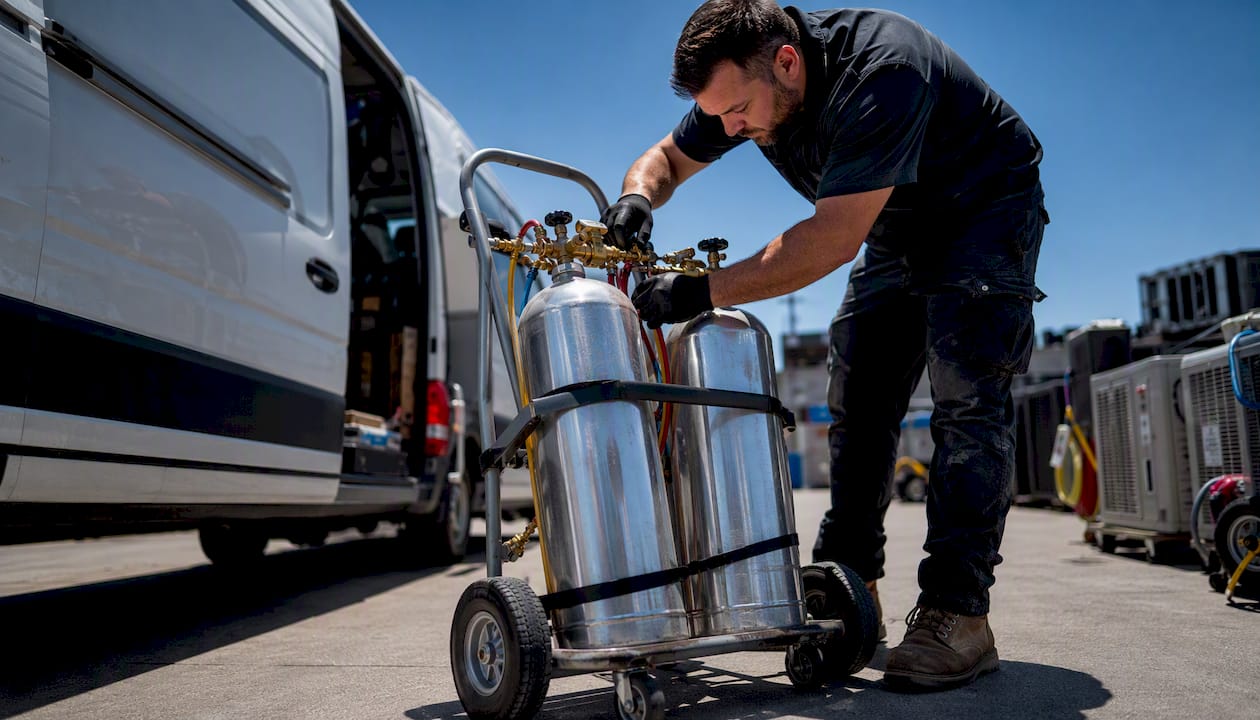
For homeowners, the practical signals of supply scarcity to watch for include technicians quoting unusually high per-pound refrigerant costs, lead times extending beyond a few days for service appointments, and distributors limiting purchase quantities to certified contractors. None of these indicate an emergency, but they are worth noting when you are evaluating whether a repair makes financial sense.
Cost ranges for common R-410A service scenarios vary widely by region, system size, and labor rates. Refrigerant leak repairs and recharges can be modest to costly depending on specific circumstances, and full system replacements with new A2L-refrigerant units can vary significantly based on multiple factors such as size, efficiency, and installation complexity. You can get a localized estimate using the HVAC installation cost calculator to compare repair and replacement scenarios side by side.
The cost of running an aging R-410A system through a Colorado summer is another factor worth quantifying. Older, lower-efficiency systems cost meaningfully more to operate each month than modern high-SEER equipment, and that gap widens as utility rates rise. The real cost of running an old AC through a Colorado summer breaks down those operating cost differences in concrete terms.
What refrigerants replace R-410A, and are they safe?
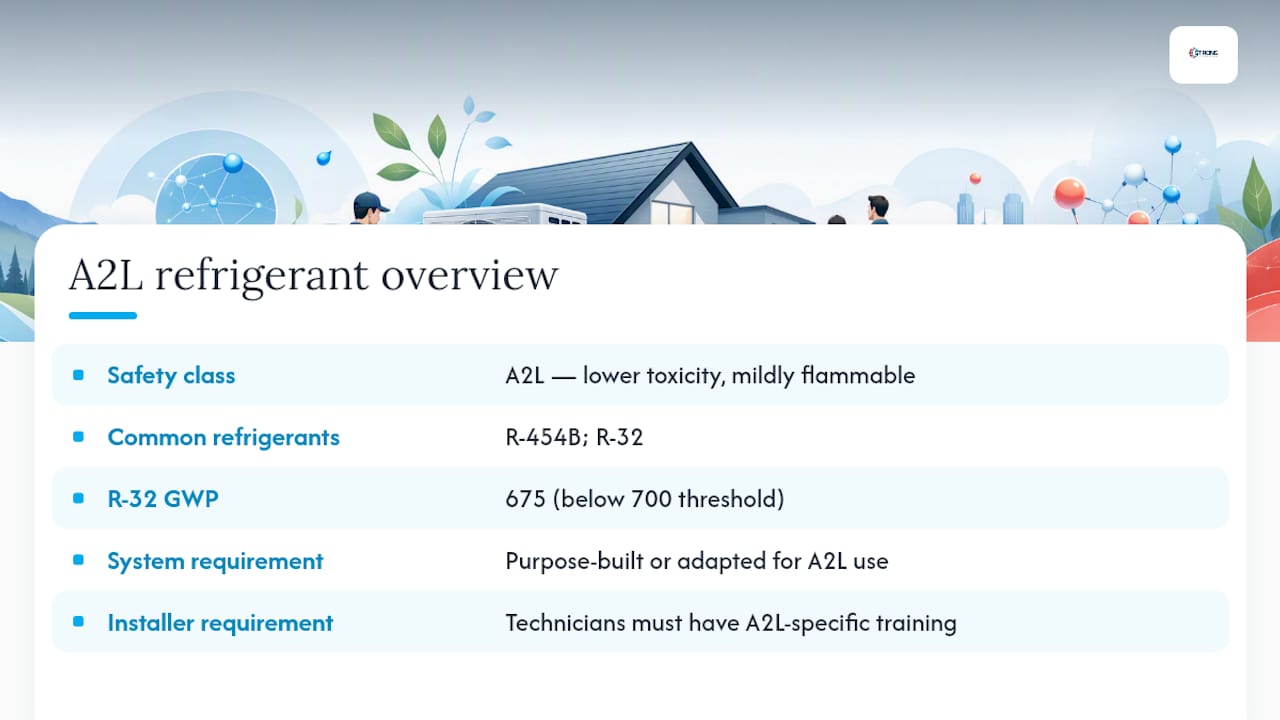
The refrigerants replacing R-410A in new residential equipment belong to the A2L safety classification. “A2L” is an ASHRAE designation that means lower toxicity (the “A”) and mildly flammable (the “2L”). The two most common A2L refrigerants appearing in new residential systems are R-454B and R-32.
R-32 has a GWP of 675, also well below the 700 threshold. Both refrigerants are designed to work in systems that are purpose-built or specifically adapted for A2L use — you cannot simply swap an A2L refrigerant into an existing R-410A system without equipment modifications.
From an efficiency standpoint, the transition is generally positive. Manufacturer guidance from Rheem and industry analysis indicate that A2L systems are designed to match or exceed the efficiency of R-410A equipment, and modern A2L units often carry higher SEER2 ratings than the systems they replace. Pairing a new A2L system with other energy efficiency improvements can produce meaningful reductions in monthly utility costs.
The mild flammability of A2L refrigerants is the characteristic that generates the most homeowner questions. Here is the practical context: A2L refrigerants have a high lower flammability limit (LFL), meaning they require a significantly higher concentration in air to ignite than common flammable gases. Accidental ignition under normal residential conditions is unlikely. The ICC’s guidance on A2L refrigerant transitions explains that updated model building codes (IBC and IRC) address this risk through requirements for ventilation, leak detection in certain applications, and system design standards. ASHRAE has been central to developing the safety standards that underpin these code updates.
The key difference for homeowners is not personal safety risk — it is installer qualification. A2L systems require technicians trained in the specific handling, charging, and leak-detection procedures for mildly flammable refrigerants. Asking your contractor whether they have completed A2L-specific training is a reasonable and important question before any new system installation.
Pro Tip: Ask your installer to show you the equipment’s A2L compliance documentation and confirm that the installation meets your local jurisdiction’s adopted building code. Some states and municipalities have adopted the latest IBC/IRC revisions; others are still on older code cycles. Your local building department can confirm which version applies to your home.
Should you repair your R-410A system or replace it?
The repair-versus-replace decision for an R-410A system comes down to four variables: system age, efficiency, repair cost relative to replacement cost, and refrigerant availability in your area. No single rule fits every situation, but a structured approach makes the decision clearer.
Start with system age. A central air conditioner or heat pump typically has a useful life of 15–20 years with proper maintenance. If your system is under 10 years old and in otherwise good condition, repair is usually the right call. Between 10 and 15 years, the economics depend heavily on the repair cost and the system’s efficiency rating. Beyond 15 years, replacement often makes more financial sense even when the repair itself is modest, because the remaining useful life is short and operating costs on older, lower-SEER equipment are higher.
Red flags that suggest replacement rather than repair:
- Multiple refrigerant leaks in different locations, indicating coil or line-set deterioration
- A failed or failing compressor, which is the most expensive single component in the system
- Parts that are no longer available or require special ordering with long lead times
- SEER ratings below 13, which are significantly less efficient than current minimum standards
- A history of repeated service calls within the past two to three years
Timeline expectations matter too. A refrigerant leak repair and recharge on an existing system can typically be completed in one to two days once parts are sourced. A full system replacement, including permitting where required, equipment delivery, and installation, generally takes three to seven days from contract signing to a running system. During peak season in Colorado Springs, lead times for replacement equipment can extend further, so planning ahead is worth the effort. The air conditioner installation guide walks through what to expect at each stage of a replacement project.
Reviewing HVAC red flags that home inspectors often miss can also help you identify whether your system has underlying issues beyond the immediate repair.
What should you ask your HVAC contractor before signing anything?
A qualified contractor will welcome these questions. One who deflects or cannot answer them is a red flag in itself.
Questions to ask before any repair or replacement work begins:
- What is the manufacture or import date on my current unit, and can you show me the label?
- What refrigerant does my system use, and is service refrigerant readily available in this area right now?
- Are you EPA 608 certified, and can I see your certification documentation?
- If you are recommending a new system, does it use an A2L refrigerant, and have your technicians completed A2L-specific training?
- What warranty covers the equipment, and what warranty covers your labor separately?
- Are all parts you plan to use new OEM components, or are any aftermarket or refurbished?
Documentation to request before work starts or at job completion:
- A photo of the existing unit’s data plate showing the manufacture date and refrigerant type
- An invoice that itemizes refrigerant pounds added, the refrigerant source (virgin or reclaimed), and the per-pound price
- Written parts and labor warranty terms, not just a verbal assurance
- A code compliance statement or permit number for any new installation
Watch for these red flags in quotes: a lump-sum refrigerant charge with no pounds listed, no mention of disposal or recovery fees for old refrigerant (legal recovery is required under EPA rules), or a proposal to install a new system without any mention of the refrigerant type or A2L compatibility. Whole-home efficiency also connects to how well your HVAC system performs — improving your building envelope alongside an HVAC upgrade can reduce the load your new system carries.
If a quote feels incomplete or a contractor cannot answer basic questions about EPA 608 certification or A2L training, requesting a second opinion is entirely reasonable. Strongheatingandcooling offers on-site inspections for homeowners who want an honest assessment of their system’s condition and repair-versus-replace economics before committing to any work.
Pro Tip: Ask specifically whether the contractor pulls permits for new installations in your municipality. Unpermitted HVAC work can create problems when you sell your home and may void manufacturer warranties. A contractor who skips permits to save time is not saving you anything.
A local installer’s perspective on what we’re seeing in the field
Strong Heating & Cooling is ready to help you through this transition
Replacing or repairing an R-410A system is a significant decision, and the regulatory changes make it more complex than it was five years ago. Strongheatingandcooling serves Colorado Springs and surrounding communities with HVAC repair and full system installation by EPA 608-certified technicians trained on both R-410A service and A2L equipment.

Whether you need a refrigerant leak diagnosed, a pre-2025 unit serviced, or a new A2L system installed, the team at Strongheatingandcooling can walk you through the options honestly. Financing is available for qualifying homeowners through the financing page, and current coupons and deals can reduce the cost of a repair or replacement. Schedule an on-site inspection to get a clear picture of your system’s condition and a straightforward recommendation on what makes sense for your home and budget.
Sources
For homeowners who want to verify regulatory claims or read the primary source documents, these are the most useful references:
- Frequent Questions on the Phasedown of Hydrofluorocarbons
- I-Codes: A2L refrigerants transition (ICC)
- What are A2L refrigerants? A homeowner’s guide (Rheem)
Note that building codes are adopted at the state and local level, so the IBC/IRC revisions covering A2L requirements may not yet apply in every jurisdiction. Contact your local building department to confirm which code version governs residential HVAC installations in your area. Some states, including New York, have adopted stricter refrigerant rules that may impose additional requirements beyond the federal baseline.
FAQ
Can I still use and service my R-410A system after 2026?
Yes. Existing R-410A systems remain fully legal to operate, repair, and recharge. The phase-out restricts new equipment manufacturing, not the service of systems already installed.
How long will R-410A refrigerant be available in the U.S.?
Reclaimed R-410A will increasingly supplement virgin supply for service shops.
Can a new R-410A system still be installed in 2026?
A brand-new, freshly manufactured R-410A residential system cannot be legally produced after January 1, 2025. However, pre-2025 units already in distributor inventory can still be installed under the flexibility provisions of the May 2026 EPA final rule, until that stock is depleted.
Is R-410A coming back, or is the phase-out permanent?
The phase-out is permanent under the AIM Act. The May 2026 EPA rule provided installation flexibility for existing inventory but did not reverse the phasedown schedule or allow new production of R-410A residential equipment.
What refrigerant replaces R-410A in new systems?
New residential systems use A2L refrigerants, most commonly R-454B and R-32. Both have significantly lower GWP than R-410A and require A2L-trained technicians and code-compliant installation practices.
Recommended
- The Real Cost of Running an Old AC Through a Colorado Summer | Strong Heating & Cooling
- What to Ask During HVAC Replacement: A Homeowner’s Guide | Strong Heating & Cooling
- Is It Time to Upgrade Your AC? 7 Signs Worth the Investment | Strong Heating & Cooling
- Smart Thermostat HVAC Trends That Matter | Strong Heating & Cooling
Need expert HVAC help?
Colorado Springs' trusted, veteran-owned heating & cooling team — emergency service.