
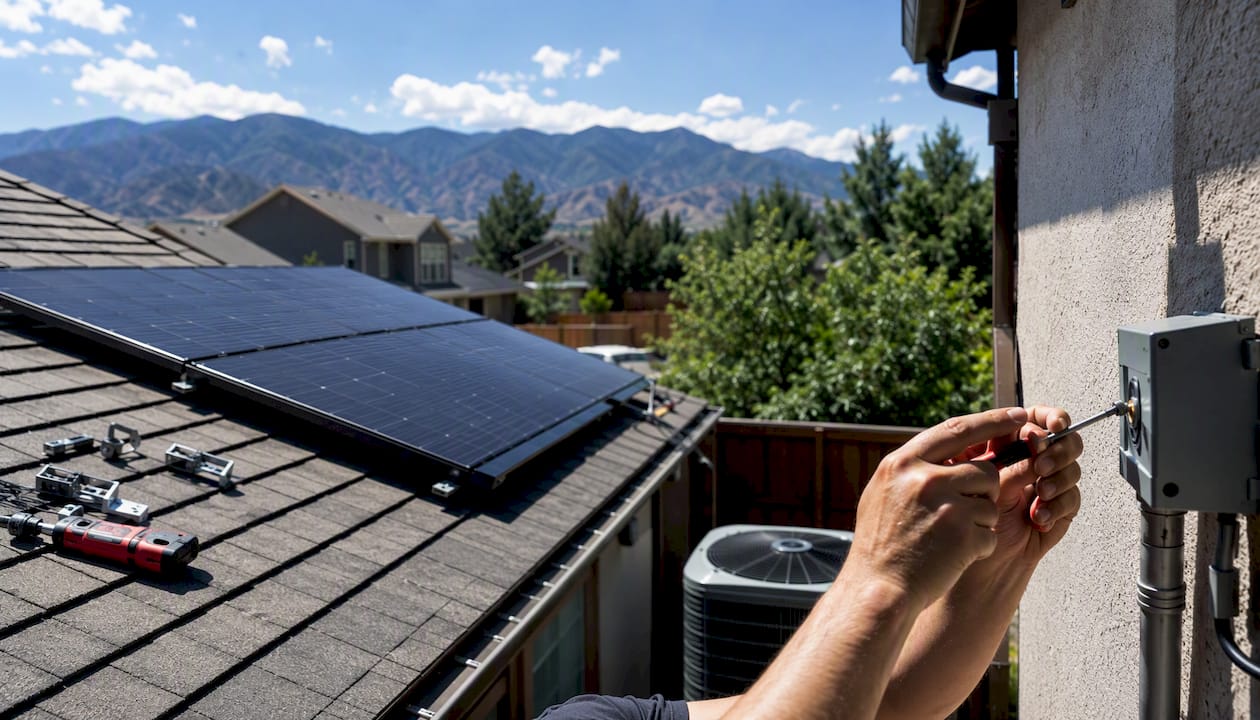
How Solar HVAC Options Work: A Homeowner’s Guide
For most homeowners, pairing rooftop solar panels with a modern heat pump is the simplest, highest-value path to solar-powered heating and cooling. Understanding how solar HVAC options work helps you choose between four main approaches: PV powering a heat pump or air conditioner, solar-assisted heat pumps (DX-SAHP or IX-SAHP), photovoltaic-thermal collectors (PVT or PVT-DX-SAHP), and solar thermal or absorption systems.
Here is how those options compare at a glance:
- PV + heat pump: Simplest to install and finance, broadest incentive eligibility, modest efficiency gains from solar alone.
- Solar-assisted heat pumps (DX-SAHP/IX-SAHP): Higher efficiency potential by feeding solar heat directly into the refrigerant cycle, but more complex and harder to service.
- PVT and PVT-DX-SAHP: Combines electrical and thermal output from one collector, raising seasonal performance in studies, but longer payback and limited installer availability.
- Solar thermal/absorption systems: Best for large or specialized loads; rarely the right fit for a standard home.
Your priorities drive the choice. If lower bills and a straightforward retrofit matter most, PV plus a heat pump wins. If you want maximum carbon reduction and have the budget and a willing installer, PVT or a solar-assisted heat pump is worth exploring.
Key Takeaways
For most homeowners, pairing rooftop PV with a modern heat pump delivers the best combination of simplicity, incentive eligibility, and long-term savings among all solar HVAC options.
| Point | Details |
|---|---|
| PV plus heat pump is the practical default | It uses mature, widely serviced technology with the broadest incentive coverage and clearest payback path. |
| Heat pump efficiency baseline | Standard air-source heat pumps deliver a COP of 3–4; solar offsets the electricity cost rather than raising the COP directly. |
| PVT raises SPF but extends payback | MDPI study data shows higher seasonal performance and lower TEWI for PVT-DX-SAHP, but longer payback periods in modeled scenarios. |
| Check DSIRE before signing | State and utility incentives found on DSIRE, plus the 30% federal ITC, can materially shorten payback on any solar HVAC system. |
| Strongheatingandcooling next step | A site evaluation from Strongheatingandcooling confirms load, solar potential, and local incentives before you commit to a system. |
Table of Contents
- How each solar HVAC option actually works
- Performance metrics homeowners should watch
- Benefits and realistic tradeoffs
- Typical costs, payback, and incentives that change the math
- What installation looks like and what maintenance requires
- How to choose the right solar HVAC path for your home
- What credible installers check and how homeowners can pay for it
- Why PV plus a heat pump is the right starting point for most homeowners
- Strong Heating And Cooling makes the next step straightforward
- Sources
- FAQ
How each solar HVAC option actually works
Solar energy reaches your HVAC system through one of three pathways: as electricity from photovoltaic panels, as captured heat from solar thermal collectors, or as a combination of both through PVT collectors. Each pathway leads to a different system design, cost structure, and maintenance profile.
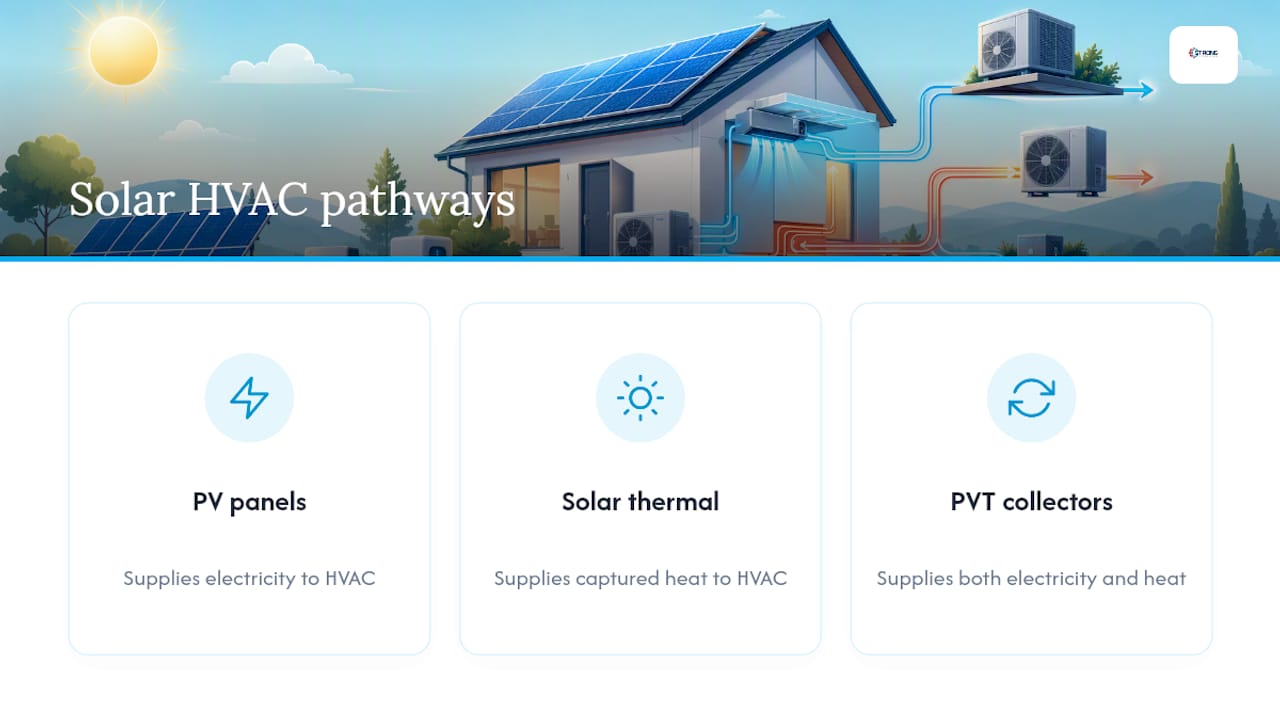
PV powering a heat pump or air conditioner
The most common setup routes solar electricity through an inverter, which converts DC power from the panels into AC power your home can use. That electricity runs the compressor in your heat pump or central air conditioner, the same way grid power would. A grid-tied system draws from the utility when solar output falls short and exports surplus power back through net metering. A hybrid system adds a battery, so the system automatically switches to stored solar energy during cloudy periods or at night. ASHRAE engineering guidance confirms that for residential solar-assisted cooling, PV powering a vapor-compression heat pump is the most practical approach, more so than solar thermal absorption systems for standard homes.
Some manufacturers, including iAIRE, offer DC-powered solar air conditioners that connect panels directly to a DC compressor, bypassing the inverter and reducing conversion losses. These units typically display live production and consumption data, which lets homeowners verify actual performance rather than relying on estimates.
Solar-assisted heat pumps: DX-SAHP and IX-SAHP
A direct-expansion solar-assisted heat pump (DX-SAHP) routes refrigerant through solar collectors on the roof, where it absorbs heat before reaching the compressor. The sun effectively pre-warms the working fluid, so the compressor does less work to reach the target temperature. An indirect-expansion version (IX-SAHP) uses a secondary fluid loop between the collector and the refrigerant circuit, adding a heat exchanger but reducing the risk of refrigerant leaks at the roof level. Both designs raise the evaporator temperature, which lifts the system’s coefficient of performance above what a standard air-source heat pump achieves on the same day.
PVT and PVT-DX-SAHP collectors
A photovoltaic-thermal (PVT) collector generates electricity and captures heat from the same panel surface. In a PVT-DX-SAHP configuration, the thermal output feeds directly into the refrigerant circuit while the electrical output runs the compressor or other loads. A 2026 MDPI comparative study found that PVT-DX-SAHP configurations achieved higher seasonal performance factors (SPF) and lower total equivalent warming impact (TEWI) than DX-SAHP in the study cases, though the PVT variants also carried longer payback periods in those modeled scenarios. The SEIA notes that PVT has a clear niche but that PV plus a heat pump remains the most broadly applicable residential approach.
Solar thermal and absorption systems
Solar thermal collectors heat a fluid, typically water or glycol, which can supply radiant floor heating, domestic hot water, or feed an absorption chiller for cooling. Absorption chillers use heat rather than electricity to drive a refrigeration cycle, making them attractive where waste heat or concentrated solar is abundant. For a typical single-family home, the equipment cost, space requirements, and maintenance complexity rarely justify the investment compared to PV-based options.
The physical components you will see on site vary by system type but generally include some combination of:
- Rooftop PV panels or PVT collectors and their mounting hardware
- A string or microinverter, or a DC-to-DC optimizer array
- An outdoor heat pump or compressor unit
- Refrigerant lines connecting the outdoor unit to indoor air handlers
- A thermal store or hot water tank (PVT and solar thermal systems)
- A battery bank and charge controller (hybrid systems)
- A smart meter or monitoring gateway
| How solar is coupled | Best climates and use cases | Energy performance | Complexity | Typical upfront cost range |
|---|---|---|---|---|
| PV → inverter → heat pump | Most climates; retrofit-friendly | COP 3–4 baseline; solar offsets operating cost | Low | $15,000–$22,000 combined |
| DX-SAHP (refrigerant through collector) | Sunny, moderate to warm | Higher COP than air-source baseline | Medium-high | $20,000–$45,000 |
| PVT-DX-SAHP | Sunny climates; new builds preferred | Highest SPF in studies; lower TEWI | High | $30,000–$60,000+ |
| Solar thermal / absorption | Large loads; commercial or specialized | Effective for heating; complex for cooling | Very high | Varies widely |
Performance metrics homeowners should watch
Energy explains that the coefficient of performance (COP) measures how much heating or cooling a system delivers per unit of electricity consumed. A COP of 3 means the system delivers three units of thermal energy for every one unit of electricity it uses. Seasonal metrics, specifically the Seasonal Coefficient of Performance (SCOP) or Seasonal Performance Factor (SPF), average that efficiency across a full heating or cooling season, accounting for cold mornings, cloudy days, and part-load operation. SPF is the more useful number for homeowners comparing annual energy bills.
Modern air-source heat pumps typically achieve a COP in the range of 3–4 under standard test conditions. Adding rooftop PV does not raise the heat pump’s COP directly; instead, it reduces the effective cost of each unit of electricity the compressor consumes. A heat pump drawing 1 kWh from solar-generated power rather than the grid costs you nothing in fuel, which is why pairing PV with a heat pump creates a meaningful hedge against rising electricity prices, as energy analysts at EnergySage emphasize.
Solar-assisted configurations (DX-SAHP, IX-SAHP, PVT-DX-SAHP) can raise the measured COP above the air-source baseline because solar heat lifts the evaporator temperature. The MDPI study cited above documented SPF increases for PVT-DX-SAHP versus DX-SAHP in specific test climates, though results depend heavily on local solar irradiance, operating schedule, and whether the system prioritizes space heating or domestic hot water. Practical guides suggest that covering a heat pump’s annual electricity load in a moderate climate may require roughly 2,000–5,000 additional kWh of panel production per year, which translates to a few extra panels beyond a basic solar array.
TEWI, or total equivalent warming impact, combines direct refrigerant emissions with indirect emissions from electricity consumption. PVT-DX-SAHP systems score lower on TEWI in studies partly because they consume less grid electricity and partly because newer systems use lower global-warming-potential (GWP) refrigerants. Regulatory pressure toward low-GWP refrigerants such as R-32 and R-454B is already reshaping equipment choices, so asking your installer about refrigerant type is worth the conversation.
Statistic callout: Heat pumps deliver 300–400% efficiency (COP 3–4) under standard conditions, meaning they move three to four times more energy than they consume. Solar generation can reduce the effective operating cost of that electricity to near zero after system payback.
Benefits and realistic tradeoffs
The case for solar heating and cooling is strongest when you look at the combination of lower bills, lower emissions, and long-term price stability. The EPA’s greenhouse gas overview confirms that displacing fossil-fuel-generated electricity with on-site solar directly reduces household carbon emissions, and the effect compounds when the solar system also powers an electric heat pump replacing a gas furnace.
Benefits worth knowing:
- Lower monthly electricity bills once the system is paid off, with operating costs approaching zero for solar-covered hours
- Reduced carbon footprint by displacing grid electricity, especially in regions with carbon-intensive utility mixes
- A hedge against volatile electricity rates, since self-consumed solar is insulated from utility price increases
- Combined upgrade ROI when a heat pump replaces an aging gas furnace or inefficient central AC at the same time as a solar installation
Realistic limits to plan for:
- Upfront costs are significant, typically $15,000–$60,000 depending on system type, before incentives
- Roof orientation, shading, and available area constrain panel output; a north-facing or heavily shaded roof may not produce enough to justify the investment
- Seasonal mismatch is real in cold climates: solar production peaks in summer while heating demand peaks in winter, so a battery or grid connection remains necessary
- PVT and absorption systems require specialized service technicians, who are less available in many markets
- Refrigerant regulations are tightening; systems using older high-GWP refrigerants may face service cost increases over time
Climate matters considerably. In the Sun Belt and high-altitude regions with strong solar irradiance, PV plus a heat pump delivers the best combination of production and efficiency. In very cold climates, a cold-climate heat pump rated for low ambient temperatures is a prerequisite, and a dual-fuel backup (heat pump plus a gas furnace) can protect against extreme cold snaps while still capturing most of the solar benefit.
Typical costs, payback, and incentives that change the math
Cost ranges vary by system type and local labor rates, but a realistic framework helps set expectations. A small PV array paired with a ductless mini-split heat pump might run $15,000–$22,000 installed. A whole-house PV system paired with a central heat pump typically falls in the $25,000–$45,000 range before incentives. Adding PVT collectors or a solar-assisted heat pump configuration adds $10,000–$20,000 or more to those figures. Solar thermal or absorption systems for residential use are rarely quoted below $30,000 and often exceed that substantially.
A simplified payback example illustrates the logic. Assume a household replaces a central AC unit with a heat pump and adds a 6 kW PV array:
State and utility programs can reduce the net cost further. DSIRE is the authoritative U.S. database for locating state and utility incentives; checking it before you sign a contract is one of the highest-value steps you can take.
Incentive sources to check before finalizing a budget:
- Federal ITC (30% of installed solar system cost for qualifying residential installations)
- Utility rebates for heat pump installation or efficiency upgrades
- Net metering or time-of-use credits from your utility
- DSIRE listings for your specific state and utility territory
Note: the federal Energy Efficient Home Improvement Credit (Section 25C) ended for equipment installed after December 31, 2025, so it no longer applies to new HVAC installations. For the rebates still available to Colorado Springs homeowners, see our 2026 Colorado HVAC rebates guide.
What installation looks like and what maintenance requires
A solar HVAC installation typically spans two to four weeks from permit approval to commissioning, though permitting timelines vary by jurisdiction. The process involves several parallel workstreams: the solar contractor handles roof or ground array siting, structural analysis, inverter and battery placement, and utility interconnection. The HVAC contractor handles heat pump placement, refrigerant line sizing, ductwork inspection or replacement, and electrical connections to the panel.
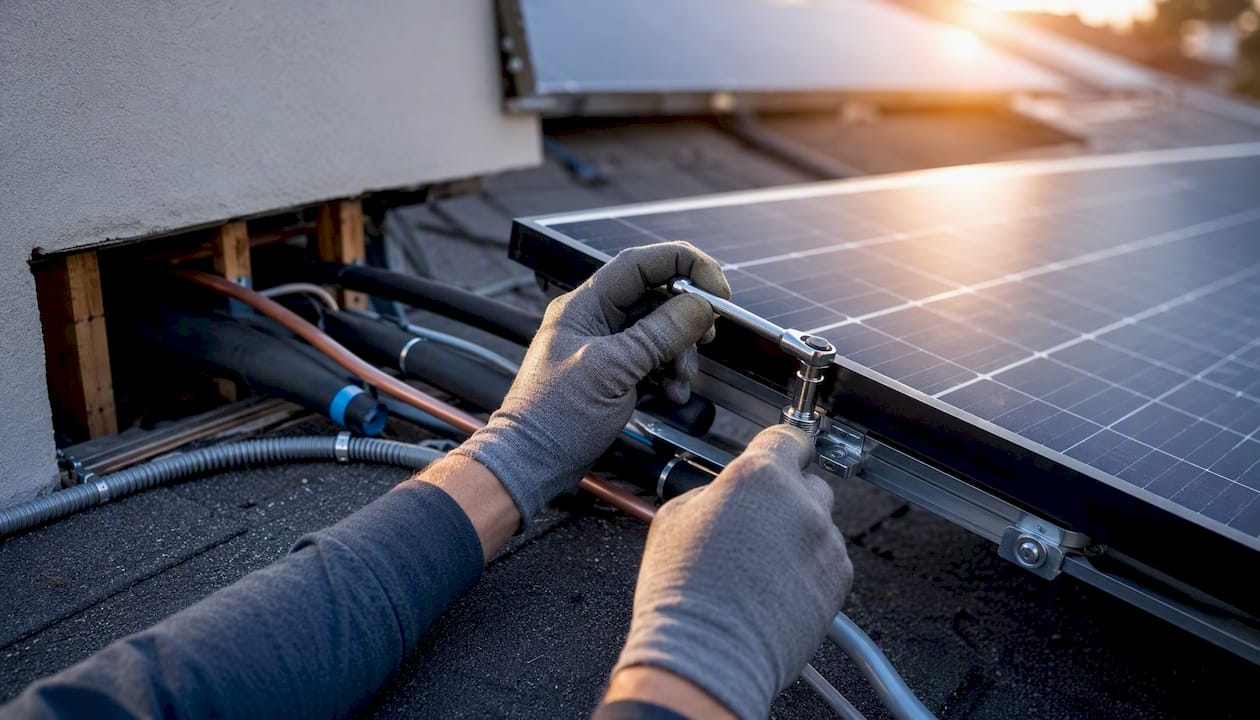
Retrofit considerations that often surprise homeowners include electrical panel capacity (a heat pump and EV charger together may require a panel upgrade), ductwork condition (leaky ducts waste a significant share of heat pump output), and backup heat strategy. In climates with extended cold periods, a dual-fuel system that pairs a heat pump with a gas furnace provides resilience without sacrificing most of the solar benefit.
Routine maintenance for a solar HVAC system covers both the solar and HVAC sides. Following a preventive HVAC maintenance schedule is especially important when a heat pump is the primary heating and cooling source, since deferred maintenance affects both comfort and efficiency. Key tasks include:
- Annual panel cleaning to remove dust, pollen, and debris that reduce output
- Inverter status checks and firmware updates (most modern inverters flag faults automatically)
- Refrigerant leak checks and pressure verification at each annual heat pump tune-up
- Filter replacement every 1–3 months depending on household dust levels
- Thermal store inspection for PVT and solar thermal systems (scale buildup, fluid pH)
- Battery capacity check for hybrid systems, typically annually
Questions to ask any installer before signing:
- What warranty covers the panels, inverter, heat pump, and installation labor separately?
- Does the system include remote monitoring, and who receives fault alerts?
- What is the modeled annual kWh production, and what degradation rate does the model assume?
- Who handles interconnection with the utility, and what is the expected timeline?
- Are all permits included in the quoted price?
How to choose the right solar HVAC path for your home
Working through a short sequence of questions helps narrow the options quickly.
- Do you already have a PV system? If yes, adding a heat pump is often the fastest payback upgrade available, since the solar infrastructure is already in place.
- What is your primary goal? Lower bills favor PV plus a heat pump. Maximum carbon reduction may justify PVT or a solar-assisted configuration if a qualified installer is available locally.
- How much usable south-facing roof area do you have? A whole-house heat pump typically needs 6–10 kW of PV to cover most of its annual load, which requires roughly 400–700 square feet of unshaded roof.
- What is your climate? Mild to warm and sunny climates get the most from PV plus a heat pump. Very cold climates need a cold-climate heat pump rated for low ambient temperatures, and a dual-fuel backup is worth considering.
- What is your budget and timeline? PV plus a heat pump is the most financeable option with the broadest incentive coverage. PVT and solar-assisted systems have fewer financing products and fewer qualified installers.
Red flags that should prompt a closer look before committing:
- Roof orientation significantly off south (more than 45 degrees east or west) without a ground-mount alternative
- Utility net metering program that pays well below retail rate, which reduces the value of exported solar
- High upfront cost without confirmed incentive eligibility
- No local installer with documented PVT or DX-SAHP service experience
When to prioritize a battery: if your utility has time-of-use rates that spike in the evening, or if backup power during outages matters to your household, a battery improves both economics and resilience. When to size PV for annual coverage rather than peak self-consumption: if your utility offers strong net metering, a larger array that exports surplus power in summer and draws credits in winter can outperform a battery-only strategy. When to consider dual-fuel: if your climate regularly drops below 15°F, a gas furnace backup reduces the risk of comfort shortfalls during the coldest weeks.
What credible installers check and how homeowners can pay for it
A thorough site assessment from a qualified installer covers more than a roof measurement. Expect the following from any contractor worth hiring:
- Roof orientation and shading study using tools such as Solar Pathfinder or PVWatts to model actual annual production
- Site energy audit or load calculation to size the PV array and heat pump correctly
- Ductwork inspection to confirm the existing distribution system can handle heat pump airflow
- Electrical panel load check and roof structural review to confirm capacity for added equipment
- Interconnection feasibility review with the utility to confirm net metering availability and timeline
- A written production estimate with the assumed panel degradation rate stated explicitly
Pro Tip: Ask every installer to provide their modeled annual kWh production figure and the degradation rate they assumed. Most panels degrade at roughly 0.5% per year, but some models use 0.8% or higher. Comparing quotes on consistent assumptions prevents you from choosing a system that looks cheaper only because the production estimate is more optimistic.
Financing options for solar HVAC systems include:
- Cash purchase, which maximizes long-term savings and simplifies the ITC claim
- Solar loans (secured or unsecured), which preserve ownership and ITC eligibility while spreading cost over time
- PACE (Property Assessed Clean Energy) financing, where available, which attaches repayment to the property tax bill
- Manufacturer or contractor financing programs, which vary in rate and term
- Leases and power purchase agreements (PPAs), which lower upfront cost but transfer ITC benefits to the lessor and may complicate home sales
Smart controls, including SG-Ready heat pump interfaces and battery management systems, can time heat pump operation to solar production peaks and increase self-consumption. Research published by pv magazine USA notes that while these strategies improve self-consumption, prioritizing hot water storage at higher supply temperatures can slightly reduce the measured seasonal SPF, so control settings involve a tradeoff worth discussing with your installer.
Why PV plus a heat pump is the right starting point for most homeowners
The appeal of PVT and solar-assisted heat pumps is real. Higher SPF numbers and lower TEWI scores are genuinely meaningful, and the MDPI study data backs the performance claims in the right conditions. But the practical reality for most homeowners is that PVT installers are scarce, service costs are less predictable, and payback periods are longer even in favorable climates.
PV plus a modern heat pump, by contrast, uses two mature, widely serviced technologies. Every major HVAC manufacturer makes cold-climate heat pumps. Every major solar installer can size and commission a grid-tied PV array. Financing, warranties, and incentives are well-established. The combination delivers most of the carbon and cost benefit of the more complex options without the service risk.
The one scenario where a more advanced configuration earns its complexity is a new build or a deep energy retrofit where the design team can integrate PVT collectors from the start, the homeowner has a long time horizon, and a qualified service provider is genuinely local. In that case, the higher SPF and lower TEWI of a PVT-DX-SAHP system may justify the premium.
For retrofit projects on existing homes, start with the fundamentals: air-seal and insulate first, then size a heat pump for the reduced load, then add PV to cover the operating cost. That sequence produces the best economics and the most durable comfort outcome.
Strong Heating And Cooling makes the next step straightforward

Strong Heating And Cooling brings over 40 years of combined industry experience to heat pump installation, system pairing with solar, and long-term maintenance across Colorado Springs and surrounding communities. If you are weighing a heat pump upgrade alongside a solar investment, the right starting point is a site evaluation that accounts for your home’s actual load, your roof’s solar potential, and the incentives available in your area.
The team at Strongheatingandcooling handles heat pump installation and replacement with honest pricing and no pressure to upsize beyond what your home needs. Whether you are replacing an aging furnace, adding a ductless mini-split, or planning a full system paired with rooftop PV, Strongheatingandcooling can assess your options and give you a clear picture of costs, savings, and timelines. Explore cooling services and heat pump options or contact the team directly to schedule a free site assessment.
Sources
- Solar-Assisted Air Conditioning: What Engineers Need to Know
- EnergySage — Benefits of solar-powered air-source heat pumps
- Solar Heating and Cooling – SEIA
- Dsireusa
- Comparative analysis of PVT‑DX‑SAHP (MDPI Processes)
FAQ
What are the main disadvantages of solar AC systems?
The primary disadvantages are high upfront cost (typically $15,000–$60,000 depending on system type), roof or space constraints that limit panel output, and seasonal mismatch between peak solar production in summer and peak heating demand in winter. More complex configurations like PVT or solar-assisted heat pumps also require specialized service technicians who are not available in every market.
Can you use solar power just for your AC unit?
Yes. A dedicated PV array sized to cover your air conditioner’s annual electricity load is technically straightforward, especially with a ductless mini-split that accepts DC power directly or with a grid-tied inverter system. Strongheatingandcooling can help size a heat pump and assess how many panels your roof can support for that purpose.
What is the informal HVAC duct and AC unit cost threshold rule?
This is an informal guideline sometimes used by HVAC contractors: if the cost of repairing an air conditioner exceeds $5,000, replacement is usually the more economical choice. It is not a regulatory standard, and the right threshold depends on the unit’s age, efficiency rating, and the cost of a replacement system in your area.
Does adding solar panels actually raise a heat pump’s efficiency?
Adding PV does not raise the heat pump’s COP directly. It reduces the effective cost of the electricity the heat pump consumes by replacing grid power with solar generation. Solar-assisted configurations (DX-SAHP, IX-SAHP, PVT-DX-SAHP) do raise measured COP and SPF by feeding solar heat into the refrigerant circuit, but those systems are more complex and carry higher upfront costs than a standard PV plus heat pump pairing.
What incentives are available for solar HVAC systems?
Recommended
Need expert HVAC help?
Colorado Springs' trusted, veteran-owned heating & cooling team — same-day service.