

TL;DR:
Note: the federal Energy Efficient Home Improvement Credit (Section 25C) ended for equipment installed after December 31, 2025, so it no longer applies to new HVAC installations. For the rebates still available to Colorado Springs homeowners, see our 2026 Colorado HVAC rebates guide.
HVAC rebates are financial incentives that reduce the upfront cost of installing energy-efficient heating and cooling systems by offering discounts through government, utility, or manufacturer programs. Understanding how HVAC rebates work can mean the difference between paying full price for a new heat pump and saving thousands of dollars on the same installation. The two primary federal programs driving rebates in 2026 are the High-Efficiency Electric Home Rebate Act (HEEHRA) and the Energy Efficient Home Improvement Credit administered by the IRS. These programs, combined with state energy office rebates and utility incentives, create a layered system that rewards homeowners and renters who choose qualifying equipment. This guide explains every layer clearly so you can claim what you are owed.
How HVAC rebates work: types and sources in 2026
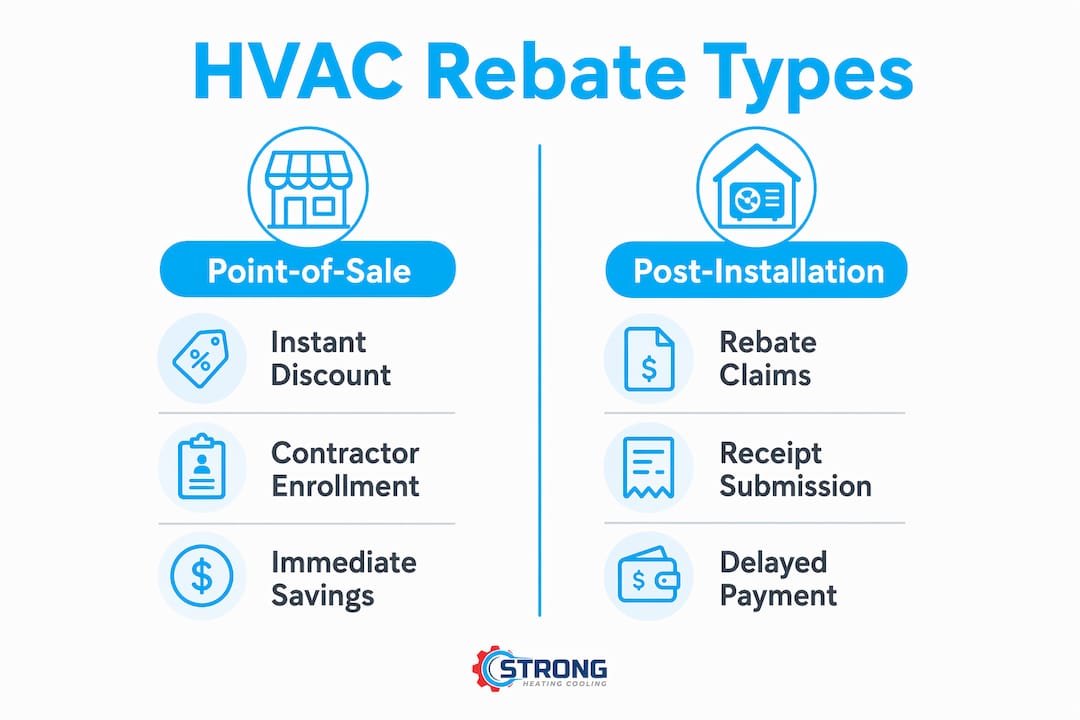
HVAC rebates fall into two broad categories: point-of-sale discounts applied at the time of purchase and post-installation reimbursements paid after the work is complete. The distinction matters because it affects your cash flow. With a point-of-sale rebate, the discount comes off your invoice directly, so you never pay the full amount. With a post-installation reimbursement, you pay upfront and receive a check or credit later, sometimes weeks after submission.
The table below summarizes the main rebate sources and how each one delivers its benefit.
| Rebate source | Delivery method | Typical benefit |
|---|---|---|
| HEEHRA (federal/state) | Point-of-sale discount via contractor | Up to $8,000 for heat pumps |
| Utility company | Instant invoice discount or check | $200 to $2,000 depending on utility |
| Manufacturer promotion | Mail-in rebate or dealer discount | $100 to $1,500 on select models |
| State energy office | Post-install reimbursement | Varies significantly by state |
Eligibility requirements differ across every source. HEEHRA ties rebate amounts to household income. Utility programs often require ENERGY STAR certified equipment. Manufacturer promotions typically require purchase within a specific date window. Knowing which programs you qualify for before installation is the single most effective way to maximize your total savings.
How income and equipment eligibility affect your rebate amount
Income qualification is the factor most homeowners overlook when researching HVAC rebate programs. HEEHRA uses Area Median Income thresholds calculated by the U.S. Department of Housing and Urban Development to determine how much each household can receive. AMI levels vary by county and household size, so a family of four in Colorado Springs will have a different AMI threshold than the same family in Denver or Nashville.
Equipment eligibility is equally specific. Most programs require ENERGY STAR certification at minimum, but HEEHRA and many state programs go further by requiring equipment that meets AHRI performance ratings. The Air-Conditioning, Heating, and Refrigeration Institute issues AHRI certificates that confirm a specific model meets efficiency thresholds. Without proper documentation, including the AHRI certificate, rebates can be denied even when the equipment itself would otherwise qualify.
Here is a step-by-step breakdown of how to confirm your eligibility before installation:
- Look up your county’s AMI on the HUD website using your household size to determine which income tier applies to you.
- Confirm your state has launched its HEEHRA program, since state program details vary significantly in timing and requirements.
- Identify the specific equipment model you plan to install and verify it carries an ENERGY STAR certification and a current AHRI certificate.
- Contact your utility company to check whether the same equipment qualifies for a utility rebate and whether income verification is required.
- Ask your contractor to confirm they are enrolled in the rebate program, since contractor enrollment is required for point-of-sale rebates to be processed.
Pro Tip: Request the AHRI certificate number from your contractor before signing any installation agreement. If the model they plan to install does not have a current certificate, the rebate will not process regardless of how efficient the equipment is.
State programs add another layer of variation. Tennessee’s HEEHRA program, for example, has specific documentation timelines and contractor certification requirements that differ from California’s rebate structure. Checking your state energy office website directly, rather than relying on general information, gives you the most accurate picture of what is available in your area.
How to apply for HVAC rebates and maximize your savings
The application process for HVAC rebates follows a predictable pattern, but the details at each step determine whether you receive the full benefit or face delays and denials. The process begins before installation, not after. Choosing a licensed HVAC contractor who is enrolled in the relevant rebate programs is the first and most critical decision you will make.
Once you have confirmed contractor enrollment, gather the documentation you will need. Most programs require an itemized invoice showing equipment model numbers and installation costs, the AHRI certificate for the installed equipment, proof of income such as a recent tax return or pay stubs, and a copy of a recent utility bill confirming the service address. Some programs also require a pre-installation energy assessment, particularly for state-administered programs tied to the HOMES Act.
The difference between point-of-sale and post-install processes affects your timeline significantly. With a point-of-sale rebate, your contractor submits the paperwork and the discount appears on your invoice before you pay. With a post-install reimbursement, you pay the full amount and submit documentation yourself or through your contractor. Rebate claims are often required within 30 to 90 days of installation, so missing the submission window means losing the benefit entirely.
How state and utility rebate programs compare in 2026
Rebate programs differ so significantly by state and utility that two homeowners installing identical equipment in different locations can receive vastly different total incentives. This variation is one of the most underappreciated aspects of HVAC energy efficiency rebates, and it makes local research non-negotiable.
New York’s Clean Heat program consolidates multiple utility rebates into a single administered system. Rebates vary by utility territory with additional incentives available for fossil fuel decommissioning and households in designated disadvantaged communities. A homeowner in Con Edison territory replacing an oil furnace with a heat pump can access layered incentives that a homeowner in a rural upstate territory may not.
| State/utility | Program name | Max rebate (heat pump) | Income requirement |
|---|---|---|---|
| New York (Con Edison) | Clean Heat | Up to $7,100 | No (higher for low-income) |
| Tennessee | HEEHRA (state-administered) | Up to $8,000 | Yes (AMI-based) |
| California (SCE/PG&E) | TECH Clean California | Up to $3,000 | No (tiered) |
| Colorado (Xcel Energy) | Xcel Energy Rebates | Up to $1,200 | No |
Program funding limits are a practical concern that most guides ignore. HEEHRA allocations are distributed to states in fixed amounts, and some states have already paused or exhausted portions of their funding. Checking your state energy office website for current program status before scheduling installation is not optional. It is the step that separates homeowners who receive rebates from those who install qualifying equipment and receive nothing because the program closed the week before.
Utility rebates tend to be more stable than state-administered programs because utilities fund them through rate structures rather than one-time federal allocations. However, utility programs often have stricter equipment lists, requiring specific models rather than general ENERGY STAR certification. Confirming your equipment appears on the utility’s approved list before purchase prevents the frustrating scenario of installing efficient equipment that does not qualify for the local utility rebate.
Key takeaways
HVAC rebates work through a layered system of federal, state, and utility incentives that reward qualifying equipment and income-eligible households, with the total benefit depending on careful documentation, contractor enrollment, and proper stacking of programs.
| Point | Details |
|---|---|
| Rebate types differ by delivery | Point-of-sale discounts reduce your invoice immediately; post-install reimbursements require upfront payment and timely submission. |
| Income tiers determine HEEHRA amounts | Households below 80% AMI qualify for up to $8,000; those between 80% and 150% AMI qualify for up to $4,000. |
| Equipment documentation is required | An AHRI certificate and ENERGY STAR certification must be confirmed before installation to avoid rebate denial. |
| State programs vary significantly | Program availability, funding status, and contractor requirements differ by state and must be verified locally before scheduling work. |
What I’ve learned from helping families navigate HVAC rebates
After working with hundreds of homeowners on heating and cooling upgrades, the pattern I see most often is not a lack of interest in rebates. It is a lack of preparation at the right moment. Most families start researching rebates after they have already chosen a contractor and scheduled installation. By that point, the contractor may not be enrolled in the relevant program, the equipment may not be on the utility’s approved list, or the state program may have paused funding. The rebate opportunity is gone before the work even begins.
My honest recommendation is to treat rebate research as part of the equipment selection process, not an afterthought. Confirm your state’s program status, verify your contractor’s enrollment, and check the utility’s approved equipment list before you sign anything. The energy efficiency savings from a qualifying heat pump or high-efficiency furnace are real and measurable. The rebates that support those upgrades are equally real, but only for homeowners who do the groundwork first.
One more thing worth saying directly: rebate programs for families at lower income levels are genuinely generous right now. A household below 80% AMI can receive up to $8,000 toward a heat pump installation. That is a meaningful reduction on a system that would otherwise cost $10,000 to $15,000. If your household qualifies, this is one of the most significant financial tools available for home comfort upgrades, and it deserves serious attention.
— Owner
How Strongheatingandcooling helps you claim every rebate you qualify for
Navigating rebate programs is straightforward when you have a contractor who knows the process from the inside out. Strongheatingandcooling serves Colorado Springs and surrounding communities with licensed installation teams who are familiar with HEEHRA requirements, utility rebate documentation, and the equipment certifications that programs require.
When you work with Strongheatingandcooling, the rebate paperwork does not fall on you alone. The team handles AHRI certificate verification, contractor enrollment confirmation, and itemized invoicing so your application is complete from day one. For homeowners who want to combine rebates with financing, the HVAC financing options available through Strongheatingandcooling make it possible to manage upfront costs while waiting for reimbursements to process. Whether you need a new heating system or a cooling upgrade, the team is ready to match you with qualifying equipment and guide you through every step.
FAQ
How do I know if my income qualifies for HEEHRA rebates?
HEEHRA uses Area Median Income thresholds set by HUD and calculated by county and household size. Households below 80% of their local AMI qualify for the maximum rebate of up to $8,000 for a heat pump, while households between 80% and 150% AMI qualify for reduced amounts up to $4,000.
Does my contractor need to be enrolled in the rebate program?
Yes. Point-of-sale rebates through HEEHRA and most utility programs require a participating, enrolled contractor to process the discount. If your contractor is not enrolled, the rebate cannot be applied at the time of sale, and you may lose access to the incentive entirely.
How long do I have to submit rebate paperwork after installation?
Most utility and state programs require rebate claims to be submitted within 30 to 90 days of installation. Missing this window typically results in a denial with no appeal option, so confirming the submission deadline before installation is scheduled is a necessary step.
Recommended
Need expert HVAC help?
Colorado Springs' veteran-owned heating & cooling team — Mon–Sat, 8 AM–7 PM. Same-day service when available.