
Homeowners: Gas or Electric Water Heater, Avoid $1,500 Retrofit Surprises
September 22, 2026
Homeowners: Gas or Electric Water Heater, Avoid $1,500 Retrofit Surprises
For most homeowners replacing an old electric resistance tank, a heat pump water heater delivers the lowest long-term operating cost. Where a gas line and vent already exist and gas rates stay low, a standard gas tank often costs less to run month to month. The right call depends on your existing infrastructure, local utility rates, and how much hot water your household actually uses.
TL;DR:
- Heat pump water heaters usually offer the lowest operating costs over ten years, especially if electrical capacity and space requirements are met.
- Gas tankless units have higher upfront costs but typically lower long-term running expenses than traditional gas tanks, provided venting and gas upgrades are feasible.
- Electric resistance tanks have the lowest initial price but the highest operating costs, making them less economical in the long run in most markets.
- Utility rates and the local ratio of electricity to gas prices greatly influence which technology is most cost-effective for a specific household.
- Proper installation considerations, such as panel capacity, venting, and clearance, can significantly impact retrofit costs and project complexity.
Table of Contents
- Gas vs Electric Water Heater: A Quick Cost and Install Comparison
- What Do Gas and Electric Water Heaters Really Cost Over 10 Years?
- How Efficient Is a Heat Pump Water Heater Compared to Gas or Electric?
- What Installation Requirements Should You Expect for Each Type?
- How Do You Size a Water Heater for Recovery Rate and Peak Demand?
- How Long Do Gas and Electric Water Heaters Last?
- Are Heat Pump Water Heaters Eligible for Tax Credits?
- Is a Gas or Electric Water Heater Safer to Own?
- Gas vs Electric Water Heater: A Simple Decision Checklist
- Strong Heating & Cooling’s Perspective on Real Retrofit Surprises
- Get a Local Estimate Before You Commit to Either Option
- Where to Verify These Numbers Yourself
- Sources
- FAQ
Gas vs Electric Water Heater: A Quick Cost and Install Comparison
Before diving into formulas and payback math, it helps to see the four main options side by side. Here’s what each one typically costs to buy, install, and keep running.
- Standard gas tank: moderate unit and installation cost; moderate operating cost; needs venting and gas line access; lifespan typically under 12 years.
- Gas tankless: higher unit and installation cost; often lower operating cost than gas tanks; needs upgraded venting and gas supply; generally longer lifespan than tanks.
- Standard electric tank: lower upfront cost; generally highest operating cost; requires dedicated 240V circuit; lifespan often into mid-teens.
- Heat pump water heater (HPWH): higher upfront cost; typically lowest operating cost; requires 240V circuit, sufficient panel capacity, and airflow clearance; lifespan typically about 10 to 15 years.
Operating cost direction comes down to physics as much as price. Gas tanks lose energy up the flue, electric resistance tanks convert electricity to heat directly but at a higher price per unit of energy in most markets, and HPWHs pull ambient heat from the air instead of generating it, which is why they usually win on the utility bill despite a higher sticker price.
What Do Gas and Electric Water Heaters Really Cost Over 10 Years?
Upfront price only tells part of the story. A gas tankless unit installed with new venting and a larger gas line can run $3,000 to $6,000 once retrofit work is included, while converting a gas closet to electric for a heat pump model might mean a $1,500 to $3,000 panel upgrade if your electrical service is already near capacity.
To compare real costs, calculate the 10-year total: purchase price plus installation plus (annual energy use × your local $/kWh or $/therm rate × 10). National averages hover around $0.16 per kWh for electricity and roughly $1.20 to $1.50 per therm for natural gas, though your utility bill is the only number that matters for your own math. Building America’s technology comparison notes that areas with an electricity-to-gas price ratio above 3 make fuel-switching a tougher sell financially, so check that ratio before assuming electric wins everywhere.
Once you run the math, heat pump water heaters typically beat standard electric tanks by a wide margin and often compete directly with gas once the federal tax credit is factored in. Consumer Reports’ testing and lifecycle analysis has found that standard electric tanks tend to cost the most to operate over a decade, while HPWHs and gas tankless units frequently tie or beat gas storage on total cost.
Before calling a contractor, pull your last 12 months of utility bills and request two written estimates so you’re comparing real numbers, not guesses.
How Efficient Is a Heat Pump Water Heater Compared to Gas or Electric?
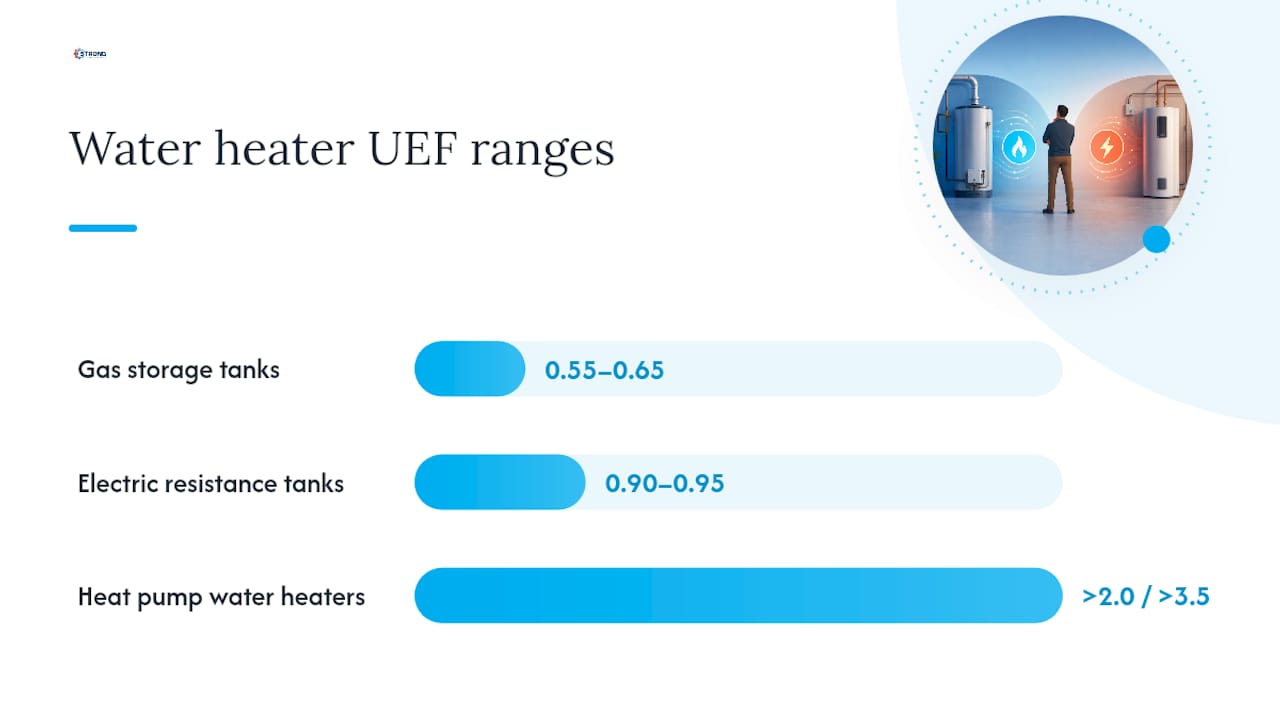
Efficiency for water heaters is measured with the Uniform Energy Factor (UEF), a rating similar to the older Energy Factor (EF) that measures how much hot water a unit produces per unit of energy consumed. Standard gas storage tanks typically land around 0.55 to 0.65 UEF because heat escapes through the flue. Standard electric resistance tanks run higher, often 0.90 to 0.95, since almost all the electricity converts directly to heat. Heat pump water heaters blow past both, frequently scoring above 2.0 and sometimes above 3.5.
That gap exists because a heat pump doesn’t generate heat. It extracts it from the surrounding air and concentrates it into the tank, the same principle behind a refrigerator running in reverse. NYSERDA’s overview of heat pump water heaters puts this at two to four times the efficiency of conventional electric resistance heating, which is why a home switching from a standard electric tank to a hybrid HPWH often sees a 60% to 75% drop in water-heating electricity use.
Tank versus tankless is a separate decision from fuel type. Storage tanks hold a reserve of hot water and recover gradually; tankless units heat water on demand and never run out, but they have flow-rate limits. Hybrid HPWHs combine a small tank with heat-pump technology and usually include a backup resistance element for high-demand periods. None of this efficiency talk means much without your own utility rate. A 3.5 UEF heat pump running on expensive electricity can still lose to a 0.65 UEF gas tank running on cheap gas, so always pair the efficiency number with your actual $/kWh or $/therm.
What Installation Requirements Should You Expect for Each Type?
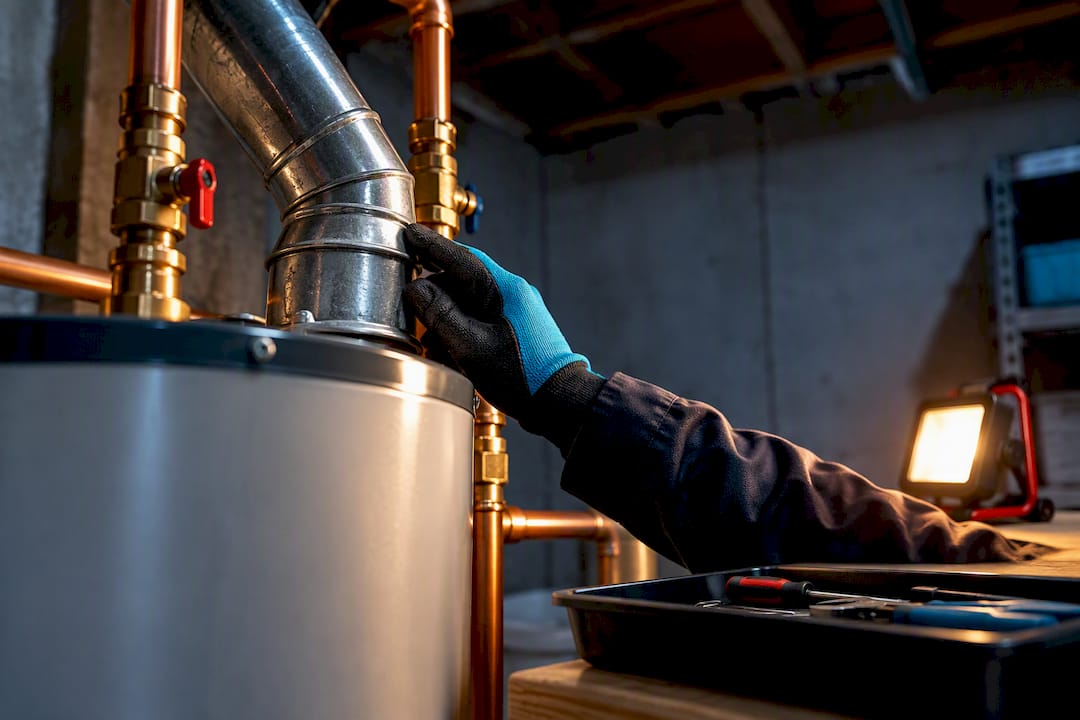
Retrofit surprises are where water heater budgets blow up. Gas and electric systems each have their own code requirements, and skipping them isn’t just risky, it can fail inspection.
- Gas installations need correctly sized venting (Category I, III, or direct vent depending on the unit), an adequately sized gas line, a working carbon monoxide detector nearby, and a permit pulled before work starts.
- Electric and HPWH installations need a dedicated 240V circuit, and many older homes require a panel upgrade if the existing service lacks capacity. ENERGY STAR’s design guidance confirms that whole-home electric tankless setups can demand multiple large breakers many panels simply don’t have room for.
- HPWH-specific needs include clearance for airflow around the unit, condensate drainage, and a mechanical space that stays above roughly 37°F, since colder rooms hurt heat-pump performance.
- Retrofit timelines typically run same-day for a straight swap, but stretch to two or three days when a panel upgrade, new gas line, or re-vented flue is involved.
Before your on-site estimate, have your panel size, gas meter capacity, and mechanical room dimensions ready. It saves the licensed plumber or electrician a return visit.
How Do You Size a Water Heater for Recovery Rate and Peak Demand?
Recovery rate tells you how fast a tank reheats water after use, and first-hour rating (FHR) tells you how much hot water is available in a single hour, combining tank size with recovery speed. A one or two person household typically needs an FHR around 30 to 40 gallons, while a household of four or more often needs 50 gallons or higher to avoid running cold mid-shower.
Tankless units sidestep the tank entirely but come with a flow-rate ceiling. Try to run two showers and a dishwasher at once on an undersized tankless unit, and the flow rate simply can’t keep up. Gas tankless models also face scaling risk in hard-water areas, where mineral buildup on the heat exchanger reduces efficiency and can shorten lifespan without regular descaling. As a rule of thumb, size for your busiest hour, not your average day. For a closer look at matching capacity to household size, see this water heater sizing guide.
How Long Do Gas and Electric Water Heaters Last?
Lifespan varies more by fuel type and tank style than most homeowners expect. Standard gas storage tanks typically last 8 to 12 years, standard electric tanks stretch to 12 to 15 years, tankless units (gas or electric) often reach 15 to 20 years, and HPWHs generally run 10 to 15 years.
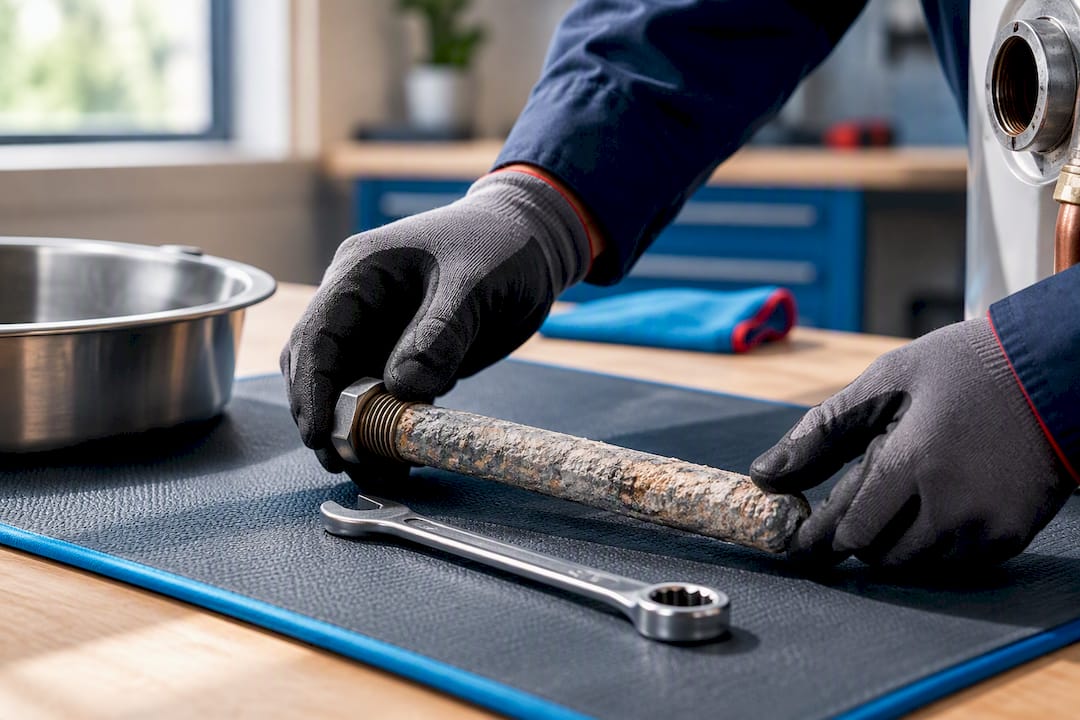
Maintenance drives most of that variance. Flushing sediment from the tank annually, replacing the sacrificial anode rod every few years, cleaning gas burners and vent connections, and descaling tankless heat exchangers in hard-water regions all extend service life. Hard water is especially rough on electric resistance elements, where scale buildup insulates the heating element and forces it to work harder for less output. If a unit is leaking from the tank body rather than a fitting, replacement is almost always cheaper than repair.
Are Heat Pump Water Heaters Eligible for Tax Credits?
Yes. Homeowners who install an ENERGY STAR–certified heat pump water heater can claim a federal tax credit worth 30% of project costs, covering both the unit and professional installation, up to a $2,000 cap for qualifying HPWH projects.
That $2,000 cap sits inside a broader $3,200 annual aggregate limit when combined with other qualifying home energy credits, so timing matters if you’re also planning furnace or heat pump HVAC work the same year. To claim the credit, confirm the specific model number appears on the manufacturer’s ENERGY STAR certification list, and keep the installer’s itemized invoice for tax filing. Beyond the federal credit, check your state or utility rebate programs through a resource like DSIRE, since many regions stack local incentives on top of the federal one.
Is a Gas or Electric Water Heater Safer to Own?
Gas systems carry combustion risk: carbon monoxide exposure from a cracked heat exchanger or blocked vent is the primary hazard, which is why annual inspection and a working CO detector near the unit aren’t optional. Electric and HPWH installs shift the risk profile toward electrical hazards tied to panel capacity, circuit wiring, and moisture near connections.
Environmentally, HPWHs have an edge since they eliminate on-site combustion entirely and their carbon footprint improves further as the electric grid adds more renewable capacity. Practical safeguards apply across the board: a CO detector for gas units, a drip pan and water alarm for tank units of any fuel type, and regular professional service to catch problems early.
Gas vs Electric Water Heater: A Simple Decision Checklist
Cut through the analysis with four questions: What fuel infrastructure already exists in your home? What’s your household’s peak hot-water demand? What’s your budget for upfront cost versus 10-year operating cost? And what incentives are available in your area right now?
From there, the choice tends to sort itself:
- Choose a gas tank if you already have gas plumbed in, gas rates are low locally, and you want the lowest upfront cost.
- Choose gas tankless if you have high hot-water demand, want endless supply, and can afford the venting upgrade.
- Choose a standard electric tank only if gas isn’t available and budget is tight. Expect the highest 10-year operating cost of the group.
- Choose a heat pump water heater if you want the lowest long-term operating cost, have adequate electrical capacity and mechanical space above 37°F, and can take advantage of the federal tax credit.
Pro Tip: Measure your mechanical room before you fall in love with a heat pump model online. HPWHs need airflow clearance on all sides, and a cramped closet can quietly disqualify the most efficient option on your list.
Next steps are straightforward: measure your install space, pull 12 months of utility bills, get two written bids, and confirm rebate eligibility before you sign anything.
Strong Heating & Cooling’s Perspective on Real Retrofit Surprises
After decades of installation calls across Colorado Springs, the most common surprise isn’t the water heater itself, it’s what surrounds it. Homeowners budget for the unit and forget that a panel upgrade, a re-vented flue, or a resized gas line can add $1,000 to $3,000 to a project that looked simple on paper.
The homeowners who avoid sticker shock are the ones who ask for documentation upfront: panel capacity, gas meter sizing, and a written scope before work begins. On-site inspection priorities should always include checking whether a shared flue serves another appliance, since capping one gas line without re-evaluating the vent for the remaining unit can create a code problem you didn’t know existed. For readers weighing tank versus tankless as part of this decision, our tankless versus tank comparison and heat pump water heater review cover the field-tested details worth knowing before you commit.
— Owner
Get a Local Estimate Before You Commit to Either Option
Choose a local HVAC provider who can have a licensed technician inspect your panel, gas line, and mechanical room and provide an accurate retrofit cost before you commit. That matters more than any national average, because your panel capacity and your utility rate are the two variables that actually decide whether gas, electric, or a heat pump water heater wins for your house.

A typical site visit covers your existing fuel and electrical setup, available space for a tank or hybrid unit, venting condition if gas is involved, and a written estimate with no surprise line items added later. The installation team manages the plumbing, electrical coordination, and permits efficiently to minimize visits and streamline the process. Explore water heater services or check heating services for gas line and venting work, and request your on-site estimate today to see real numbers for your home instead of a national average.
Where to Verify These Numbers Yourself
For readers who want the primary sources: DOE Building America’s water heating comparison, ENERGY STAR’s federal tax credit page, Energy, and Consumer Reports’ buying guide. Check DSIRE or your local utility’s website for rebates specific to your area.
Sources
- Building America — Comparison of Water Heating Technologies
- NYSERDA — All about heat pump water heaters
- Consumer Reports — Water heater buying guide (2026)
FAQ
Why Are Gas Water Heaters Being Phased Out?
Gas water heaters aren’t banned nationally, but several states and cities have adopted building codes that push new construction toward electric appliances to cut on-site combustion and emissions. Existing gas units in most areas remain legal to repair and replace, though incentives increasingly favor electric and heat pump alternatives.
Is It Worth Switching From Gas to Electric Water Heater?
It depends on your electrical capacity and local rates. Switching to a standard electric tank rarely pays off since it usually carries the highest operating cost of the group, but switching to a heat pump water heater often makes sense, especially with the 30% federal tax credit up to $2,000 shortening the payback period.
Why Do Plumbers Not Recommend Tankless Water Heaters?
Some plumbers hesitate on tankless recommendations because of upfront installation complexity, including venting upgrades and, in hard-water regions, scaling that requires regular descaling to maintain efficiency. That caution reflects installation cost and maintenance needs, not a flaw in the technology itself, since tankless units typically last 15 to 20 years.
Is It Worth Changing From Gas to Electric Heating for Water Heating Specifically?
For water heating specifically, a heat pump water heater is usually the stronger electric option rather than a standard resistance tank. NYSERDA’s guidance notes HPWHs run two to four times more efficiently than resistance heating, which changes the math compared to switching to a standard electric unit.
What Does a Water Heater Replacement Cost Through Strong Heating & Cooling?
Pricing depends on the unit type, retrofit needs, and installation complexity at your home. Current service pricing and options are available on the water heater services page, where you can also request a site visit for an exact quote.
Recommended
Need expert HVAC help?
Colorado Springs' trusted, veteran-owned heating & cooling team — emergency service.