A furnace that runs constantly is usually doing one of two things: the blower is circulating air because of a setting or a failed control, or the burners are really firing nonstop because the house cannot keep up. The first is often a thirty-second fix at the thermostat. The second points to airflow, ductwork or equipment size. If the burners never stop, or the furnace overheats and shuts itself off, it needs a technician, and in Colorado Springs our team at Strong Heating And Cooling can diagnose it, often with same-day service.
This guide walks through how to tell which situation you have, the checks that are safe for a homeowner, what a long run time means in a Front Range winter, and the point where a repair or replacement conversation makes sense.
TL;DR
- First find out whether only the fan is running or the burners are heating. A thermostat fan setting of ON keeps the blower going all the time, even with no heat.
- A dirty filter or blocked vents restrict airflow, make the furnace run longer and can trigger overheating shutdowns. Check the filter before anything else.
- Long run times on a very cold Colorado Springs night can be normal. A furnace that never stops on a mild day is not.
- Failed controls (limit switch, blower motor, control board) and leaky or undersized ducts also cause nonstop operation and need a professional.
- Do not open the burner compartment or service gas components yourself. Call a technician if basic checks do not fix it.
Table of Contents
- Is it the fan or the burners?
- Start at the thermostat
- A clogged filter makes the furnace work harder
- Blocked vents and closed registers
- Ducts, returns and heat that never arrives
- Is the furnace the right size?
- What counts as normal in a Colorado Springs winter
- Parts that fail and keep the system running
- Safe checks you can do in ten minutes
- When to call a technician
- Repair or replace?
- What we do about it in Colorado Springs
- Our view on a furnace that never stops
- FAQ
- Sources
Is it the fan or the burners?
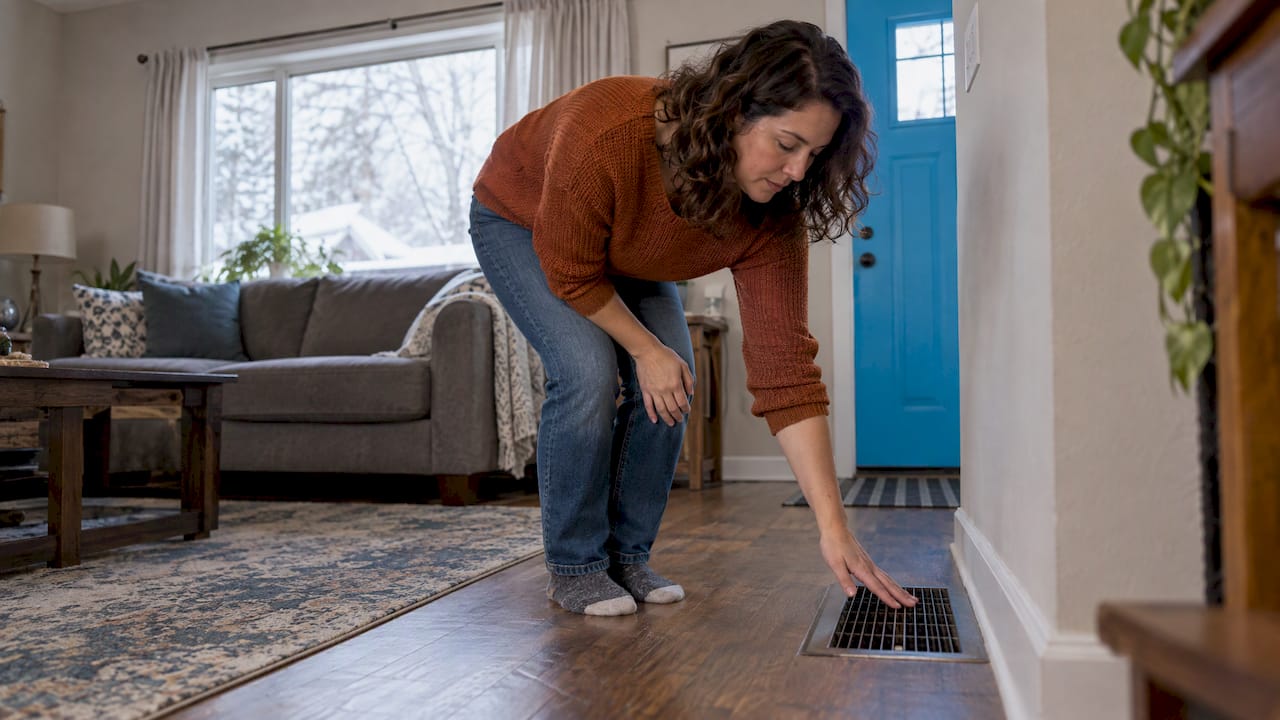
Before troubleshooting anything, work out what “running constantly” means in your house. Stand near a supply vent and put your hand in the airflow. Warm air means the furnace is actually in a heating cycle. Room-temperature or cool air means the blower is moving air that is not being heated.
On a healthy gas furnace, the sequence is predictable. A small inducer motor starts first and clears the combustion chamber, the burners light, and about 30 seconds to a minute later the main blower starts and the air from the vents turns warm, as one furnace service guide describes it. When the thermostat is satisfied, the burners shut off and the blower keeps going for a minute or a few minutes to push the remaining heat out of the heat exchanger. That brief run-on is normal. It is not the same as a fan that never stops.
This distinction decides everything that follows. A blower that runs with no heat is nearly always a setting, a control or a sensor problem. Burners that stay lit and a furnace that never reaches the temperature you asked for point to airflow, heat loss or sizing. Burners that stay lit after the thermostat is satisfied are a safety problem, and that is a call to us, not a do-it-yourself project.
Start at the thermostat
The most common cause of a furnace fan that will not shut off is also the cheapest to fix. Most thermostats have a fan switch with two positions, AUTO and ON. With the fan set to ON, the blower runs around the clock regardless of whether the furnace is heating. In AUTO, the blower runs only during a heating or cooling cycle and for a short time afterward.
If the thermostat shows ON, switch it to AUTO and wait a few minutes. If the blower stops once the cycle ends, you have found it. People often leave the setting on ON after a power outage, a battery change or a visit from a house guest or a contractor, so it is easy to miss that anything changed.
If the fan is already on AUTO, look at a few other thermostat details:
The mode. Make sure it says Heat, not Auto changeover or Emergency Heat, which can behave differently on heat pump systems.
The set temperature. A setpoint well above what the house can reach will keep the furnace calling for heat. Raising the setting several degrees during a cold snap, or using a large “recovery” setback, can make the furnace run for hours.
The location. A thermostat on an exterior wall, near a door that opens often, or in direct sun reads a temperature that does not match the rest of the house. A sensor sitting in a cold draft can make the furnace run continuously or cycle rapidly as the door opens and closes.
The batteries and display. Weak batteries and a dim or erratic screen can send confused signals. Replace the batteries if the model uses them.
If the fan still does not stop after the thermostat is set to AUTO, an electrical fault in the thermostat or its wiring is possible. At that point the thermostat is a diagnostic question, not a settings question.
A clogged filter makes the furnace work harder
The next stop is the air filter. The U.S. Department of Energy’s Building America program notes that a dirty or clogged filter can dramatically reduce airflow, which increases furnace run time, wear on the motor and energy use. The same guidance says filters should be replaced or cleaned frequently and placed where the homeowner can easily reach them.
There are two ways this shows up. In the mild case, the furnace still heats but it takes far longer to move the heat into the house, so the cycles stretch out. In the more serious case, restricted airflow lets the heat exchanger run hot enough that its safety limit switch shuts the burners off. The blower then keeps running to cool the furnace down, and when the limit resets the furnace tries again. From the living room, that looks like a furnace that never stops.
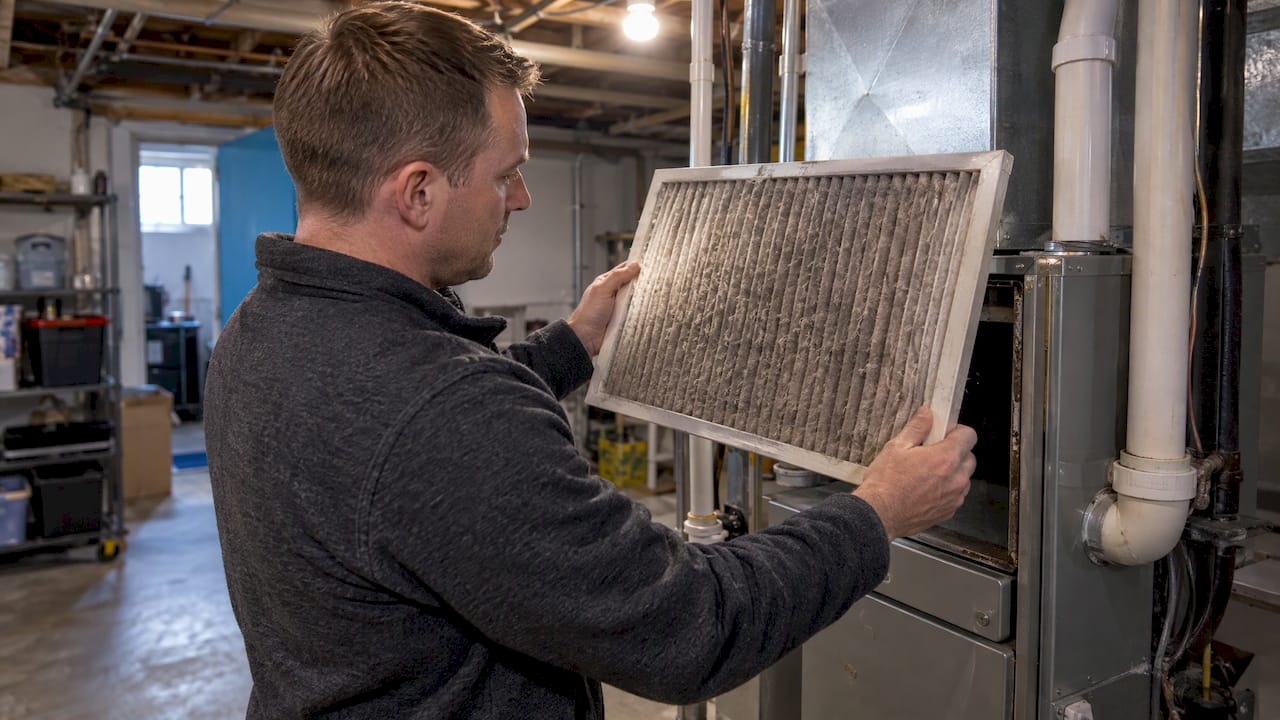
Checking is simple. Turn the furnace off at the thermostat, slide the filter out and hold it up to a light. If you cannot see light through it, replace it with the same size and put the arrow on the frame pointing toward the furnace. Most households do well changing it every one to three months, with the shorter end for homes with pets or a lot of dust. Our furnace filter schedule breaks that down month by month.
A thicker, higher-rated filter is not automatically better. A very dense filter in a system that was not designed for it can restrict airflow the same way a dirty one does. If you are unsure which rating your furnace is built for, ask us at the next visit.
Blocked vents and closed registers
Airflow also fails at the house, not just at the furnace. Furniture pushed against a return grille, rugs over floor registers, or supply vents closed in unused rooms all raise the resistance the blower works against. Carrier’s troubleshooting guide notes that blocked room vents contribute to short cycling and reduce efficiency and comfort.
Walk the house and open every supply register at least partway. Make sure the large return grilles, usually in a hallway or on a wall, are clear. Closing vents does not save heat as many people assume. It pushes the same volume of air through fewer openings, raises pressure in the ducts and can make the system run longer or more noisily.
If you want a closer look at the opposite symptom, a furnace that turns on and off too often, we wrote about why a furnace short cycles. The causes overlap with the ones here, because both come down to airflow, sensing and sizing.
Ducts, returns and heat that never arrives
Sometimes the furnace runs constantly because the heat it makes is not reaching the rooms. The Department of Energy’s Building America guide notes that more than 65% of U.S. homes are heated with central forced-air furnaces, and that duct losses can reach 30% or more when ducts are leaky, poorly insulated and run through an uninsulated attic or crawlspace.
A field study of 48 homes under the same program found just how common the problem is. On average, about 10% of the heat the furnace produced did not reach the conditioned space. In 31 of the 48 homes the return duct was too small for the airflow required, and in 43 of them the filter significantly reduced airflow. The study found that system tune-ups could deliver up to 23% more energy from the furnace to the living space.
What this means for you: if the furnace seems to run endlessly and some rooms are always cold, the cause may be leaking ducts, an undersized return or a disconnected duct run, not the furnace itself. These are not issues you can see by looking at the furnace. A technician can measure static pressure, inspect the ducts and tell you whether sealing, a larger return or a different layout is the fix.
Is the furnace the right size?
Sizing cuts both ways. An oversized furnace heats the air quickly, satisfies the thermostat and shuts off, then starts again soon after, which is short cycling. An undersized furnace, or one that has lost capacity, can run for long stretches on a cold day and never quite catch up.
Sizing also depends on what the house has become. Finished basements, added rooms, replaced windows, extra insulation and changes to ductwork all change the load. A furnace that was well matched to the house 20 years ago may not be today. Proper sizing is done with a load calculation, not by matching the old unit’s number, and it is one of the main reasons to have a professional involved in a replacement.
What counts as normal in a Colorado Springs winter
Not every long cycle is a fault. Colorado Springs is a cold, high-altitude city. NOAA’s 1981 to 2010 climate normals for the Colorado Springs airport, at an elevation of 6,181 feet, show a January average daily low of 17.7°F, about 29.7 days in January with a low at or below freezing, and annual heating degree days (a measure of how much heating a year demands) of 6,292.
NOAA’s engineering weather data for the same area lists a design temperature of 1°F, the level that is exceeded only about 0.4% of the time, and a median of extreme lows of -6°F. On nights near those temperatures, a properly working furnace will run for long stretches, and a well-sized system sized for the cold may cycle fewer, longer times.
A practical way to judge this is to compare against the weather. If the furnace runs most of the night on a 5°F morning, your house is losing heat fast and the furnace is doing its job, though poor insulation, drafts and duct leaks make it work harder. If it runs nonstop when the outdoor temperature is in the 40s or 50s, that is not normal and something is wrong with airflow, controls or the thermostat.
Also keep in mind the situation after a setback. If you lowered the temperature overnight and raise it by several degrees in the morning, the furnace may run for an hour or more to recover. That is not a malfunction.
Parts that fail and keep the system running
If the thermostat is correct, the filter is clean and the vents are open, the cause is probably inside the furnace. Trane’s troubleshooting page lists the usual suspects: a malfunctioning blower motor or limit switch, leaky ducts, and failed interior controls such as wiring, switches, sensors or the control board.
The fan limit switch tells the blower when to start and stop based on the temperature inside the furnace. If it sticks or fails, the blower can stay on, or run in odd patterns. A worn blower motor or its relay can fail to shut off when the call for heat ends. A control board that has failed can keep sending a signal to the blower. Each of these shows the same symptom, a blower that keeps running after the thermostat is satisfied, which is why a technician tests each part rather than guessing.
Trane’s page on the topic also says the fan normally runs one to five minutes after a cycle. If it keeps running well beyond that with the thermostat satisfied, a thermostat electrical fault, the limit switch, the blower motor or the control board is the likely place to look.
These are electrical and gas-appliance components. They sit behind panels with live voltage and near combustion parts. This is where a homeowner’s checklist should end and a service visit begin.
Safe checks you can do in ten minutes
These steps need no tools beyond a screwdriver for a filter door, and they cover most of the cases that are not a failed part.
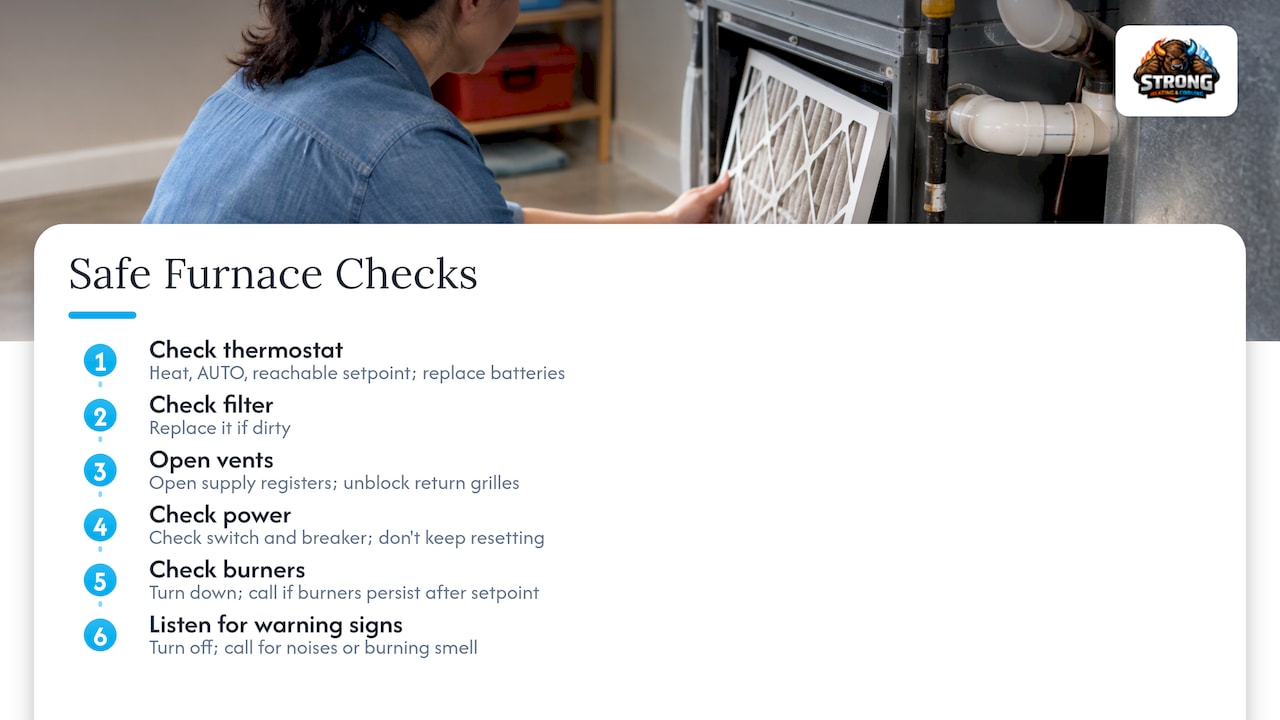
First, look at the thermostat. Confirm it is powered, set to Heat, set to AUTO for the fan and set to a temperature that the house can reasonably reach. Replace batteries if applicable.
Second, check the filter. Replace it if it is dirty. This single step resolves a surprising number of cases.
Third, open the vents. Go through every room and confirm the supply registers are open and the return grilles are unblocked.
Fourth, check the furnace power switch and breaker. The switch on or near the furnace looks like a light switch and is occasionally flipped by accident. If a breaker keeps tripping, do not keep resetting it. Our article on the two-minute fan test when a furnace trips the breaker explains what to look at and when to stop.
Fifth, find out whether burners are on or only the blower. If you can see the burner flame through the viewing window or feel warm air, heating is happening. If the burners are on after the thermostat is satisfied, or the furnace overheats, turn the thermostat down and call a technician. Do not remove the burner cover to investigate.
Sixth, listen. Banging, squealing, repeated clicking or a burning smell are signs to turn the furnace off at the thermostat and call. If the furnace will not start at all, our guide on what to check when the furnace is not turning on covers that opposite problem.
After these checks, give the system a full cycle. If the symptom clears, note what you changed. If it comes back within a day or two, the cause is something the basic checks cannot reach.
When to call a technician
Call us if the burners stay lit and the furnace will not shut off, if the furnace shuts down on its limit switch and restarts repeatedly, if the blower runs nonstop with the thermostat on AUTO and the filter clean, or if you smell gas or see soot or scorching near the furnace. If you smell gas, leave the house and call the gas utility or 911 from outside before anything else. Our emergency furnace repair checklist lists what to do while you wait.
Carbon monoxide is the reason these calls are not optional. The Consumer Product Safety Commission states that more than 200 people die each year from unintentional non-fire carbon monoxide poisoning linked to consumer products, with heating equipment among the top contributors. It urges a yearly professional inspection of all fuel-burning heating systems, including furnaces, flues and vents. A furnace that overheats or runs abnormally is a reason to have the heat exchanger and venting examined, and every home with a gas furnace should have working carbon monoxide alarms.
That yearly inspection is also the best prevention for the problem in this article. The Department of Energy’s guide recommends an annual furnace tune-up that includes checking the heat exchanger for cracks and leaks and adjusting the blower control and supply-air temperature. Our 15-point fall furnace tune-up shows what a thorough visit should cover.
Repair or replace?
Most nonstop-running problems are repairs: a thermostat, a switch, a motor, a control board, a duct fix. Replacement enters the picture when the furnace is old, the heat exchanger is cracked, repairs are stacking up, or the house has outgrown its equipment. A furnace that cannot keep up even with clean filters, open vents and sound ducts may simply be at the end of its life or the wrong size.
If you are weighing the two, ask for a written repair quote and a replacement quote together. A flat-rate price, stated before work begins, makes the comparison straightforward.
What we do about it in Colorado Springs
Strong Heating And Cooling is a veteran-owned HVAC company in Colorado Springs with more than 40 years of combined experience and NATE-certified technicians. We diagnose furnace problems and offer same-day service when needed, with flat-rate pricing and no hidden fees. You can see what we handle on our furnace repair and tune-up page.
When a furnace is past repairing, our published starting prices for installed furnaces are $3,900 for an 80% AFUE single-stage furnace, $4,500 for an 80% AFUE two-stage variable speed furnace, $6,500 for a 96% AFUE variable speed condensing gas furnace and $8,250 for a 98% AFUE modulating gas furnace. AFUE is the percentage of fuel that becomes heat for the home. The full list is on our furnace pricing page.

Our view on a furnace that never stops
Most calls about a furnace that will not shut off start with the same worry: is this dangerous, and is it going to be expensive? The honest answer is that it is often neither, and that the way to know is to sort the symptom before anyone touches a part.
We start with the simple things because they are the cause more often than people expect: a fan set to ON, a filter that has gone too long, a register behind a couch. We also know that Colorado Springs asks a lot of a furnace. High altitude, long cold stretches and big temperature swings mean a system here works harder than the same model in a mild climate, and that is why we treat sizing, airflow and yearly maintenance as part of the repair, not an upsell.
Our approach is to find the real cause the first time, tell you the price before work begins and fix it correctly. If the answer is a thermostat setting, we will say so. If it is a failed control or a duct problem, we will show you what we found. If the furnace has reached the end of its life, we will lay out the replacement options in plain terms, so the decision is yours and not rushed.
Our technicians are NATE-certified, and our workmanship is backed by a guarantee. A furnace should heat your home and then rest. If yours does not, call us.
Owner
FAQ
Why is my furnace constantly running?
The usual reasons are a thermostat fan set to ON, a dirty filter, blocked vents, leaky or undersized ducts, or a failed part such as the limit switch, blower motor or control board. On very cold Colorado Springs nights long run times can also be normal. Check the thermostat and filter first, then call a technician if the problem continues.
Is it normal for the furnace fan to run after the heat stops?
Yes, briefly. The blower typically keeps running for one to five minutes after a heating cycle to move the remaining heat out of the furnace. If it runs much longer with the thermostat on AUTO, a control, limit switch or motor problem is possible and it should be looked at.
How do I stop my furnace fan from running all the time?
Set the thermostat fan from ON to AUTO. With AUTO, the fan runs only during a heating or cooling call and a short time afterward. If the fan keeps running in AUTO, replace the filter and check the vents, then schedule a diagnosis.
Is it dangerous if my furnace will not turn off?
It can be, if the burners stay lit or the furnace overheats. Turn the thermostat down, switch the furnace off if it does not respond and call a technician. If you smell gas, leave the house and call the gas utility or 911 from outside. A blower that only circulates air with no heat is usually less urgent but should still be diagnosed.
How often should a furnace run in cold weather?
There is no single number, because it depends on the outdoor temperature, your insulation and the size of the system. On a very cold day, long and frequent cycles are expected. If the furnace runs constantly when it is mild outside, or never reaches the temperature you set, have it checked.
Sources
- HVAC Proper Installation of Filters, U.S. Department of Energy Building America
- Energy Savings From System Efficiency Improvements in Iowa homes, DOE Building America, August 2013
- Building America Best Practices Series Vol. 14, U.S. Department of Energy, August 2011
- Home Heating Equipment, U.S. Consumer Product Safety Commission
- Summary of Monthly Normals, Colorado Springs, NOAA 1981 to 2010
- Engineering weather data for Colorado Springs, NOAA 1988 to 2017
Recommended
Need expert HVAC help?
Colorado Springs' veteran-owned heating & cooling team — Mon–Sat, 8 AM–7 PM. Same-day service when available.