Homeowners: 60 Second Dew Point Test to Choose Evaporative Cooler or AC
Pick an evaporative cooler if you live where summer air stays below 50% relative humidity. It costs significantly less to install and run compared to central air conditioning. Pick AC if your afternoons get muggy or you need guaranteed dehumidification. Run the 60-second dew-point test below before you decide.
TL;DR:
- Evaporative coolers perform best in areas with relative humidity below 50% and require open windows or vents to function effectively.
- The installation cost of a whole-house evaporative cooler ranges from $1,500 to $3,900, while central air conditioning can cost over $5,500 and up.
- Operating a dry-climate evaporative cooler uses about a quarter of the electricity of central AC, with water consumption being its main trade-off.
- In humid regions above 60% relative humidity or a dew point above 58°F, refrigerated air becomes the more reliable cooling option.
- Maintenance involves changing pads and cleaning water reservoirs for evaporative coolers, whereas AC needs less frequent filters changes but more technical repairs.
Table of Contents
- Evaporative Cooler vs AC: The Side-by-Side Breakdown
- How Does Each Cooling System Actually Work?
- What Does Each System Cost to Buy and Run?
- Is Your Climate Dry Enough for an Evaporative Cooler?
- How Much Maintenance Does Each System Really Need?
- What Does Installation and Sizing Involve?
- How Does Each System Affect Indoor Air Quality?
- What Should You Ask an Installer Before You Choose?
- An Owner’s Note on Making This Call
- Get a Climate-Based Cooling Assessment
- Where These Numbers Come From
- Sources
- FAQ
Evaporative Cooler vs AC: The Side-by-Side Breakdown
The two systems solve the same problem in almost opposite ways, and the differences show up everywhere from your utility bill to your ductwork.
- Cooling method: evaporative coolers pull outside air across water-soaked pads, dropping temperature 15°F to 40°F depending on dryness; refrigerant-based AC chills and recirculates indoor air regardless of humidity.
- Upfront and seasonal cost: whole-house evaporative units often install for $1,500 to $3,900, while central AC installs and operates at notably higher cost across a season.
- Humidity and ventilation: evaporative systems need open windows or exhaust vents to work; AC is a closed, sealed-house system.
- Maintenance profile: evaporative coolers demand hands-on seasonal care (pads, water); AC needs less frequent but more technical servicing, including refrigerant work.
How Does Each Cooling System Actually Work?
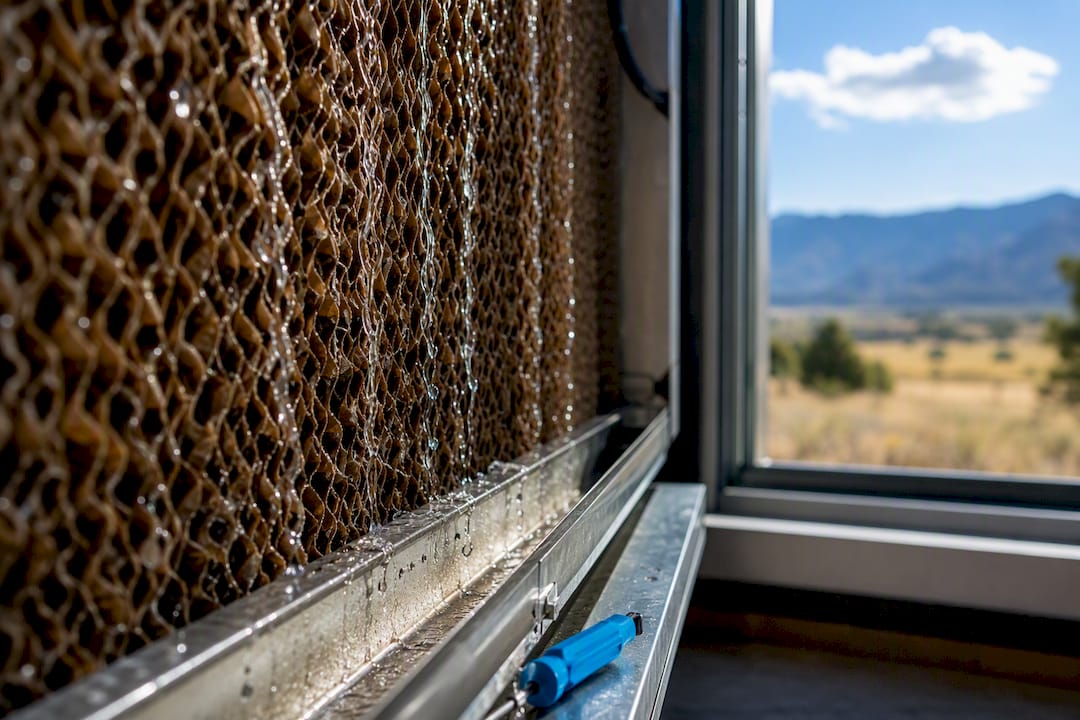
Evaporative cooling runs on a simple physical fact: water absorbs heat as it evaporates. Dry outside air passes through wet pads, water evaporates into it, and the air comes out cooler and more humid. The drier the starting air, the bigger the drop. That gap between the air temperature and how much cooler it can get through evaporation is called wet-bulb depression, and it’s the entire reason evaporative cooling works beautifully in Arizona and barely at all in Florida. In favorable dry conditions, the temperature drop can range from 15°F to 40°F.
Air conditioning works on refrigeration, not evaporation. A compressor cycles refrigerant through coils, pulling heat and moisture out of indoor air and pumping it outside. That’s why AC dehumidifies as a side effect of cooling. It’s also why evaporative coolers are open systems that need airflow through the house, while AC is a closed loop that wants windows shut.
What Does Each System Cost to Buy and Run?
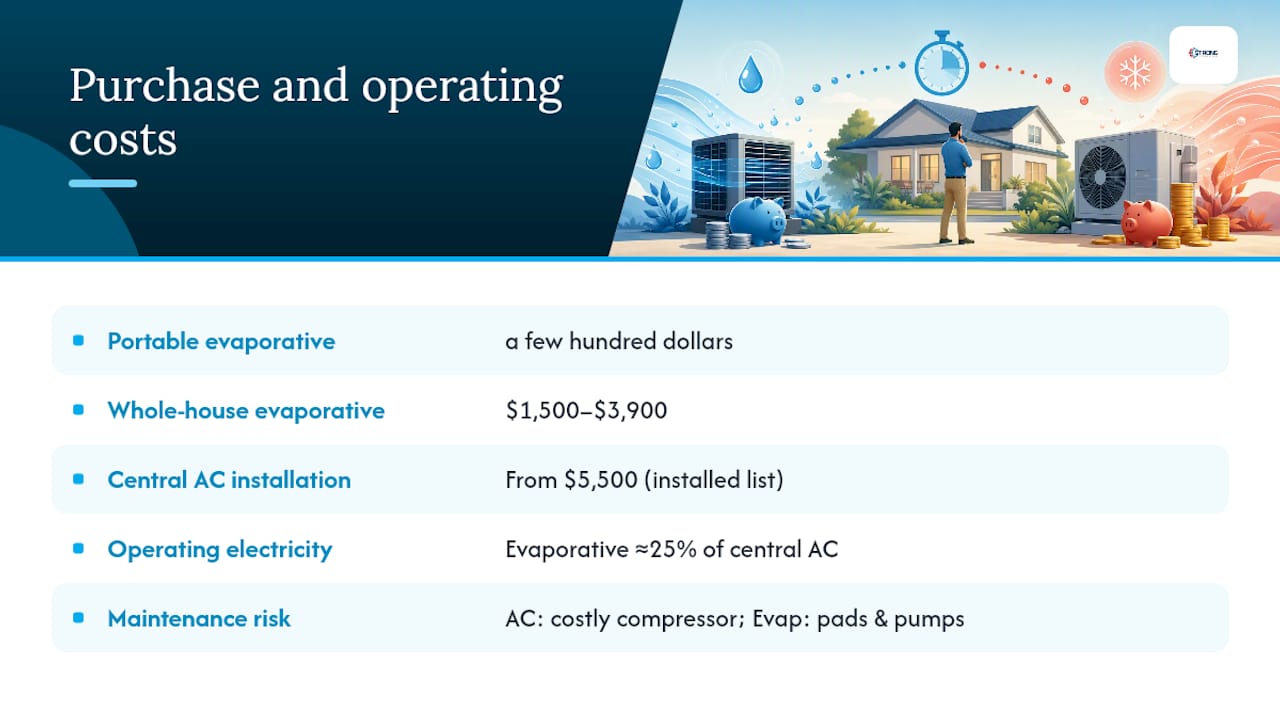
Money is where the climate-first decision really pays off. A window or portable evaporative unit runs a few hundred dollars, while a whole-house system typically installs for $1,500 to $3,900. Central AC installation tends to run higher, and Strong Heating & Cooling lists 14 SEER2 single-stage AC systems from $5,500 for a sense of current installed pricing.
Operating costs follow the same pattern. Evaporative coolers use about a quarter of the electricity of central AC, and in dry climates that can mean hundreds of dollars saved per cooling season. Water use is the trade-off, since evaporative units consume water continuously during operation.
Over five years, the gap tends to widen. AC’s biggest expense risk is a failed compressor, often the costliest single repair a homeowner faces. Evaporative coolers rarely have a catastrophic failure point; instead, they accumulate smaller costs from pad replacement and pump wear. Neither system is free to maintain, but the failure economics differ sharply.
Is Your Climate Dry Enough for an Evaporative Cooler?
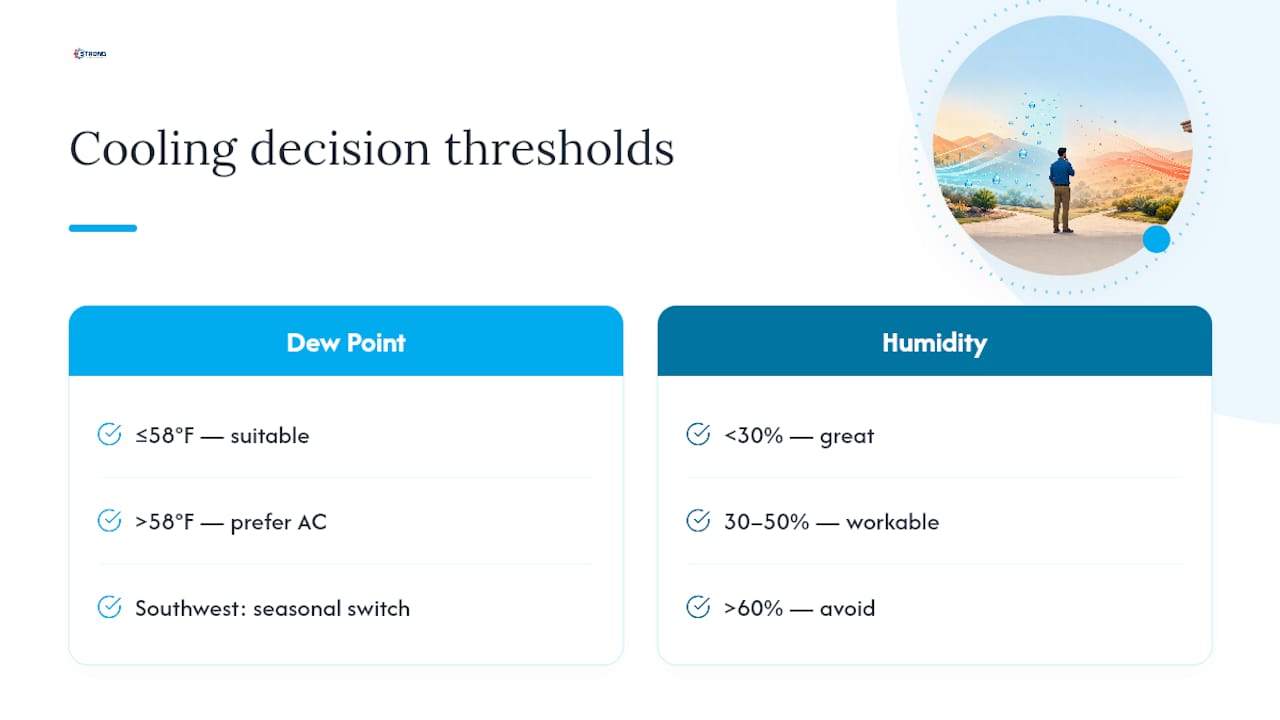
Run this test before you spend a dollar. Look up your area’s July afternoon relative humidity or dew point on Weather or NOAA’s climate data. Below 30% relative humidity, evaporative cooling performs great. Between 30% and 50%, it’s workable but less dramatic. Above 60%, skip it entirely, since performance drops sharply as humidity climbs.
Southwest HVAC practitioners use a simpler shortcut: a dew point around 58°F or lower generally means evaporative cooling will work well; above that, refrigerated air becomes the more dependable choice. This matters most during monsoon season in the Southwest, when humidity spikes for weeks even in normally dry regions. Homeowners in those markets sometimes run both systems seasonally, leaning on evaporative cooling most of the summer and switching to AC during humid stretches. Experts generally agree the decision should follow local climate design days rather than sticker price alone, since a cheap system that can’t handle your actual weather isn’t a bargain.
How Much Maintenance Does Each System Really Need?
Evaporative coolers ask for more frequent, simpler upkeep. AC asks for less frequent but more technical service.
- Evaporative coolers: replace pads once or twice per season, clean the reservoir regularly, and drain and winterize the unit before freezing weather to prevent mold and mineral buildup.
- Air conditioners: change filters monthly during heavy use, schedule an annual tune-up, and have refrigerant levels checked when performance drops. Repairs involving the compressor can be among the priciest an AC owner faces.
Both systems can last well over a decade with consistent care. Skipped maintenance shortens both, but neglect tends to hit an evaporative cooler’s performance gradually while AC neglect often ends in a sudden, expensive breakdown. Our residential HVAC maintenance guide breaks down a seasonal schedule for either system.
What Does Installation and Sizing Involve?
Whole-house evaporative coolers mount on the roof or an exterior wall and need a dedicated exhaust path, whether that’s open windows or relief vents. The mechanicals are relatively simple, which is part of why installed cost stays lower. Central AC installation is more involved: it typically requires ductwork, electrical capacity, and a condenser pad, and retrofitting ducts into a house that doesn’t have them can push costs up fast.
Sizing works differently for each. Evaporative coolers are sized by CFM (airflow) against square footage; undersized units simply won’t keep up on hot days. AC is sized in tons based on a Manual J load calculation that accounts for insulation, windows, and orientation, not just square footage. If your home needs duct modifications or your layout calls for multiple zones, that’s your cue to get a professional estimate rather than guess.
How Does Each System Affect Indoor Air Quality?
Evaporative coolers constantly bring in outdoor air, which keeps a home feeling fresh but also lets in pollen, dust, and wildfire smoke on bad-air days. That’s a real consideration for allergy sufferers. AC recirculates and filters indoor air while removing humidity, which tends to suit people with allergies or asthma better, especially with an upgraded filter. If you run an evaporative cooler in a high-pollen season, pairing it with a standalone air purifier and staying on top of indoor air quality upgrades helps close the gap.
What Should You Ask an Installer Before You Choose?
Ask any contractor for a Manual J load calculation, not a square-footage guess, and get the expected seasonal energy cost range in writing along with warranty terms. At Colorado’s altitude, air is thinner and drier than most calculators assume by default, which changes both evaporative performance and AC sizing.
Pro Tip: Schedule your evaporative cooler’s pad swap and reservoir cleaning at the start of the season, not mid heat wave, and keep a spare pad set on hand so a Saturday breakdown doesn’t turn into a week without cooling.
An Owner’s Note on Making This Call
With over 40 years of combined experience serving Colorado Springs, our team treats this decision as a climate question first, not a budget question. Every assessment starts with a site visit, a real Manual J calculation, and a clear written estimate. We’d rather walk you through the trade-offs honestly than sell you the wrong system.
— Owner
Get a Climate-Based Cooling Assessment
Strong Heating & Cooling is the practical next step once you know which side of the humidity line you fall on. Unlike a generic online calculator, we send a technician to your Colorado Springs home, run an actual Manual J load calculation, and hand you a straightforward, honest estimate instead of a guess based on square footage alone.
If your climate test points to AC, our 14 SEER2 single-stage systems start at $5,500 with options up through variable-speed heat pumps for homes that want tighter humidity control. If you’re already running a system and just need it serviced or repaired, our AC repair and maintenance team can get it back on track before the next hot stretch. Call for a free on-site assessment and we’ll tell you plainly which system fits your home, not just which one we’d rather sell.
Where These Numbers Come From
Cost and performance figures here draw from PickComfort’s cost comparison, BTU Size’s dry-climate guide, and maintenance guidance from The Home Depot, among other HVAC industry sources cited throughout.
Sources
- How to use and maintain an evaporative cooler — The Home Depot
- Evaporative cooler — Wikipedia
- Swamp Cooler vs AC: Which to Buy in a Dry Climate | BTU Size
- Swamp cooler vs AC cost and operating price comparison - PickComfort
FAQ
Is Evaporative Cooling Better Than AC?
Neither system is universally better; it depends entirely on your local humidity. In dry climates below 50% relative humidity, evaporative cooling costs less to install and run, but AC performs more reliably in humid or highly variable conditions.
How Do Amish Communities Cool Homes Without AC?
Amish households typically rely on passive strategies like cross-ventilation, shaded windows, thick walls, and evaporative methods such as wet cloths or basement cooling rather than mechanical air conditioning. These approaches work best in moderate, drier climates and lean on the same evaporation and airflow principles used in modern evaporative coolers.
What Is a Downside of Evaporative Cooling?
The biggest downside is humidity dependence: performance drops sharply above roughly 60% relative humidity, and the system adds moisture to indoor air rather than removing it. Evaporative coolers also need continuous water and more frequent hands-on maintenance, including pad replacement and reservoir cleaning.
What Is the $5,000 Rule for AC?
The “rule” is a rough homeowner guideline suggesting that if the age of your AC unit multiplied by the estimated repair cost exceeds a certain threshold, replacement usually makes more financial sense than repair. It’s a general rule of thumb, not a fixed industry standard, so getting an actual quote from a technician gives you a clearer answer for your specific system.
How Much Does Strong Heating & Cooling Charge for AC Installation?
Pricing starts at $5,500 for a 14 SEER2 single-stage air conditioner and increases with higher-efficiency and variable-speed options. Exact pricing depends on your home’s size and layout, which is why a Manual J assessment comes before any final quote.
Recommended
Need expert HVAC help?
Colorado Springs' trusted, veteran-owned heating & cooling team — emergency service.