
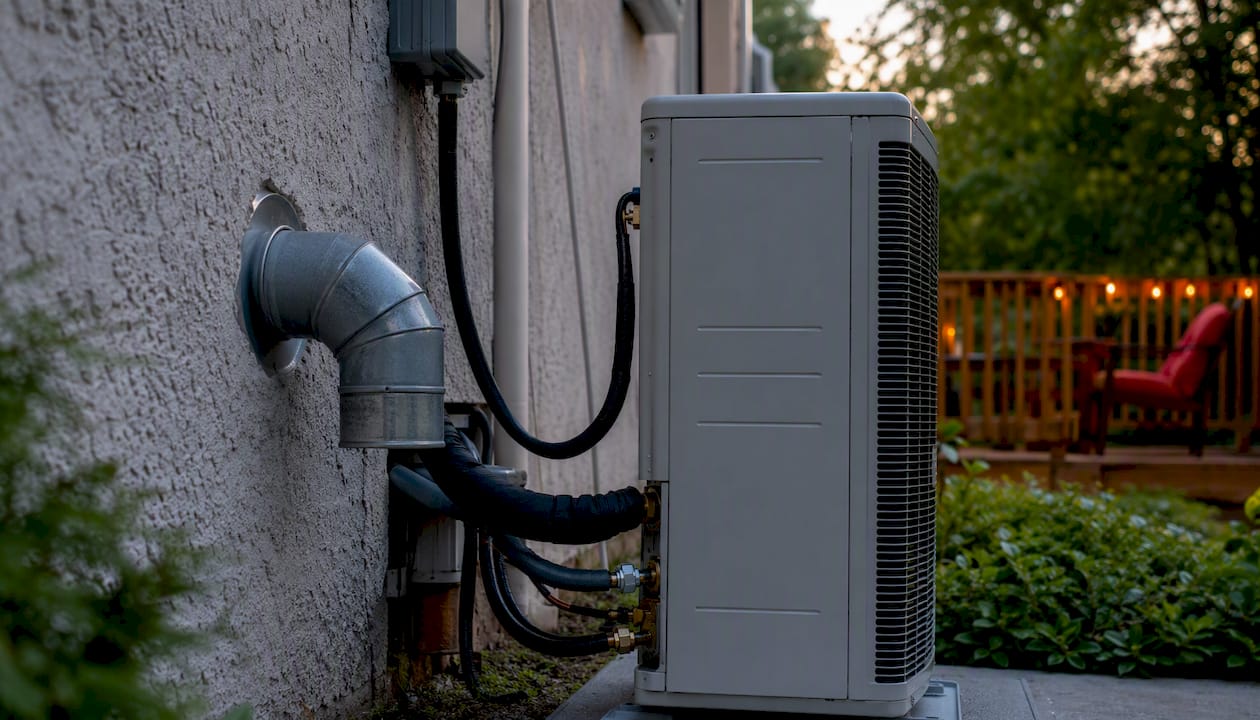
Is a Dual Fuel Heat Pump Right for Your Home?
A dual fuel heat pump pairs an electric heat pump with a gas or propane furnace, letting a thermostat pick whichever fuel source is cheaper and more effective at any given outdoor temperature. It’s a strong fit for homeowners in variable climates, especially anyone who already has a gas line and wants efficient cooling plus dependable heat on the coldest nights.
Here’s why it earns that recommendation for most homes with mixed weather:
- Efficiency and comfort year-round. The heat pump handles both air conditioning in summer and low-cost heating through most of the fall, winter, and spring.
- Best for variable-climate homes with existing gas service. If your winters swing between mild 40s and brutal single digits, this setup covers both ends without forcing one system to do a job it’s bad at.
- The tradeoff is real. Expect a higher upfront cost and more complexity than a single-system replacement, plus two pieces of equipment to maintain instead of one.
Before you commit, check three things: your climate zone, your current gas and electric rates, and what incentives are available in your area. Those three variables decide whether this system pays for itself or just adds cost.
Key Takeaways
A dual fuel heat pump saves the most money in climates with real seasonal swings, where the heat pump covers mild weather and the furnace backs up the coldest stretches.
| Point | Details |
|---|---|
| What it is | An electric heat pump paired with a gas or propane furnace, switching automatically at a calculated balance point. |
| Best-fit homeowner | Variable climates with existing gas service and a need for both cooling and reliable cold-weather heat. |
| Main tradeoff | Higher upfront installation cost and two systems to maintain instead of one. |
| Cost range | Roughly $4,500 to $16,000 depending on whether you’re adding a heat pump or doing a full replacement. |
| Next step | Get a local site assessment from Strong Heating And Cooling to confirm sizing, balance point, and real cost before you commit. |
Table of Contents
- What Is a Dual Fuel Heat Pump System?
- How Does a Dual Fuel Heating System Decide When to Switch?
- What Are the Real Benefits of a Dual Fuel Setup?
- What Are the Downsides of a Dual Fuel Heat Pump?
- Is a Dual Fuel System the Right Choice for Your House?
- How Much Does a Dual Fuel Heat Pump Cost to Install?
- What Does Installing and Maintaining a Dual Fuel System Involve?
- What Do Real-World Dual Fuel Scenarios Look Like?
- What Are the Alternatives to a Dual Fuel Heat Pump?
- What Do Installers See Most Often With Dual Fuel Systems?
- How Strong Heating And Cooling Handles Dual Fuel Installations
- Sources
- FAQ
What Is a Dual Fuel Heat Pump System?
A dual fuel system, sometimes called a hybrid heating system, combines two heat sources under one control scheme: an electric heat pump for everyday heating and cooling, and a fossil-fuel furnace that kicks in when temperatures drop low enough to make the heat pump inefficient. The Department of Energy describes this setup as one that automatically selects whichever heat source is more cost-effective at a given outdoor temperature, so the system isn’t guessing. It’s making a calculation, every hour, based on conditions outside your window.
Understanding the components helps before you start comparing quotes:
- Heat pump: An outdoor unit that moves heat rather than generating it, providing both air conditioning and efficient heating down to a certain outdoor temperature.
- Backup furnace: A gas or propane furnace already installed (or newly added) that takes over once the heat pump’s efficiency drops off.
- Balance point: The outdoor temperature at which running the furnace becomes cheaper or more effective than running the heat pump. This is a moving target, not a fixed number.
- Smart thermostat: The control brain that reads outdoor temperature, indoor demand, and sometimes utility rates to decide which system runs.
- Auxiliary heat: A backup heat source (often electric resistance strips) some heat pump systems use in a pinch; in a dual fuel setup, the furnace typically replaces this role entirely.
Picture the wiring this way: the heat pump and furnace both tie into the same ductwork, sharing a blower and distribution system. The thermostat sits at the center, wired to both units through a control board or interlock that prevents them from firing simultaneously. When the thermostat calls for heat, it checks outdoor temperature against the programmed balance point, then routes the call to whichever system should respond.
How Does a Dual Fuel Heating System Decide When to Switch?
The switching logic follows a predictable sequence built around outdoor temperature and cost.
- Cooling season: The heat pump runs exclusively as your air conditioner, just like a standard AC unit.
- Mild to moderate heating season: As temperatures drop, the heat pump reverses and pulls heat from outside air, typically staying efficient down into the 30s or 40s Fahrenheit.
- Cold weather below the balance point: Once outdoor temperature falls below the calculated threshold, the system shuts off the heat pump and fires the furnace instead, since gas combustion becomes the cheaper or more reliable option at that point.
Balance points typically fall somewhere between 30°F and 40°F, though that range moves depending on your local electricity and gas prices and the specific heat pump’s HSPF and SEER ratings. A high-efficiency cold-climate heat pump might push that threshold down into the 20s, while an older or lower-efficiency unit might hand off to the furnace closer to 40°F. The balance point itself isn’t static — it should be reviewed periodically as utility rates shift, because a threshold set for 2022 gas prices might waste money in 2026.
Smart thermostats add another layer of control. Many models let you set the switchover manually, override it during a utility rate spike, or even program time-of-use logic so the system favors electric heating during off-peak hours and gas during expensive peak windows. That flexibility is one of the more overlooked dual fuel heat pump benefits homeowners discover only after living with the system for a season.
- Most dual fuel installations use a single unified thermostat rather than two separate controls, simplifying day-to-day use.
- Interlocks in the control board prevent the heat pump and furnace from running at the same time, protecting equipment and avoiding wasted energy.
What Are the Real Benefits of a Dual Fuel Setup?
The case for dual fuel heating rests on four practical advantages, not marketing language.
- Year-round comfort from one integrated system. You get efficient cooling in summer and heating that adapts to conditions instead of running on one fuel regardless of outdoor temperature.
- Lower operating costs in mixed climates. By handing off to gas only when it’s actually cheaper, you avoid the worst-case scenario of running a heat pump inefficiently in extreme cold or running a furnace when a heat pump would do the job for less.
- Reliable performance during deep cold snaps. A furnace doesn’t lose capacity as temperatures fall the way a heat pump can, so you’re not left short on heat during a January cold front.
- Lower emissions when electricity is cleaner. Since the heat pump covers the majority of the heating season in many climates, your carbon footprint drops compared to a furnace-only setup, even before accounting for renewable generation.
Contractor-facing reporting on dual fuel systems has found they can meaningfully cut site energy usage compared to single-fuel heating, largely by sharing the load between two energy sources instead of forcing one system to cover every condition. That load-sharing also acts as a hedge against price volatility: if gas prices spike one winter, the heat pump absorbs more of the heating load, and vice versa.
There’s a grid-level benefit too. Wider dual fuel adoption eases the pressure on electric grids during extreme cold snaps, since the furnace covers peak demand hours instead of forcing every home in a neighborhood to pull maximum electric load simultaneously. For utilities managing the shift toward electrification, that backup capacity is a genuine planning advantage, not just a homeowner convenience.
What Are the Downsides of a Dual Fuel Heat Pump?
No system is free of tradeoffs, and dual fuel systems have four worth taking seriously before you sign a contract.
- Higher upfront cost. You’re buying and installing two heat sources instead of one, and that shows up on the estimate.
- Two systems to maintain. Annual service, filter changes, and eventual repairs apply to both the heat pump and the furnace, not just one unit.
- Continued fossil fuel dependence. If full electrification is your long-term goal, keeping a gas or propane furnace as backup means you’re not entirely off fossil fuels yet.
- Thermostat misconfiguration risk. A poorly set balance point can leave the furnace running far more than necessary, erasing most of the savings the system was supposed to deliver.
Pro Tip: If you’re weighing dual fuel against a full electrification plan, think about resale value too. A home with working gas service and a dual fuel system tends to appeal to a broader range of buyers than an all-electric home in a region where gas heating is still the norm, at least for now.
Watch for a few practical red flags before installation. An older furnace that’s incompatible with the new control board, an outdoor unit location with no viable yard space, or an electrical panel that can’t support the heat pump’s amperage draw can all turn a straightforward install into a costly one. Get these checked during your initial site visit, not after equipment shows up on a truck.
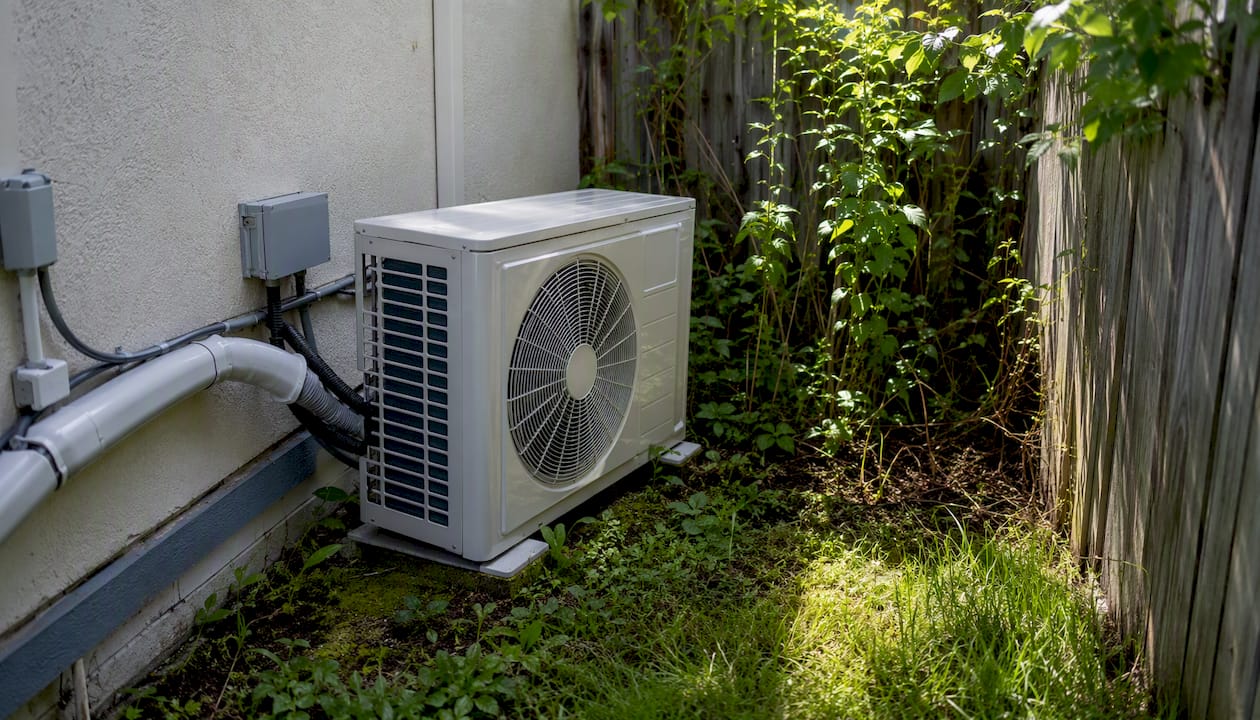
Is a Dual Fuel System the Right Choice for Your House?
Run through this short checklist before you request quotes.
Signals that point toward yes:
- You live somewhere with a real mix of hot summers and cold winters, not a climate that stays mild year-round.
- You already have a gas line and functioning furnace, reducing the incremental cost of adding a heat pump.
- Reliable heat during extreme cold matters to you more than squeezing out the absolute lowest operating cost.
- You want one system handling both heating and cooling instead of juggling separate equipment.
Signals that point toward no:
- Your climate rarely drops below freezing, in which case a heat-pump-only system likely covers everything you need.
- You have no gas service and the cost to extend a line to your home is steep.
- Your budget can’t absorb the higher installation cost dual fuel systems carry compared to a single-system swap.
- Your electrical panel would need a significant (and expensive) upgrade to support a heat pump.
If you’re on the fence, walk through this quick sequence: check your climate zone and average winter lows, pull your last twelve months of gas and electric bills, get a real installation estimate for your specific home, then check what incentives apply. That order matters, because incentives can change the math significantly, but only after you know the baseline cost.
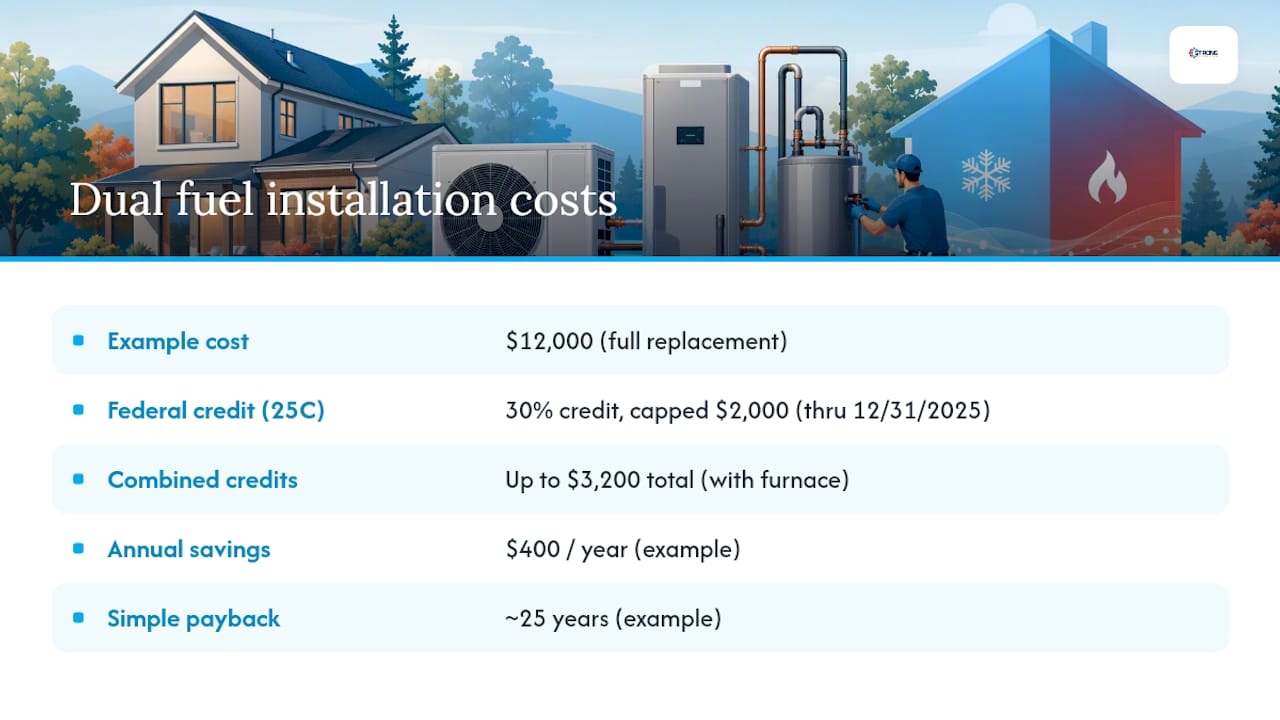
How Much Does a Dual Fuel Heat Pump Cost to Install?
Cost ranges vary by home size, existing ductwork, and whether you’re adding a heat pump to a furnace you already own or replacing both systems at once.
These ranges reflect equipment size, brand, and regional labor costs, and they can shift based on your specific home. A HVAC installation cost calculator is a fast way to narrow the range for your square footage before you request in-home estimates.
Note: the federal Energy Efficient Home Improvement Credit (Section 25C) ended for equipment installed after December 31, 2025, so it no longer applies to new HVAC installations. For the rebates still available to Colorado Springs homeowners, see our 2026 Colorado HVAC rebates guide.
Pro Tip: Federal credits are only part of the picture. Check your state energy office and your utility company for rebates on qualifying heat pumps. Many stack on top of the federal credit, and combining incentives properly can shave thousands off your actual out-of-pocket cost. This is general tax information, not personalized tax advice. Confirm eligibility and current limits with a tax professional or the IRS before filing.
What Does Installing and Maintaining a Dual Fuel System Involve?
A proper install follows a defined sequence, and skipping steps here is exactly where problems start.
Installation checklist:
- Site survey to assess outdoor unit placement, ductwork condition, and existing furnace compatibility.
- Electrical service assessment to confirm your panel can handle the heat pump’s amperage draw.
- Permit application and inspection scheduling, which varies by jurisdiction and can add days to your timeline.
- Thermostat and control board integration, ensuring the interlock logic is programmed correctly from day one.
- Refrigerant charge verification and system testing before the crew leaves.
Ask your contractor these questions before signing anything:
- How did you calculate the sizing for my home, and did you run a load calculation or just match the old equipment?
- What balance point are you setting, and how did you arrive at that number based on my utility rates?
- Is my existing furnace compatible with the new heat pump’s control board, or does it need replacement?
- What’s the expected installation timeline, including permits and inspection?
- What does your workmanship warranty cover, and for how long?
Once installed, plan on an annual heat pump inspection, a separate furnace tune-up before heating season, and filter replacement every one to three months depending on your filter type and household. Watch for warning signs like short-cycling, unusually high bills in the first few months, or a system that seems to favor the furnace even during mild weather. Each of those points to a sizing error or a misconfigured switchover, not normal wear.
What Do Real-World Dual Fuel Scenarios Look Like?
Numbers land differently depending on climate, so here are three simplified scenarios to show how the math shifts.
Operating costs stay low year-round because the heat pump rarely hands off.
Mixed-climate dual fuel home: A home with real seasonal swings, cold winters and hot summers, might split heating roughly 60/40 between heat pump and furnace, with the balance point set around 35°F. This is the profile where dual fuel systems shine, since neither single-fuel system would perform as well across the full range of conditions.
Here, a cold-climate heat pump paired with the furnace, and a carefully tuned balance point, keeps costs in check better than a standard heat pump would.
Example assumptions used above: electricity priced around $0.14 to $0.16 per kWh, natural gas priced around $1.20 to $1.40 per therm, and a heat pump with an HSPF rating in the mid-to-high range for its class. Your actual numbers will vary, and that’s exactly why re-checking them matters.
Pro Tip: Balance-point tuning isn’t a one-time setup. A technician should revisit it whenever utility rates shift meaningfully, since a threshold calculated three years ago may no longer reflect what’s cheapest today.
What Are the Alternatives to a Dual Fuel Heat Pump?
Three realistic alternatives exist, and each fits a different priority.
- Heat-pump-only system: Best when your climate rarely sees extended deep freezes and you want the lowest emissions profile with the simplest single-system install.
- Furnace-only system: Still makes sense in very cold climates with cheap natural gas, or for homeowners who don’t need central air conditioning and want to minimize upfront cost.
- Cold-climate heat pump (no furnace backup): A middle ground for homeowners who want to go fully electric but live somewhere with harsh winters; these units maintain efficiency at much lower temperatures than standard heat pumps, sometimes eliminating the need for a backup fuel source entirely.
| Option | Best Climate | Typical Upfront Cost | Year-Round Cooling | Emissions Profile |
|---|---|---|---|---|
| Heat-pump-only | Mild to moderate | Lower | Yes | Lowest, especially with clean electricity |
| Furnace-only | Very cold, cheap gas | Lowest | No (needs separate AC) | Higher, fossil-fuel dependent |
| Dual fuel | Variable/mixed | Higher | Yes | Moderate, drops as electricity gets cleaner |
| Cold-climate heat pump | Cold, no gas access | Moderate to higher | Yes | Low, fully electric |
If your top priority is the lowest possible upfront cost and you don’t need central cooling, a furnace-only approach still works. If lowest operating cost and year-round comfort matter most, and your climate is genuinely mixed, dual fuel heating tends to win the comparison. If your goal is the lowest carbon footprint with no fossil fuel backup at all, a cold-climate heat pump deserves a serious look, and it pairs well with guidance on combined furnace and AC replacement economics if you’re comparing total system costs.
What Do Installers See Most Often With Dual Fuel Systems?
The single biggest factor in whether a dual fuel system performs well isn’t the equipment brand. It’s whether the balance point was calculated using real, current utility rates instead of a generic default setting. We see systems installed correctly on paper that still run up high bills because nobody revisited the switchover point after gas or electric rates changed. Sizing matters too. A heat pump that’s oversized or undersized for the home throws off the entire balance-point calculation, no matter how good the thermostat programming is.
The decision factor that matters most for Colorado homeowners in particular is climate variability. Front Range weather swings from 70°F afternoons to single-digit nights within the same week during shoulder seasons, which makes accurate balance-point tuning more valuable here than in climates with steadier temperature patterns.
Pro Tip: Ask your installer to show you the load calculation, not just the equipment specs. If they can’t explain how they sized your system for your specific home, that’s worth a second opinion before you commit.
How Strong Heating And Cooling Handles Dual Fuel Installations
Strong Heating And Cooling gives Colorado Springs homeowners something a generic equipment quote can’t: a properly calculated balance point and thermostat setup done by technicians who verify it against your actual utility rates, not a factory default.

Our team handles the full scope, heat pump installation, furnace pairing, electrical assessment, and thermostat integration, so you’re not coordinating between separate contractors for each piece. We also walk homeowners through financing options where the upfront cost of a dual fuel system needs to be spread out, and every installation includes proper load calculation and workmanship backing so you’re not guessing whether the sizing was done right. If you’re ready to find out what a dual fuel setup would cost for your specific home, request an in-home assessment through our HVAC installation page and we’ll walk the property, check your ductwork and electrical service, and give you real numbers instead of a rough estimate over the phone.
Sources
- ACHR News — ‘Dual Fuel Heat Pumps: By the Numbers’
- MNASHP — How dual-fuel heat pump systems balance emissions reduction and savings
- IRS — Frequently asked questions about the Energy Efficient Home Improvement Credit
Check the IRS and ENERGY STAR pages for incentive eligibility, since those rules can change year to year. Use the Department of Energy and MNASHP sources for the technical side of how balance points and switching logic actually work.
FAQ
What Is a Dual Fuel Heat Pump?
A dual fuel heat pump combines an electric heat pump with a gas or propane furnace under one thermostat, automatically switching between them based on outdoor temperature and cost efficiency.
What Are the Downsides of a Dual Fuel Heat Pump?
The main downsides are a higher upfront installation cost, two systems to maintain instead of one, and continued reliance on fossil fuel for backup heat during cold weather.
Is a Dual Fuel Heat Pump Worth It?
For homeowners in climates with real seasonal swings and existing gas service, it’s often worth the higher upfront cost because of lower operating costs and reliable heat in extreme cold. In consistently mild climates, a heat-pump-only system usually makes more financial sense.
How Much Does a Dual Fuel HVAC System Cost?
Adding a heat pump to an existing furnace typically runs $4,500 to $8,500, while a full dual fuel replacement with new equipment generally falls between $9,000 and $16,000, more if electrical or ductwork upgrades are needed.
Recommended
Need expert HVAC help?
Colorado Springs' trusted, veteran-owned heating & cooling team — same-day service.