
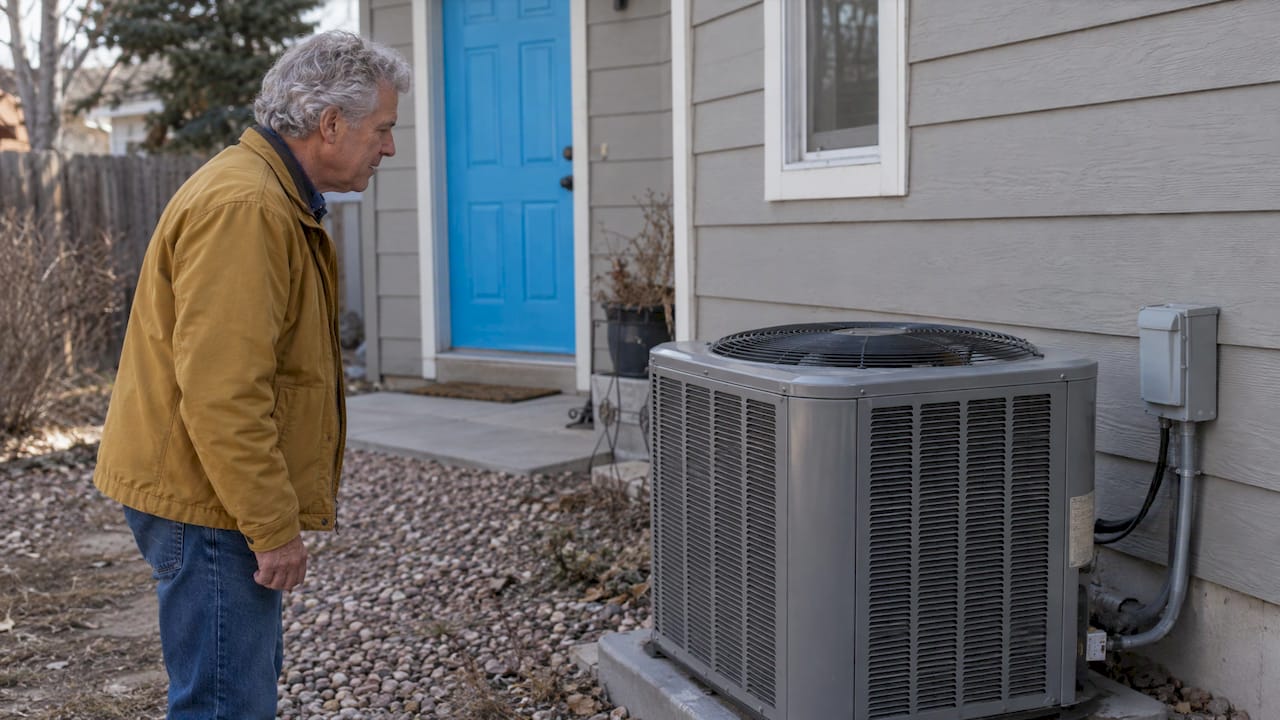
A dirty condenser coil usually shows up as an air conditioner that runs longer, cools less and costs more to operate, sometimes with ice on the lines or a system that switches on and off in short bursts. None of these signs proves the coil is the problem, which is why a technician’s measurements matter more than a guess. If your system is showing several of them, our team at Strong Heating And Cooling can inspect it, clean the coil if that is what the system needs, and tell you what we find at a flat-rate price.
TL;DR
- The most common dirty coil symptoms are long run times, weak or warm airflow, rooms that will not reach the thermostat setting, short cycling, ice on the refrigerant lines and a bill that climbs without a reason.
- Dirt acts like insulation on the coil. Federal research shows even moderate fouling can cost a typical system a few percent of capacity, and heavily fouled coils far more.
- The same symptoms can come from a clogged filter, low refrigerant or an electrical fault, so treat them as clues, not a diagnosis.
- You can safely clear debris and plants from around the outdoor unit. Coil cleaning, refrigerant and electrical work belong to a technician.
- Left alone, a dirty condenser makes the compressor work at higher pressure and temperature, which shortens its life.
Table of Contents
- What the condenser coil does, and why dirt matters
- The symptoms of a dirty condenser or AC coil
- How much a dirty coil costs you
- Is it the coil, or something else?
- What you can safely do yourself
- What happens if you leave it
- Colorado Springs conditions
- When to call, and what to expect
- When the coil is a sign the system is tired
- Strong Heating And Cooling can take it from here
- Our perspective
- FAQ
- Sources
What the condenser coil does, and why dirt matters
Your air conditioner does not create cold. It moves heat from inside your home to the outdoors. The condenser is the outdoor unit, and its coil is the finned metal grid you see through the louvered sides. Refrigerant carries heat to that coil, and a fan pulls outdoor air across it to carry the heat away.
When dust, pollen, grass clippings or cottonwood fluff coat the fins, less air gets through and the coil cannot shed heat as well. ASHRAE explains that reduced airflow across the condenser lowers the system’s ability to reject heat, so capacity drops, especially on hotter days. That is why a dirty coil is a comfort problem on the hottest afternoons and not only an efficiency problem.
The indoor coil, called the evaporator, can foul too. It sits inside your air handler or above your furnace, so you cannot see it. When people search for dirty AC coil symptoms, they are usually describing effects of either coil, and many of the signs overlap. This article covers both and notes where they differ.
The symptoms of a dirty condenser or AC coil
No single sign settles it. Look for a pattern, and note when it appears. A coil problem tends to get worse as the outdoor temperature rises.
The air conditioner runs longer than it used to
If your system once cycled off after twenty minutes on a warm day and now runs for an hour or more, the coil may be struggling to shed heat. ENERGY STAR’s maintenance checklist says dirty coils reduce the system’s ability to cool and cause it to run longer. Carrier’s troubleshooting page lists continuous or unusually long operation among the signs of an excessively dirty condensing unit.
If your system runs nearly nonstop, our guide to quick checks when an AC runs constantly walks through what to look at first.
Weak cooling or warm air at the vents
A coil that cannot release heat leaves the refrigerant warmer than it should be, so the air coming out of your vents is not as cool. You may notice that upstairs rooms or rooms farthest from the unit never reach the thermostat setting, even though the system is running. Carrier also lists no cooling or inadequate cooling among the symptoms.
Short cycling
Short cycling means the system starts, runs briefly and shuts off, then starts again. With a dirty condenser, pressure in the system can climb quickly and trip a safety control that shuts the compressor down until it cools. Carrier names rapid on and off cycling as a symptom of a faulty or very dirty condensing unit. If you hear the outdoor unit start and stop repeatedly within a few minutes, it is worth a call.
Ice on the coil or refrigerant lines
Frost on the copper line running to your outdoor unit, or ice on the coil itself, is one of the clearest warnings. Carrier notes that a frozen evaporator coil can sometimes be caused by excessive dust, dirt or debris, and that it shows up as frost on the refrigerant lines, extra condensate draining, poor cooling and higher utility bills.
If you see ice, turn the cooling off and let the system thaw. Running it frozen puts extra strain on the compressor. We cover the usual causes in why an AC freezes up.
Higher energy bills with no change in your habits
A utility bill that rises while your thermostat settings and weather stay the same is a reasonable reason to look at the coils. Bills alone do not prove anything, though. Many things move a bill, so use it as a prompt to have the system measured, not as a verdict.
Visible buildup on the outdoor unit
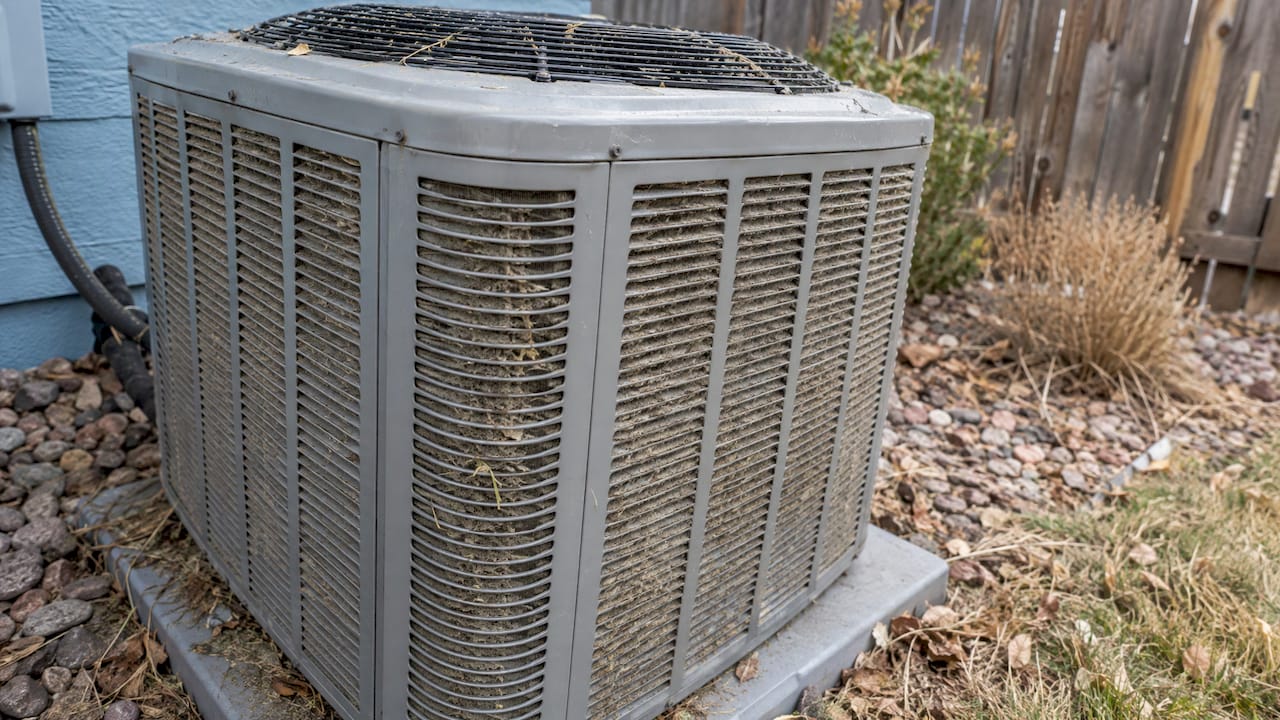
This is the one symptom you can check without touching anything. Stand a few feet from the unit and look at the fins. A gray mat of fuzz, a layer of dust, grass clippings, leaves or a wall of weeds pressed against the sides all restrict airflow. Look at the top grille too, where debris can settle and block the fan.
Noises, a tripped breaker or a unit that will not start
Carrier lists a unit that will not turn on at all among the signs of a faulty or very dirty condensing unit. A breaker that trips on hot afternoons, or a loud hum, buzz or grinding from the outdoor unit, also deserves a service call. If you smell burning, see smoke or see sparks, shut the system off at the thermostat and the breaker and call for service right away.
How much a dirty coil costs you
The numbers vary with how dirty the coil is and how marginal the system was to begin with. Here is what published research shows.
| Finding | Source |
|---|---|
| Typical fouling: 5 to 10% less airflow and 2 to 4% lower efficiency and capacity, with 10 to 20% or more for marginal systems | Lawrence Berkeley National Laboratory study |
| Raising condensing temperature from 95°F to 105°F: about 7% less cooling capacity and 10% more power | Carrier guide citing DOE figures |
| Airflow problems can cut efficiency by up to 15% | ENERGY STAR |
| Very dirty condenser coils: cooling capacity down by as much as about 40% and compressor power up by as much as about 70% | DOE Federal Energy Management Program presentation, 2010 |
| Dirty condenser coils can cost as much as one-third more to operate | WASBO 2024 handout |
The range is wide because a lightly dusty coil and a coil packed with cottonwood fluff are very different cases. Most homes sit at the lighter end. The point is that the loss is gradual. The same Berkeley study found that a typical coil takes years to foul enough to double its resistance to airflow, so you tend to adapt to the decline without noticing it. That is one reason a yearly checkup catches what you cannot.
A worked example
Suppose your system uses 3,000 kilowatt-hours over a cooling season. If a dirty coil raises power use by 10%, which matches the Carrier and DOE figure for a 10°F rise in condensing temperature, that is about 300 extra kilowatt-hours. Multiply by your own rate per kilowatt-hour on your utility bill to see the cost. The exact figure depends on your system, your rate and how dirty the coil is, but the arithmetic shows why a small percentage matters over a whole summer.
Is it the coil, or something else?
This is where most homeowners get stuck. Every symptom above can have another cause.
- A clogged air filter restricts airflow indoors and can cause weak cooling, long run times and even a frozen evaporator coil.
- Low refrigerant causes poor cooling and ice, and no amount of coil cleaning fixes a leak.
- A failing fan motor or capacitor can cause weak airflow, noise and a unit that will not start.
- Duct leaks or an undersized system can leave rooms warm even with a spotless coil.
Bryant’s cleaning guide makes a related point: rising energy costs alone do not prove a cleaning need, and a professional should inspect when energy use changes unexpectedly.
Here is a sensible order of checks:
- Check the filter first. Replace it if it is dirty. This is the cheapest fix and the most common cause.
- Look at the outdoor unit with the power off. Note debris, plants and anything stacked near it.
- Note the pattern. Does the problem get worse on the hottest days? Does ice appear? Does the unit short cycle?
- If the symptoms continue, schedule a diagnostic visit. A technician can measure the temperature drop across the coil, check refrigerant conditions and test the electrical parts, none of which you can judge by eye.
Our AC repair team does this kind of whole-system diagnosis, so you learn whether the coil, the refrigerant, a motor or something else is behind the problem. Our technicians are NATE-certified, and our flat-rate pricing means you know the cost before work begins.
What you can safely do yourself
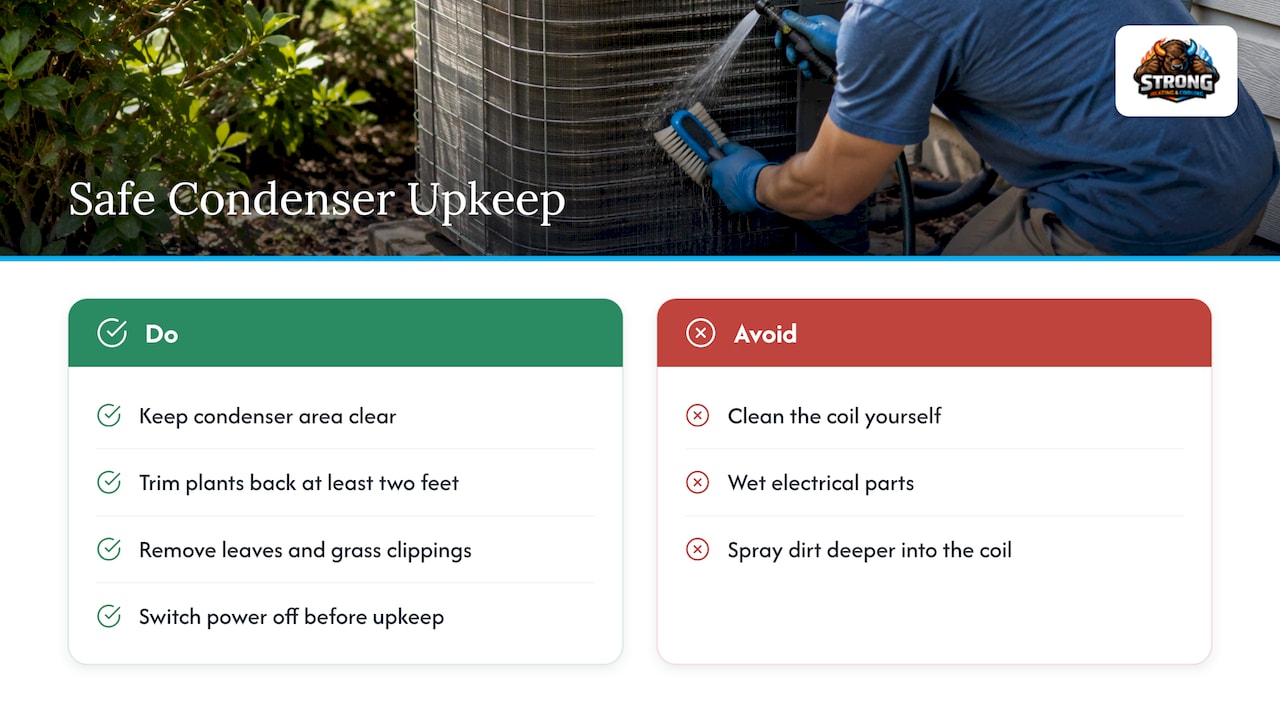
Some upkeep around the outdoor unit is simple and safe. Keep the area around the condenser clear, and trim shrubs and plants back at least two feet so air can move through freely. Remove leaves and grass clippings from the base and top of the unit. Keep the lawn mower and string trimmer from throwing clippings at the fins.
Before doing any of that, turn the unit’s power off at the disconnect box near it or at the breaker. The outdoor unit has high-voltage parts and a fan that can start on its own.
We suggest leaving the actual coil cleaning to a technician. Water on electrical parts is a hazard, fins bend easily, and aggressive spraying can push dirt deeper into the coil instead of out of it. Trane recommends having a professional inspect and clean coils, noting that DIY maintenance can void the warranty on a unit that is still covered. Check your warranty paperwork if your system is fairly new.
What happens if you leave it
A dirty condenser does more than cost you money each month. When the coil cannot shed heat, pressure and temperature in the refrigerant circuit rise. A WASBO handout on HVAC systems explains that elevated pressure and temperature can break down the compressor’s lubricant, form acid and ultimately lead to equipment failure. The compressor is the most expensive part of the outdoor unit, so a coil that causes it to overwork is the kind of problem worth catching early.
A smaller step also matters: the high-pressure safety switch that protects the compressor may trip again and again, which you experience as short cycling or a unit that quits on hot afternoons. Each trip is the system protecting itself from conditions it should not be in.
If your air conditioner is already old and has had repeated problems, the real question may be whether to repair or replace. Our guide on signs your AC is about to fail helps you weigh that.
Colorado Springs conditions
The Front Range sets its own terms for outdoor equipment. Many Colorado Springs yards have mature trees, native grasses and open areas, and the outdoor unit collects whatever blows by. Our team has worked on systems across the Springs and nearby communities such as Monument, Fountain, Divide and Midland, so the habits below are suited to how local homes are built and landscaped.
- Clear the unit in late spring, before the first hot stretch, and again after the season when leaves have dropped.
- Check the unit after wind or storms, which can pile debris against the fins.
- Keep stored items, firewood and garden supplies away from the cabinet.
Because our approach is built around high-altitude Front Range conditions, we pay attention to how your system performs where you live, not only to what it does on a test bench. For a seasonal routine, see our preventive HVAC maintenance schedule and our residential HVAC maintenance guide.
When to call, and what to expect
Call for service when your system cannot hold the thermostat setting, runs almost constantly, shows ice, short cycles, trips the breaker or has noticeably weak airflow. Call right away, and keep the system off, if you smell burning or see smoke or sparks.
A good visit should answer three questions: is the coil dirty enough to hurt performance, is anything else contributing, and what is the right fix? A clean coil and a healthy refrigerant charge are the baseline. If the system is worn out, you should hear that plainly too, with the cost of each path before anyone starts work. If you want a regular checkup instead of waiting for symptoms, our AC upkeep tips explain what a seasonal tune-up covers.
When the coil is a sign the system is tired
Sometimes a dirty coil is not the root problem. A system that has struggled for years, runs on an older refrigerant or has a damaged coil may cost more to keep running than a new one. In that case replacement can lower your cooling costs and improve comfort. Our published starting prices for new systems are:
| System | Starting price |
|---|---|
| 14 SEER2 single-stage air conditioner | from $5,500 |
| 16+ SEER2 single-stage air conditioner | from $6,500 |
| 15 SEER2 single-stage heat pump | from $6,500 |
| 17 SEER2 three-stage heat pump | from $8,500 |
| 18 SEER2 variable heat pump | from $10,000 |
SEER2 is the rating for how efficiently an air conditioner or heat pump cools over a season, and a higher number means lower running costs for the same cooling. You can see the full details on our air conditioner pricing page.
Strong Heating And Cooling can take it from here
We are a veteran-owned HVAC company in Colorado Springs with over 40 years of combined experience and more than 200 five-star reviews. If your air conditioner is showing the symptoms above, we can diagnose the cause, handle the repair, and offer same-day service when needed. Our pricing is flat-rate with no hidden fees, and we also offer HVAC maintenance plans for homeowners and property managers who want regular checkups.
To get started, see our air conditioner services in Colorado Springs or reach us through strongheatingcooling.com.

Our perspective
We hear the same sentence from many homeowners: the AC just does not keep up like it used to. Often that is a slow change, and a dirty coil is one of the first things we look at because it is common and it is correctable.
Our view is simple. Treat symptoms as clues, find the real cause, and tell you the price before we start. That is why we work on a flat-rate basis with no hidden fees, and why our NATE-certified technicians look at the whole system and not only at the part you called about.
Colorado’s Front Range is hard on equipment, and our work is built around its high-altitude climate. A system that is cleaned, checked and kept clear of debris tends to run the way it was designed to. A maintenance plan is the easiest way to keep that going, and we stand behind our workmanship.
Owner
FAQ
Can I tell if my AC coil is dirty just by looking at it?
You can spot obvious outdoor buildup, such as fuzz, grass clippings or leaves pressed against the fins. You cannot see the indoor coil, and a coil can be dirty deep between the fins where the eye cannot reach. If you see buildup or have symptoms, a technician can confirm with measurements.
How often should condenser coils be cleaned?
There is no single schedule that suits every home. Coils should be cleaned when buildup begins to affect airflow or heat transfer, and a yearly checkup before cooling season is a practical way to catch it. A home with trees, dust or heavy cottonwood fluff may need more attention.
Is it safe to spray my outdoor unit with a hose?
Clearing loose debris from around the unit is safe once the power is off at the disconnect. Cleaning the coil itself is best left to a technician, because water near electrical parts is a risk, fins bend easily and some warranties are affected by DIY work. Never use a pressure washer on the fins.
What are the symptoms of a dirty evaporator coil versus a dirty condenser?
Both cause weak cooling, longer run times and higher bills. A dirty evaporator coil, the indoor one, is more likely to show as frost on the refrigerant lines, extra water draining from the system or weak airflow at the vents. A dirty condenser is more likely to cause short cycling, a hot unit and trouble on the hottest afternoons.
Will cleaning the coil fix my AC?
It will if dirt is the cause. If the real problem is a refrigerant leak, a failing motor or a duct issue, cleaning will not solve it, which is why a diagnosis comes first. We check the whole system so you pay to fix the actual problem.
Sources
- AC Troubleshooting, Carrier
- How to Clean an AC Unit, Carrier
- Maintenance Checklist, ENERGY STAR
- Dirty Air Conditioners: Energy Implications of Coil Fouling, Lawrence Berkeley National Laboratory
- HVAC Maintenance and Technologies, DOE FEMP
- Understanding HVAC, WASBO
- Top Ten Things Consumers Should Know About Air Conditioning, ASHRAE
- How to Clean Condenser Coils, Trane
- The Ultimate Guide to HVAC Cleaning, Bryant
Recommended
Need expert HVAC help?
Colorado Springs' veteran-owned heating & cooling team — Mon–Sat, 8 AM–7 PM. Same-day service when available.