

Coordinating HVAC Repairs Between Tenants: 2026 Guide
TL;DR:
- Effective HVAC repair coordination involves managing tenant requests, scheduling vendors, and maintaining clear communication throughout the process. Proper use of tenant portals, scheduling software, and vetted vendors reduces response time, costs, and tenant complaints. Prioritizing urgent repairs and confirming resolution with tenants prevents repeated issues and improves satisfaction.
Coordinating HVAC repairs between tenants is defined as the structured process of managing repair requests, scheduling vendors, and maintaining clear communication across all parties in a rental property. Property managers who handle this process well see fewer complaints, faster resolution times, and stronger lease renewals. Automated maintenance notifications raise tenant satisfaction scores to 4.1 out of 5, compared to 2.8 out of 5 without them. That gap reflects a real operational difference, not just a preference. The industry term for this process is maintenance coordination, and it covers everything from the first tenant call to final work order closure.
What tools do you need for coordinating HVAC repairs between tenants?

Effective maintenance coordination starts with the right systems in place before a single repair request arrives. Property managers who wait until a problem surfaces to build their process spend more time reacting and less time resolving. Three categories of tools form the foundation: communication platforms, scheduling software, and a vetted vendor list.
Tenant portals and automated maintenance request systems give tenants a consistent way to submit requests and receive updates. These platforms capture photos, descriptions, and unit details at intake, which reduces the back-and-forth clarification that wastes time for everyone involved. AI-driven intake forms reduce unnecessary follow-up visits by ensuring technicians arrive with the right tools and information the first time.
Scheduling software with conflict detection and geographic zoning reduces technician travel time significantly. Efficient scheduling cuts HVAC response time by up to 70% and prevents 60 to 90 minutes of wasted travel per technician each day. That time savings translates directly into faster service for tenants and lower labor costs for landlords.
Your vendor list is equally important. Waiting until an emergency to find a contractor results in higher costs and poorer service. Pre-vetted HVAC contractors who understand multi-family property settings respect tenant privacy, communicate professionally, and arrive prepared. Lease agreements and local regulations also require specific notice periods before entry, so your process must account for those legal requirements from the start.
| Tool | Role in coordination |
|---|---|
| Tenant portal or maintenance app | Captures repair requests with photos and details at intake |
| Scheduling software | Assigns vendors, detects conflicts, and reduces travel time |
| Automated notification system | Sends status updates to tenants at each repair milestone |
| Vetted HVAC vendor list | Provides reliable contractors familiar with multi-tenant properties |
| Work order management system | Tracks open, in-progress, and completed repairs in one place |
Pro Tip: Use intake forms that require tenants to upload a photo and describe the issue in their own words. This single step eliminates most repeat clarification calls and helps technicians prepare correctly before arriving on site.
How do you triage and prioritize HVAC repair requests from tenants?
Not every HVAC complaint carries the same urgency, and treating them all the same creates two problems. Emergencies get delayed, and routine issues consume resources they do not need. A clear triage system solves both.
The three standard urgency categories used in property management are emergency, urgent, and routine. Emergency issues involve complete heating or cooling failure during extreme temperatures, gas leaks, or carbon monoxide concerns. These require same-day response, often within two to four hours. Urgent issues include partial system failures, unusual noises, or refrigerant leaks that affect comfort but do not pose immediate safety risks. These require resolution attempts within 24 to 48 hours. Routine issues cover filter replacements, thermostat calibration, and minor airflow problems that can be scheduled within five to seven business days.
Sending an initial acknowledgment within two hours reduces repeat tenant calls by 80%. That first message does not need to include a repair date. It simply confirms the request was received and sets an expectation for next steps. This one practice eliminates a significant share of the follow-up calls that consume manager time.
Every request, regardless of urgency, should generate a written work order. A good work order includes the unit number, the reported issue, access instructions, the assigned vendor, and any authorization limits on repair cost. Written work orders protect both the landlord and the tenant by creating a clear record of what was approved and when.
Common issues by urgency category:
- Emergency: No heat below 55°F, no cooling above 90°F, gas odor, carbon monoxide alarm, refrigerant leak with visible ice buildup
- Urgent: Intermittent heating or cooling, loud mechanical noises from the unit, thermostat unresponsive, one zone not functioning
- Routine: Dirty filters, minor airflow imbalance, thermostat battery replacement, annual tune-up scheduling
| Urgency level | Response target | Communication expectation |
|---|---|---|
| Emergency | 2–4 hours | Immediate acknowledgment, real-time updates |
| Urgent | 24–48 hours | Acknowledgment within 2 hours, daily updates |
| Routine | 5–7 business days | Acknowledgment within 2 hours, appointment confirmation |
What are the best practices for scheduling and vendor communication during HVAC repairs?
Once a work order exists and urgency is assigned, the coordination process moves into scheduling and dispatch. This phase is where most property managers lose time if they do not have a defined workflow.
Start by assigning the repair to a vendor from your approved list. Match the vendor to the job type. A contractor who specializes in planned HVAC maintenance handles routine tune-ups efficiently, while a contractor with emergency dispatch capability handles urgent failures. Vendors who batch calls by building and maintain parts inventories on their trucks lower per-unit costs and reduce the frequency of multiple trips. That batching approach is worth building into your vendor agreements.
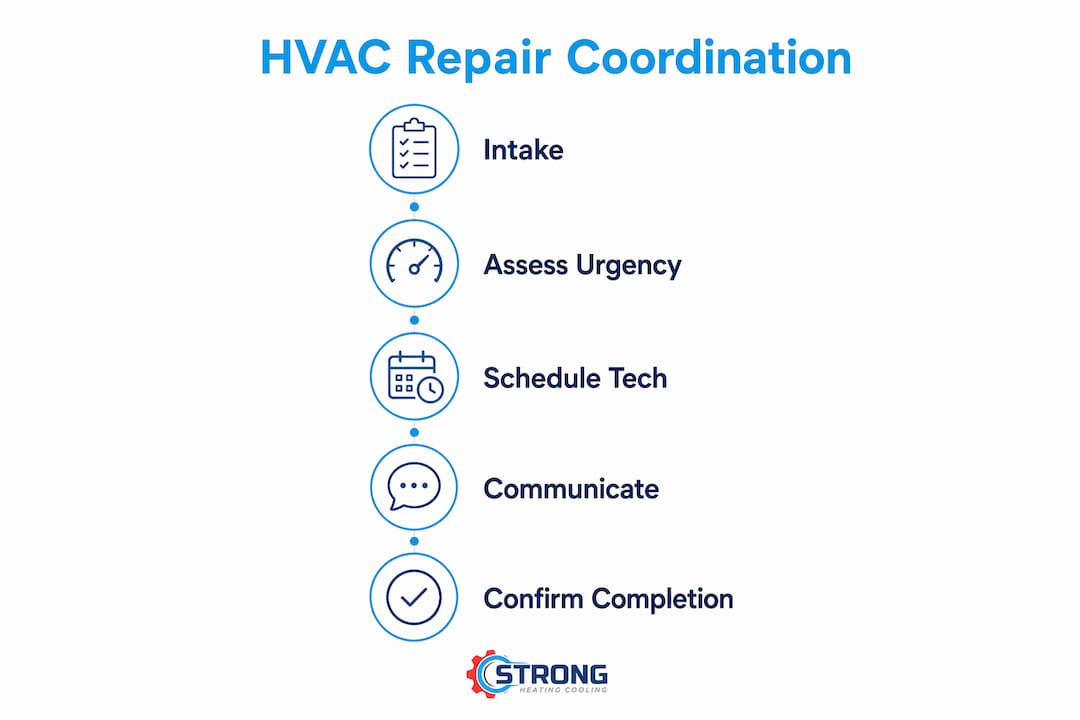
The scheduling process works best when it follows a defined sequence:
- Assign the vendor and confirm availability within the urgency window.
- Notify the tenant of the scheduled appointment window, including the date, time range, and vendor name.
- Send a reminder to the tenant 24 hours before the appointment.
- Confirm vendor arrival with the tenant on the day of service.
- Send a completion message once the vendor marks the job done.
- Follow up with the tenant within 24 hours to confirm the repair fully resolved the issue.
Closing a work order without tenant confirmation causes repeat service calls and lowers satisfaction scores. Step six is the one most managers skip, and it is the one that generates the most callbacks. A short message asking “Did the repair fully resolve your issue?” takes seconds to send and prevents hours of rework.
Structured update workflows, including event-based and time-based notifications, reduce tenant frustration and manager workload. Event-based updates fire automatically when a status changes: appointment scheduled, vendor en route, repair completed. Time-based updates fire on a schedule if no status change has occurred, reassuring the tenant that the issue has not been forgotten. Together, these two update types cover the full communication gap between intake and resolution.
Pro Tip: Build a library of five or six message templates covering the most common update types: acknowledgment, appointment confirmation, delay notice, completion, and follow-up check-in. Reusing templates reduces manager effort and keeps your tone consistent across every tenant interaction.
How do you handle common challenges when managing HVAC repairs across multiple units?
Even well-run coordination processes hit obstacles. Tenant refusals, scheduling conflicts, and communication breakdowns are the three most common. Each has a reliable solution.
Tenant refusals happen more often than most landlords expect. The most effective approach is to frame repairs as tenant benefits rather than legal obligations. A message that says “We want to make sure your heating system is running safely before temperatures drop” lands differently than one that references lease clauses. When a tenant refuses access after reasonable notice, document the refusal in writing and inform the tenant that they may bear financial responsibility for damages caused by the delay. That documentation protects you legally and often prompts cooperation.
Scheduling conflicts across multiple units require batching and buffer time. Group routine maintenance visits by building or floor when possible. This reduces technician travel between units and allows one visit to address several low-priority items at once. Build buffer time into every appointment window. A 30-minute buffer between appointments prevents one delayed job from cascading into a full day of missed windows.
Access issues are a separate problem from refusals. Sometimes tenants are simply unavailable during the scheduled window. Offering two or three appointment options at intake, including one evening or weekend slot, significantly improves access rates without requiring special accommodations.
Troubleshooting tips for common coordination challenges:
- Never close a work order based on the vendor’s report alone. Always confirm with the tenant directly.
- If a repair requires a second visit, notify the tenant before the first visit ends so they are not surprised.
- Keep a log of every tenant communication related to a repair, including dates, times, and content.
- When a delay occurs, notify the tenant proactively rather than waiting for them to call.
- Batch filter replacements and seasonal tune-ups across all units in a single scheduled day to minimize disruption.
- Avoid scheduling non-emergency repairs during early morning or late evening hours without tenant consent.
Communication dos and don’ts:
- Do confirm every appointment in writing, even if you also called.
- Do send a delay notice the moment you know a vendor will be late.
- Do not assume a repair is complete because the vendor said so.
- Do not send repair notices that read like legal warnings. Plain, friendly language works better.
- Do not leave a work order open indefinitely. Set a maximum resolution window for each urgency level and escalate if it is not met.
Key Takeaways
Effective HVAC repair coordination requires structured intake, clear urgency triage, proactive tenant communication, and confirmed work order closure at every stage.
| Point | Details |
|---|---|
| Acknowledge requests within 2 hours | Early acknowledgment eliminates 80% of repeat tenant calls during active repairs. |
| Use urgency categories | Classify every request as emergency, urgent, or routine to set correct response timelines. |
| Confirm repairs with tenants | Never close a work order without asking the tenant if the issue is fully resolved. |
| Pre-vet your HVAC vendors | Contractors familiar with multi-family settings reduce costs, trips, and tenant friction. |
| Automate status updates | Event-based notifications raise tenant satisfaction scores and reduce manager workload. |
What I have learned about HVAC coordination after years in the field
The property managers who handle HVAC repairs well share one habit: they treat communication as part of the repair, not an afterthought. The technical fix matters, but the tenant’s experience of the process matters just as much. A repair completed in 48 hours with no updates feels slower to the tenant than one completed in 72 hours with three clear messages along the way.
The second thing I have seen consistently is that vendor relationships determine outcomes more than any software tool. A contractor who knows your properties, respects your tenants, and stocks common parts for your equipment types will outperform a cheaper contractor who shows up unprepared every time. That relationship takes time to build, but it pays off in fewer callbacks, faster resolutions, and tenants who feel cared for.
The third lesson is harder to accept: most repeat service calls are caused by premature work order closure. Managers close the ticket when the vendor reports the job done. The tenant discovers the issue persists. A new request opens, a new vendor is dispatched, and the cycle repeats. One follow-up message to the tenant after every repair breaks that cycle entirely. It is the lowest-effort, highest-impact change any property manager can make to their coordination process.
Technology helps, but it does not replace judgment. Automated notifications, intake forms, and scheduling tools all reduce friction. They do not replace the decision to call a tenant directly when something goes wrong, or the judgment to escalate an urgent issue before it becomes an emergency. The best coordination systems are built around people, with technology filling in the gaps.
— Owner
How Strongheatingandcooling supports landlords with HVAC service coordination
Property managers in Colorado Springs and surrounding communities rely on Strongheatingandcooling for heating repairs and maintenance that fit the demands of multi-unit rental properties. With over 40 years of combined industry experience, the team understands the scheduling pressures, tenant communication requirements, and cost controls that landlords face every day.

Strongheatingandcooling provides repair dispatch, seasonal maintenance planning, and cooling system services for rental properties of all sizes. The team communicates directly with property managers, keeps records organized, and follows through on every job until the tenant confirms the issue is resolved. If you manage rental properties in the Colorado Springs area and want a reliable HVAC partner who understands your workflow, contact Strongheatingandcooling to schedule a consultation.
FAQ
What does coordinating HVAC repairs between tenants mean?
Maintenance coordination is the process of managing tenant repair requests, scheduling vendors, and communicating status updates across all parties in a rental property. It covers everything from the initial tenant request to confirmed work order closure.
How quickly should a property manager respond to an HVAC repair request?
The industry standard is to send an initial acknowledgment within two hours of receiving any repair request. This single step reduces repeat tenant calls by 80% during the repair process.
What is the best way to handle a tenant who refuses HVAC repair access?
Frame the repair as a benefit to the tenant’s comfort and safety rather than a legal requirement. Document any refusal in writing and inform the tenant of potential financial responsibility for damages caused by denied access.
How do automated notifications improve HVAC repair coordination?
Automated status notifications raise tenant satisfaction to 4.1 out of 5, compared to 2.8 out of 5 with manual communication. Event-based updates sent at each repair milestone reduce tenant frustration and manager workload simultaneously.
Why should landlords pre-vet HVAC contractors before emergencies occur?
Pre-vetted contractors who know your properties and tenant expectations deliver faster, more cost-effective service. Waiting until an emergency to find a vendor consistently results in higher costs and lower service quality.
Recommended
- A Facility Manager’s Guide to Planned HVAC Maintenance | Strong Heating And Cooling
- Residential HVAC Maintenance Guide | Strong Heating And Cooling
- Preventive HVAC Maintenance Schedule for Homeowners | Strong Heating And Cooling
- HVAC Repair vs Replace: How the Decision Works | Strong Heating And Cooling
Need expert HVAC help?
Colorado Springs' trusted, veteran-owned heating & cooling team — same-day service.