

Comparing HVAC Service Quotes: Colorado Springs Guide
TL;DR:
- Comparing HVAC service quotes involves evaluating equipment details, costs, and warranty terms to avoid unexpected expenses. A complete proposal must be itemized, matching system specifications and including permit, labor, and disposal costs. Homeowners should verify load calculations, local rebate opportunities, and contractor experience to ensure accurate pricing and system performance.
Comparing HVAC service quotes is the process of evaluating multiple contractor proposals side by side to assess equipment specifications, labor costs, permit fees, warranty terms, and total scope of work before committing to any installation or replacement. Most homeowners focus only on the bottom line, but that approach regularly leads to unexpected costs and underperforming systems. Homeowners who compare at least 3 quotes save an average of 23% on overall project cost. That savings potential makes a structured comparison process one of the most practical steps you can take before signing any HVAC contract in Colorado Springs.
What should a complete HVAC service quote include?
A complete HVAC quote is an itemized document, not a single number on a page. The industry term for a properly structured proposal is a “line-item bid,” and it gives you the transparency needed to evaluate what you are actually buying. Lump-sum quotes with no breakdown are a clear red flag. A quote listing “$12,500 installed” with no specifics obscures every cost driver and opens the door to change orders after work begins.
Equipment details
Every quote should name the specific equipment brand, model number, and efficiency rating. For cooling systems, look for the SEER2 rating, which is the current federal efficiency standard. For heating, check the AFUE percentage. Brands like Carrier, Trane, Lennox, and Bryant all manufacture equipment across a wide efficiency range, so knowing the exact model matters. A quote that says “high-efficiency air conditioner” without a model number is not a complete quote.
Labor and permit costs
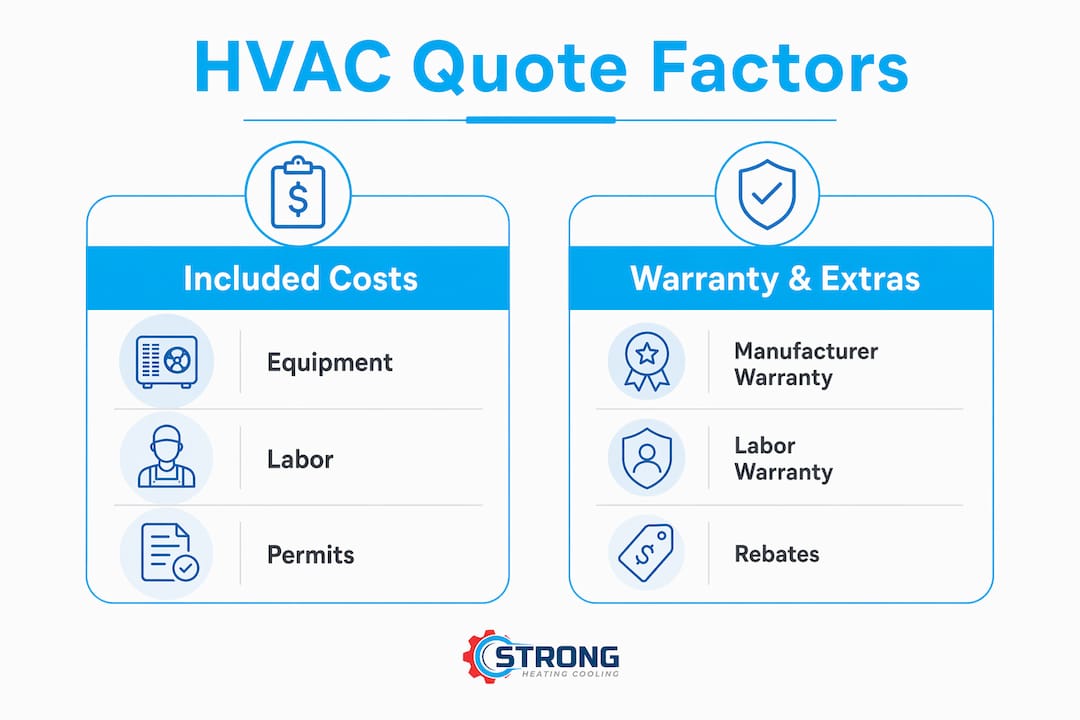
Labor typically accounts for 25–35% of the total HVAC project cost. Two-person crews in Colorado Springs generally bill $80–$150 per hour fully loaded, and a standard equipment swap runs 6–12 labor hours. More complex jobs involving ductwork modifications or attic installations can run 1–3 days. Permit fees in most Colorado Springs jurisdictions add $100–$400 to the total. These costs should appear as separate line items, not buried inside a single installation figure.
Warranty terms
Manufacturer parts warranties from brands like Carrier, Trane, and Lennox typically cover 10–12 years, but registration within 60–90 days of installation is required to activate full coverage. Labor warranties vary widely, ranging from 1 to 10 years depending on the contractor. Understanding why HVAC warranty matters before you sign protects you from unexpected repair costs down the road.
The table below summarizes the key line items you should see in any complete proposal.
| Quote Line Item | What to Look For | Typical Range |
|---|---|---|
| Equipment (brand, model, SEER2/AFUE) | Exact model number and efficiency rating | Varies by system type |
| Labor (hours and rate) | Hours estimated, hourly rate, crew size | $80–$150/hr, 6–12 hours |
| Permit and inspection fees | Contractor-pulled, listed separately | $100–$400 |
| Materials and ancillary parts | Refrigerant, line sets, disconnect, pad | Itemized per component |
| Manufacturer parts warranty | Years covered, registration deadline | 10–12 years with registration |
| Labor warranty | Years covered, transferability | 1–10 years |
| Startup and testing | Included or excluded, clearly stated | Should be included |
Pro Tip: Ask every contractor to send the quote in writing before your follow-up call. Verbal quotes are impossible to compare accurately and give you no protection if the scope changes after work begins.
How to do an apples-to-apples HVAC quote comparison
An apples-to-apples comparison means you are evaluating the same system size, efficiency level, and scope of work across every quote you receive. Comparing only brand names is not enough. True comparison requires matching system tonnage, SEER2 ratings, and every element of the scope before drawing any conclusions about price.
Follow these steps to put your quotes on a level playing field.
- Confirm system tonnage and efficiency ratings match across all quotes. A 3-ton, 16 SEER2 system is not the same value as a 3-ton, 14 SEER2 system, even if the brand is identical.
- Verify that each quote includes permit pulling by the contractor. Owner-builder permits void equipment warranties and can expose you to insurance denial if an installation issue causes property damage.
- Check whether old equipment removal and disposal are included. Some contractors exclude haul-away fees, which can add $100–$200 to your actual cost.
- Confirm startup, commissioning, and testing are listed. A system that is installed but never properly tested can run inefficiently from day one.
- Look for ductwork assessment or adjustment costs. If one contractor includes duct sealing and another does not, the lower quote may not reflect the full job.
The comparison table below shows how two quotes for the same job can look very different once you break them down.
| Scope Item | Quote A | Quote B |
|---|---|---|
| Equipment model and SEER2 | Carrier 24ACC636, 16 SEER2 | Carrier 24ACC636, 14 SEER2 |
| Permit pulled by contractor | Yes | Not listed |
| Old unit removal and disposal | Included | Not included |
| Startup and testing | Included | Not included |
| Labor warranty | 2 years | 1 year |
| Total quoted price | $7,800 | $6,900 |
Quote B looks $900 cheaper. Once you add permit fees, disposal, and the lower efficiency unit, the real cost difference shrinks or reverses entirely.
Proper Manual J load calculations and duct static pressure measurements are pre-quote steps that determine correct system sizing. Ignoring these leads to premature equipment failure and higher energy bills despite a lower initial price. Ask every contractor whether they performed a load calculation before sizing the system. If they guessed based on square footage alone, that is a problem worth addressing before you accept any proposal.
You can also use an HVAC installation cost calculator to build a baseline estimate before your contractor meetings. Having a reference number helps you recognize when a quote is unusually high or suspiciously low.
Pro Tip: Create a simple spreadsheet with each contractor’s name across the top and every scope item down the left column. Fill in each cell as you review the quotes. Gaps in a column tell you exactly what questions to ask.
What local factors in colorado springs affect your quote?
Colorado Springs presents specific conditions that influence HVAC pricing and system selection in ways that a national cost average will not capture. Understanding these factors helps you evaluate quotes more accurately and avoid paying for the wrong system.
Labor rates in the Colorado Springs metro area reflect a competitive but specialized market. Two-person installation crews typically bill within the $80–$150 per hour range, and the complexity of your home’s layout directly affects how many hours a job requires. A straightforward garage furnace swap takes far less time than a system replacement in a finished basement with limited access. Contractors who give you a flat price without assessing your home’s layout are estimating, not quoting.
Permit requirements in El Paso County and the City of Colorado Springs require licensed contractors to pull mechanical permits for HVAC installations. This is not optional. A contractor who suggests you pull the permit yourself to save money is putting your warranty and your homeowner’s insurance at risk. Hidden cost drivers like permit fees and inspection scheduling are worth understanding before you compare final numbers.
Colorado Springs sits at roughly 6,035 feet in elevation, and the climate swings from hot, dry summers to cold winters with occasional extreme cold snaps. That range means your system needs to be properly sized for both heating and cooling loads. A contractor who sizes your system based on a Denver home’s specs or a national average is not accounting for your actual conditions. Altitude affects equipment performance, and a load calculation done for your specific home and elevation is the only reliable sizing method.
Utility rebate programs through Black Hills Energy and Colorado Springs Utilities occasionally offer incentives for high-efficiency equipment upgrades. These rebates can reduce your net cost by several hundred dollars. A contractor who is familiar with local programs will mention these in the proposal. If none of your quotes reference available rebates, ask directly whether your chosen equipment qualifies.
What questions should you ask before accepting any quote?
The right questions separate contractors who know their work from those who are simply competitive on price. Asking these questions before you accept any proposal gives you the information needed to make a confident decision.
Ask how the contractor determined the system size. The correct answer is a Manual J load calculation based on your home’s square footage, insulation levels, window area, and local climate data. An answer like “we use square footage as a rule of thumb” is not sufficient. Load calculations and airflow analysis are the foundation of correct sizing, and skipping them leads to systems that cycle too frequently, wear out faster, and cost more to operate.
Ask who is responsible for warranty registration. Manufacturer warranties from Carrier, Trane, Lennox, and Bryant require registration within a specific window after installation, often 60–90 days. If the contractor does not register the equipment on your behalf, you may end up with a shorter warranty than you expected. Confirm in writing who handles registration and when it will be completed.
Ask whether the permit is included in the quoted price and who pulls it. The contractor should pull the mechanical permit. Confirm that the permit fee is listed as a line item in the quote, not absorbed into a vague installation charge.
Ask about the labor warranty length, what it covers, and whether it transfers to a new owner if you sell the home. A one-year labor warranty is standard at the low end. Contractors who offer two years or more are signaling confidence in their installation quality.
Watch for red flags that suggest a contractor is not operating transparently. High-pressure tactics like “today-only” pricing or verbal quotes without an in-home assessment are signs to walk away. A reputable contractor will give you time to review a written proposal and will not pressure you into a same-day decision.
Pro Tip: If a contractor refuses to provide a written, itemized quote after an in-home visit, treat that as a disqualifying factor. Transparency at the quote stage reflects how the contractor will communicate throughout the entire job.
Reviewing HVAC service contracts alongside your installation quotes also helps you understand what ongoing maintenance coverage looks like after the system is installed.
Key takeaways
Evaluating HVAC service quotes accurately requires matching equipment specs, scope of work, permit responsibility, and warranty terms across every proposal before comparing prices.
| Point | Details |
|---|---|
| Demand line-item bids | Lump-sum quotes hide costs and lead to change orders; always request itemized proposals. |
| Match specs before comparing price | Confirm tonnage, SEER2 rating, and full scope match across all quotes before evaluating cost. |
| Verify contractor-pulled permits | Owner-builder permits void manufacturer warranties and can trigger insurance claim denials. |
| Ask about load calculations | Manual J sizing is the only reliable method; square-footage guessing leads to premature failure. |
| Factor in local rebates | Black Hills Energy and Colorado Springs Utilities offer efficiency rebates that reduce net cost. |
What i’ve learned after years of watching homeowners compare quotes
The single most common mistake I see is treating the lowest number as the best answer. A quote that comes in $1,500 below the others almost always reflects something missing from the scope, a lower-efficiency unit, or a contractor who plans to make up the difference in change orders once the job is underway. The price is not the proposal. The proposal is everything behind the price.
The second mistake is not asking about warranty registration. I have spoken with homeowners who assumed their 10-year parts warranty was active, only to discover the contractor never registered the equipment. They were left with a standard 5-year warranty instead, which is a significant difference when a compressor fails in year seven. This is a detail that costs nothing to confirm upfront and can save thousands later.
What actually works is building a side-by-side comparison before you make any calls. Write down every scope item you expect to see in a complete quote, then check each contractor’s proposal against that list. The gaps tell you more than the totals. A contractor who includes startup, testing, permit fees, and disposal in a mid-range price is often a better value than one who quotes low and excludes half the work.
I also believe strongly in the value of local knowledge. A contractor who works regularly in Colorado Springs understands the permit process, knows the elevation-related sizing adjustments, and is familiar with the rebate programs available through local utilities. That familiarity shows up in the quality of the proposal and the accuracy of the installation. Choosing a contractor based on a national platform review without verifying local experience is a risk that rarely pays off.
— Owner
Get a transparent, itemized quote from Strongheatingandcooling
Strongheatingandcooling provides detailed, line-item proposals for every heating and cooling project in Colorado Springs and surrounding communities. With over 40 years of combined industry experience, the team sizes systems using proper load calculations, pulls all required permits, and registers manufacturer warranties on your behalf. Every quote includes equipment specifications, labor hours, permit fees, and warranty terms so you can compare with confidence.
Whether you need a new furnace, a full system replacement, or a cooling upgrade, Strongheatingandcooling delivers honest pricing and quality workmanship without financial pressure. Explore heating installation in Colorado Springs or get a quote for cooling services to see exactly what a transparent HVAC proposal looks like.
FAQ
How many HVAC quotes should i get before deciding?
Get at least three quotes. Comparing three or more proposals saves homeowners an average of 23% on total project cost and gives you enough data to identify outliers in both directions.
What does seer2 mean on an HVAC quote?
SEER2 is the current federal efficiency rating standard for cooling equipment, replacing the older SEER metric. A higher SEER2 number means lower operating costs, so matching this rating across quotes is critical for an accurate price comparison.
Why does it matter who pulls the HVAC permit?
When a homeowner pulls the permit instead of the licensed contractor, most manufacturer warranties are voided. Owner-builder permits also expose you to insurance claim denials if an installation defect causes property damage.
What is a manual j load calculation?
Manual J is the industry-standard method for calculating the correct heating and cooling capacity for a specific home. Skipping this calculation leads to oversized or undersized systems that fail prematurely and cost more to operate.
What is a red flag in an HVAC quote?
A lump-sum quote with no line-item breakdown is the most common red flag. Quotes without itemization obscure labor hours, permit costs, and materials, making accurate comparison impossible and leaving you exposed to unexpected charges.
Recommended
- Reading HVAC Contractor Reviews: A Colorado Springs Guide
- HVAC Services in Colorado Springs, CO | Install, Repair & Maintenance | Strong Heating & Cooling
- Colorado Springs HVAC Company - Residential & Commercial HVAC Contractor
- HVAC Company in Colorado Springs, CO | AC, Heating & Water Heaters | Strong Heating & Cooling
Need expert HVAC help?
Colorado Springs' trusted, veteran-owned heating & cooling team — emergency service.