

Top 10 Commercial HVAC Inefficiencies for Facility Managers
TL;DR:
- Most commercial HVAC inefficiencies are operational issues like filters, coils, and controls that are correctable. Addressing these problems can reduce building energy waste by a median 12 percent, often within 72 hours. Proactive maintenance and proper BAS management significantly improve efficiency and extend equipment lifespan.
The ten most common commercial HVAC inefficiencies are clogged filters, dirty coils, duct leakage, faulty controls and scheduling errors, short cycling, economizer and damper faults, refrigerant charge problems, compressor and motor degradation, condensate and drainage failures, and ventilation mismatches. Each one is correctable, and small persistent issues across these categories often account for a median 12% of wasted building energy, according to a study of 151 commercial buildings. The good news: most can be identified and partially addressed within 72 hours without waiting for a full service visit.
72-hour immediate actions for facility teams:
- Walk the mechanical room and note any unusual sounds, odors, or visible moisture around air-handling units (AHUs) and condensate pans.
- Pull and inspect filters on your highest-load units; replace any that are visibly loaded or past their scheduled interval.
- Log into your building automation system (BAS) and verify that occupied and unoccupied schedules are active and accurate for the current season.
- Do a quick visual check of accessible ductwork for disconnected joints, missing insulation, or obvious gaps near AHU connections.
- Open a simple occupant reporting channel (a shared email or work-order form) so comfort complaints reach you before they escalate.
Table of Contents
- What are the most common commercial HVAC inefficiencies, and how do you fix them?
- How do you detect HVAC inefficiencies before they become expensive failures?
- What should your preventive maintenance schedule actually look like?
- When should you repair, and when should you replace?
- Why does proactive maintenance and BAS tuning actually save money?
- How do occupancy patterns affect HVAC efficiency?
- How do design and installation flaws create lasting performance problems?
- What advanced control strategies go beyond basic thermostats?
- How does BAS integration improve HVAC operations?
- Key Takeaways
- What most facility managers get wrong about HVAC efficiency
- Strongheatingandcooling commercial HVAC services for Colorado Springs properties
- Authoritative sources and further reading
- FAQ
What are the most common commercial HVAC inefficiencies, and how do you fix them?
A study of 151 commercial buildings found operation-related opportunities in nearly every building, with a median whole-building annual energy savings of 12% after targeted corrective actions. The problems below are ranked by how frequently they appear and how much energy they typically waste.
Clogged filters
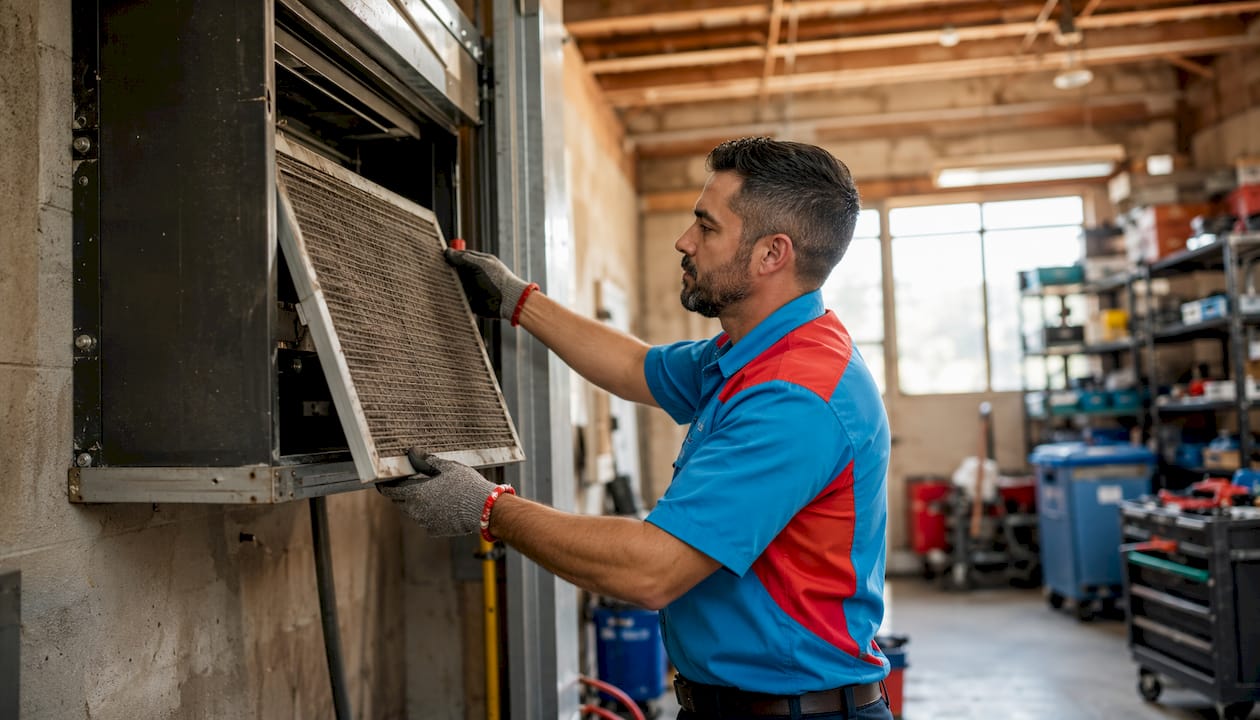
Cause: Filters load with particulates over time, restricting airflow and forcing fans to work harder. Symptoms include reduced supply air volume, rising static pressure alarms, and occupant complaints about stuffiness. The fix is straightforward: establish a filter replacement schedule tied to actual pressure-drop readings rather than calendar dates alone, and document each change with a photo and a pressure reading.
Dirty evaporator and condenser coils
Dirty coils reduce heat transfer efficiency, raise compressor head pressure, and increase energy consumption measurably. You will often see longer run times, higher discharge temperatures, and elevated utility bills before any alarm triggers. Coil cleaning at least twice per year, combined with a coil-condition log, keeps this from becoming a compressor problem.
Duct leakage and insulation loss
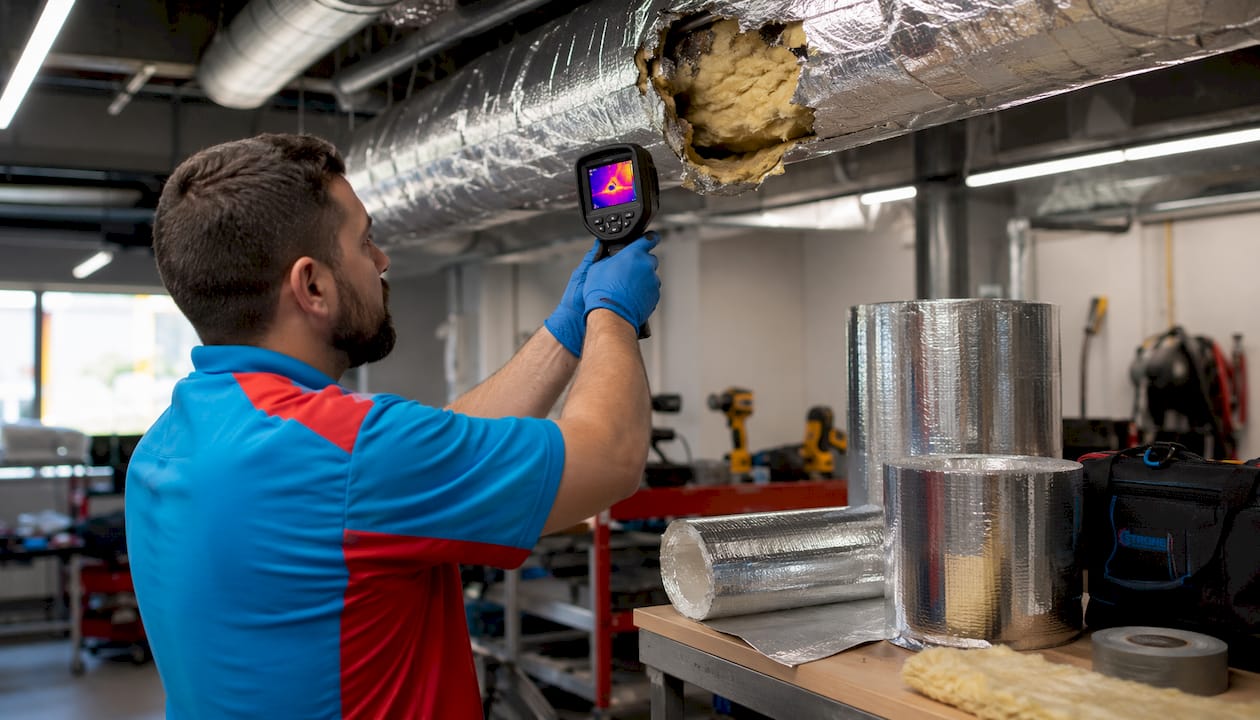
Leaky ducts deliver conditioned air to unconditioned spaces rather than occupied zones. A building with moderate duct leakage can lose a significant share of its conditioned air before it reaches the people paying for it. Duct smoke tests or duct blaster pressure tests identify leaks; mastic sealant or UL 181-rated tape are the correct repair materials.
Control and scheduling errors
Operational drift in schedules, setpoints, and sensor calibration is one of the most common and invisible sources of energy waste. An AHU running on a summer schedule in October, or a zone thermostat with a 10°F deadband, wastes energy continuously without triggering any alarm. Audit BAS schedules at every season change and after any tenant move-in or renovation.
Pro Tip: Check your BAS override log monthly. Persistent manual overrides that were never cleared are a primary driver of long-term inefficiency and are easy to miss during routine inspections.
Short cycling and oversizing
A unit that turns on and off too frequently never reaches steady-state efficiency and accumulates compressor wear faster than normal. Short cycling is often a symptom of oversizing, but it can also result from a refrigerant charge problem or a faulty low-pressure switch. Log cycle counts per hour; more than six cycles per hour on a rooftop unit warrants investigation.
Economizer and damper faults
Economizers are designed to use outdoor air for free cooling when conditions allow, but a stuck or miscalibrated damper can either lock out free cooling or flood the building with unconditioned air. Operational faults in dampers and controls are often invisible until an audit because the unit still appears to run normally. Test damper travel and verify economizer changeover logic at least twice per year.
Refrigerant charge problems
An undercharged or overcharged system operates outside its design envelope, reducing capacity and efficiency while accelerating compressor wear. Symptoms include ice on the suction line, high superheat, or longer-than-normal run times on mild days. Refrigerant work requires a certified technician; document charge levels and leak-check results at every service visit.
Compressor and motor degradation
Compressors and fan motors are the highest-cost components in most commercial systems. Degradation shows up as rising amp draws, reduced capacity, and eventually hard starts or trips. Trending motor amp draw over time, rather than waiting for a failure, gives you a repair-or-replace window before an emergency.
Condensate and drainage failures
Blocked condensate drains cause pan overflow, water damage, and mold growth, and they can trigger safety shutoffs that take a unit offline unexpectedly. Monthly drain-line flush with a dilute bleach solution is a low-cost task that prevents expensive water-damage claims.
Ventilation mismatches and poor IAQ
Supplying more or less outside air than occupancy demands wastes energy and degrades indoor air quality. Demand-controlled ventilation (DCV) using CO₂ sensors adjusts outside air based on actual occupancy, which is particularly valuable in spaces with variable loads like conference rooms and lobbies.
| Inefficiency | Primary Cause | Quick Fix | Typical Energy Impact |
|---|---|---|---|
| Clogged filters | Deferred replacement | Replace; shift to pressure-drop triggers | Moderate fan energy increase |
| Dirty coils | Infrequent cleaning | Bi-annual coil cleaning | Measurable compressor load increase |
| Duct leakage | Age, poor installation | Pressure test; seal with mastic | Significant conditioned-air loss |
| Scheduling errors | Operational drift | BAS schedule audit | Up to 19% annual energy savings when corrected (median building switching from least-efficient to most-efficient AHU shutdown scheme) |
| Short cycling | Oversizing or charge fault | Log cycles; call technician | Accelerated compressor wear |
| Economizer faults | Stuck/miscalibrated damper | Test damper travel twice yearly | Lost free-cooling hours |
| Refrigerant issues | Leaks, improper charge | Certified technician leak check | Capacity and efficiency loss |
| Compressor/motor wear | Age, deferred maintenance | Trend amp draw; plan replacement | Rising energy per ton of cooling |
| Condensate failure | Blocked drain lines | Monthly drain flush | Water damage risk; unit shutoff |
| Ventilation mismatch | Fixed OA rates | Install CO₂-based DCV | Reduced unnecessary ventilation load |
How do you detect HVAC inefficiencies before they become expensive failures?
Early detection depends on measuring the right things consistently, not on waiting for occupant complaints. By the time tenants are uncomfortable, the inefficiency has usually been running for weeks.
Key KPIs to track:
- Delta-T across cooling coils (supply air temperature minus return air temperature): a narrowing delta-T often signals dirty coils or low refrigerant charge.
- Runtime and cycle counts per hour: trending upward runtime on mild days points to a capacity or efficiency problem.
- kWh per square foot per month: a drift of more than 5% from your baseline without a corresponding change in occupancy or weather warrants investigation.
- BAS alarm frequency and override count: rising overrides are a leading indicator of control drift.
- Airflow at key supply registers: a simple anemometer reading takes two minutes and catches duct or filter problems early.
Simple on-site tests your team can run:
- Thermometer delta-T check: measure supply and return air temperatures at the AHU with a calibrated digital thermometer. Compare against design specs.
- Fan amp draw spot-check: use a clamp meter on the fan motor leads. A reading above nameplate amps indicates a restriction or motor problem.
- Visual coil and filter inspection: photograph coil face and filter condition at each inspection; the photo record alone often reveals a trend before measurements do.
- Door and duct smoke test: hold a smoke pencil near accessible duct joints with the system running. Smoke drawn into a joint confirms a leak.
- Condensate pan check: standing water or staining around the pan indicates a drainage problem even before a shutoff occurs.
Condition-based monitoring provides roughly 8–12% additional savings compared with standard time-based preventive maintenance. Placing submeters on your largest HVAC loads and reviewing trend data monthly is the most cost-effective way to catch drift early.
Pro Tip: A nighttime fan runtime report from your BAS is one of the fastest ways to find scheduling problems. If fans are running at full speed at 2 AM in an unoccupied building, you have a scheduling error that is costing money every night.
What should your preventive maintenance schedule actually look like?
Moving from reactive to planned maintenance is the single highest-leverage change most facility teams can make. The schedule below separates what building staff can handle from what requires a licensed technician.
Weekly (building staff):
- Visually inspect filter condition on high-load units and note any unusual sounds or odors.
- Check condensate pans for standing water.
- Review BAS alarms and clear or escalate any active faults.
Monthly (building staff or site technician):
- Flush condensate drain lines with dilute bleach solution.
- Check and log supply air temperatures at representative zones.
- Review BAS override log and clear any overrides that should not be permanent.
- Inspect accessible ductwork connections near AHUs for visible gaps or disconnections.
Quarterly (licensed HVAC technician):
- Replace filters based on pressure-drop readings or at a maximum of 90 days, whichever comes first.
- Inspect and clean coil faces; document condition with photos.
- Test economizer damper travel and verify changeover setpoints.
- Check refrigerant charge and perform a visual leak inspection.
- Verify BAS schedules match current occupancy patterns.
Annual (licensed HVAC technician or commissioning agent):
- Full refrigerant leak check with electronic detector.
- Motor amp draw trending and bearing inspection on all AHU fans.
- Duct leakage test on critical distribution sections.
- Full BAS controls calibration and schedule review.
- Verify AHU shutdown compliance with ASHRAE 90.1 unoccupied requirements.
Pro Tip: Structure every work order to capture before-and-after measurements (filter pressure drop, supply air temperature, motor amps). That data becomes your maintenance ROI record and makes budget justification straightforward when you need capital approval.
For a deeper look at building a maintenance program, the facility manager’s guide to planned HVAC maintenance covers vendor management and documentation in detail.
When should you repair, and when should you replace?
The $5,000 rule is a widely used decision heuristic: if the cost of a repair exceeds $5,000 and the unit is more than halfway through its expected service life, replacement typically delivers better long-term value than the repair. The rule is a starting point, not a formula. It works best for self-contained units like rooftop packaged systems; for large chillers or central plant equipment, the math needs to account for remaining useful life more carefully.
A simple repair-vs-replace framework:
- Estimate the repair cost from a licensed technician.
- Multiply the repair cost by the unit’s age divided by its expected life (typically 15–20 years for commercial rooftop units, 20–25 years for chillers).
- If that product exceeds 50% of the replacement cost, replacement is usually the better financial decision.
- Factor in the efficiency gap: a 15-year-old unit running at 60% of its rated efficiency versus a new unit at 95%+ efficiency generates measurable annual savings that shorten the payback period on replacement.
Signals that favor replacement over repair:
- The unit has had two or more major repairs in the past three years.
- Refrigerant type is R-22 (phased out; replacement refrigerant costs are high and supply is limited).
- The unit is beyond its expected service life and parts availability is declining.
- Emergency repair premiums have been paid more than once in 12 months.
- A performance gap analysis shows the unit is operating well below its rated COP even after servicing.
Emergency repairs often carry labor premiums of 2–3x standard rates and may shorten the useful life of major assets like chillers and boilers by 25–40%. That premium alone often justifies a planned replacement over a reactive one.
For budget planning on replacement, the HVAC pricing calculator gives a starting cost range based on system type and size.
Why does proactive maintenance and BAS tuning actually save money?
The evidence here is clear and consistent. Analysis of 151 commercial buildings found that scheduling and zone-control fixes had implementation rates of roughly 60% and 50% respectively, making them the highest-probability, lowest-cost wins available to most facility teams. AHU and hot-water opportunities followed at over 40% implementation rates.
Only 23% of AHUs fully comply with ASHRAE 90.1 unoccupied shutdown requirements. Modeling shows that switching from the least-efficient to the most-efficient AHU shutdown scheme can yield 19% annual energy savings for the median building. That is a scheduling change, not a capital project.
Reactive maintenance is also a financial trap. Shifting to at least 70% planned work is an industry best practice for optimizing both cost and equipment life. The cost difference between planned and reactive maintenance compounds over time as reactive repairs accelerate wear on adjacent components.
Practical KPIs to set for your program:
- Planned-to-reactive maintenance ratio: target 70% or more of all work orders as planned.
- AHU scheduling compliance: target 100% of units compliant with ASHRAE 90.1 unoccupied shutdown.
- Filter replacement compliance: 100% of units replaced at or before pressure-drop threshold.
- BAS override count: track monthly and target a downward trend quarter over quarter.
Pro Tip: Log your planned-to-reactive ratio in your CMMS every month. A ratio below 50% planned work is a reliable predictor of a major unplanned failure within 12 months. The ratio alone can make the case for a maintenance contract to building ownership.
How do occupancy patterns affect HVAC efficiency?
Building occupancy is one of the most underused inputs in commercial HVAC control. A system sized and scheduled for a fully occupied office building running the same schedule on a weekend or a half-staffed holiday week wastes a predictable and avoidable amount of energy.
Variable occupancy spaces like conference rooms, training centers, and lobbies are the highest-impact targets. A conference room that holds 80 people twice a week but receives full ventilation and conditioning 60 hours a week is a common source of unnecessary energy use. CO₂-based demand-controlled ventilation addresses this directly by modulating outside air to actual occupancy rather than design-maximum assumptions.
Tenant behavior also matters. After-hours HVAC requests, propped-open doors in conditioned corridors, and portable space heaters all create loads the central system was not designed to handle. A simple after-hours HVAC request policy, combined with BAS logging of after-hours runtime, gives facility teams visibility into these patterns.
How do design and installation flaws create lasting performance problems?
A system that was improperly commissioned at installation can underperform for its entire service life, regardless of how well it is maintained. Performance gaps are often due to improper commissioning, suboptimal maintenance, and control calibration errors that reduce real-world efficiency well below rated COP values.
Common installation-era problems that persist for years include oversized equipment (which causes short cycling), undersized ductwork (which creates high static pressure and noise), and improperly located sensors (which cause the system to condition spaces based on inaccurate data). None of these are visible on a maintenance inspection unless someone specifically looks for them.
Retrocommissioning, which is the process of systematically verifying that an existing system performs as originally designed, is the most direct way to find and correct these embedded flaws. It typically costs less than a major repair and often reveals savings that pay back the investment within one to two years.
What advanced control strategies go beyond basic thermostats?
Basic programmable thermostats set a schedule and hold a setpoint. Advanced control strategies actively respond to conditions, occupancy, and grid signals to reduce energy use without sacrificing comfort.
Demand-controlled ventilation (DCV) is the most widely applicable upgrade for variable-occupancy commercial spaces. By using CO₂ sensors to modulate outside air dampers, DCV reduces ventilation energy in proportion to actual occupancy rather than design-maximum assumptions. The DOE’s commercial HVAC technology assessment identifies DCV as one of the higher-impact control upgrades available across commercial building types.
Variable air volume (VAV) systems with pressure-independent zone controllers allow each zone to receive exactly the airflow it needs rather than a fixed volume. When combined with supply air temperature reset, which raises the supply air temperature setpoint during low-load periods, VAV systems can cut fan and cooling energy substantially compared with constant-volume designs.
Fault detection and diagnostics (FDD) software, integrated with the BAS, automatically flags performance deviations like a coil delta-T outside its expected range or a damper that is not responding to commands. FDD moves detection from periodic manual inspection to continuous automated monitoring.
How does BAS integration improve HVAC operations?
A building automation system is only as effective as the quality of its programming, sensor calibration, and operator engagement. Many commercial buildings have a BAS that was installed at construction and has never been fully recommissioned, leaving schedules, setpoints, and sequences that no longer match how the building is actually used.
Effective BAS integration for HVAC operations involves three ongoing practices. First, trend logging: configure the BAS to log supply air temperature, return air temperature, damper position, and runtime for every AHU. Review trends monthly rather than only responding to alarms. Second, sequence-of-operations verification: confirm that the control sequences programmed in the BAS match the current design intent, especially after tenant changes or equipment replacements. Third, alarm rationalization: too many nuisance alarms cause operators to ignore the BAS entirely. Rationalize alarms so that every active alarm represents a real condition requiring a response.
Human factor issues, including persistent manual overrides and poor operator handoff, are primary drivers of long-term inefficiency. A BAS governance policy that requires documented justification for any override lasting more than 24 hours closes this gap without requiring new hardware.
For a practical overview of commercial HVAC best practices that includes BAS management, the Strongheatingandcooling resource library covers the operational side in detail.
Key Takeaways
Proactive maintenance, accurate BAS scheduling, and early detection of operational drift are the three highest-leverage actions for reducing commercial HVAC energy waste and avoiding costly emergency repairs.
| Point | Details |
|---|---|
| Scheduling is the fastest win | Only 23% of AHUs meet ASHRAE 90.1 unoccupied shutdown requirements; fixing schedules can yield up to 19% annual energy savings for the median building. |
| Condition-based monitoring pays | Continuous monitoring provides roughly 8–12% additional savings over time-based preventive maintenance alone. |
| Plan at least 70% of your work | Targeting 70% planned-to-reactive maintenance reduces emergency labor premiums of 2–3x and extends equipment life. |
| Median savings from corrective action | A study of 151 buildings found a median 12% whole-building annual energy savings after targeted operational fixes. |
| Strongheatingandcooling supports commercial teams | Strongheatingandcooling provides commercial audits, planned maintenance contracts, and emergency repair for Colorado Springs area properties. |
What most facility managers get wrong about HVAC efficiency
The conventional wisdom in commercial facilities management is that HVAC efficiency is primarily an equipment problem. Older equipment gets replaced, newer equipment gets installed, and energy bills are expected to drop. The research tells a different story.
The OSTI study of 151 buildings found operational opportunities in nearly every building, most of them unrelated to equipment age. Scheduling errors, stuck dampers, and persistent manual overrides were creating measurable energy waste in buildings with relatively new systems. Replacement alone does not fix a misconfigured BAS or a damper that has been stuck open for two years.
The more useful mental model is to treat your HVAC system as a living program, not a piece of hardware. The hardware matters, but the programming, calibration, and operator habits running on top of that hardware determine whether you get 80% or 100% of the efficiency you paid for. That shift in perspective changes where you invest attention first: schedules and controls before capital, detection before replacement, governance before new equipment.
There is also a tendency to underestimate the compounding cost of reactive maintenance. An emergency repair at 2x or 3x the standard labor rate is painful once. When it happens three times in two years on the same unit, the total cost often exceeds what a planned replacement would have cost, and the building has had the disruption of multiple failures rather than one planned transition.
Strongheatingandcooling commercial HVAC services for Colorado Springs properties
Facility teams in Colorado Springs and surrounding communities have a direct path to proactive HVAC management through Strongheatingandcooling. With over 40 years of combined industry experience, the team provides commercial HVAC audits that identify the specific inefficiencies covered in this article, from scheduling gaps and dirty coils to refrigerant charge problems and economizer faults, and delivers a prioritized action plan with realistic cost ranges.

Planned maintenance contracts are structured around the frequency buckets described above, with documented work orders that give you the audit trail you need for budget justification and capital planning. Emergency repair service is also available for Colorado Springs area properties when an unplanned failure cannot wait. If a unit is approaching the end of its useful life, the team can walk you through replacement options and installation with honest pricing and no pressure. For immediate repair needs, HVAC repair services are available with straightforward scheduling. Contact Strongheatingandcooling to request a commercial audit or discuss a maintenance plan for your property.
Authoritative sources and further reading
The sources below support the claims and guidance in this article. Each is listed with a note on its primary use.
| Source | Best Used For |
|---|---|
| OSTI: Prevalence of typical operational problems (151-building study) | Median 12% savings figure; operational drift prevalence; scheduling and zone-control fix prioritization |
| OSTI: AHU Shutdowns During Unoccupied Hours | 23% AHU compliance figure; 19% savings from shutdown scheme improvement; scheduling fix ROI |
| PNNL: Operations and Maintenance best practices | Condition-based monitoring 8–12% additional savings; planned maintenance program structure |
| PNNL: Prevalence of operational problems (publication) | Implementation rates by opportunity type; scheduling and zone-control fix prioritization |
| DOE: Energy Savings Potential for Commercial HVAC | DCV and advanced control technology savings potential; commercial HVAC energy breakdown |
| Springer Nature: Role of HVAC in building energy consumption | Commissioning and controls gaps; real-world COP vs. rated performance |
| Purdue/IRACC: Energy Impact of Faults in U.S. Commercial Buildings | Operational fault energy impact; why occupant feedback misses control problems |
| Human factor in HVAC operations (academic DOI) | Manual overrides and operator error as efficiency drivers; governance recommendations |
| Preventive vs. reactive maintenance: costs and ROI | Emergency repair labor premiums (2–3x); asset life reduction (25–40%); 70% planned-work target |
| Strongheatingandcooling: Why planned HVAC maintenance reduces repairs and costs | Practical cost savings from planned maintenance; supports $5k rule and repair-vs-replace guidance |
| Strongheatingandcooling: Commercial HVAC efficiency upgrades | Capital upgrade options and quick-ROI projects for commercial properties |
FAQ
What are the most common HVAC problems in commercial buildings?
The most common problems are clogged filters, dirty coils, scheduling errors in the BAS, duct leakage, and economizer or damper faults. Most are operational rather than mechanical failures, which means they are correctable without major capital investment.
What is the $5,000 rule for HVAC?
The $5,000 rule is a decision heuristic: if a repair costs more than $5,000 and the unit is past the midpoint of its expected service life, replacement usually delivers better long-term value. It is a starting point for the decision, not a substitute for a full repair-vs-replace analysis.
What makes a commercial HVAC system inefficient?
The leading causes are operational drift (misconfigured schedules, stuck dampers, persistent manual overrides), deferred maintenance (dirty coils, clogged filters), and installation-era flaws like oversizing or poor commissioning. Equipment age contributes, but operational issues often cause more waste than age alone.
How much energy can fixing HVAC inefficiencies actually save?
A study of 151 commercial buildings found a median 12% whole-building annual energy savings after targeted corrective actions. Fixing AHU scheduling alone can yield up to 19% annual savings for buildings currently running the least-efficient shutdown scheme.
Recommended
Need expert HVAC help?
Colorado Springs' trusted, veteran-owned heating & cooling team — emergency service.