
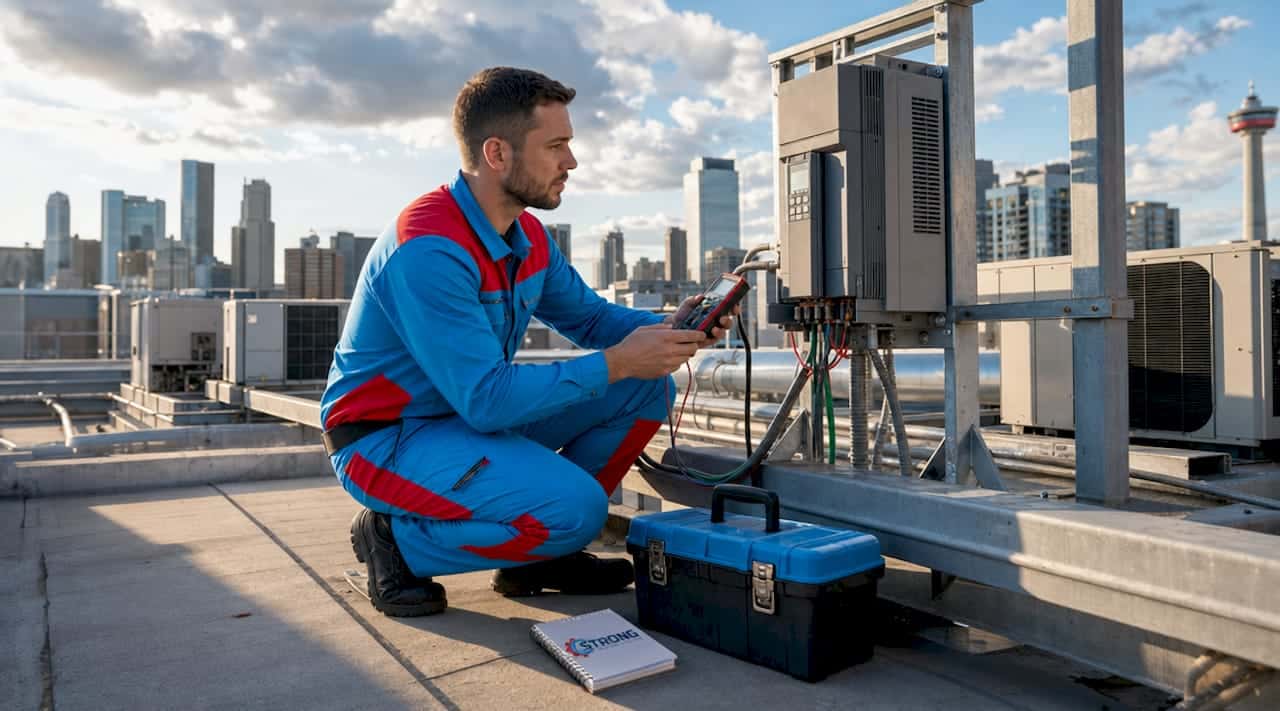
TL;DR:
- Commercial HVAC upgrades focus on efficiency improvements like VFDs, AI-driven controls, and heat pumps that significantly reduce energy use. Implementing operational strategies and leveraging 2026 federal incentives can maximize savings and shorten payback periods. Starting with operational fixes before equipment replacement yields the highest long-term value and faster returns.
Note: the federal Energy Efficient Home Improvement Credit (Section 25C) ended for equipment installed after December 31, 2025, so it no longer applies to new HVAC installations. For the rebates still available to Colorado Springs homeowners, see our 2026 Colorado HVAC rebates guide.
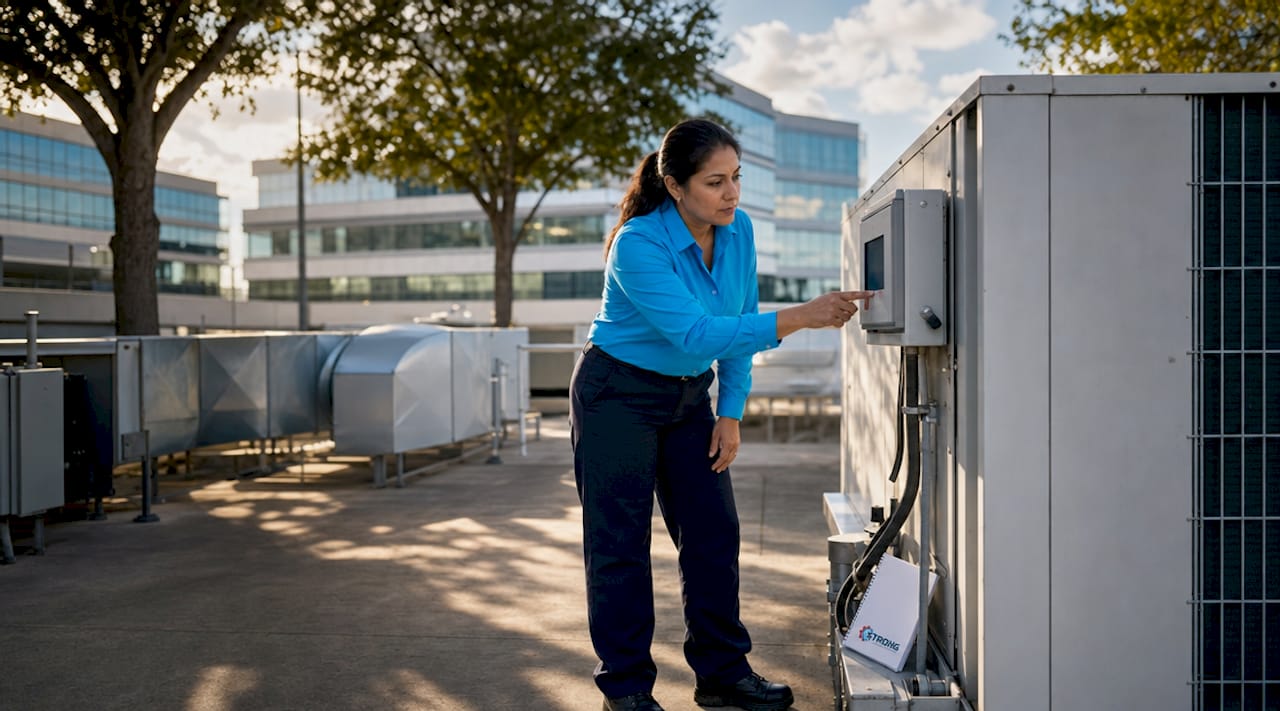
1. Variable frequency drives: the highest-ROI upgrade for most buildings
Variable frequency drives are electronic controllers that adjust motor speed in fans, pumps, and compressors to match actual demand rather than running at full capacity all the time. Most commercial HVAC motors run at 100% speed even when a building only needs 60% of that output. A VFD corrects that mismatch by modulating speed in real time, and because energy use drops with the cube of speed reduction, even a 20% speed reduction cuts energy consumption by nearly 50%.
VFDs are typically the first upgrade to consider when equipment is in good condition but energy bills are high. They require minimal structural changes, integrate with existing systems, and deliver measurable savings within the first billing cycle. The payback period for a VFD installation on a commercial air handler or chiller pump is commonly under three years, making it one of the best hvac upgrades available on a pure return basis.
Pro Tip: Install VFDs on supply and return fans simultaneously. Running only one at reduced speed while the other operates at full capacity creates pressure imbalances that reduce the efficiency gains you would otherwise capture.
2. AI-driven smart controls and building automation systems
AI-driven building automation systems (BAS) represent the most significant shift in commercial HVAC management in the past decade. These systems use machine learning to recalibrate setpoints every 15 minutes based on occupancy patterns, outdoor weather, and internal heat loads. The result is continuous, real-time optimization that no manual schedule can replicate.
One documented case involved a Class A office tower where AI-driven HVAC optimization reduced energy bills by 28% and saved $392,000 annually. The same system reduced occupant comfort complaints by 74%, which is a benefit that rarely appears in energy audits but matters significantly to tenant retention. For property managers overseeing multi-tenant buildings, that combination of cost reduction and comfort improvement is difficult to achieve through any other single upgrade.
A modern BAS from providers like Johnson Controls, Siemens, or Honeywell Building Technologies can integrate with existing HVAC equipment without requiring full system replacement. The controls layer sits on top of your current infrastructure and begins optimizing from day one. This makes smart controls one of the most accessible upgrades for buildings with aging but functional mechanical systems.
3. Heat pump retrofits for commercial buildings
Heat pump retrofits replace or supplement conventional gas or electric resistance heating with systems that move heat rather than generate it, which is fundamentally more efficient. Commercial-grade heat pumps, including water-source and ground-source (geothermal) configurations, can deliver three to four units of heating or cooling energy for every unit of electricity consumed.
Operational readiness is critical to sustaining the efficiency gains from a heat pump retrofit. Structured preventive maintenance, including refrigerant checks, coil cleaning, and controls calibration, must be in place before and after installation to protect the investment. Properties that skip this step often see efficiency degrade within 18 months of installation.
4. When to retrofit vs. when to replace entirely
The retrofit versus replacement decision is one of the most consequential choices a commercial property owner makes, and it is not simply a matter of equipment age. Retrofits with VFDs and controls are ideal when equipment is mechanically sound and can still meet current comfort and code requirements. Full replacement becomes the better path when systems can no longer maintain baseline comfort, fail current energy codes, or carry deferred maintenance costs that exceed the value of the equipment.
A useful rule of thumb: if the cost of repairs over the next two years exceeds 50% of replacement cost, replacement typically delivers better long-term value. Age alone is not the deciding factor. A 15-year-old rooftop unit that has been well maintained and recently had its controls upgraded may outperform a poorly maintained 8-year-old system on both efficiency and reliability. The total cost of ownership calculation, not the purchase price, should drive the decision.
5. Comparing upgrade options: costs, savings, and payback periods
Not every upgrade fits every building. The table below summarizes the most common commercial HVAC efficiency upgrade options, their typical energy savings, estimated payback periods, and key considerations for 2026.
| Upgrade type | Typical energy savings | Estimated payback | Key consideration |
|---|---|---|---|
| Variable frequency drives | 20% to 50% on motor loads | 1 to 3 years | Best when equipment is in good condition |
| AI-driven smart controls / BAS | 15% to 30% total HVAC energy | 2 to 4 years | Integrates with existing equipment |
| Heat pump retrofit | 30% to 50% vs. gas heating | 4 to 12 years | 30% ITC available for geothermal systems |
| Full system replacement | 28% to 60% total energy | 2.2 to 7 years | Required when systems fail codes or comfort |
| Operational schedule optimization | 24% to 35% HVAC energy | No capital cost | Immediate savings with no equipment purchase |
The most important column in that table is the last one. Operational schedule optimization costs nothing and delivers 24% to 35% savings. That makes it the logical starting point before any capital investment, because it also establishes a lower baseline against which equipment upgrades are measured.
6. Operational strategies that amplify every equipment upgrade
Equipment upgrades perform significantly better when paired with smart operational practices. These strategies require no new hardware and can be implemented immediately by any facility manager with access to their building’s controls.
The four most impactful operational changes are:
-
Shortening HVAC schedules to match actual occupancy. Reducing runtime by 32 hours per week cuts HVAC energy waste by 24% to 35% across climate zones. Most commercial buildings run their systems 2 to 4 hours longer than occupancy requires.
-
Widening thermostat deadbands and implementing night setbacks. Expanding the acceptable temperature range from 2 degrees to 4 degrees Fahrenheit reduces compressor cycling and fan runtime. Combined with night setbacks, this produces approximately 7.7% total site energy savings with no capital expenditure.
-
Using optimal start algorithms. These algorithms calculate the minimum runtime needed to bring a building to comfort conditions based on outdoor temperature and building thermal mass. Instead of starting systems at 6:00 AM every day regardless of conditions, the system starts at 7:15 AM on a mild spring morning and 5:30 AM on a cold winter day. The savings accumulate across hundreds of operating days each year.
-
Participating in demand response programs. Peak demand charges represent 30% to 50% of monthly commercial energy bills. Pre-cooling buildings during off-peak hours and allowing temperatures to drift during peak grid periods can cut those charges by up to 50% without purchasing any new equipment.
Pro Tip: Audit your HVAC schedule before investing in new equipment. If your system runs from 6:00 AM to 8:00 PM but your building empties by 5:30 PM, you are paying for 2.5 hours of conditioning empty space every single day.
7. How to leverage 2026 federal incentives and financing
The financial case for commercial HVAC upgrades in 2026 is stronger than it has been in years, largely because of federal incentives that directly offset capital costs.
Utility rebates vary by provider but are widely available across Colorado through Xcel Energy and Black Hills Energy programs. These rebates often cover 10% to 30% of equipment costs for high-efficiency rooftop units, VFDs, and smart controls. Stacking utility rebates with federal incentives is legal and common practice.
C-PACE (Commercial Property Assessed Clean Energy) financing is the option that removes the upfront cost barrier entirely. C-PACE enables 100% project financing for commercial HVAC retrofits, with repayment structured through property tax assessments over 10 to 25 years. The repayment obligation transfers with the property if it is sold, which makes it attractive for owners who are uncertain about their holding period. You can explore HVAC financing options that fit your building’s specific situation before committing to any upgrade path.
8. Real-world results: what documented case studies show
The numbers cited in energy audits and manufacturer spec sheets are often more conservative than what buildings actually achieve. Documented case studies from commercial properties provide a more reliable picture of what to expect.
Philadelphia office buildings that completed full HVAC upgrade programs achieved energy reductions of 28% to 60% depending on the scope of work and baseline conditions. Buildings that combined equipment upgrades with operational changes consistently landed at the higher end of that range.
The Class A office tower case study referenced earlier is particularly instructive. The building did not replace its primary HVAC equipment. It added AI-driven controls to an existing system and captured $392,000 in annual savings. The controls investment paid for itself in under two years, and the 74% reduction in comfort complaints improved tenant satisfaction scores measurably.
“The buildings that achieve the best results are not necessarily the ones that spend the most. They are the ones that combine smart controls with disciplined operational practices and then add equipment upgrades where the data supports it.”
Facility managers who approach upgrades this way, starting with operational fixes and controls before committing to capital equipment, consistently outperform those who lead with equipment replacement. The commercial HVAC retrofit results from buildings that follow this sequence show both faster payback and higher total savings over a 10-year horizon.
One factor that rarely gets enough attention is short-cycling. HVAC short-cycling silently increases energy costs by 20% to 30% and reduces equipment life, but it often goes undetected because it does not trigger alarms until the system fails. Addressing short-cycling through controls calibration or equipment right-sizing is frequently the highest-value fix in a building that has never had a formal energy audit.
Key takeaways
The most effective commercial HVAC efficiency upgrades combine operational schedule optimization, smart controls, and targeted equipment investments to deliver documented energy savings of 28% to 60% with payback periods as short as two years.
| Point | Details |
|---|---|
| Start with operations, not equipment | Shortening schedules and widening deadbands delivers 24% to 35% savings at zero capital cost. |
| VFDs offer the fastest payback | Variable frequency drives typically pay back in 1 to 3 years and work with existing equipment. |
| AI controls multiply every upgrade | Machine learning setpoint recalibration every 15 minutes captures savings no manual schedule can match. |
| Lifecycle cost beats purchase price | Facility directors who focus on total cost of ownership reduce HVAC costs by 20% to 30% more than those who prioritize lowest bid. |
What I have learned after 40 years of commercial HVAC work
After four decades in this industry, the pattern I see most often is property owners who delay upgrades because the upfront cost feels large, then spend far more over time on energy waste and reactive repairs. The math on that trade-off is not close. A building running an unoptimized HVAC system for five years while waiting for the “right time” to upgrade typically spends more in excess energy costs than the upgrade would have cost in year one.
The shift I encourage every property manager to make is from thinking about HVAC as a maintenance line item to thinking about it as a financial asset. A well-optimized system is not just comfortable. It is a source of measurable, recurring cost reduction that shows up on the bottom line every month.
AI-driven controls are the part of this conversation that most property owners underestimate. The idea that a software layer can capture $392,000 in annual savings from an existing system without replacing a single piece of equipment is genuinely surprising to most people. But the case study data supports it, and the technology is now accessible to mid-size commercial buildings, not just large institutional portfolios.
My practical advice is to phase upgrades in a specific sequence. Fix operations first. Add controls second. Then invest in equipment where the data shows the remaining opportunity. That sequence consistently delivers faster payback and higher total savings than leading with a full system replacement. It also gives you a cleaner baseline for measuring what each investment actually contributes.
— Owner
Ready to reduce your building’s HVAC operating costs?
Strongheatingandcooling has spent over 40 years helping commercial property owners in Colorado Springs and the surrounding region get more from their HVAC systems without overspending on equipment they do not need. Whether your building is a candidate for VFD installation, smart controls, a heat pump retrofit, or a full system upgrade, the right path starts with an honest assessment of where your energy is actually going.

Explore the best commercial HVAC upgrades available for your building type and budget, or review cooling services that address both efficiency and comfort. If upfront cost is a concern, Strongheatingandcooling works with financing structures that let you start capturing savings before the project is fully paid off. Contact the team today to schedule a building assessment and find out exactly where your biggest opportunities are.
FAQ
What are the most cost-effective commercial HVAC upgrades?
Variable frequency drives and operational schedule optimization deliver the fastest payback, often under three years, with no structural changes required. AI-driven smart controls rank closely behind, with documented savings of 28% or more on total HVAC energy costs.
How much can commercial HVAC upgrades reduce energy bills?
Documented results show commercial HVAC upgrades reduce energy consumption by 28% to 60% depending on the scope of work and baseline building conditions. Buildings that combine equipment upgrades with operational changes consistently achieve the higher end of that range.
What is Section 179D and does it apply to HVAC upgrades?
Is it better to retrofit or replace a commercial HVAC system?
Retrofitting with VFDs and controls is the better choice when equipment is mechanically sound and meets current comfort and code requirements. Full replacement makes more financial sense when repair costs over two years would exceed 50% of replacement cost, or when the system can no longer maintain baseline comfort.
What is C-PACE financing for commercial HVAC projects?
C-PACE is a financing structure that covers 100% of commercial HVAC retrofit costs, with repayment tied to property tax assessments over 10 to 25 years. It removes the upfront cost barrier and allows buildings to capture energy savings immediately while spreading repayment over the life of the improvement.
Recommended
Need expert HVAC help?
Colorado Springs' veteran-owned heating & cooling team — Mon–Sat, 8 AM–7 PM. Same-day service when available.