

TL;DR:
- Effective commercial HVAC management in 2026 requires strategic practices such as long-term lifecycle analysis, thorough documentation, and AI-driven fault detection to optimize energy use and property value. Building proactive maintenance, continuous commissioning, and occupancy-based control enhances efficiency, while tailoring solutions to building-specific needs reduces operational costs. Partnering with experienced service providers ensures reliable records and proper system functioning, supporting sustainable and compliant facility operations.
Managing a commercial building’s heating and cooling system in 2026 means dealing with aging infrastructure, tightening energy regulations, and the growing pressure to cut operational costs without sacrificing tenant comfort. Adopting the right commercial HVAC best practices is no longer a maintenance checkbox. It is a strategic decision that affects your operating budget, your compliance standing, and the long-term value of your property. This article breaks down 10 proven practices, from foundational maintenance to AI-driven optimization, so you can make confident decisions about your facility’s HVAC strategy.
Table of Contents
- Key takeaways
- 1. Establish a framework for evaluating commercial HVAC best practices
- 2. Build a consistent, proactive maintenance schedule
- 3. Prioritize HVAC documentation as a strategic asset
- 4. Use certified technicians and proper commissioning protocols
- 5. Implement AI-driven fault detection and diagnostics
- 6. Use continuous commissioning to catch system drift
- 7. Integrate occupancy-based conditioning
- 8. Explore model predictive control for peak load management
- 9. Compare traditional versus smart HVAC approaches
- 10. Match best practices to your specific facility
- My perspective on where most facilities actually fall short
- How Strongheatingandcooling supports your commercial HVAC goals
- FAQ
Key takeaways
| Point | Details |
|---|---|
| Lifecycle cost drives decisions | Evaluate HVAC systems over a 20 to 30 year horizon, not just upfront installation cost. |
| Documentation protects your asset | Maintaining inspection logs, repair records, and TAB reports reduces compliance risk and supports capital planning. |
| Smart systems cut measurable waste | AI-based fault detection and occupancy sensing can reduce HVAC energy use by 15 to 30 percent. |
| Early maintenance reduces downtime | Proactive seasonal servicing prevents unscheduled outages during peak demand periods. |
| Match practices to your building | Prioritize upgrades and protocols based on building age, occupancy type, and regulatory requirements. |
1. Establish a framework for evaluating commercial HVAC best practices
Before you invest in any upgrade or shift in maintenance strategy, you need a clear framework for deciding what actually qualifies as a best practice for your specific facility. Not every approach that works in a new Class A office tower translates to a 1980s retail center with mixed-use zones.
The most useful framework centers on six criteria. First, lifecycle cost analysis should be based on net present value over 20 to 30 years, not just the equipment purchase price. A system that costs $30,000 more upfront but saves $4,000 per year in energy and maintenance pays for itself in under eight years. Second, energy performance metrics matter: look at energy use intensity (EUI) per square foot as a benchmark before and after any change.
Third, compliance with current refrigerant regulations and local mechanical codes is non-negotiable. Fourth, maintenance consistency and documentation quality directly affect your warranty coverage, insurance claims, and resale value. Fifth, your system needs to integrate with or at least not conflict with your building management system. Sixth, risk mitigation means knowing which failures cost you the most and protecting against them first.
Pro Tip: Before reviewing any vendor proposal, score it against all six criteria above. A proposal that excels in one area but ignores lifecycle cost or documentation is likely to cost you more over time.
2. Build a consistent, proactive maintenance schedule
Reactive maintenance is always more expensive than preventive maintenance. That is not an opinion. It is the financial reality every facility manager faces after an unplanned chiller failure in July or a heat exchanger failure in January. Preventive maintenance is critical risk management, not just a comfort measure.
A structured maintenance schedule for commercial HVAC should include quarterly filter inspections and replacements, semiannual coil cleaning, annual belt and motor inspections, and pre-season refrigerant checks before summer and winter peaks. For rooftop units, drainage pans and condensate lines need attention every spring to avoid water damage and mold growth inside the unit. For large chillers and air handlers, vibration analysis and oil sampling can detect bearing wear before it becomes a failure.
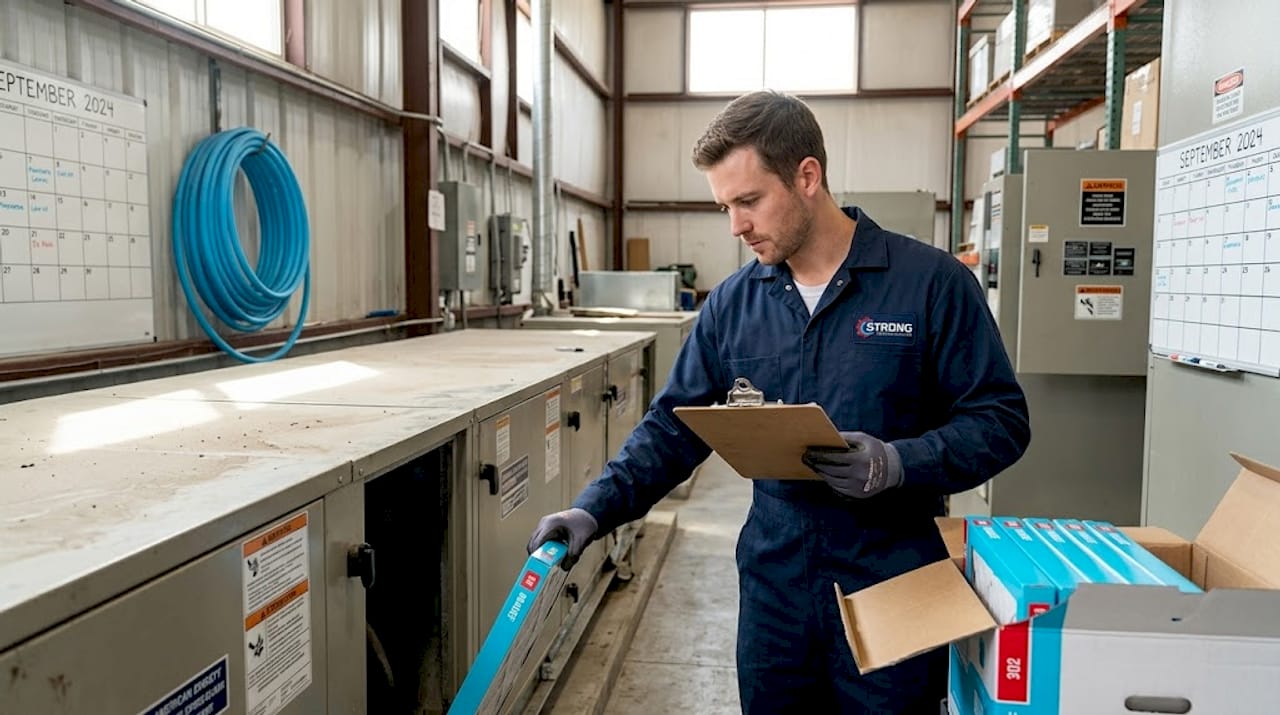
The cadence matters as much as the task list. Facility leaders who complete early season maintenance secure parts and technician availability ahead of peak demand periods, when lead times on compressors and control boards can stretch to weeks. Scheduling your spring HVAC service in February or March, rather than May, is one of the lowest-cost risk management moves you can make.
3. Prioritize HVAC documentation as a strategic asset
Most facility managers know they should keep records. Few treat those records as the strategic asset they actually are. Consistent, thorough HVAC documentation protects your property value, supports insurance claims, simplifies compliance audits, and makes capital planning far more accurate.
A complete documentation system includes equipment inventories with model numbers, serial numbers, and install dates; inspection reports with findings and technician sign-offs; maintenance logs with dates, tasks, and parts used; repair records including the cause of failure; and performance data like supply and return air temperatures and static pressure readings over time. When a tenant files a complaint about air quality or comfort, your documentation is your first line of defense.
Digital recordkeeping is no longer optional for most commercial properties. Cloud-based HVAC management platforms allow you to track service history across multiple units or multiple buildings from a single dashboard. They also make it far easier to pull records during a lease renewal, a refinancing, or a sale.
Pro Tip: Store your HVAC documentation in the same location as your building’s certificate of occupancy and mechanical permits. Auditors and buyers will ask for all of them together.
4. Use certified technicians and proper commissioning protocols
The quality of installation and commissioning work determines the efficiency ceiling of any HVAC system. You can purchase the best equipment available and still operate it at 70 percent of its rated efficiency if the system was never properly commissioned.
Commissioning should verify that every diffuser, grille, and terminal is balanced to within ±10% of design values through a formal testing, adjusting, and balancing (TAB) report. A system that is out of balance wastes energy by overcooling some zones while undercooling others, which also generates more tenant comfort complaints. Third-party TAB technicians certified by AABC or NEBB provide the independent verification that your system is actually performing to specification, not just theoretically capable of it.
For systems connected to building automation, commissioning should also include verifying control sequences against the original design intent. Schedules that no longer match building occupancy, setpoints that were never adjusted after move-in, and sensor drift that went unnoticed for years are all common problems that commissioning catches before they become expensive ones.
5. Implement AI-driven fault detection and diagnostics
AI-based fault detection identifies equipment faults that cause 5 to 30 percent of HVAC energy waste, and those faults often go undetected for months or even years. This is one of the most underpublicized sources of energy cost in commercial buildings. A refrigerant leak causing 15 percent capacity loss, a damper stuck partially closed, or a compressor cycling inefficiently can each cost thousands of dollars per year without triggering any obvious alarm.
Fault detection and diagnostics (FDD) software connects to your building automation system and monitors hundreds of data points simultaneously. It compares actual system behavior against expected performance models and flags deviations before they grow into failures. Think of it as a continuous energy audit running in the background every hour of every day.
The practical barrier for most facility managers is the upfront complexity of integration. The good news is that many FDD platforms now offer cloud-based deployment that connects to existing BAS infrastructure without a full system replacement. Starting with your largest energy consumers, typically chillers, cooling towers, and large air handling units, gives you the fastest return on that investment.
6. Use continuous commissioning to catch system drift
Even a perfectly commissioned system drifts over time. Control sequences get overridden by technicians during service calls. Setpoints get adjusted to handle temporary comfort complaints and never get reset. Sensors fall out of calibration. Over two to three years, these small changes compound into significant efficiency losses.
Continuous commissioning uses real-time data from your building automation system to compare current performance against the original design baseline. When the system detects drift, it flags it for review. Some platforms can automatically correct minor deviations, while others generate work orders for technician review.
This is not the same as monitoring and alarming, which most BAS systems already do. Monitoring tells you when something breaks. Continuous commissioning tells you when something is slowly getting worse before it breaks. That distinction is worth understanding clearly, because it is where most of the hidden energy waste actually lives.
7. Integrate occupancy-based conditioning
One of the most straightforward energy savings in commercial heating and cooling comes from not conditioning space that no one is using. Occupancy sensing integrated into HVAC control can reduce energy use by 15 to 25 percent with no impact on occupant comfort, because the savings come entirely from unoccupied periods.
Modern occupancy-based control goes beyond simple time schedules. It uses CO2 sensors, PIR (passive infrared) motion detectors, and in some cases desk reservation data or badge access logs to build a real-time picture of which zones are occupied. The HVAC system then conditions only those zones, or holds unoccupied zones at setback temperatures until occupancy is detected.
For mixed-use commercial buildings with variable occupancy patterns, such as conference-heavy office environments or retail properties with anchor and inline tenants on different schedules, this type of control can deliver the largest measurable efficiency gains of any single upgrade. The key is granular zoning. A single large VAV box serving an entire floor cannot respond the same way that individual zone-level control can.
8. Explore model predictive control for peak load management
Model predictive control (MPC) is a step beyond reactive control. Instead of responding to current conditions, MPC uses weather forecasts, building thermal mass data, and occupancy predictions to precondition the building before peak load periods arrive.
A practical example: on a forecast high of 95°F, an MPC system begins cooling the building’s thermal mass during early morning off-peak hours, when electricity rates are lower and the cooling load is smaller. By the time occupants arrive and outdoor temperatures climb, the building is already partially pre-cooled. The cooling system runs less during the peak period, which cuts both energy cost and peak demand charges.
For facilities in markets with time-of-use electricity pricing or demand response programs, MPC can reduce peak demand charges by 10 to 20 percent. Those charges often represent 20 to 30 percent of a commercial facility’s total electricity bill, so the savings are not marginal. They show up clearly on your monthly utility statement.
9. Compare traditional versus smart HVAC approaches
Understanding the differences between conventional maintenance-focused HVAC management and smart, data-driven approaches helps you prioritize where to invest.
| Factor | Traditional approach | Smart, AI-enabled approach |
|---|---|---|
| Fault detection | Found during scheduled inspections or after failure | Continuous automated monitoring with early alerts |
| Energy waste | Often hidden for months or years | Identified and quantified in near real time |
| Documentation | Paper logs or basic spreadsheets | Digital records with automated timestamps and trend data |
| Commissioning | One-time at installation | Continuous drift monitoring and correction |
| Technician requirements | General mechanical knowledge | Requires data literacy and BAS familiarity |
| Lifecycle cost impact | Higher due to reactive repairs | Lower through optimized run hours and early fault resolution |
| Tenant comfort | Reactive to complaints | Proactive through occupancy and predictive control |
The traditional approach is not without value, particularly in smaller or simpler buildings where the cost of smart system integration exceeds the savings potential. The right choice depends on your building’s size, complexity, and operational priorities.
10. Match best practices to your specific facility
Not every practice in this list applies equally to every building. A 15,000-square-foot single-tenant office building has very different HVAC priorities than a 300,000-square-foot mixed-use property. Before committing to any upgrade or new protocol, consider where your building actually stands.
Start by assessing your current system’s age and condition. As many as 60 to 70 percent of commercial buildings operate with HVAC controls that no longer match actual building use. If your controls are outdated, fixing that is a higher priority than adding FDD software, because the FDD system needs accurate control data to function properly.
Next, weigh your regulatory exposure. If your building is in a jurisdiction with mandatory benchmarking, carbon reporting, or refrigerant phasedown requirements, compliance-related documentation and system upgrades move to the top of the list. If your primary pressure is operational cost, then occupancy sensing and continuous commissioning will likely deliver the best near-term returns.
- Assess building age and verify controls still reflect actual occupancy patterns
- Identify your three largest energy-consuming HVAC systems and prioritize them
- Review your documentation gaps before your next lease renewal or refinancing
- Plan smart system upgrades in phases, starting with the highest-consumption equipment
- Partner with service providers who can deliver both technical work and written records
Pro Tip: Ask your HVAC service contractor to provide a written system condition report at the end of every maintenance visit, not just an invoice. That one step closes the most common documentation gap in commercial properties.
My perspective on where most facilities actually fall short
I’ve spent years working on commercial HVAC systems across a wide range of building types, and the single most consistent finding is this: most of the problems facility managers deal with are not equipment problems. They are information problems.
A chiller that has been running inefficiently for 18 months is not a chiller problem. It is a documentation and monitoring problem. If you had the data, you would have caught it earlier. If you had the maintenance history, you would know whether the degradation was gradual or sudden. Without that paper trail, you are making decisions based on symptoms rather than causes.
I’ve also seen the reluctance many facility managers have toward trusting AI-driven diagnostics. The concern is understandable. When a software system tells you that your equipment has a fault your technician did not find, it can feel like the software is wrong. What I’ve found is that in most cases, the software is detecting something real that is just too subtle for a quarterly inspection to catch. Trusting those early alerts, and acting on them before they become failures, is where the real cost savings live.
The other thing I’d push back on is the idea that smart HVAC systems are only for large portfolios or new construction. A single building with one aging rooftop unit and a basic BAS can still benefit from digital fault monitoring and better documentation. The barrier is lower than most people think. Start small, document everything, and build from there.
— Owner
How Strongheatingandcooling supports your commercial HVAC goals

Implementing these best practices requires a service partner who brings both technical depth and reliable documentation to every visit. Strongheatingandcooling has over 40 years of combined industry experience serving commercial properties in Colorado Springs and the surrounding region. Whether you need a structured preventive maintenance program, a full commercial cooling service evaluation, or support with smart system integration and commissioning, the team at Strongheatingandcooling delivers the written records and quality workmanship your facility deserves.
For facilities that need to address unexpected failures quickly, emergency HVAC repair is also available to minimize downtime and get your systems back on track. If upfront costs are a concern, Strongheatingandcooling offers financing options that make planned upgrades more manageable without delaying work that affects your building’s performance. Contact the team today to schedule a commercial system assessment and take the first concrete step toward better efficiency and lower operating costs.
FAQ
What is the most overlooked commercial HVAC best practice?
Comprehensive HVAC documentation is consistently the most overlooked practice. Inspection reports, maintenance logs, and repair records protect property value, support compliance, and make capital planning more accurate.
How often should commercial HVAC systems be serviced?
Most commercial systems require quarterly inspections and filter changes, semiannual coil cleaning, and full pre-season service before both summer and winter peaks to maintain reliable performance.
Can AI fault detection work in older commercial buildings?
Yes. Many AI-based fault detection platforms connect to existing building automation systems without requiring full equipment replacement, making them accessible even in older facilities.
What energy savings can occupancy sensing deliver?
Facilities that integrate occupancy sensing into HVAC control typically reduce energy use by 15 to 25 percent, with no reduction in occupant comfort during occupied hours.
Why does commissioning matter after installation?
Proper commissioning verifies that every component is balanced and operating to design specifications, which prevents energy waste, tenant comfort complaints, and premature equipment wear from the first day of operation.
Recommended
Need expert HVAC help?
Colorado Springs' veteran-owned heating & cooling team — Mon–Sat, 8 AM–7 PM. Same-day service when available.