

Choosing a Reliable HVAC Contractor Locally in Colorado Springs
TL;DR:
- Choosing a reliable HVAC contractor in Colorado Springs requires verifying licenses, insurance, and certifications before requesting detailed, written quotes. Online reviews and verification of local presence help identify trustworthy professionals, while long-term maintenance contracts foster ongoing reliability. Thorough vetting, including permit confirmation and clear communication, prevents costly mistakes and ensures quality work.
Choosing a reliable HVAC contractor locally means identifying a licensed, insured professional with verified certifications, consistent reviews, and transparent pricing before any work begins. In Colorado Springs, where winters drop well below freezing and summer heat demands a dependable air conditioner, the stakes of hiring the wrong contractor are high. A poor installation or unqualified repair can void equipment warranties, create safety hazards, and cost you far more in follow-up repairs. This guide walks you through every step of the vetting process, from confirming state licenses to reading between the lines of online reviews, so you can hire with confidence.
What credentials and licenses should a Colorado Springs homeowner verify?
A reliable HVAC contractor holds a valid state contractor license, carries active insurance, and employs technicians with recognized industry certifications. These are not optional extras. They are the baseline requirements that separate qualified professionals from unqualified ones.
Colorado requires HVAC contractors to hold a state mechanical contractor license. You can verify this through the Colorado Department of Regulatory Agencies (DORA) online license lookup. If a contractor cannot provide a license number or asks you to look it up yourself, that is a warning sign worth taking seriously.
Insurance: what to request and why it matters
Insurance protects you, not just the contractor. General liability coverage pays for property damage if something goes wrong during the job. Workers’ compensation covers the technician if they are injured on your property. Without both, you could be held financially responsible for accidents that happen in your own home.

The right way to confirm coverage is to request a Certificate of Insurance directly from the contractor’s insurance agency, not from the contractor themselves. That direct confirmation removes any possibility of a forged or outdated document. Ask for this before any work begins, not after.
Certifications that signal real technical expertise
Years of experience alone do not guarantee quality work. Certifications do. NATE certification is the industry gold standard for HVAC technicians, covering airflow, diagnostics, and electrical systems through rigorous testing. A NATE-certified technician has proven their knowledge in a way that a general experience claim cannot.
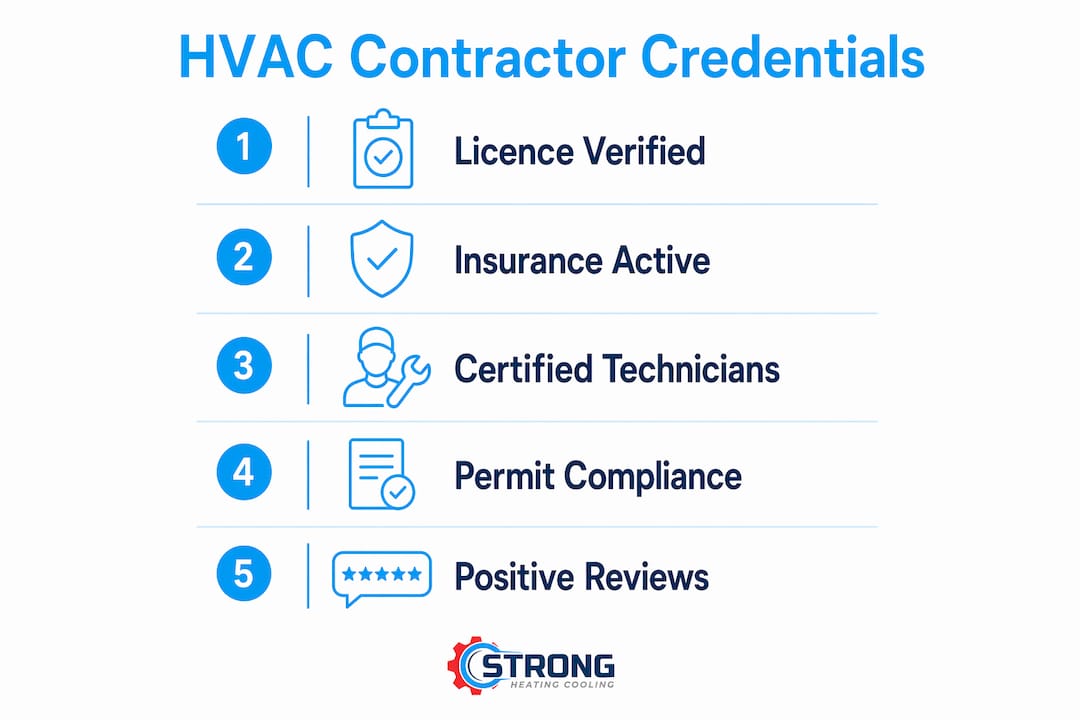
EPA Section 608 certification is also required by federal law for any technician handling refrigerants. If a contractor services or installs equipment containing refrigerant and their technicians lack this certification, the company is operating outside federal regulations. Manufacturer-specific training is a bonus worth asking about, particularly if you are installing a specific brand like Carrier, Trane, or Lennox.
Permits: a non-negotiable part of legitimate HVAC work
Permits protect you long-term. They trigger a city or county inspection that confirms the installation meets local building codes. If a contractor asks you to pull the permits yourself, treat it as a serious red flag. Contractors who avoid pulling permits are often trying to sidestep inspections, which means the work may not meet code and could create problems when you sell your home.
Pro Tip: Ask every contractor upfront: “Will you pull the permits for this job?” A confident yes is the only acceptable answer.
How do online reviews help you find trustworthy HVAC services?
Online reviews are one of the most reliable tools for finding trustworthy HVAC services, but only when you read them with a critical eye. The goal is not to find a contractor with a perfect score. The goal is to find one with a consistent, honest track record.
Experts recommend looking for contractors with at least 50 reviews averaging 4.0 or higher, and avoiding lead-generation or paid placement sites that inflate visibility without reflecting real customer experience. A contractor with 200 reviews averaging 4.2 stars tells you far more than one with 8 reviews averaging 5.0.
Reading the reviews that matter most
Five-star reviews confirm that things went well. Two- and three-star reviews tell you what goes wrong. Mid-tier reviews often reveal patterns in communication failures, unexpected cost additions, or technicians who arrived late without notice. If you see the same complaint repeated across multiple reviews, that is not a coincidence. It is a pattern.
Look specifically for recent reviews that mention punctuality, how the technician communicated during the job, and whether the final price matched the original quote. These three factors predict your experience better than any marketing claim on the contractor’s website.
Verifying that the company is actually local
Not every contractor that appears in a “best HVAC contractors near me” search is genuinely local. Local search results often mix in lead-generation sites, and some companies list Colorado Springs addresses without maintaining a real office there. Drop the company’s address into Google Street View before you call. A legitimate local operation will have a recognizable office, service vehicles, or commercial space. A residential address or a vacant lot is a reason to keep looking.
Personal referrals from neighbors, coworkers, or local community forums like Nextdoor are often more reliable than any review platform. Someone who recently had their furnace replaced and was happy with the result is giving you firsthand, unfiltered feedback.
Pro Tip: Search the contractor’s name alongside “Colorado Springs” on Google and check both the Google Business Profile reviews and the Better Business Bureau listing for any unresolved complaints.
Why do written, itemized quotes protect Colorado Springs homeowners?
Written, itemized quotes are the clearest way to compare contractors fairly and protect yourself from unexpected costs after the job starts. A verbal estimate or a lump-sum number on a napkin gives you no basis for comparison and no protection if the final bill looks different.
Getting at least three written, itemized quotes allows you to compare labor costs, parts, equipment specifications, permit fees, and warranty terms side by side. That comparison often reveals significant differences in what each contractor is actually proposing, not just in price but in the quality of equipment and the scope of work.
What a quality quote includes
A thorough quote lists the equipment model and SEER rating, the labor cost broken out separately from materials, any permit fees, the warranty on both parts and labor, and the expected project timeline. It should also confirm that the contractor will perform a Manual J load calculation. A Manual J calculation determines the correct equipment size for your home based on square footage, insulation, window placement, and local climate data. Skipping this step is one of the most common causes of inefficient systems and premature equipment failure.
Comparing quotes beyond the bottom line
The lowest bid is not always the best value. A quote that comes in $800 lower than the others may be using a lower-efficiency unit, skipping the load calculation, or planning to subcontract the installation to an uncertified crew. Well-crafted itemized quotes help you identify hidden cost differences and quality gaps that a lump-sum bid conceals entirely.
Use Strongheatingandcooling’s HVAC cost calculator to benchmark what a fair installation price looks like in Colorado Springs before you start collecting bids. That context makes it much easier to spot quotes that are either unrealistically low or unjustifiably high.
| Quote element | What to look for |
|---|---|
| Equipment model and SEER rating | Specific brand and model listed, not just “standard unit” |
| Labor cost | Broken out separately from parts and materials |
| Permit fees | Included in the quote, handled by the contractor |
| Warranty terms | Both parts and labor warranty durations stated clearly |
| Manual J load calculation | Confirmed as part of the installation process |
Pro Tip: If a contractor refuses to provide an itemized quote or pressures you to sign before you have reviewed it carefully, walk away. Transparency in pricing is a direct indicator of how the contractor will handle problems after the job is done.
What are common hiring pitfalls when finding local HVAC contractors?
Colorado Springs homeowners face a specific set of risks when hiring local HVAC contractors, and most of them are avoidable once you know what to look for. The contractors who cut corners tend to follow predictable patterns.
The most common red flags include:
- No verifiable physical office in Colorado Springs or the surrounding area
- Pressure to sign a contract or pay a deposit immediately, before you have compared other bids
- Refusal to provide a Certificate of Insurance or a license number
- Asking you to pull the building permits yourself
- Quotes that are vague, verbal, or presented as a single lump sum
- No mention of a warranty on labor or parts
- Technicians who arrive in unmarked vehicles with no company identification
The risk of unlicensed or subcontracted installers
Some contractors win jobs with competitive pricing and then subcontract the installation to piece-rate workers who are paid per job rather than per hour. This creates a financial incentive to finish fast rather than finish correctly. The original contractor may be licensed, but the person doing the work in your home may not be. Ask directly whether the technicians who will perform the installation are employees of the company or subcontractors, and whether they hold NATE certification.
Hiring an unlicensed or uninsured contractor to save money upfront is one of the most expensive decisions a homeowner can make. A failed inspection, a voided equipment warranty, or an injury on your property can cost far more than the difference between a low bid and a fair one.
Response time and emergency availability also matter. Colorado Springs winters are not forgiving. A contractor who cannot respond to a heating failure within a reasonable timeframe is not a reliable partner for your home. Ask about emergency service availability before you sign any agreement. You can also review guidance on avoiding HVAC repair scams to sharpen your awareness of tactics that target homeowners during urgent situations.
How do you build a long-term relationship with your HVAC contractor?
The best time to establish a relationship with a reliable HVAC contractor is before your system breaks down, not during a January emergency. A contractor who already knows your system, its age, and its service history can diagnose problems faster and recommend repairs with more accuracy.
Annual service contracts are the most practical way to formalize that relationship. These contracts typically cost between $150 and $500 per year, depending on system complexity and how many visits are included. That cost covers preventive maintenance that extends equipment life, catches small problems before they become expensive ones, and often includes priority scheduling for repairs.
A reputable maintenance plan from a trustworthy local HVAC provider includes seasonal tune-ups for both heating and cooling systems, filter replacements or reminders, safety checks on components like heat exchangers and electrical connections, and a written report after each visit. If a contractor’s maintenance plan does not include a written summary of what was inspected and what was found, ask for one.
What a solid annual maintenance agreement should cover:
- Fall furnace tune-up before heating season begins
- Spring air conditioner check before cooling season starts
- Inspection of refrigerant levels, electrical connections, and safety controls
- Filter replacement or cleaning
- Priority scheduling for repair calls
- Documented service records for each visit
Clear communication is the other half of a good long-term contractor relationship. A contractor who responds to calls and messages promptly, explains what they found in plain language, and follows through on warranty commitments is worth keeping. You can explore types of HVAC service contracts to understand what different plan structures include and which one fits your system and budget.
Key Takeaways
Choosing a reliable HVAC contractor locally requires verifying licenses, certifications, and insurance before comparing at least three itemized written quotes.
| Point | Details |
|---|---|
| Verify credentials first | Confirm state license, general liability insurance, workers’ comp, and NATE certification before any other step. |
| Read mid-tier reviews carefully | Two- and three-star reviews reveal communication and pricing patterns that five-star reviews often omit. |
| Require itemized written quotes | Get at least three quotes listing equipment, labor, permits, and warranty terms to compare bids accurately. |
| Watch for permit red flags | A contractor who asks you to pull permits is likely avoiding inspections, which creates code compliance risks. |
| Invest in a maintenance contract | Annual service agreements costing $150–$500 extend equipment life and give you a reliable contractor relationship before emergencies arise. |
What I have learned from 40 years of HVAC work in Colorado Springs
The single most reliable predictor of a good contractor is not their price and not their website. It is how they handle the questions you ask before you hire them. A contractor who welcomes your questions about licensing, insurance, and certifications is telling you something important about how they will treat you after the job is done.
I have seen homeowners choose the lowest bid and end up paying twice, once for the original installation and once to fix what was done wrong. The pattern is almost always the same: no permit, no load calculation, and a technician who was not actually employed by the company that answered the phone. The savings at the front end evaporate quickly.
Certifications matter more than most homeowners realize. A technician with NATE certification has passed a standardized test that covers the technical knowledge required to do the job correctly. Years of experience can mean years of repeating the same shortcuts. Certification means someone verified the knowledge independently.
Local accountability is also real. A contractor with a physical office in Colorado Springs, a name in the community, and neighbors who recognize their trucks has something to lose by doing poor work. A contractor who operates out of a call center and subcontracts every job has no such accountability. That difference shows up in the quality of the work and in how quickly they respond when something needs to be corrected.
My honest recommendation is to take the extra time to vet three contractors thoroughly rather than calling one and hoping for the best. The process described in this article takes a few hours. A bad HVAC installation can cost you years of frustration and thousands of dollars in repairs.
— Owner
Why Colorado Springs homeowners trust Strongheatingandcooling
Strongheatingandcooling has served Colorado Springs and surrounding communities for over 40 years of combined experience, with licensed technicians, transparent pricing, and a commitment to honest workmanship on every job.

When you request a quote from Strongheatingandcooling, you receive a fully itemized written bid that covers equipment specifications, labor, permits, and warranty terms. There are no lump-sum surprises and no pressure to sign before you are ready. Whether you need heating installation in Colorado Springs or a scheduled HVAC maintenance plan to protect your system year-round, the team at Strongheatingandcooling is ready to walk you through your options with the clarity and care your home deserves.
FAQ
What licenses should an HVAC contractor in Colorado have?
Colorado HVAC contractors must hold a valid state mechanical contractor license, verifiable through the Colorado DORA online lookup. Technicians handling refrigerants must also carry EPA Section 608 certification by federal law.
How many quotes should I get before hiring an HVAC contractor?
Get at least three written, itemized quotes before committing to any contractor. This gives you a realistic price range and reveals differences in equipment quality, warranty terms, and installation standards.
What is a Manual J load calculation and why does it matter?
A Manual J load calculation determines the correct equipment size for your home based on square footage, insulation, and local climate. Skipping it is a leading cause of inefficient systems and premature equipment failure.
How do I verify that an HVAC contractor is actually insured?
Ask the contractor’s insurance agency to email you a Certificate of Insurance directly. This confirms active general liability and workers’ compensation coverage without relying on documents the contractor provides themselves.
What does an annual HVAC maintenance contract typically cost?
Annual HVAC service contracts range from $150 to $500 depending on system complexity and visit frequency. Most reputable plans include seasonal tune-ups, safety inspections, and priority scheduling for repair calls.
Recommended
Need expert HVAC help?
Colorado Springs' trusted, veteran-owned heating & cooling team — emergency service.