
Winter Thermostat Settings: What Actually Saves Money
Set your thermostat to about 68°F while you’re home this winter, and set it back roughly 7°–10°F for about eight hours (sleeping or away) to save up to 10% a year on heating, according to Department of Energy guidance. That’s the baseline. Comfort preference can push it to around 70°F without losing much efficiency, but a few situations change the math:
- Heat pumps don’t tolerate deep setbacks well. Keep them to approximately 3°–5°F.
- Homes with infants, elderly residents, or someone managing a medical condition should skip aggressive setbacks and monitor comfort directly.
- During extreme cold snaps, avoid letting unoccupied spaces drop below about 55°F, or you risk frozen pipes.
Everything below explains why these numbers work and how to apply them to your actual routine.
Key Takeaways
The most reliable winter thermostat strategy combines a 68°F daytime baseline with a 7°–10°F setback for roughly eight hours, adjusted down to 3°–5°F for heat pumps.
| Point | Details |
|---|---|
| Set a 68°F daytime baseline | Comfort can stretch this to 70°F without a major efficiency hit. |
| Use setbacks strategically | Drop 7°–10°F for about eight hours while asleep or away to capture up to 10% annual savings. |
| Adjust for heat pumps | Keep setbacks to around 3°–5°F to avoid triggering costly auxiliary heat. |
| Manage humidity, not just temperature | Keeping indoor humidity between 30% and 50% makes lower settings feel warmer. |
| Fix placement and fan settings first | Mount thermostats on interior walls and run the fan on AUTO before assuming a system problem. |
Table of Contents
- Best Thermostat Settings for Winter by Situation
- How to Program Your Thermostat for Winter Savings
- Do Heat Pump Owners Need Different Settings?
- Managing Humidity Makes Lower Settings Feel Warmer
- Thermostat Placement and Fan Settings You Might Be Getting Wrong
- What Winter Thermostat Setbacks Actually Save You
- Winter Thermostat Mistakes That Waste Energy
- Installer Tips That Make Your Thermostat Schedule Actually Work
- The Real Problem With Most Thermostat Advice
- Sources
- FAQ
Best Thermostat Settings for Winter by Situation
The right number depends on who’s in the house and what they’re doing. Here’s how to think about each part of the day.
When you’re home and awake, about 68°F is the standard energy-saving target. If that feels a little cool, 68°–70°F is still reasonable. USA Today’s reporting on winter thermostat guidance notes that many experts consider 70°F a safe, comfortable upper bound even while 68°F remains the efficiency benchmark. The gap between those two numbers costs you more than most homeowners realize over a full winter, so treat 68°F as the default and only nudge it up when you actually need to.
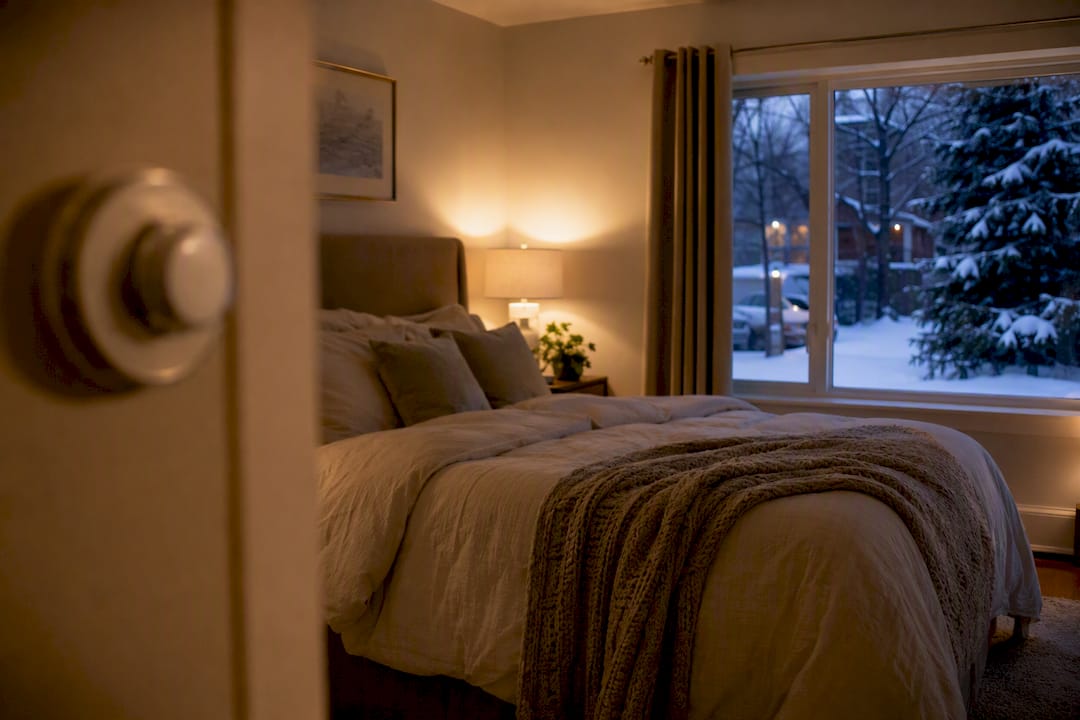
When you’re asleep, cooler air works in your favor twice over: it saves energy and it helps you sleep better. The Sleep Foundation recommends bedroom temperatures in the low-to-mid 60s, typically 62°F to 66°F, paired with warmer bedding rather than warmer air.
When you’re away for extended periods, drop the setpoint roughly 7°–10°F below your daytime baseline. But don’t go lower than necessary. In unheated or poorly insulated spaces, keep the whole house above about 55°F so pipes don’t freeze during a hard cold snap.
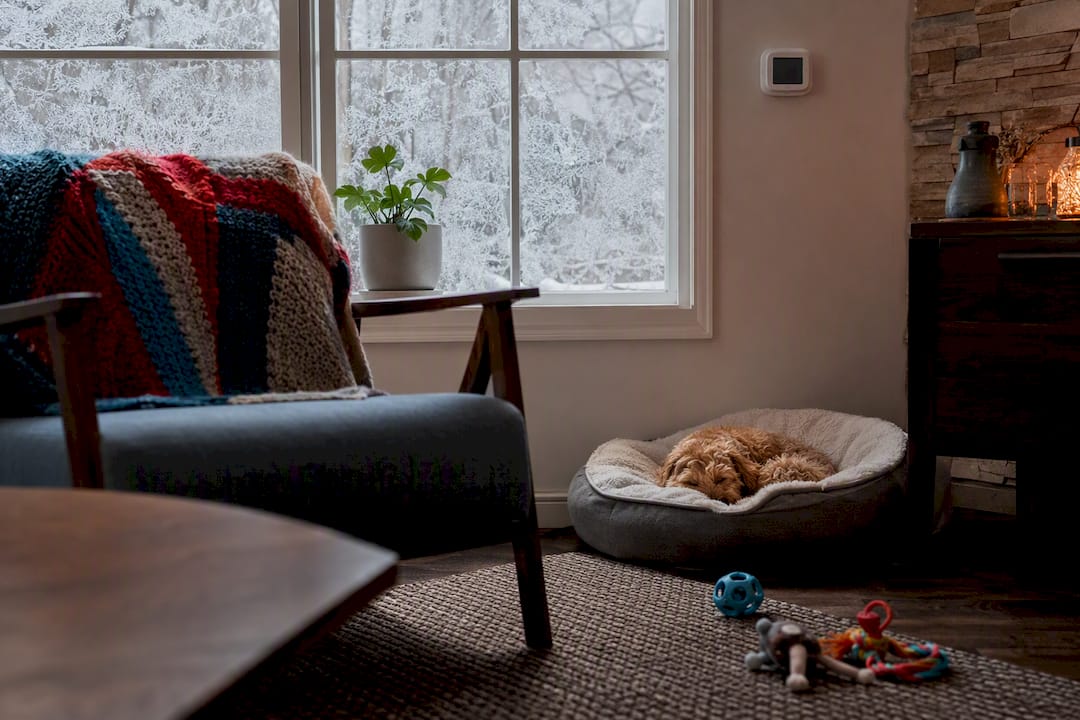
Households with infants, elderly residents, or pets need a different calculus. Babies and older adults regulate body heat less efficiently, and a thermostat schedule built around an empty house during the day can leave a napping infant or a homebound grandparent uncomfortably cold. Set daytime and sleeping minimums somewhat warmer for these households, and check on pets left alone rather than assuming the “away” setback is safe for them too. When there’s any doubt, prioritize the people and animals in the house over the savings percentage.
How to Program Your Thermostat for Winter Savings
A programmable or smart thermostat only pays off if the schedule actually matches your life. Here’s a simple structure to start from:
- Wake setting: Program the temperature to rise to 68°F about 30 minutes before you get up, so the house is comfortable when you need it, not cold.
- Daytime setting: Hold at 68°F if someone’s home; if the house empties out for work or school, drop it 7°–10°F.
- Evening return: Set a short pre-heat cycle 20 to 30 minutes before you’re typically back, rather than holding a high temperature all afternoon waiting for you.
- Sleep setting: Drop to 62°–66°F at bedtime. Consider starting the setback slightly before your actual bedtime, since a house takes time to cool.
- Weekend variant: If your weekend schedule differs, most thermostats let you save a separate program. Use it instead of manually overriding every Saturday.
Smart thermostats add convenience on top of this same structure. Features like geofencing, occupancy learning, and remote pre-heat mean the system adjusts automatically instead of you remembering to program anything, but the underlying temperature targets don’t change. Our overview of smart thermostat trends covers which features are worth paying for.
If your routine is genuinely unpredictable, rigid scheduling can backfire; you’ll just override it constantly, which defeats the purpose. In that case, a smart thermostat that learns patterns or responds to your phone’s location does more work than a fixed weekly program.
Do Heat Pump Owners Need Different Settings?
Yes, and this is the mistake that costs heat pump owners the most money. A standard 7°–10°F setback that works beautifully with a gas furnace can backfire on a heat pump. When the system has to recover a large temperature swing, it often kicks on auxiliary or emergency heat, typically electric resistance strips, to catch up faster. That backup heat is far more expensive to run than the heat pump’s normal compressor cycle, and it can erase the savings the setback was supposed to create.
The fix is smaller setbacks: 3°–5°F rather than a full 10. Many heat pump thermostats also include a dedicated mode that manages recovery gradually to avoid triggering aux heat. If your system seems to run auxiliary heat frequently or struggles to hold its setpoint, that’s a sign the controls need tuning by someone who works on heat pumps specifically, not a generic thermostat swap.
Managing Humidity Makes Lower Settings Feel Warmer
Dry winter air is why 68°F can feel chilly in one house and perfectly comfortable in another. Moisture in the air affects how quickly your skin loses heat, which is why maintaining indoor relative humidity in the 30% to 50% range improves perceived warmth enough that many households can run the thermostat a degree or two lower without noticing a difference.
A few practical steps get you there:
- Run a humidifier sized for your square footage, especially in bedrooms.
- Seal obvious drafts around windows and doors so cold, dry air isn’t constantly replacing warmer humid air.
- Use bathroom and kitchen exhaust fans during and after showers or cooking, but not so much that you strip humidity you’re trying to keep.
Watch the upper end of that range carefully. Indoor humidity above 50% in winter can lead to condensation on windows and, over time, mold growth in poorly ventilated areas. The goal is comfort, not a rainforest.
Thermostat Placement and Fan Settings You Might Be Getting Wrong
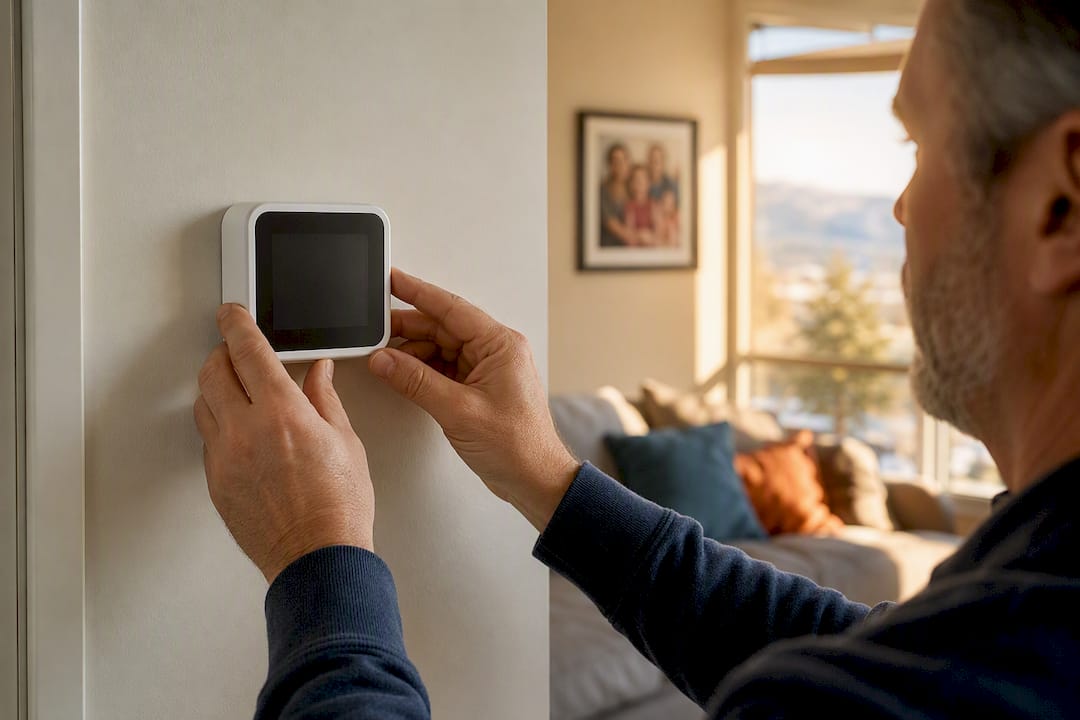
A thermostat can only manage temperature accurately if it’s reading the right air. Mount it on an interior wall, away from direct sunlight, heating vents, kitchens, and exterior doors. Any of those will feed it a false reading and throw off your whole schedule.
Fan setting matters more than most homeowners assume. Leaving the fan switch on ON keeps air moving constantly, which can feel drafty and doesn’t actually improve heating performance. Setting it to AUTO runs the fan only during active heating cycles, which delivers more even warmth without the constant airflow that makes rooms feel colder than they are.
Check thermostat batteries seasonally, and if the displayed temperature seems consistently off from how the room actually feels, it may need recalibration or professional service.
What Winter Thermostat Setbacks Actually Save You
Roughly 1% off your heating bill for every degree you lower the thermostat over an eight-hour period. That’s the rule of thumb NYSERDA’s thermostat worksheet uses, and it lines up with the DOE’s estimate that a setback of roughly 7°–10°F for eight hours can save up to 10% annually on heating and cooling combined.
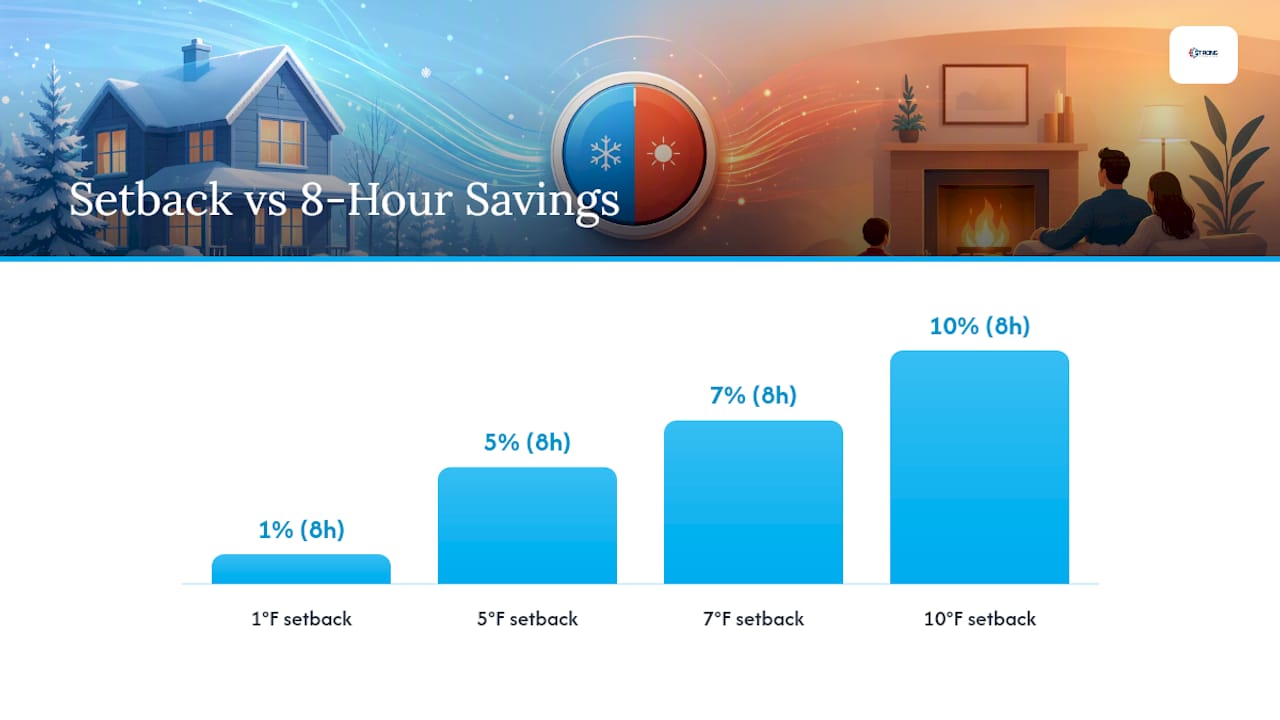
Do it every night and the savings compound across the season.
The exact dollar figure depends heavily on your fuel type and climate. EIA’s analysis of thermostat setback savings found that percentage savings typically are higher in milder climates, while colder regions see smaller percentage savings but usually larger dollar amounts because they’re heating so much more overall. Our guide to lowering heating bills walks through additional levers beyond the thermostat itself.
Winter Thermostat Mistakes That Waste Energy
Cranking the thermostat to 75°F because a room feels cold doesn’t heat the house any faster, it just runs the system longer and burns more fuel getting there. Constant manual adjustments throughout the day are almost as costly, since they interrupt the efficient, steady cycling a good schedule is designed to produce.
If a room runs cold despite a reasonable setpoint, work through this before assuming the thermostat is broken:
- Check that vents aren’t blocked by furniture or closed doors cutting off airflow.
- Replace the filter if it hasn’t been changed in the last one to three months.
- Confirm the thermostat itself is reading accurately and isn’t miscalibrated.
Uneven heating room to room, a system that short cycles on and off, or a thermostat that never quite reaches its setpoint usually points to something beyond a settings fix, and that’s when it’s worth scheduling a professional inspection.
Installer Tips That Make Your Thermostat Schedule Actually Work
Over 40-plus years of combined field experience, our technicians at Strongheatingandcooling see the same pattern: the thermostat gets blamed for problems that start with the wiring or configuration behind it. Older thermostats sometimes have anticipator settings that were never calibrated correctly for the furnace they’re paired with, which causes overshoot or short cycling no schedule can fix. On multi-stage systems and heat pumps, verifying the correct stage configuration during installation prevents the auxiliary heat issues covered earlier.
Recurring short cycling, a system that never quite holds its setpoint, or a thermostat pushing 10 years old or more are all signs it’s worth having someone look at the setup rather than keep adjusting the schedule.
Pro Tip: Leave your fan on AUTO all winter and use a short pre-heat cycle 20 to 30 minutes before you need warmth, instead of holding a high temperature all day waiting for the house to feel right.
If your system struggles to keep up no matter how you set it, that’s often a sign of an aging furnace rather than a thermostat problem, and our residential maintenance guide is a good next stop before considering replacement.
The Real Problem With Most Thermostat Advice
Most articles on this topic treat 68°F like a magic number and stop there. It isn’t. The research actually supports a range, not a single setpoint, and the bigger lever is consistency: a schedule you’ll actually follow beats a theoretically perfect number you keep overriding.
The conventional advice also glosses over heat pumps almost entirely, lumping them in with furnaces as if the same 10-degree setback applies equally. It doesn’t, and homeowners who follow generic advice on a heat pump system often end up paying more, not less, because they’ve triggered auxiliary heat without realizing it.
If there’s one thing to prioritize first, it’s humidity, not temperature. Most homeowners chase a lower number on the display before they’ve addressed the dry air making 68°F feel like 64°F. Fix that, and the “ideal” setting becomes a lot easier to live with.
Sources
- Thermostat Savings Worksheet
- Winter Energy Savings from Lower Thermostat Settings (EIA)
- Best temperature for sleep | Sleep Foundation
FAQ
What is the best thermostat setting for winter?
About 68°F while you’re home and awake is the standard recommendation, with 68°–70°F acceptable for comfort. Setting back 7°–10°F for roughly eight hours while asleep or away can save up to 10% a year on heating.
What temperature should I set my thermostat to at night?
Most sleep experts recommend 62°F to 66°F for bedrooms, which improves both sleep quality and energy savings compared to daytime settings.
Should heat pump owners use the same setback as furnace owners?
No. Large setbacks on a heat pump often trigger expensive auxiliary or emergency heat during recovery, so 3°–5°F setbacks work better than the 7°–10°F range recommended for furnaces.
Does humidity really affect how warm a house feels?
Yes. Keeping indoor relative humidity between 30% and 50% in winter improves perceived warmth, letting many households run the thermostat a degree or two lower without losing comfort.
Should my thermostat fan be set to ON or AUTO in winter?
AUTO is the better choice for most homes. It runs the fan only during active heating cycles, which delivers more even heat without the constant airflow that can make rooms feel drafty.
Recommended
Need expert HVAC help?
Colorado Springs' trusted, veteran-owned heating & cooling team — same-day service.