
How Long Does an Air Conditioner Last? A Homeowner’s Guide
Most central air conditioners last 15–20 years, with well-maintained units occasionally reaching 25 years and neglected systems sometimes failing well before the 10-year mark. That range is not a guarantee in either direction. How long your specific system lasts depends on installation quality, how consistently it’s maintained, the climate where you live, and how hard the unit runs each season. In Colorado Springs, for example, wide temperature swings and dry air create conditions that differ meaningfully from coastal climates, and those differences show up in equipment wear over time.
Key Takeaways
A well-maintained central air conditioner typically lasts 15–20 years, but installation quality, refrigerant condition, and annual service determine whether your system reaches that range or falls short of it.
| Point | Details |
|---|---|
| Central AC lifespan | Most central systems last 15–20 years; diligent care can extend that to 25 years. |
| Annual tune-up timing | Schedule professional service each spring to clean coils, verify refrigerant charge, and protect warranty coverage. |
| The $5,000 rule | Multiply repair cost by unit age; if the result exceeds $5,000, replacement usually makes more financial sense. |
| R-22 systems | Units using R-22 refrigerant face high repair costs due to the 2020 phase-out; factor this into any repair decision. |
| Strongheatingandcooling | Serves Colorado Springs with tune-ups, diagnostics, and replacements; maintenance plans available for planned care. |
Table of Contents
- How long does air conditioner lifespan vary by unit type?
- What factors shorten or extend your AC’s life?
- How do you know when it’s time to replace your AC?
- What does professional maintenance include, and what can you do yourself?
- Should you repair or replace? How the $5,000 rule helps
- What does AC replacement typically cost, and how long does it take?
- What R-22 owners need to know before their next repair
- How to choose an HVAC contractor who will protect your investment
- Why proactive maintenance beats emergency repairs every time
- Strongheatingandcooling keeps Colorado Springs comfortable year-round
- Sources
- FAQ
How long does air conditioner lifespan vary by unit type?
Not all air conditioning equipment ages at the same rate. The type of system, how it’s installed, and how much it runs each year all shape realistic expectations.
| Unit Type | Typical Lifespan | Key Note |
|---|---|---|
| Central split system | 15–20 years | Most common residential type; lifespan tied closely to maintenance and installation quality |
| Heat pump | 15–20 years | LBNL survey data shows average service life varies; compressor replacement often occurs around year 14 |
| Ductless mini-split | 15–20 years | Fewer duct-related losses; outdoor unit exposed to elements year-round |
| Window/portable unit | 8–10 years | Consumer Reports cites build quality and usage as the main variables |
| Packaged unit | 12–15 years | Entire system sits outdoors; weather exposure accelerates wear on electrical components |
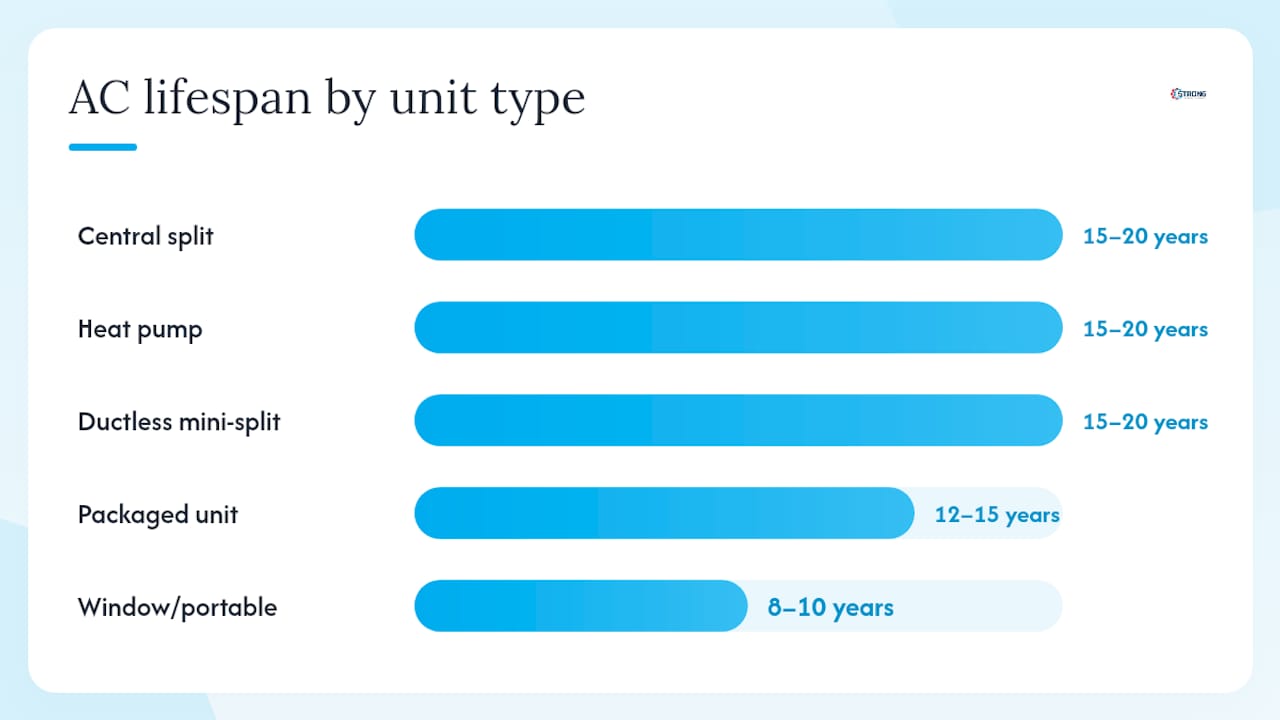
Central split systems and heat pumps share similar lifespan ranges, but heat pumps run year-round for both heating and cooling, which means more total operating hours. A heat pump in a mild climate may outlast a central AC in a hot desert region simply because it cycles less aggressively. Window units sit at the short end of the spectrum, partly because of their compact design and partly because most homeowners don’t maintain them with the same attention they give a central system.
What factors shorten or extend your AC’s life?
Understanding which variables you can control makes a real difference in how long your equipment lasts. Some factors are set at installation and rarely revisited; others are ongoing choices you make every season.
-
Installation quality. Oversizing is one of the most common and damaging mistakes. An oversized unit short-cycles, turning on and off too frequently, which increases wear on the compressor and electrical components while doing a poor job of controlling humidity. Energy is direct: correct sizing, proper refrigerant charge, and sealed ductwork are as important as the equipment itself when it comes to long-term performance.
-
Refrigerant charge. An incorrect refrigerant charge, whether too high or too low, forces the compressor to work outside its design parameters. Over time, that stress accelerates wear and can lead to premature compressor failure, which is often the repair that tips the scale toward full replacement.
-
Airflow and duct health. Low airflow causes the evaporator coil to ice over, makes accurate refrigerant checks impossible, and puts strain on the compressor. Keeping filters clean, registers open, and ducts sealed is a first-line defense against this kind of damage.
-
Maintenance frequency. Systems that receive annual professional service consistently outlast those that don’t. The Building America field program found that many installed systems have multiple interacting defects, and that correcting airflow and refrigerant issues together produced large, measurable energy and performance improvements.
-
Climate and operating hours. A unit in Phoenix running eight months a year accumulates far more wear than one in Denver running four. Colorado Springs sits in a moderate-to-high-use zone, with hot summers and occasional heat spikes that push systems hard.
-
Component quality. Higher-tier equipment tends to use more durable compressors, better coil materials, and more robust electrical components. The upfront cost difference often reflects real differences in expected service lives.
Statistic callout: The Arkansas CoolSaver Program, documented in the Building America Measure Guideline, reported 38% energy savings when technicians corrected both airflow and refrigerant charge in the field. That figure reflects how much performance is lost when those two factors are off simultaneously.
Pro Tip: Keep at least two feet of clearance around your outdoor condenser unit and clear away leaves, grass clippings, and debris after storms. A clogged condenser coil restricts airflow, raises operating pressures, and puts direct stress on the compressor. This one habit costs nothing and pays off in years of added life.
How do you know when it’s time to replace your AC?
Age alone rarely tells the whole story, but it’s a useful starting point. A 10-year-old unit showing repeated problems is in a different position than a 17-year-old unit that has been professionally serviced every spring and is still cooling efficiently.
Watch for these signals, especially when they appear in combination:
- Repeated breakdowns in a single season. One repair is normal; two or three in the same summer suggests the system is entering a failure cascade.
- Rising energy bills without a change in usage. A unit that’s losing efficiency works harder to deliver the same cooling, and that shows up on your utility bill.
- Reduced cooling capacity. If rooms that used to cool quickly now stay warm, the system may no longer be able to meet the load.
- Compressor noise. Grinding, banging, or hard-start sounds from the outdoor unit are serious. Compressor repairs are expensive, and on an older system, they rarely make financial sense.
- R-22 refrigerant leaks. If your system uses R-22 (Freon) and has a leak, the cost of refrigerant alone can make repair impractical. More on this in the refrigerant section below.
- Age past 15 years with declining performance. At this point, 9 signs your AC is about to fail become worth reviewing carefully before committing to another repair.
An older unit that still cools well, runs quietly, and has had recent major component work (a new compressor or coil within the last few years) may still be worth keeping for another season or two. The decision isn’t automatic.
What does professional maintenance include, and what can you do yourself?
Annual professional service in spring is the single most effective thing you can do to extend your system’s life and keep your manufacturer warranty valid. Here’s what a qualified technician should cover during a tune-up:
- Clean evaporator and condenser coils
- Check and adjust refrigerant charge
- Inspect and test all electrical connections and components
- Measure airflow and check for duct leaks
- Inspect and clean the condensate drain line
- Test thermostat calibration and cycling behavior
- Lubricate fan motors and check belts where applicable
- Document findings for warranty records
Between professional visits, homeowners can do a meaningful amount to protect their investment:
- Change air filters every 1–3 months, depending on filter type and household conditions (pets, dust, allergies).
- Keep the outdoor condenser unit clear of debris, vegetation, and standing water.
- Check that all supply and return registers are open and unobstructed.
- Avoid large thermostat setpoint swings. Energy notes that sensible setpoint habits reduce unnecessary compressor cycles and lower energy use.
- Follow a seasonal prep checklist before the first hot day of the year. The summer preparation guide from Strongheatingandcooling walks through the key steps.
Pro Tip: Call a technician immediately if you see water pooling around the indoor air handler, hear a hard-start or grinding noise from the outdoor unit, or notice ice forming on the refrigerant lines. These are not “watch and wait” situations. Delaying can turn a moderate repair into a compressor replacement.
Should you repair or replace? How the $5,000 rule helps
The $5,000 rule is a practical heuristic, not a hard law. Multiply the repair cost by the unit’s age in years. If that number exceeds $5,000, replacement is usually the better financial decision. A $400 repair on a 10-year-old unit gives you $4,000, which suggests repair makes sense. A $600 repair on a 16-year-old unit gives you $9,600, which points toward replacement.
The rule works because it captures two things at once: the size of the repair relative to remaining useful life, and the compounding risk of additional repairs on aging equipment. It doesn’t account for everything, so consider these factors alongside it:
- Remaining useful years. A 12-year-old unit with good maintenance history may have 6–8 years left. A 17-year-old unit with deferred maintenance may have 2–3.
- Efficiency gains from replacement. Modern systems with higher SEER ratings use significantly less electricity than units installed 15 years ago. Those savings can offset a portion of replacement cost over time.
- Available rebates and tax credits. Federal tax credits and utility rebates for high-efficiency equipment are worth checking before you decide. These change periodically, so confirm current programs with your utility and a tax advisor.
- Planned home upgrades. Adding insulation, replacing windows, or sealing the building envelope reduces cooling load. If those upgrades are coming, they may allow you to right-size a replacement system smaller and cheaper than the current one.
Three quick scenarios:
- $350 repair, 8-year-old unit, no recent breakdowns: Repair. The unit has years of life ahead and the math is straightforward.
- $800 repair, 14-year-old unit, second repair this year: Borderline. The $5,000 rule says repair, but the pattern of breakdowns suggests the system is entering decline. Plan for replacement within 1–2 years.
- $1,200 compressor repair, 17-year-old R-22 unit: Replace. The refrigerant situation alone changes the calculus, and the LBNL lifecycle analysis supports replacement over compressor repair for older units.
What does AC replacement typically cost, and how long does it take?
Replacement costs vary considerably based on system size, efficiency rating, and what the installation requires beyond the equipment itself.
- Low end: $3,500–$5,000 for a smaller, standard-efficiency system with straightforward installation and no ductwork changes.
- Mid-range: $5,000–$8,000 for a mid-size system with a higher SEER rating, standard ductwork, and typical permit costs.
- High end: $8,000–$12,000 or more for larger homes, high-efficiency equipment, required electrical upgrades, ductwork modifications, or complex installations.
Variables that push costs up include the need for new ductwork, electrical panel upgrades, permit fees (which vary by municipality), and disposal of the old unit. Always get an itemized quote so you know exactly what’s included.
On timeline:
- A site visit and detailed quote typically takes 1–2 hours.
- Scheduling lead time varies by season. Spring and early summer are the busiest periods for HVAC contractors; booking in late winter or fall often means faster scheduling.
- Installation day for a standard central system usually runs 4–8 hours.
- Final testing and commissioning adds another 30–60 minutes after installation.
Check for available rebates through your utility company and review current federal tax credit programs for qualifying high-efficiency equipment before signing a contract.
What R-22 owners need to know before their next repair
If your system was installed before 2010, there’s a reasonable chance it uses R-22 refrigerant, also known by the brand name Freon. The EPA phased out R-22 production and import in the United States as of January 1, 2020. Only reclaimed or stockpiled refrigerant is now available, and prices have risen sharply as supplies shrink.
What this means practically:
- Check the data plate on your outdoor unit. It will list the refrigerant type. R-22 is clearly labeled.
- If your R-22 system develops a refrigerant leak, the repair cost now includes expensive reclaimed refrigerant on top of the labor to find and fix the leak.
- Retrofit refrigerants exist, but they are not a perfect substitute and require a technician’s assessment to determine compatibility.
- For most homeowners with an R-22 system over 12–15 years old, a refrigerant leak is a strong signal to replace rather than repair. The economics rarely favor keeping the old system once refrigerant cost enters the picture.
Ask your technician directly: “What refrigerant does my system use, and what would a leak repair cost at current prices?” That answer alone often clarifies the replacement decision.
How to choose an HVAC contractor who will protect your investment
The technician you hire matters as much as the equipment you buy. A poorly installed new system can underperform and fail early, while a well-maintained older system can outlast its expected life. Here’s what to ask before you hire:
- Are you licensed and insured in Colorado (or your state)?
- Do you perform a full Manual J load calculation before sizing a replacement system?
- Do you follow ACCA/ANSI installation standards for refrigerant charge and airflow?
- What warranty do you offer on parts and labor, separate from the manufacturer warranty?
- Do you offer a maintenance plan, and what does it include?
Red flags to watch for:
- A contractor who quotes a replacement system without measuring your home or reviewing your ductwork.
- Vague answers about refrigerant handling or charge verification.
- Pressure to replace immediately without a written diagnostic.
- No mention of permits or inspections.
When you call, a straightforward script works well: “I’m looking for a quote on a central AC tune-up/replacement. Can you tell me whether you do a load calculation for sizing, and whether you follow ACCA installation standards?” A qualified contractor will answer both questions without hesitation. During the on-site visit, expect the technician to inspect the air handler, measure airflow, check refrigerant pressure, and review the ductwork condition before recommending anything.
Why proactive maintenance beats emergency repairs every time
After more than 40 years of combined experience in HVAC, the pattern is consistent: the homeowners who get the most life from their equipment are the ones who treat annual maintenance as a fixed expense, not an optional one. A tune-up that catches a low refrigerant charge or a failing capacitor in April costs a fraction of what an emergency call costs in July, and it prevents the kind of compressor damage that turns a $300 repair into a $4,000 decision.
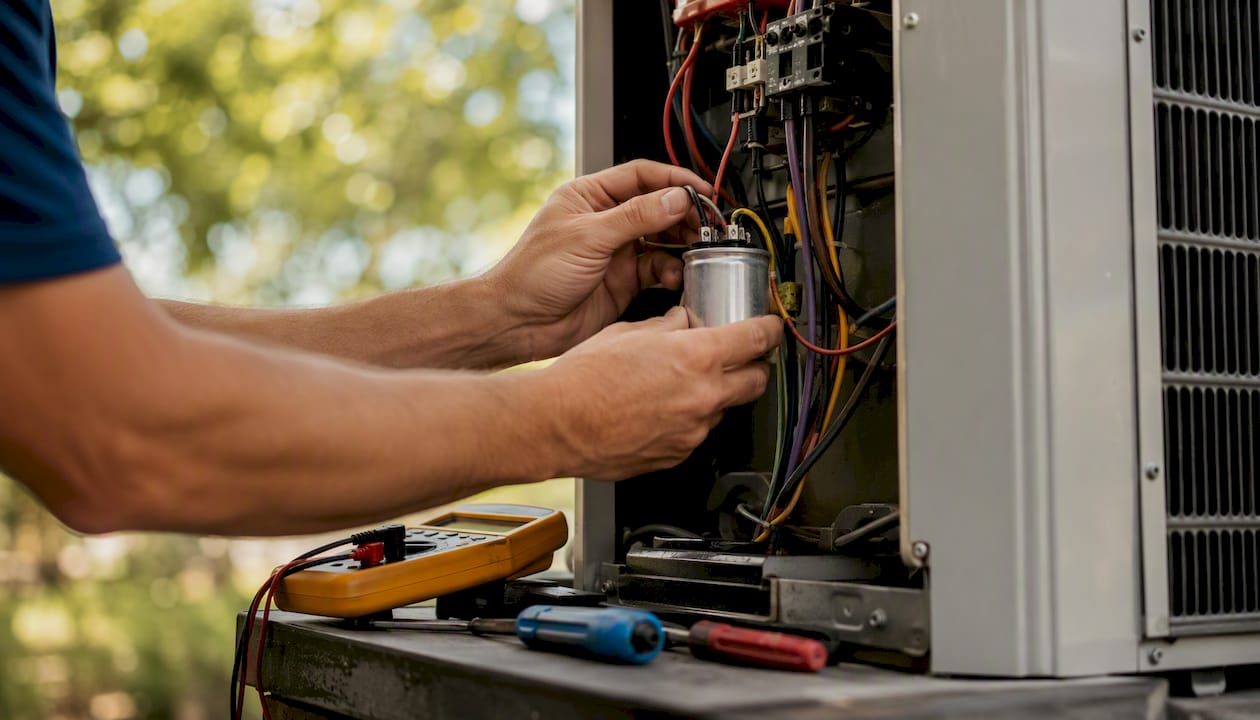
There’s also a planning advantage. When a technician documents the condition of your system each spring, you build a record that makes the repair-versus-replace decision much clearer. You’re not guessing about the unit’s history; you have it in writing. That documentation also matters for warranty claims and for negotiating with contractors when replacement time comes.
The other thing worth saying plainly: a system that fails in the middle of a Colorado Springs heat wave gives you no time to make a good decision. You’re choosing under pressure, often from a limited pool of available contractors and equipment. Planned replacement, even if it’s a year or two early, almost always produces a better outcome than emergency replacement.
Strongheatingandcooling keeps Colorado Springs comfortable year-round
Strongheatingandcooling serves Colorado Springs and surrounding communities with air conditioner services that cover the full range: annual tune-ups, diagnostic assessments, repairs, and complete system replacements. With over 40 years of combined experience, the team sizes systems correctly, verifies refrigerant charge, and follows ACCA installation standards on every job.

For homeowners who want to stay ahead of problems, Strongheatingandcooling’s maintenance plans provide scheduled spring service, priority scheduling, and transparent pricing with no surprise fees. Whether your system needs a tune-up before summer or you’re ready to plan a replacement, the team offers honest assessments and equipment options that fit your budget. Schedule your assessment at Strongheatingcooling.
Sources
- How Long Do Air Conditioners Last? | Carrier
- AC maintenance guide | Carrier
- Energy
- Measure Guideline: Air Conditioner Diagnostics, Maintenance, and Replacement | Building America
- Is It Time to Get a New Window Air Conditioner? | Consumer Reports
FAQ
What is the $5,000 AC rule?
Multiply the repair cost by the unit’s age in years. If the result exceeds $5,000, replacement is generally the better financial choice. It’s a heuristic, not a guarantee, but it captures both repair cost and remaining useful life in one simple calculation.
Is a 7-year-old AC unit old?
No. A 7-year-old central air conditioner is well within its expected service life of 15–20 years. At that age, repair almost always makes more sense than replacement, assuming the unit was properly installed and has been reasonably maintained.
What is the 20-year rule for air conditioning?
The general guidance is that a central AC system approaching or past 20 years old is a strong replacement candidate, even if it’s still running. At that age, efficiency has declined, parts availability may be limited, and the risk of a major failure rises significantly.
Which AC brand lasts the longest?
No single brand consistently outlasts all others across all conditions. Longevity depends more on installation quality, maintenance history, and operating conditions than on brand alone. That said, units from established manufacturers with broad parts networks tend to be easier and less expensive to service over their full lifespan.
Recommended
- The Real Cost of Running an Old AC Through a Colorado Summer | Strong Heating & Cooling
- Air Conditioner Installation Guide | Strong Heating & Cooling
- How Central Air Conditioning Works: A Homeowner’s Guide | Strong Heating & Cooling
- How to Prepare Air Conditioner for Summer | Strong Heating & Cooling
Need expert HVAC help?
Colorado Springs' trusted, veteran-owned heating & cooling team — emergency service.