
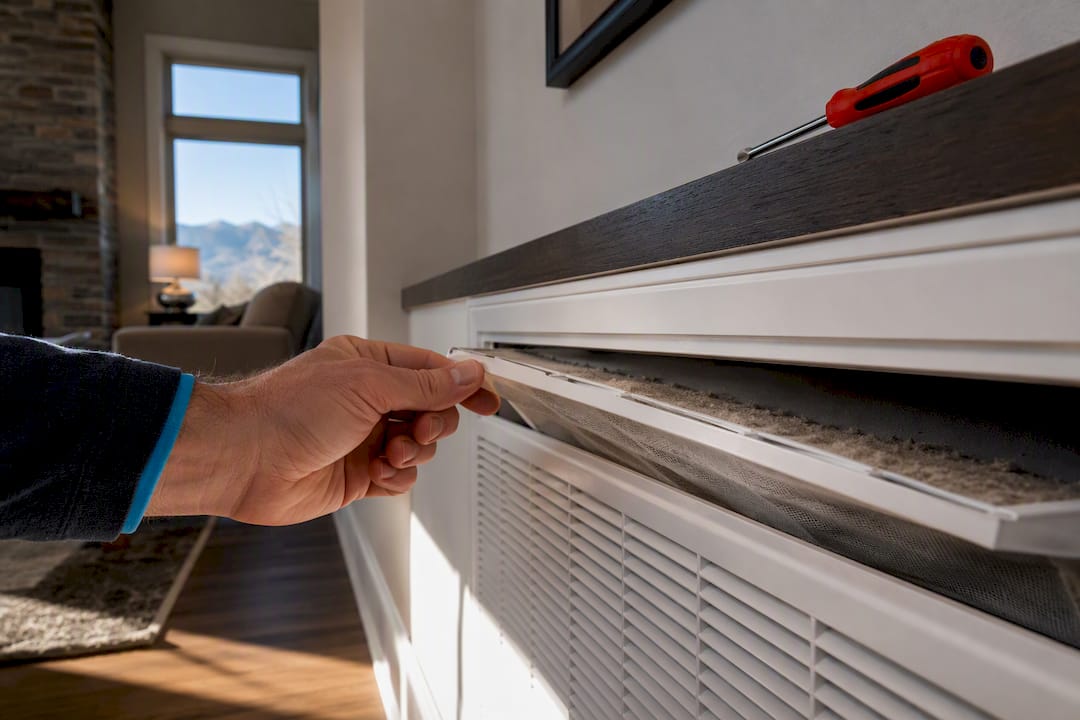
Restricted airflow from a dirty filter or blocked vents causes most nonstop AC operation, followed by thermostat glitches, dirty coils, low refrigerant, leaky ducts, and equipment that is simply too small or too old for the house. Start with three checks: swap the filter, confirm the thermostat is set to COOL with the fan on AUTO, and clear debris from around the outdoor unit. If the house never reaches the set temperature, you spot ice on the lines, smell burning, or the breaker keeps tripping, shut the system off and call a technician.
TL;DR:
- Restricted airflow from a dirty filter or blocked vents is the leading cause of nonstop AC operation, often exacerbated by closed vents or debris blocking outdoor units.
- Thermostat issues, including incorrect settings, placement near heat sources, or dead batteries, can prevent the system from shutting off properly.
- Dirty coils, low refrigerant, or leaky ductwork reduce heat transfer efficiency and cause the system to run longer than necessary.
- A system that runs for more than 15 to 20 minutes on mild days may still be normal unless the house does not reach the set temperature or shows other faults like ice or smells.
- Homeowners should perform basic checks, including filter replacement, thermostat verification, and outdoor unit clearance, before calling a technician for diagnosis and repair.
Table of Contents
- Why Your AC Won’t Stop Running: The Most Common Causes
- Is Nonstop AC Operation Normal, or Is Something Wrong?
- Quick Homeowner Checklist Before You Call for Service
- When to Call a Professional and What They’ll Actually Test
- What Years of Service Calls Taught Us About Runaway AC Systems
- How Strong Heating And Cooling Solves Nonstop AC Problems for Good
- Sources
- FAQ
Why Your AC Won’t Stop Running: The Most Common Causes
A system that runs and runs usually has one thing in common: it can’t move enough heat out of the house fast enough to satisfy the thermostat. Several problems can cause that, and most leave clues.
Restricted airflow is the number one culprit. A clogged filter chokes the return air, forcing the blower to work harder while the evaporator coil gets colder than it should. Left alone long enough, that coil ices over completely, which paradoxically makes cooling worse even as the system keeps running. Check the filter monthly and replace it every 30 to 90 days depending on pets, dust, and household size. While you’re at it, open closed supply vents and clear furniture away from return grilles. Closing vents in unused rooms to “save energy” actually throws off the system’s air pressure balance, which can starve the return side and push the coil toward freezing.
Thermostat problems come next. Confirm the mode is set to COOL, not fan-only, and that the fan setting is AUTO rather than ON, which keeps the blower running even when the compressor cycles off. A thermostat mounted near a sunny window, a heat register, or a drafty door will read the room wrong and run the system far longer than the actual temperature requires. Dead batteries and outdated wiring cause the same kind of confusion.
Dirty coils, indoor or outdoor, cut heat transfer significantly. A grimy condenser coil outside can’t reject heat well, and a fouled evaporator coil inside can’t absorb it. Both force longer cycles to hit the same setpoint. You can visually check the outdoor coil for dirt and debris, but a full cleaning is a job for a technician.
Low refrigerant shows up as weak, lukewarm air from the vents or ice forming on the copper lines near the indoor unit. Refrigerant doesn’t get used up; a low charge always means there’s a leak somewhere in the system. This is not a do-it-yourself repair. Refrigerant handling requires EPA certification and specialized equipment to find and seal the leak properly.
Leaky or disconnected ductwork lets cooled air escape into the attic or crawlspace before it ever reaches your living room. Duct leakage can waste 20 to 30 percent of conditioned air in homes with exposed duct runs, which explains why some houses run their AC constantly and still feel warm. A duct leakage test settles the question.
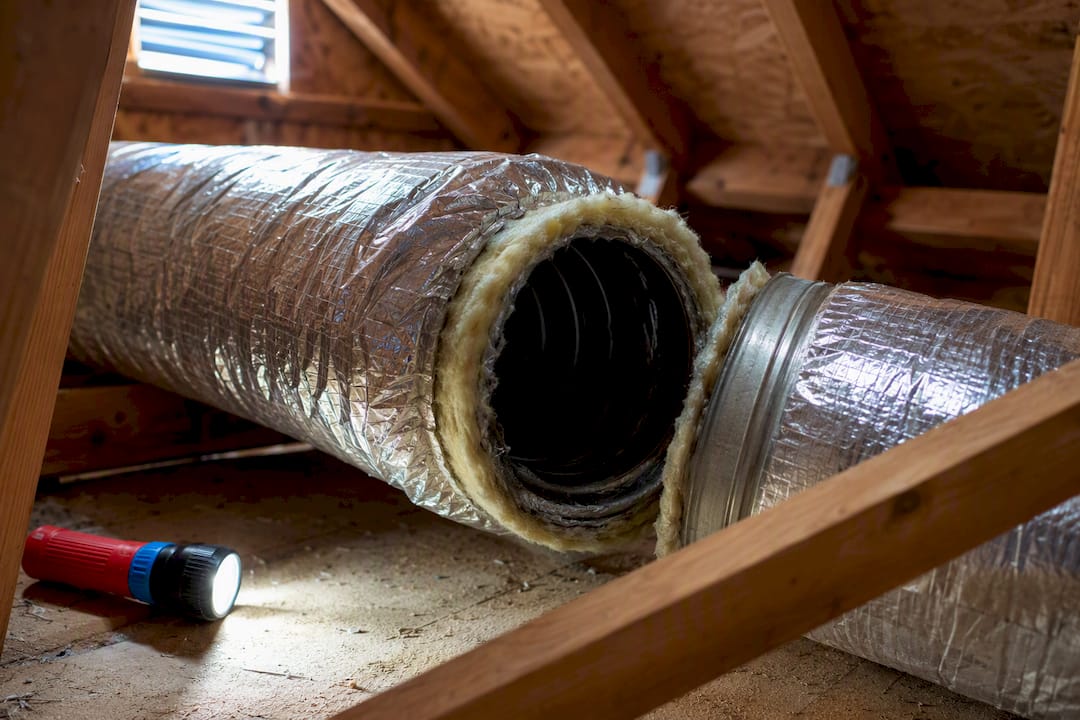
Undersized or aging equipment simply can’t keep pace on the hottest days or as components wear down and lose capacity over the years. If the unit runs nonstop even in mild weather, sizing may be the real issue, not maintenance.
Pro Tip: Keep a small notebook or phone note logging when the AC struggles most. Patterns tied to time of day, humidity, or specific rooms make it much easier for a technician to zero in on the cause during a service call.
Is Nonstop AC Operation Normal, or Is Something Wrong?
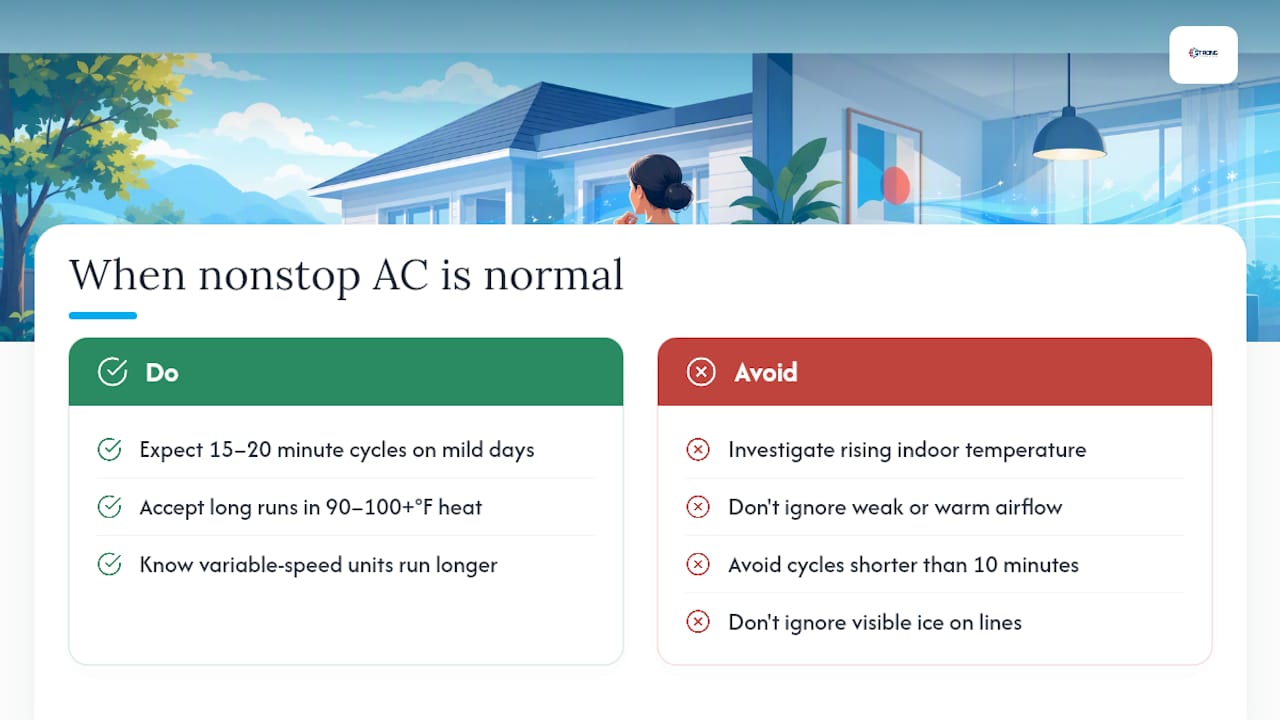
Not every long run cycle is a red flag. On mild days, a properly sized system typically cycles for about 15 to 20 minutes at a time. Push the outdoor temperature into the upper 90s or past 100°F, though, and even a healthy system will run for hours at a stretch simply because the heat load is that much higher.
Variable-speed and inverter compressors complicate the picture further. These systems are designed to run longer at lower capacity on purpose, because slower, steadier airflow removes more humidity and uses less energy than blasting on and off. Long runtime on one of these units is a feature, not a fault.
The real test isn’t how long the system runs. It’s whether the house actually reaches and holds the temperature on the thermostat. Rising indoor temperature despite constant operation, weak or warm airflow from the vents, cycles shorter than 10 minutes, visible ice on the lines, or a utility bill that suddenly spikes all point to a genuine problem rather than a hot day doing what hot days do.
Quick Homeowner Checklist Before You Call for Service
Run through these steps in order. Each one takes a few minutes and can rule out the easiest, cheapest fixes first.
- Check the thermostat. Confirm it’s set to COOL with the fan on AUTO, then compare the displayed temperature to a separate room thermometer to catch a miscalibrated reading.
- Inspect the filter and airflow path. Replace a dirty filter, open closed supply vents, and make sure nothing is blocking return air grilles.
- Look at the outdoor unit. Clear at least two feet of grass, leaves, and debris around the condenser, and confirm the outdoor fan spins whenever the compressor runs.
- Feel the vents and check for ice. Warm or weak airflow, or frost on the refrigerant lines, both point to a bigger issue than a dirty filter.
- Know when to stop. If you see ice, smell anything burning, the breaker trips more than once, or the house still isn’t cooling after all four checks, turn the system off and call a technician rather than troubleshooting further on your own.
Pro Tip: Snap a photo of your thermostat model and settings before you call for service. It saves time on the phone and helps the technician bring the right diagnostic tools on the first visit.
When to Call a Professional and What They’ll Actually Test
Some symptoms mean it’s time to stop troubleshooting and pick up the phone: a house that never reaches the setpoint, ice on the refrigerant lines, a burning smell, a breaker that keeps tripping, or a system that’s run nonstop for 24 hours with indoor temperature still climbing.
A qualified technician works through a structured diagnostic rather than guessing. Expect a service call in the neighborhood of $80 to $200 just to identify the problem, with repair costs on top depending on what they find.
- Airflow and blower motor inspection to confirm the system is moving the right volume of air.
- Refrigerant pressure check and leak detection, since low charge always traces back to a leak somewhere in the line set.
- Coil cleaning for both the evaporator and condenser if fouling is limiting heat transfer.
- Duct leakage testing to quantify how much cooled air is escaping before it reaches your rooms.
- A Manual J load calculation if the technician suspects the equipment was never sized correctly for your house in the first place.
| Diagnostic or repair | What it checks | Typical outcome |
|---|---|---|
| Service call diagnostic | Overall system performance | Identifies the specific fault |
| Refrigerant leak check | Line set, coils, connections | Leak location and repair estimate |
| Duct leakage test | Supply and return duct integrity | Percentage of air lost before delivery |
| Manual J load calculation | Whether equipment matches home’s cooling needs | Confirms correct sizing or flags undersizing |
Refrigerant work and electrical repairs both carry real safety risk and can void manufacturer warranties if handled by anyone without the right certification, so this is one area where a DIY attempt usually costs more in the end.
What Years of Service Calls Taught Us About Runaway AC Systems
With more than 40 years of combined experience behind our technicians, the same handful of issues show up again and again: a filter nobody’s changed in a year, leaves packed around the condenser, or ductwork quietly leaking cooled air into an attic. None of it is exotic. Most of it is preventable.
A seasonal tune-up catches these problems while they’re still cheap to fix, before a clogged filter turns into a frozen coil or a small refrigerant leak turns into a failed compressor. Homeowners who stick to the checklist above and get an annual inspection tend to see fewer emergency calls and lower cooling bills, which is really the whole point.
— Owner
How Strong Heating And Cooling Solves Nonstop AC Problems for Good
A filter change might fix a nonstop AC, or the real issue might be a duct leak, a refrigerant leak, or equipment that was undersized the day it was installed. Some service providers offer a real diagnostic visit that includes airflow inspection, refrigerant checks, coil cleaning, duct leakage testing, and a Manual J load calculation when sizing is in question, instead of a guess and a part swap.

Choosing a qualified local technician over a patchwork DIY fix protects your equipment’s manufacturer warranty and keeps small problems from turning into a full system replacement. If a repair does turn into a bigger job, financing options are available so a major fix doesn’t have to strain your budget. Ready to find out exactly why your system won’t shut off? Schedule an HVAC repair diagnostic and get a straight answer instead of another guess.
Sources
- Why Is My Air Conditioner Running Constantly? — CenterPoint Energy
- Is it bad when the air conditioner runs a lot? — Green Building Advisor
- ACCA — industry standards and contractor resources
- How to optimize HVAC run times — HVACDatabase
- What to do when your air conditioner won’t turn off — Lennox
FAQ
How do I stop my AC from running constantly?
Start by replacing the filter, confirming the thermostat is set to COOL with the fan on AUTO, and clearing debris from the outdoor unit. If those steps don’t help, the cause is likely dirty coils, low refrigerant, a duct leak, or undersized equipment, all of which need a technician to diagnose properly.
Is it normal for AC to run 20 hours a day?
It can be, especially during extreme heat above 100°F or with a variable-speed system designed to run long cycles at lower capacity for better humidity control. The key question is whether the house actually reaches and holds the thermostat setting during those hours.
Is it normal for AC to run every 15 minutes?
Cycles of roughly 15 to 20 minutes are typical in mild weather for a properly sized system. Cycles shorter than 10 minutes, known as short cycling, usually point to an electrical, thermostat, or sizing problem rather than normal operation.
What causes your air conditioner to run continuously?
The most common causes are restricted airflow from a dirty filter, thermostat malfunctions, dirty evaporator or condenser coils, low refrigerant from a leak, leaky ductwork, and equipment that’s undersized or aging for the home it’s cooling.
Recommended
Need expert HVAC help?
Colorado Springs' veteran-owned heating & cooling team — Mon–Sat, 8 AM–7 PM. Same-day service when available.