
5 Safe Checks Homeowners Can Do When an AC Won’t Turn On
Start with two things: the thermostat and the breaker. Set the thermostat to COOL, drop the setpoint five degrees below room temperature, and check whether the main and AC breakers have tripped. If both check out and the unit still won’t start, you’re likely dealing with a condensate float switch, a failed capacitor, or a control-voltage fault, and it’s time to work through the checklist below. Stop and call a professional if you smell burning, notice repeated breaker trips, see ice on the lines, or find water pooling near the unit.
TL;DR:
- Most AC failures originate from simple causes like tripped breakers, clogged filters, or a thermostat left in the wrong mode, which homeowners can easily check first.
- Persistent issues such as a humming compressor, ice buildup, or water pooling near the unit indicate more serious faults needing professional diagnosis, especially if safety signs like burning smells appear.
- Repeated breaker trips suggest serious electrical problems, and attempting multiple resets can cause further damage to motors or control boards, requiring a technician intervention.
- Faulty capacitors, control wiring issues, and refrigerant leaks are common technical causes that only licensed professionals should handle due to safety risks.
- Regular preventive maintenance, including filter changes, outdoor coil rinsing, and condensate line flushing, significantly reduces the likelihood of future AC start-up problems.
Table of Contents
- Why Is My AC Not Turning On? Start Here
- What’s Actually Stopping Your AC From Starting?
- When Should You Stop and Call a Professional?
- How to Safely Reset Your AC System
- Preventive Maintenance That Cuts Down Future No-Starts
- What Strong Heating And Cooling Sees on These Calls
- Need a Technician? Here’s What to Have Ready
- Sources
- FAQ
Why Is My AC Not Turning On? Start Here
A dead AC almost always traces back to one of five places: the thermostat, the electrical supply, airflow, the condensate system, or a start component like the capacitor. Working through them in order, cheapest and safest first, saves you a service call in a lot of cases.
Here’s the five to ten minute sequence worth running before you touch anything else:
- Confirm the thermostat is set to COOL and the target temperature is at least a few degrees below the current room reading. A blank display usually means dead batteries, so swap them even if the unit is hardwired, since many models still run on battery backup for the display.
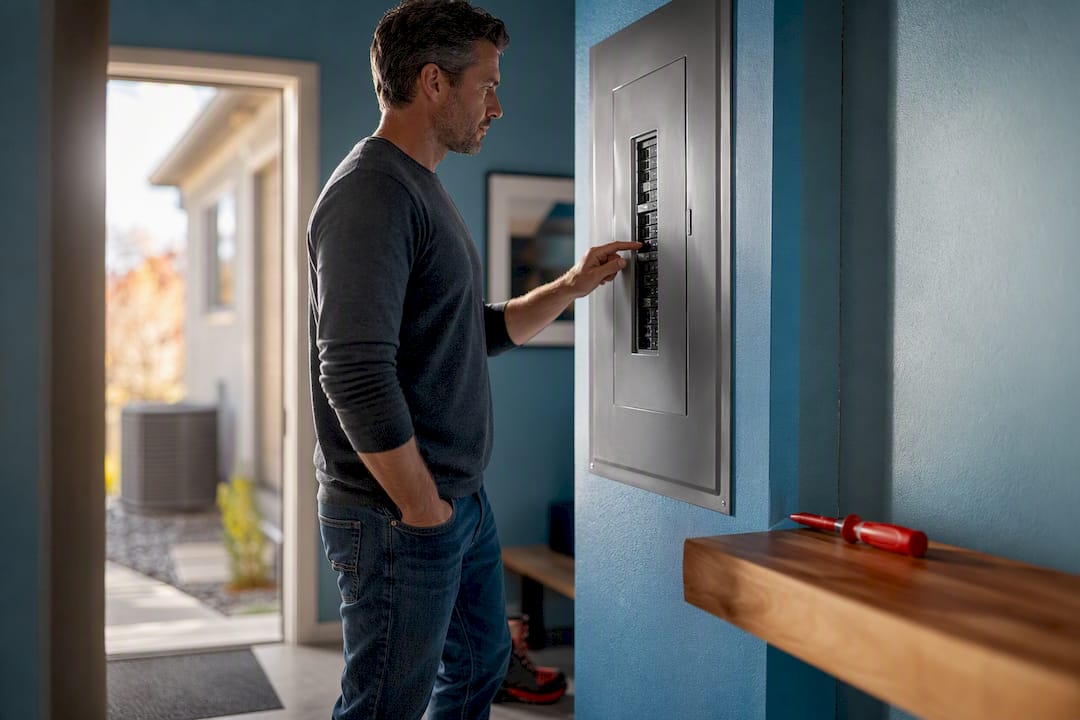
- Check your electrical panel. Look for a tripped breaker feeding the air handler and a separate one for the outdoor condenser. A tripped breaker or blown fuse is one of the most common reasons an AC won’t start, so switch it fully off, then back on, once. If it trips again immediately, stop resetting it.
- Pull the air filter and hold it up to a light. If you can’t see light through it, replace it. A clogged filter restricts airflow enough to trigger safety cutouts that shut the whole system down.
- Walk outside and look at the condenser. Clear leaves, grass clippings, or mulch away from the unit, and see whether the fan blades move freely or show any obstruction.
- Check the condensate pan and float switch near your indoor air handler. Standing water there means the safety switch has likely cut power to protect your ceiling or floor from an overflow.
If every one of these checks out fine and the system still won’t start, the problem has moved past what a screwdriver and a flashlight can fix.
What’s Actually Stopping Your AC From Starting?
Once the easy wins are ruled out, the causes get more specific, and so does the line between what you can safely handle and what needs a licensed technician.
Power and breaker behavior. A breaker trip isn’t random. It happens because something downstream is drawing more current than the circuit allows, whether that’s a failing compressor motor, a short in the wiring, or a jammed fan. One reset is a reasonable test. A second trip within minutes is your system telling you there’s a real fault, and repeatedly resetting a tripped breaker can escalate the problem, damaging motors or control boards that were otherwise fine.
Thermostat and low-voltage controls. Beyond dead batteries, a blank or unresponsive thermostat can point to a blown low-voltage fuse on the control board or a failed 24-volt transformer. Technicians sometimes test this by briefly jumping specific thermostat wires at the equipment to see if the system responds directly, which confirms whether the fault is in the thermostat or downstream. This is a diagnostic technique, not a homeowner task. Thermostat wiring and power issues are a frequent, often easily fixed cause of a no-start AC, but wiring faults inside the equipment are not.
Airflow restrictions beyond the filter. Blocked return grills, closed supply vents throughout the house, or a frozen evaporator coil all choke airflow. A frozen coil is particularly telling, since it usually means the system ran with restricted airflow or low refrigerant long enough to freeze condensation on the coil, and it will trip a safety switch until it thaws completely.
- Dirty filters and blocked returns are the most common airflow culprits.
- Closed vents in unused rooms restrict total airflow more than people expect.
- A frozen coil needs hours to thaw before the system will attempt to restart safely.
Condensate float switch and pump problems. This is one of the most overlooked shutdown causes. A clogged condensate line or a tripped float switch will stop a system from starting even though nothing electrical is wrong at all. Clearing a drain line with a wet vacuum from the outside termination point is a reasonable homeowner task. A pump that keeps failing, or water that returns within a day of clearing the line, points to a bigger drainage problem worth having inspected.
Start components: capacitors and contactors. If the outdoor unit hums but the fan doesn’t spin, or you hear a click at the condenser with no response at all, you’re likely looking at a failed capacitor or a pitted contactor.
Pro Tip: A humming compressor with a stalled fan is one of the more recognizable signs of a bad capacitor. Don’t try to spin the fan blade by hand to “help it along.” That’s how people get hurt.
Capacitors hold a lethal electrical charge even after the unit is powered off, and technicians discharge them with specific tools before touching anything. This is not a job for a screwdriver and a Saturday afternoon. Our breakdown of capacitor failure signs covers what a technician actually checks during that repair.
Outdoor unit faults. A seized fan motor, a compressor that won’t engage, or debris jammed in the housing all show up here. Note what you observe, whether the fan spins freely by wind alone, whether you hear a hum, whether there’s a burning smell, since that detail speeds up diagnosis considerably.
By the numbers: technicians diagnosing electrical no-starts often use a method called hopscotching, checking voltage at each control point moving from a known-good source toward the dead load until the voltage suddenly disappears. That drop pinpoints the exact failed control, rather than guessing and swapping parts one at a time.
Refrigerant safety cutouts. Low refrigerant from a leak can trip a low-pressure safety switch that prevents the compressor from starting at all, protecting it from running dry. Hissing sounds near the lines, ice forming where there shouldn’t be any, or a system that ran fine yesterday and won’t start today are all worth mentioning to your technician. Refrigerant handling is federally regulated under EPA rules, and only certified technicians can legally recover, add, or repair a sealed refrigerant system.
Control board and wiring issues. Loose connections, corroded terminals, or a failing transformer create the most frustrating kind of fault: intermittent. The system might start fine three times and fail the fourth. Confirming that both the indoor air handler and outdoor condenser are actually receiving power is the first diagnostic step technicians take here, since a fault at the disconnect or a safety interlock can look identical to a dead control board from the outside.
When Should You Stop and Call a Professional?
Most of what’s listed above is safe to check yourself. A few situations aren’t, and they call for stopping immediately rather than working through the rest of the checklist.
- Burning smells, smoke, or visible sparks at the thermostat, breaker panel, or outdoor unit mean shut off power at the breaker and call for emergency service.
- A breaker that trips a second time after one reset. Don’t reset it again; that fault needs a technician’s eyes.
- A refrigerant odor or hissing sound near the outdoor lines, especially paired with visible ice.
- Water pooling rapidly, not just a small puddle, but water that’s actively spreading near the indoor unit.
- Ice building up on the refrigerant lines or indoor coil.
Capacitors and other high-voltage components inside an AC system carry enough stored charge to injure someone well after the unit has been powered down. That’s not a risk worth taking to save a service call.
If you hit any of these, snap a few photos of the panel, the outdoor unit, and anything unusual before you call. It genuinely speeds up the technician’s diagnosis when they arrive.
How to Safely Reset Your AC System
Once you’ve ruled out anything on the stop-immediately list, a clean power cycle resolves more no-starts than people expect, especially after a storm or outage.
- Set the thermostat off, then switch it back to COOL after a few seconds.
- Go to your electrical panel and fully switch the indoor air handler breaker off, wait ten seconds, then switch it back on.
- Do the same for the outdoor condenser breaker or the disconnect switch near the outdoor unit itself.
- Return to the thermostat and set your target temperature.
- Wait. If your power was out recently, give the compressor a few minutes before expecting it to engage. Many units have built-in delay protection that holds the compressor off briefly to protect it from short-cycling.
Pro Tip: If the breaker trips again during this reset, stop. Don’t cycle it a third time hoping it “catches.” That’s exactly the pattern that turns a simple fix into a motor or control board replacement.
Note what happens: does the indoor blower start but the outdoor fan stays silent? Does everything stay dead? Those details matter when you eventually describe the problem to a technician. Our guide on resetting an HVAC system safely after a power outage walks through this in more detail if your outage lasted longer than a few hours.
Preventive Maintenance That Cuts Down Future No-Starts
A lot of “AC not turning on” calls trace back to something a $15 filter or a five-minute clearing job would have prevented.
- Replace filters every one to three months depending on your household, and keep return grills unobstructed by furniture or rugs.
- Book a professional tune-up each spring before cooling season starts, covering electrical connections, refrigerant charge, and capacitor health.
- Keep at least two feet of clearance around the outdoor unit, and rinse the condenser coil gently with a garden hose (power off first) once a season.
- Flush the condensate line periodically, since algae and debris buildup there is one of the sneakier causes of a sudden shutdown.
Our residential HVAC maintenance guide lays out a full seasonal schedule if you want to get ahead of this permanently.
What Strong Heating And Cooling Sees on These Calls
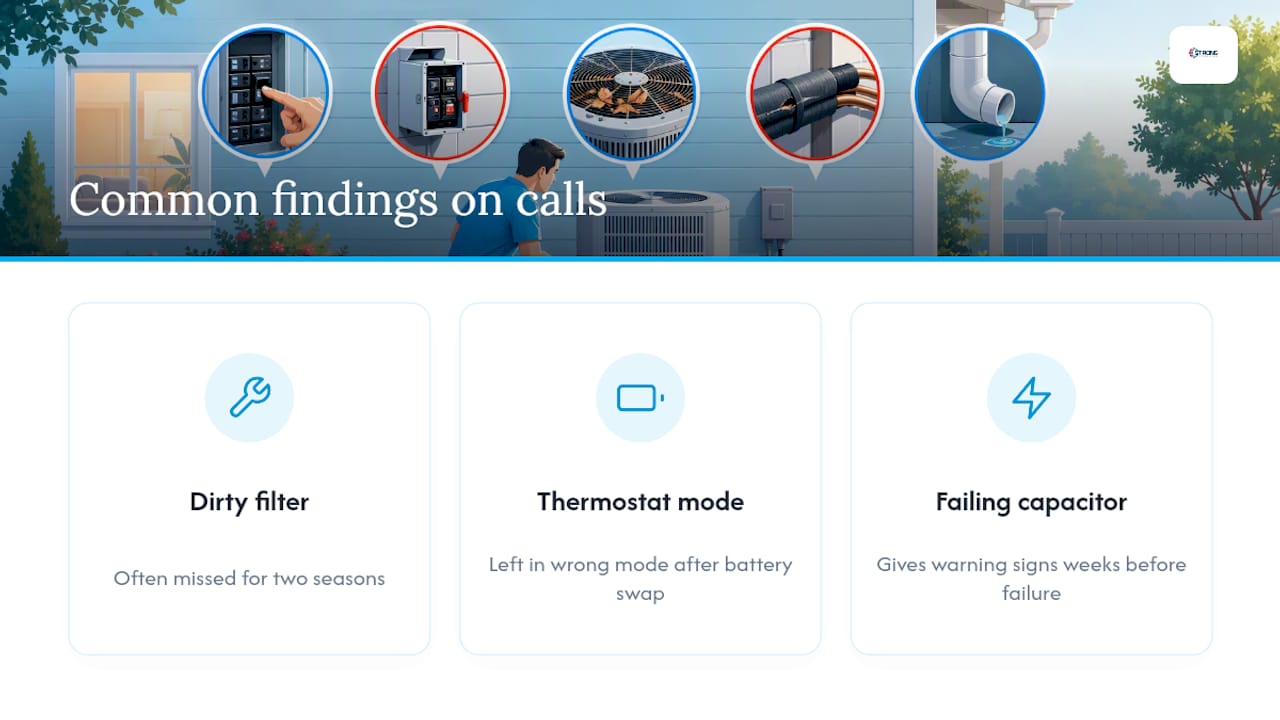
Across our service calls in and around Colorado Springs, the pattern repeats more than most homeowners expect: a dirty filter that got missed for two seasons, a thermostat left in the wrong mode after a battery swap, or a capacitor that finally gave out after years of humming along under stress. Timing matters here. A capacitor that’s struggling but hasn’t failed completely often gives warning signs weeks before it strands you without cooling on the hottest day of the summer.
Our technicians walk you through exactly what they find before recommending a fix, no guessing games, no upsell pressure. If your system won’t start and the checks above didn’t solve it, our cooling services page covers what a diagnostic visit involves.
— Owner
Need a Technician? Here’s What to Have Ready
Strong Heating And Cooling handles the full range of “AC not turning on” repairs: electrical diagnostics, capacitor and contactor replacement, condensate line clearing, control board troubleshooting, and refrigerant leak repair under proper EPA certification. We’re not a parts-swapping outfit guessing our way to a bill. Our techs isolate the actual fault first, then explain the fix and cost before any work starts.

Before you call, have a few details ready: your system’s age or model number if it’s visible, whether the breaker tripped once or repeatedly, and any noises or smells you noticed. A quick photo of the outdoor unit and the breaker panel helps our technician arrive prepared rather than diagnosing from scratch. We offer scheduled service for routine failures and prioritize emergency dispatch when you’re dealing with the stop-immediately signs covered above, so you’re not left without cooling overnight in a Colorado Springs summer. Ready to get someone out to look at it? Request service through our air conditioner services page and we’ll get you on the schedule.
Sources
- AC Not Turning On | Carrier
- Air conditioner won’t start diagnostic sequence - InspectAPedia
- Common HVAC electrical failures and safety guidance - ServiceMag
FAQ
How do I make my AC kick on?
Set the thermostat to COOL with a target temperature below the current room reading, confirm the breakers haven’t tripped, and check that the air filter isn’t clogged. If those three checks don’t fix it, the issue has likely moved to a component that needs a technician.
Why is my outside AC unit not running?
The outdoor condenser can fail to run because of a tripped breaker or disconnect switch, a bad capacitor that leaves the compressor humming without starting, debris jamming the fan, or a refrigerant-related safety cutout. A humming sound with no fan movement usually points to a failed capacitor.
How do I force an AC to turn on?
You can’t safely force a system with a genuine electrical or safety fault, and trying to bypass a safety switch like a condensate float can cause water damage or equipment failure. The safest approach is running the full checklist (thermostat, breaker, filter, condensate, outdoor unit) and calling a professional if the unit still won’t start.
Why does my furnace won’t turn on when I need heat instead?
Many of the same categories apply: thermostat settings, tripped breakers, a clogged filter, and control board issues are common across both heating and cooling equipment. Our guide on what to check when a furnace won’t turn on walks through the heating-specific steps.
Is it safe to replace an AC capacitor myself?
No. Capacitors store a lethal electrical charge even when the system is powered off, and technicians use specific tools to discharge them safely before replacement. This is one of the clearest examples of a repair that belongs to a licensed professional, not a homeowner project.
Recommended
Need expert HVAC help?
Colorado Springs' trusted, veteran-owned heating & cooling team — same-day service.