

TL;DR:
- Reading HVAC contractor reviews reveals operational details like punctuality and invoice matching, which better predict reliability than star ratings. Verifying local Colorado Springs licenses, permits, and insurance is essential to confirm contractors’ legal compliance and prevent billing surprises or code violations. Combining reviews with credential checks and itemized quotes helps homeowners make informed decisions and avoid untrustworthy or non-compliant providers.
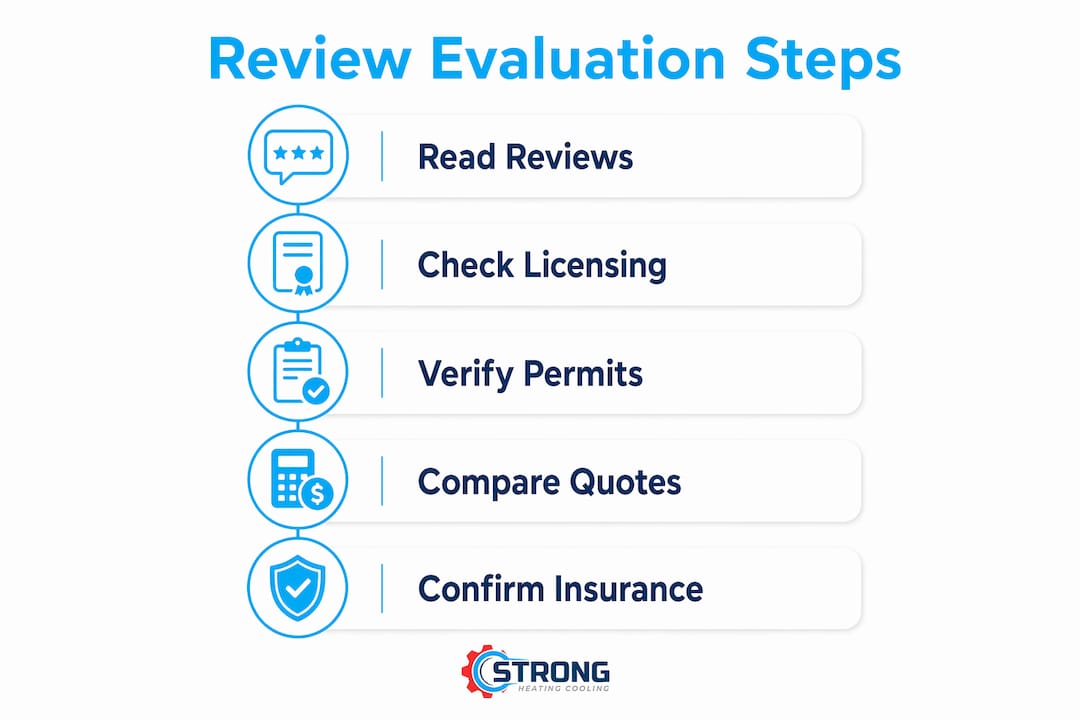
Reading HVAC contractor reviews is the most reliable way to find trustworthy installation, repair, and maintenance professionals in Colorado Springs when you know exactly what to look for. Most homeowners scan star ratings and move on, missing the operational details that actually predict service quality. This guide teaches you to read contractor feedback the way an industry professional would, then layer in the local licensing, permitting, and insurance checks that reviews alone cannot confirm. By the end, you will have a repeatable process for evaluating any HVAC contractor serving the Colorado Springs area.
What do HVAC contractor reviews actually reveal about reliability?
Recurring operational details such as punctuality, respect for the home, and invoice matching are the clearest indicators of quality HVAC service in reviews. These signals matter far more than a contractor’s overall star rating because they describe real behavior on real jobs. A contractor with a 4.2-star average and consistent comments about on-time arrivals and clean work areas is a stronger candidate than one with a 4.8-star average built on vague praise.
When reading HVAC contractor feedback, focus on the specifics that repeat across multiple reviews. A single mention of a technician wearing shoe covers is anecdotal. Ten mentions across different jobs is a pattern. The same logic applies to invoice accuracy: when multiple customers confirm the final bill matched the original quote, that signals a contractor who prices honestly and communicates clearly.
Review indicators vary by service type. For repair calls, look for comments about how clearly the technician explained the diagnosis and what caused the problem. For full system replacements, the dominant review themes shift to how well the crew protected the home during installation and whether permits were handled without pushing that responsibility onto the homeowner. Reading with this distinction in mind sharpens your ability to assess contractor feedback for the specific job you need done.
Negative reviews deserve the most attention, not the least. Reading the one-star and two-star feedback first uncovers the operational issues a contractor’s marketing will never mention. Look for patterns in complaints rather than isolated incidents. One customer upset about scheduling is noise. Three customers describing the same billing surprise is a signal worth taking seriously.
The quality of a contractor’s response to negative feedback is equally telling. A professional and solution-focused response to a complaint signals accountability more reliably than star ratings alone. A contractor who dismisses criticism publicly, or never responds at all, is showing you how they handle problems after the job is done.
Here are the operational review features worth prioritizing when evaluating HVAC contractor experience:
- Repeated mentions of on-time arrival and accurate scheduling windows
- Comments about technicians protecting floors, furniture, and work areas
- Confirmation that final invoices matched the original quoted price
- Clear explanations of diagnosis and repair options during service calls
- Permit handling managed by the contractor without shifting responsibility to the homeowner
- Responsive and professional replies to negative reviews
Pro Tip: Check the review volume alongside the ratings. A contractor with 200 reviews and a 4.3-star average has a more credible track record than one with 12 reviews and a perfect 5.0. Low review counts on HVAC review sites like Google, Yelp, or the Better Business Bureau can indicate a newer business or one that discourages customers from leaving feedback.
How does local licensing in Colorado Springs affect review context?
Colorado HVAC licensing is local rather than statewide, which means verifying a city-specific mechanical contractor certificate is the only way to confirm a contractor’s legal standing in Colorado Springs. There is no state-issued HVAC license that covers all of Colorado. This distinction matters when reading reviews because a contractor operating without the proper local license may still have positive feedback from customers who never thought to check. Understanding the benefits of a licensed HVAC contractor makes clear why this verification step cannot be skipped.
Mechanical permits are required for HVAC replacement in Colorado Springs, and failure to handle permits properly is one of the most consequential red flags you can find in customer reviews. Permits trigger inspections that confirm the installation meets local code. Without that inspection, you have no independent verification that the work was done correctly, and your homeowner’s insurance may not cover related damage.
Review comments about permits are a direct heuristic for installation quality. When a reviewer mentions that the contractor skipped the permit process, or worse, asked the homeowner to pull the permit themselves, that is a warning about the contractor’s willingness to cut corners. Homeowners pushed to pull their own permits should treat that request as a serious red flag, because it shifts legal and financial liability away from the contractor and onto you.
Colorado Springs also sits at an elevation above 6,000 feet, which requires contractors to perform adjusted Manual J load calculations when sizing equipment. Contractors who ignore altitude-specific sizing requirements generate callbacks and negative reviews about systems that short-cycle or fail to heat and cool effectively. If you see reviews mentioning a new system that never quite keeps up, undersized equipment from a contractor skipping proper load calculations is a likely cause.
| Verification item | What to check | Where to verify |
|---|---|---|
| Local mechanical contractor license | Active license issued by Colorado Springs | City of Colorado Springs Development Services |
| Mechanical permit for replacement | Permit pulled before work begins | Colorado Springs permit portal or contractor confirmation |
| Permit inspection completion | Final inspection signed off by city inspector | City permit records |
| Workers’ compensation insurance | Active policy covering all employees on site | Certificate of Insurance from contractor |
| General liability insurance | Minimum coverage for property damage | Certificate of Insurance from contractor |
Pro Tip: Call the City of Colorado Springs Development Services office directly to confirm a contractor’s mechanical license status before signing any agreement. You can also check the permit portal to verify that a permit was pulled for your address after work begins. This takes less than ten minutes and removes any doubt about compliance.
How do you interpret an itemized HVAC quote alongside reviews?
An itemized HVAC quote must clearly list equipment, labor, materials, permits, and warranty details as separate line items. Lump-sum quotes and pressure tactics are red flags that frequently appear in negative reviews as complaints about unexpected costs or charges that were never discussed upfront. When a quote bundles everything into a single number, you have no way to know whether permits are included, what equipment brand and model you are getting, or what labor rate you are paying.
Cross-checking quotes with review feedback reveals whether pricing complaints in reviews stem from missing itemization or undisclosed permit fees. If three reviewers mention being surprised by a permit charge at the end of the job, and the quote you received does not list permits as a line item, you are looking at the same pattern. That connection between review complaints and quote structure is one of the most practical tools available when evaluating contractors. For a deeper look at what drives unexpected costs, the article on hidden HVAC cost drivers covers the most common sources of billing surprises.
Follow these steps when reading and analyzing an HVAC quote:
- Confirm the equipment section lists the brand, model number, and SEER or AFUE rating. Vague descriptions like “new AC unit” are not acceptable on a professional quote.
- Check that labor is listed separately from equipment and materials. A combined line makes it impossible to compare labor rates across contractors.
- Look for a permit line item. If permits are not listed, ask the contractor directly whether they are included and get the answer in writing.
- Review the warranty section. It should specify both the manufacturer’s equipment warranty and the contractor’s labor warranty as separate items.
- Note whether the quote has an expiration date and whether the contractor applied any pressure to sign quickly. Legitimate contractors give you time to compare options.
- Compare the quote structure against the review complaints you have already read. If reviewers mention surprise charges, identify which line items in the quote could produce those charges.
Pro Tip: Ask every contractor the same three questions when requesting a quote: “Is the permit fee included in this price?”, “What equipment brand and model does this quote cover?”, and “What is your labor warranty?” Contractors who answer these questions clearly and without hesitation are demonstrating the transparency that top-rated HVAC contractors consistently show in their reviews.
What insurance credentials should you verify beyond reading reviews?
General liability insurance and workers’ compensation are the two required coverage types for any HVAC contractor working in your home. General liability protects your property if the contractor causes damage during the job. Workers’ compensation covers the contractor’s employees if someone is injured on your property. Without both, you carry financial exposure that most homeowners do not realize exists until something goes wrong.
Verify HVAC contractor insurance before any work begins by requesting a current Certificate of Insurance. The COI is a standard document that lists the insurer, policy numbers, coverage amounts, and expiration dates. A contractor who hesitates to provide a COI or offers a document that looks altered or expired is showing you a red flag that reviews rarely capture, because most customers never ask for this document in the first place.
Calling the insurance agent listed on the COI to confirm active coverage takes about five minutes and removes any remaining doubt. Insurance policies can lapse between the time a contractor prints a COI and the day work begins. That phone call confirms the policy is still active and that the coverage amounts match what the contractor claimed. Colorado credibility hinges on proper local licensing and insurance, and reviews alone cannot guarantee contractor legitimacy on either front.
Use this checklist when verifying insurance credentials:
- Request the COI before signing any contract or allowing work to begin
- Confirm the COI lists both general liability and workers’ compensation coverage
- Check that the policy expiration dates extend through your project’s completion date
- Call the insurer or agent listed on the COI to verify the policy is active
- Confirm the coverage amounts are reasonable for the scope of work (at minimum $1 million general liability for a full system replacement)
- Note whether the contractor lists your name and address as an additional insured on the COI for larger projects
Practical steps for using HVAC service ratings effectively in Colorado Springs
The most effective approach to evaluating HVAC contractors combines review reading, licensing verification, quote analysis, and insurance confirmation into a single process. No single step is sufficient on its own. A contractor with excellent reviews but no local mechanical license is still a liability. A contractor with verified credentials but a pattern of pricing complaints in reviews deserves a closer look at their quote structure.
Start with platforms that use review moderation and verification, such as Google, the Better Business Bureau, and Angi. These platforms apply some level of quality control that reduces the volume of fake or incentivized reviews. Read the negative reviews first, then look at how the contractor responded. Move to the positive reviews only after you understand the contractor’s known weaknesses.
Cross-reference what you find in reviews against the contractor’s local licensing status and permit history. The City of Colorado Springs Development Services office maintains records of active mechanical contractor licenses and pulled permits. This step takes minutes and confirms whether the contractor’s operational reputation in reviews is backed by legal compliance.
Safety note: Be cautious of contractors who contact you unsolicited after a storm or major weather event, offer unusually low prices to secure a quick signature, or cannot provide a COI on request. These are common patterns among non-compliant contractors who rely on urgency and price to close jobs before homeowners have time to verify credentials.
The table below summarizes the key signals to look for and the red flags to avoid when evaluating HVAC contractors in Colorado Springs.
| Signal type | Green flag | Red flag |
|---|---|---|
| Review content | Repeated operational detail, permit mentions, invoice accuracy | Vague praise, no mention of permits, billing surprise patterns |
| Contractor response to complaints | Professional, solution-focused, specific | Dismissive, absent, or defensive |
| Licensing | Active local mechanical contractor license confirmed | Cannot provide license number or city has no record |
| Permit handling | Contractor pulls permit before work begins | Homeowner asked to pull permit or permit skipped entirely |
| Quote structure | Itemized with equipment, labor, permits, and warranty | Lump-sum pricing, no permit line, pressure to sign quickly |
| Insurance | Current COI with both coverage types, verified by insurer | Expired COI, missing workers’ comp, hesitation to provide documentation |
What I’ve learned from years of HVAC contractor evaluations
After working in the Colorado Springs HVAC market for years, the pattern that stands out most is how rarely homeowners verify licensing before hiring. They read reviews, they get a quote, and they assume the contractor is legitimate because the reviews sound good. The first time I called the city to check a contractor’s mechanical license status and found it had lapsed, it changed how I approach every evaluation. Reviews told me the contractor did good work. The city told me the contractor was not legally authorized to do that work in Colorado Springs.
The pricing traps I see most often in reviews are not about contractors charging too much. They are about contractors not disclosing enough. A homeowner who feels surprised by a permit fee at the end of a job is not upset about the fee itself. They are upset because no one told them it was coming. Reading the negative reviews on that contractor’s profile almost always reveals the same complaint from multiple customers, which means the issue is structural, not accidental.
Reading negative reviews first genuinely changed how I select contractors to recommend. The positive reviews confirm what a contractor does well. The negative reviews tell you what to watch for and whether the contractor takes responsibility when things go wrong. A contractor who responds to a one-star review with a specific explanation and a resolution offer is demonstrating the same accountability you want them to show if something goes wrong on your job.
My advice to any Colorado Springs homeowner or tenant is to treat the review reading process as the starting point, not the conclusion. Verify the license, request the COI, and compare itemized quotes before making a decision. The contractors who hold up well under that level of scrutiny are the ones worth hiring.
— Owner
Why Strong Heating & Cooling makes the review process easier
When you have done the work of reading reviews, verifying credentials, and comparing quotes, you want a contractor who holds up under that scrutiny. Strongheatingandcooling provides fully itemized quotes that list equipment, labor, permits, and warranty details as separate line items, so there are no billing surprises after the job is done. The team carries active general liability and workers’ compensation insurance, and the company holds the local mechanical contractor credentials required to work legally in Colorado Springs.

For homeowners and tenants considering a full system replacement, Strongheatingandcooling offers HVAC replacement financing options that make the investment manageable without sacrificing equipment quality. Whether you need a new furnace, air conditioner, or heat pump, the team at Strong Heating & Cooling is ready to walk you through every step with the transparency and honesty that top-rated HVAC contractors consistently demonstrate in their reviews.
FAQ
What should I look for when reading HVAC contractor reviews?
Focus on repeated operational details such as punctual arrivals, invoice accuracy, and permit handling rather than overall star ratings. Negative reviews and contractor responses to complaints reveal the most about real service quality.
Does Colorado require a statewide HVAC license?
Colorado does not issue a statewide HVAC license. Contractors must hold a city-specific mechanical contractor license, so verifying local licensing status with Colorado Springs Development Services is the correct step before hiring.
Are HVAC permits required for system replacement in Colorado Springs?
Mechanical permits are required for HVAC replacement in Colorado Springs, and the permit process includes a city inspection to confirm code compliance. A contractor who asks you to pull the permit yourself is transferring legal liability onto you.
How do I verify that an HVAC contractor has valid insurance?
Request a current Certificate of Insurance listing both general liability and workers’ compensation coverage, then call the insurer listed on the document to confirm the policy is active. This step takes about five minutes and protects you from financial exposure if something goes wrong on the job.
Why do some HVAC reviews mention unexpected charges?
Pricing surprises in reviews most often trace back to lump-sum quotes that do not itemize permits, labor, or warranty costs separately. Comparing an itemized quote against review complaints about billing is the most direct way to identify whether a contractor has a pattern of undisclosed fees.
Key takeaways
Reading HVAC contractor reviews effectively requires combining operational review signals with local licensing verification, itemized quote analysis, and insurance confirmation to make a fully informed hiring decision.
| Point | Details |
|---|---|
| Operational details over star ratings | Repeated mentions of punctuality, invoice accuracy, and permit handling predict service quality better than overall ratings. |
| Local licensing is non-negotiable | Colorado Springs requires a city-specific mechanical contractor license; verify it directly with Development Services before hiring. |
| Permits protect the homeowner | Skipped permits void warranties and insurance coverage; any contractor asking you to pull your own permit is a red flag. |
| Itemized quotes expose pricing patterns | Lump-sum quotes hide permit and labor costs that frequently appear as billing complaints in negative reviews. |
| Insurance must be verified independently | Request a current COI and call the insurer to confirm active coverage before any work begins on your property. |


