

TL;DR:
- Older HVAC systems gradually become less efficient, increasing energy bills and failure risks before outright breakdowns occur.
- Replacing equipment before peak seasons avoids costly emergency repairs and enhances savings through modern energy-efficient models.
Most homeowners assume their HVAC system will simply keep running until it stops. That assumption tends to be expensive. Understanding why HVAC system age triggers replacement is less about waiting for a dramatic breakdown and more about recognizing a slow, steady decline in performance and reliability that accelerates well before the system quits entirely. The older a unit gets, the more energy it wastes, the more often it needs repairs, and the greater the risk it fails on the coldest day of winter or the hottest afternoon of summer. This guide walks you through the mechanics, the financial logic, and the practical signs that point toward replacement.
Table of Contents
- Key Takeaways
- How age affects HVAC efficiency and performance
- The economics of repair costs vs. replacement
- Avoiding peak season breakdowns
- Benefits of upgrading to a modern HVAC system
- Evaluating your system’s age and repair history
- My take on why waiting almost always costs more
- How Strongheatingcooling can help you plan the right move
- FAQ
Key Takeaways
| Point | Details |
|---|---|
| Age drives gradual inefficiency | Older systems consume more energy to produce the same output, raising utility bills steadily over time. |
| The 50% rule guides finances | If a repair costs 50% or more of a new system’s price, replacement is usually the better investment. |
| Peak season risk is real | Aging HVAC systems are most likely to fail during extreme heat or cold, when replacement options are costliest. |
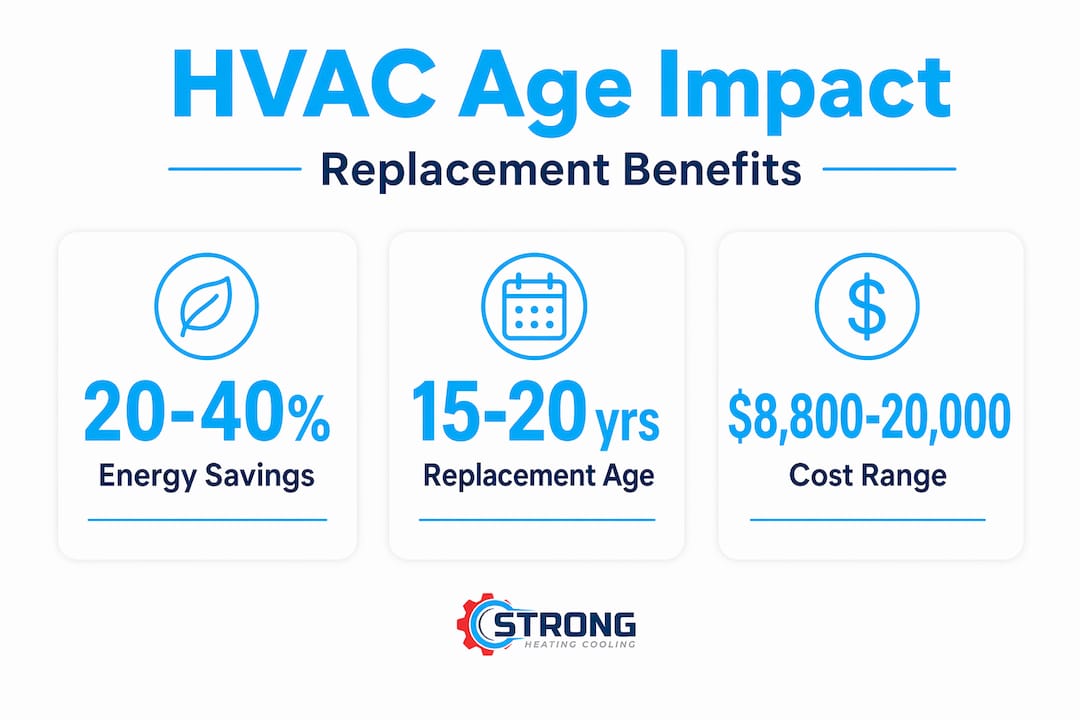
| Modern systems offer major savings | New ENERGY STAR models typically cut energy use by 20 to 40 percent compared to older equipment. |
| Maintenance history matters | A well-maintained older unit may outlast a neglected newer one, so repair records shape replacement timing. |
How age affects HVAC efficiency and performance
There is a common assumption that an HVAC system either works or it does not. The reality is more gradual. Age correlates with slowly increasing inefficiency and growing failure risk rather than acting as a hard cutoff date. Components wear at different rates, and as each one degrades, the system has to work harder to maintain the same level of comfort.
The compressor in a central air conditioner, for example, is designed to cycle on and off in controlled intervals. As the unit ages, refrigerant levels can drift, coils accumulate buildup, and the compressor begins running longer cycles to hit your thermostat’s target temperature. That extended run time creates additional mechanical stress, which accelerates wear on other components. The result is a system that consumes noticeably more electricity without delivering better performance.
Furnaces follow a similar pattern. Heat exchangers develop micro-cracks over years of thermal expansion and contraction. Inducer motors lose efficiency. Burners become less consistent. Each of these issues compounds the others, and utility bills rising over 20% from one season to the next without a corresponding change in weather is a strong signal that the system is no longer operating efficiently.
Typical lifespan ranges give you a useful benchmark, though they are not guarantees. Central air conditioners generally last 15 to 20 years. Furnaces often reach 15 to 30 years depending on fuel type and maintenance. Heat pumps tend to fall in the 10 to 15 year range because they operate year-round, accumulating wear faster than systems used only seasonally. Once a unit passes the midpoint of its expected lifespan and begins showing signs of strain, the question shifts from whether to replace it to when.
Pro Tip: Check your HVAC system’s manufacture date on the data plate, usually found on the side of the unit or inside the furnace cabinet. If you cannot locate it, the first four digits of the serial number often encode the year and week of manufacture.
The economics of repair costs vs. replacement
The financial case for replacement is often clearer than it feels in the moment. When a technician quotes you a repair, that number on its own can seem manageable. The problem is that aging systems rarely need just one repair.
Here is how the cost logic typically plays out as a system ages:
- Minor repairs accumulate over two to three years, each feeling reasonable at the time.
- A major component like the compressor or heat exchanger fails, generating a repair quote that rivals the cost of a new system.
- Even if you authorize the repair, the underlying equipment is still old, so additional failures follow within another year or two.
- Total expenditure across that period often exceeds what a new system would have cost upfront.
The industry standard for resolving this pattern is what most HVAC professionals call the 50% rule. A repair costing 50% or more of a new system’s price usually means replacement is the smarter financial move, particularly when the unit is already past its midpoint in expected service life. Paying $4,000 to repair a 16-year-old system worth $9,000 new does not make economic sense because you are investing heavily in equipment with limited remaining life.
| Scenario | Repair Cost | New System Cost | Better Option |
|---|---|---|---|
| 8-year-old unit, minor repair | $400 | $9,500 | Repair |
| 14-year-old unit, compressor failure | $4,200 | $9,500 | Replace |
| 18-year-old unit, heat exchanger crack | $3,800 | $10,000 | Replace |
| 12-year-old unit, inducer motor | $900 | $9,500 | Likely repair, monitor closely |
Refrigerant type adds another layer of financial pressure. Older systems built before 2010 often use R-22 refrigerant, which was phased out under federal environmental regulations. The shrinking supply of R-22 has driven recharge costs sharply upward, meaning a refrigerant leak on an older system can generate a repair bill that makes replacement the obvious choice even before the 50% threshold.
Full air conditioner replacement costs typically range from $8,800 to over $20,000 depending on system size, features, and installation complexity. That range reflects the difference between a standard single-stage unit and a premium variable-speed system with advanced zoning. Understanding where your needed system falls in that range gives you a concrete number to apply the 50% rule against.
Pro Tip: Keep a running log of every repair you authorize, including the date, the part replaced, and the cost. After two or three service calls, you will be able to see a pattern that either supports continued repair or makes the case for replacement far more clearly.
Avoiding peak season breakdowns
Beyond the immediate cost of repairs, there is a category of risk that financial comparisons alone do not fully capture. HVAC systems rarely fail without warning. Inefficiency and the likelihood of breakdown rise gradually with age, but the actual failure event often happens when the system is under the most stress. That means a sweltering July afternoon or a Colorado Springs cold snap in January.
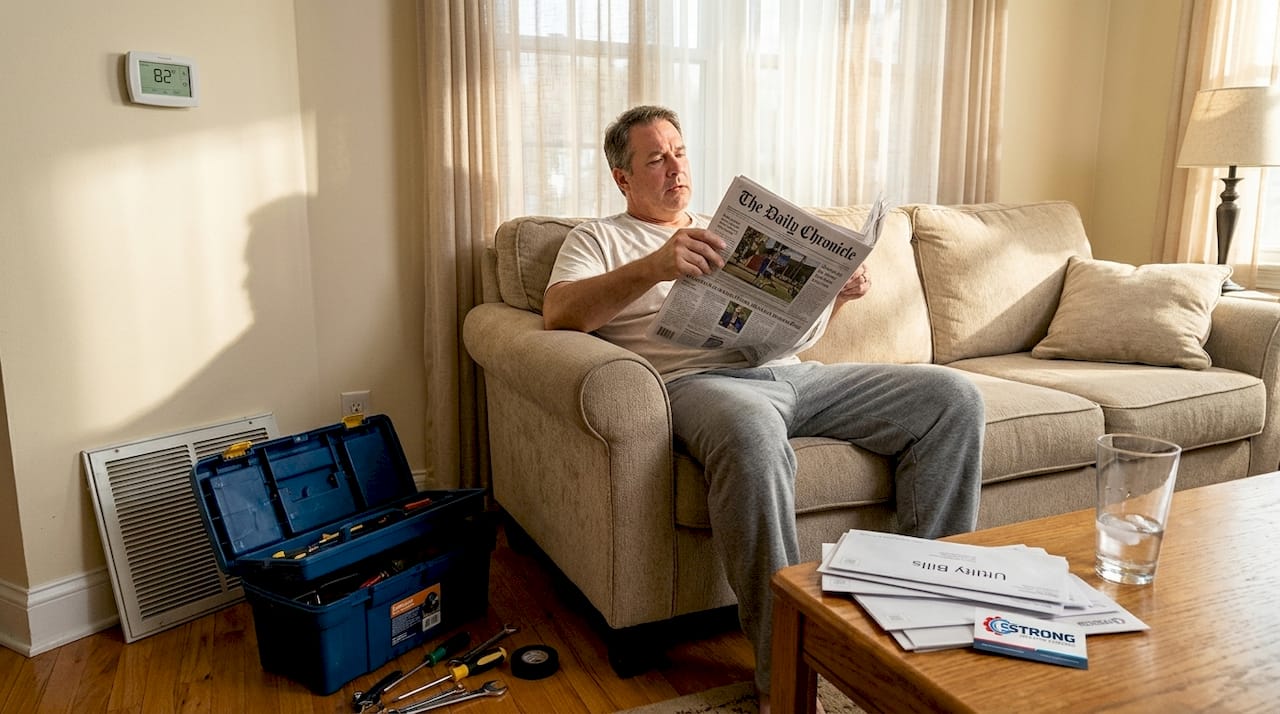
The timing matters enormously. Emergency replacements during extreme seasons cost 40 to 70 percent more than planned replacements. When every HVAC contractor in your area is overwhelmed with service calls, you lose the ability to compare quotes, choose your preferred equipment, or explore financing options calmly. You accept whatever is available, at whatever price the market demands that week.
Signs that your aging system is approaching this kind of failure are usually visible before the breakdown occurs:
- Uneven temperatures from room to room, with some spaces consistently too hot or too cold
- The system cycling on and off more frequently than it used to, a pattern called short cycling
- Unusual sounds such as grinding, banging, or rattling during startup or operation
- A noticeable increase in dust, humidity problems, or reduced air quality indoors
- The system running nearly continuously without reaching the set temperature on moderate weather days
Aging HVAC systems fail more frequently during peak demand seasons because that is precisely when they are under the greatest load. Proactive replacement before those seasons eliminates the emergency premium, gives you time to research equipment, and allows you to schedule installation during a slower period when technicians are more available. Preventive maintenance extends system life and provides your technician with a regular opportunity to flag components approaching failure, giving you enough lead time to plan a replacement on your terms.
Benefits of upgrading to a modern HVAC system
The case for replacement is not only about avoiding costs. A modern system delivers genuine improvements in comfort, efficiency, and long-term economics that an aging unit simply cannot match.
ENERGY STAR certified models typically reduce energy consumption by 20 to 40 percent compared to older equipment. That is not a marketing estimate. It reflects measurable differences in efficiency ratings. Current air conditioners are rated using the SEER2 standard, and modern furnaces achieve AFUE ratings well above those of units manufactured 15 or 20 years ago. In a Colorado Springs climate where both heating and cooling systems work hard, those efficiency gains translate directly to lower monthly utility costs.
The following table illustrates what that savings potential looks like over time:
| System Age | Annual Energy Cost (Estimate) | Savings with New System | 10-Year Savings |
|---|---|---|---|
| 20-year-old system | $2,400 | 35% savings | $8,400 |
| 15-year-old system | $2,100 | 25% savings | $5,250 |
| 10-year-old system | $1,800 | 15% savings | $2,700 |
Beyond the utility bill, modern systems offer features that older units cannot provide. Variable-speed motors modulate output instead of cycling fully on or off, which maintains steadier temperatures and reduces humidity more effectively. Two-stage and modulating furnaces operate at partial capacity most of the time, creating quieter, more consistent heat. Smart thermostat integration is standard on most new equipment, giving you control over scheduling and monitoring that older analog systems never had.
Federal tax credits and utility rebates further reduce the net cost of replacement. The Inflation Reduction Act extended tax credits for qualifying high-efficiency HVAC equipment, meaning eligible homeowners can reduce their federal tax liability by up to $2,000 on a qualifying heat pump or $600 on a high-efficiency furnace or central air conditioner. When you factor in available incentives alongside projected energy savings, the payback period on a new system often falls within five to seven years.
Replacement also contributes to property value. Buyers and appraisers recognize the difference between a home with a recently installed, high-efficiency system and one carrying aging equipment that may need replacement shortly after purchase.
Evaluating your system’s age and repair history
Calendar age is a useful starting point, but it does not tell the whole story. Treating HVAC replacement timing as an asset management decision means weighing efficiency decline, failure likelihood, parts availability, and cumulative repair costs together rather than relying on age alone.
A system that has received consistent annual maintenance, including filter changes, coil cleaning, refrigerant checks, and belt inspections, may perform reliably for years beyond its average service life. By contrast, a system that has gone five years without a tune-up and has accumulated multiple unaddressed issues may be approaching end-of-life well ahead of schedule.
When assessing whether your system warrants replacement, consider these practical indicators:
- Two or more significant repairs within the past two years suggest deteriorating reliability regardless of age
- Replacement parts that are no longer readily available signal an aging system that is becoming difficult and expensive to maintain
- Comfort complaints that persist even after repairs indicate the system is no longer sized or functioning adequately for your space
- An energy audit or diagnostic showing efficiency far below the system’s rated specifications confirms real-world degradation
Pro Tip: Ask your technician for an efficiency diagnostic during your next service call. Modern diagnostic tools can measure your system’s actual output against its rated capacity, giving you concrete data instead of having to rely on a general sense that something feels off.
If you are unsure where your system stands, a professional assessment from a qualified HVAC technician is the most reliable way to get clear information. A thorough inspection covers all major components, identifies what is wearing, and gives you a realistic picture of remaining service life alongside repair costs. That data makes the replacement decision much easier to evaluate objectively.
My take on why waiting almost always costs more
In my experience working with homeowners across Colorado Springs, the most common and most expensive mistake is treating HVAC replacement as something to figure out after the system stops working. I understand the logic. The system is still running. Repairs have been manageable. Why spend thousands of dollars on something that seems to be functioning?
What I have learned is that aging equipment extracts its cost slowly, in ways that are easy to overlook individually but significant when added together. The utility bills that have climbed $40 a month over three years. The three service calls in the past two winters. The compressor that your technician mentioned was running hot. Each of those events signals that the system is past its efficient prime, and the cumulative cost of those signals often exceeds what a planned replacement would have cost.
I also think homeowners underestimate the stress of a reactive replacement. When a system fails in January and your house is at 45 degrees, you are not making a careful financial decision. You are saying yes to whatever gets you heat fastest. Proactive replacement avoids emergency costs and the rushed decision-making that drives total replacement costs higher than they need to be. The homeowners I have seen navigate this well are the ones who made the call in September, before heating season, with time to choose their equipment and explore financing without pressure.
Modern systems have also changed the return-on-investment calculation. The efficiency gains in equipment available today are substantial enough that waiting another two years on an old unit often costs more in utilities than the interest on a financed replacement would. That is a calculation worth doing before the next service call.
— Strong
How Strongheatingcooling can help you plan the right move
When you are weighing repair against replacement, having a trusted local team makes a genuine difference. Strongheatingcooling serves homeowners and property managers throughout Colorado Springs with transparent pricing, experienced technicians, and 24/7 availability when you need emergency HVAC repair on short notice.

Whether you are dealing with a system showing early signs of decline or you need a new installation planned around your schedule, Strongheatingcooling walks you through every option with clear cost information upfront. If budget is a concern, flexible financing options are available to spread the cost of replacement over time without delaying the comfort and efficiency you should be getting from your home’s HVAC system. The team also handles new AC installations and furnace replacements with the same level of transparency and care. Reach out to schedule an assessment and get the information you need to make a confident, well-timed decision.
FAQ
What age makes an HVAC system a replacement candidate?
Most central air conditioners and furnaces become strong replacement candidates between 15 and 20 years of age, especially when repairs become more frequent or costly. Heat pumps typically reach this threshold earlier, around 10 to 15 years, due to year-round operation.
How does HVAC age affect my energy bills?
As components wear over time, the system runs longer cycles to reach the same temperature, which increases energy consumption. Utility bills rising over 20% without a weather-related explanation are a reliable sign of age-related efficiency loss.
What is the 50% rule for HVAC replacement?
The 50% rule states that if a repair costs 50% or more of the price of a new system, replacement is usually the smarter financial choice. This rule applies most clearly when the unit is already past the midpoint of its expected service life.
Can regular maintenance extend an aging HVAC system’s life?
Yes. Well-maintained units can exceed average service life by five or more years compared to systems with inconsistent maintenance. However, maintenance cannot reverse mechanical wear indefinitely, so it extends useful life rather than eliminating replacement.
Why does HVAC replacement cost more during summer and winter?
Demand for HVAC services peaks during extreme weather, which limits technician availability and equipment inventory. Emergency replacements during these periods can cost 40 to 70 percent more than replacements scheduled during shoulder seasons like spring or fall.


