

TL;DR:
- HVAC manufacturer warranties typically cover parts but exclude labor, service calls, and emergency fees. Extended plans or home warranties provide emergency access and labor coverage, reducing unexpected costs during system failures. Proper maintenance records and timely plan enrollment are essential for swift, effective emergency repair responses.
Your furnace stops working at 11 PM on a January night in Colorado Springs, and your first thought is that your warranty will handle it. Then you get the bill and realize the warranty only covered the part, not the labor, not the service call, and not the after-hours fee. Understanding why hvac warranty covers emergency repairs, and when it does not, is one of the most practical things a homeowner can do before a crisis happens. This article breaks down the types of coverage available, what each one actually pays for, and how to make sure you are protected when it counts most.
Table of Contents
- Key takeaways
- Why HVAC warranty covers emergency repairs: what you need to know first
- How home warranties and service plans handle emergency repairs
- The financial case for having emergency repair coverage
- Making the most of your HVAC warranty during an emergency
- Choosing the right warranty for emergency repair protection
- My perspective on emergency coverage after 40 years in HVAC
- Ready for an emergency? Strong Heating & Cooling can help
- FAQ
Key takeaways
| Point | Details |
|---|---|
| Manufacturer warranties cover parts, not labor | Standard HVAC warranties protect against defective parts but rarely pay for the labor needed to fix them. |
| Emergency coverage comes from extended or home warranty plans | Home warranties and service agreements are what actually provide emergency repair coordination and cost predictability. |
| Labor costs are the biggest surprise expense | Labor for warranty repairs can range from $200 to over $2,000, making supplemental coverage worth evaluating carefully. |
| Maintenance records protect your coverage | Skipping annual service can void your manufacturer warranty and lead to denied claims during urgent repairs. |
| Preparation speeds up emergency claims | Having your model number, serial number, and symptom timeline ready can significantly shorten repair response times. |
Why HVAC warranty covers emergency repairs: what you need to know first
Most homeowners picture a warranty as a blanket promise that covers everything that goes wrong with their HVAC system. That picture is accurate in some situations but incomplete in most. The industry distinguishes between two very different types of coverage: manufacturer warranties and service or labor warranties.
A manufacturer warranty is what comes standard when you purchase a new heating or cooling system. It protects against defects in the equipment itself, meaning if a heat exchanger cracks due to a manufacturing flaw or a compressor fails prematurely, the manufacturer will supply a replacement part at no cost. However, manufacturer warranties often exclude the labor required to install that part, plus any associated service fees, which is where many homeowners are caught off guard.
Emergency repairs add another layer of complexity. An emergency repair is typically a situation where your system fails completely during extreme weather, outside of normal business hours, or when a safety risk like a gas leak or carbon monoxide concern is present. These situations almost always involve labor, diagnostic fees, and sometimes after-hours surcharges. None of those costs fall under a standard manufacturer warranty.
Pro Tip: Read the warranty documentation that came with your HVAC equipment before you need it, not during an emergency. Look specifically for what the warranty excludes under “labor” and “service fees” so you know exactly where your out-of-pocket responsibility begins.
Here is what standard manufacturer warranties typically cover and exclude:
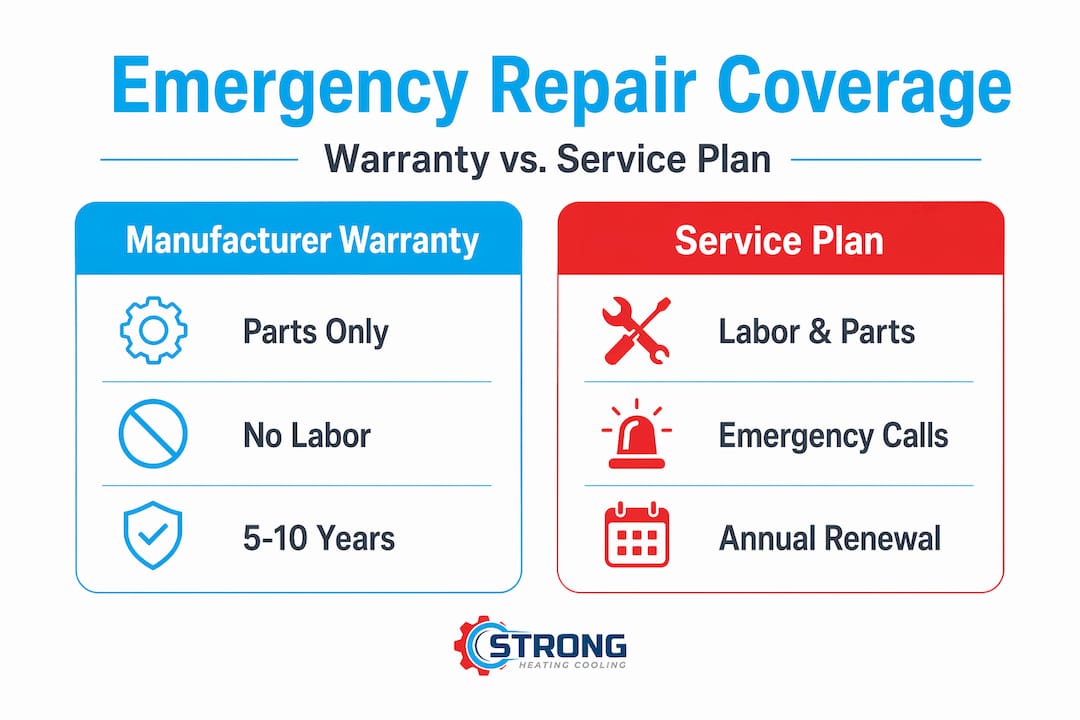
- Parts that fail due to manufacturing defects within the warranty period, usually five to ten years
- Replacement components such as motors, coils, heat exchangers, and circuit boards when defects are confirmed
- Exclusions typically include labor, refrigerant, diagnostic fees, and any damage caused by improper installation or lack of maintenance
- After-hours or emergency service fees are almost never included in manufacturer coverage
Understanding this gap is the foundation for making smarter decisions about extended coverage.
How home warranties and service plans handle emergency repairs
Once you recognize that manufacturer warranties stop at parts, the next question is what covers the rest. That answer is usually a home warranty plan or an extended service agreement, and the two work quite differently from each other.
A home warranty is a service contract, typically renewed annually, that covers the repair or replacement of home systems and appliances when they fail due to normal wear and tear. For HVAC systems, this usually means home repair plans coordinate service and send a technician when you file a claim. You pay a service fee, often between $75 and $150 per visit, and the plan covers the remaining repair costs up to its stated limit.
An extended service agreement, sometimes called a labor warranty, is often purchased directly through the HVAC manufacturer or the contractor who installed your system. These plans extend the labor coverage beyond what the manufacturer warranty provides and sometimes include priority scheduling for emergency calls.
The table below compares how these two options differ in practical terms.
| Feature | Manufacturer warranty | Home warranty or extended plan |
|---|---|---|
| Parts coverage | Yes, for defects | Yes, for wear and breakdowns |
| Labor coverage | Rarely or limited | Usually included up to a cap |
| Emergency service access | No | Often yes, with a hotline |
| Service fee per visit | None for parts | $75 to $150 typically |
| Coverage term | 5 to 10 years for parts | Annual renewal |
| Waiting period | None | Often 30 days from enrollment |
One detail worth understanding is the waiting period. Some providers require a 30-day waiting period before new coverage becomes active. If you enroll in a home warranty after your system starts acting up, that repair may not be covered. Timing your enrollment matters, and doing it during a routine maintenance visit rather than when something is already failing is the smarter approach.
Pro Tip: When reviewing a home warranty or service plan, look for the coverage cap on HVAC repairs. Some plans cap payouts at $1,500 per year, which may not be enough if your system needs a major component replaced. Compare caps across providers before signing.
The real value of these plans extends beyond money. Emergency coverage functions as a service-delivery product, meaning you get access to a vetted technician network and an emergency line instead of scrambling to find someone available at midnight during a heat wave.
The financial case for having emergency repair coverage
Thinking about HVAC warranties through the lens of financial risk makes the value much clearer. Without any coverage beyond the manufacturer warranty, you are personally responsible for every dollar of labor and service fees when your system breaks down urgently.
Typical HVAC repairs cost between $130 and $450, which is manageable for most households. But that range reflects routine repairs scheduled during normal business hours. An emergency repair on a weekend in the middle of winter can easily land outside that range, especially when you factor in after-hours surcharges, refrigerant costs, or a failed component that requires significant labor to access. Full system replacement, when a repair is no longer viable, can reach $5,000 or more.
The table below puts these costs into context.
| Repair scenario | Estimated cost without coverage | Estimated cost with plan |
|---|---|---|
| Minor component repair, business hours | $130 to $300 | $75 to $150 service fee |
| Major component repair, business hours | $450 to $1,200 | $75 to $150 plus plan cap offset |
| Emergency repair, after hours | $500 to $2,000+ | $75 to $150 plus emergency fee |
| Full system replacement | $3,000 to $5,000+ | Partial offset depending on plan |
Labor costs for warranty repairs can range from $200 to over $2,000 depending on the repair type, even when the parts themselves are covered. That figure surprises most homeowners because they assume covered parts means a covered repair. It does not.
The financial argument for extended coverage is most compelling for homeowners with systems that are five years old or older. As equipment ages, the likelihood of a significant repair increases, and so does the potential labor involved. A service plan that costs a few hundred dollars per year starts to look very reasonable when weighed against a single after-hours repair bill.
Beyond the dollar amounts, there is also the hidden cost of unexpected HVAC expenses that most homeowners do not budget for. Coverage removes a significant portion of that financial unpredictability.
Making the most of your HVAC warranty during an emergency
Knowing that coverage exists is one thing. Using it effectively when your system fails at the worst possible time is another. The homeowners who get the fastest service and the fewest billing surprises are the ones who prepare before an emergency happens.
The first priority is keeping your warranty valid. Skipping maintenance voids many warranties and can result in a denied claim exactly when you need coverage most. Most manufacturers require annual professional maintenance as a condition of coverage, and they will ask for documentation when you file a claim. Keeping records of every service visit, including the date, technician name, and work performed, gives you proof that you held up your end of the agreement.
Here is a practical checklist for staying ready to use your warranty effectively:
- Register your equipment with the manufacturer immediately after installation. Unregistered systems often receive shorter default warranty periods.
- Schedule a professional maintenance visit once a year, ideally in the fall for heating systems and spring for cooling systems.
- Keep your warranty documents, service records, and equipment information in one place, whether that is a physical folder or a digital file you can access from your phone.
- Note your system’s model number, serial number, and installation date. Having this information ready when you call for emergency service helps administrators route your request faster.
- Write down the symptoms before you call, including when the problem started, what the system is doing or not doing, and any error codes displayed on the thermostat or control board.
- Confirm whether your coverage includes after-hours service calls and whether an emergency hotline is available before you need it.
Pro Tip: Take a photo of your equipment’s model and serial number plate and save it in your phone’s camera roll. When you are stressed and it is 10 PM and your heat is out, finding that number instantly can save meaningful time during the claim process.
Understanding the typical workflow also helps. After you contact your warranty provider, some services contact you within four hours for urgent claims. Knowing that timeline helps you manage the situation rather than feeling like you are waiting with no information.
Choosing the right warranty for emergency repair protection
Not all warranty products are built the same, and the differences become obvious during an emergency. When evaluating your options, the features that matter most for emergency situations are specific and worth knowing before you commit to a plan.
The most important features to look for include:
- A dedicated emergency or after-hours service line, separate from standard customer service
- Labor coverage that extends beyond the manufacturer’s standard term
- A reasonable service fee per visit, ideally under $125
- A per-incident or annual cap high enough to cover major component repairs, at least $1,500 to $2,000
- Clear language on what qualifies as an emergency versus a routine repair
Comparing the fine print across providers takes time, but it protects you from choosing a plan that sounds thorough until you actually need it. Pay particular attention to exclusions. Some plans exclude refrigerant costs, some exclude secondary damage caused by a failed component, and some limit coverage to systems under a certain age.
The most practical approach for most homeowners is to layer coverage. Your manufacturer warranty handles defective parts during the first several years. An extended labor warranty or home service plan covers the labor and emergency access on top of that. When you evaluate a provider, assessing the maintenance provider’s reputation and response times matters as much as the price of the plan.
The comparison below outlines key differences between two common warranty approaches to help frame that decision.
| Consideration | Extended manufacturer plan | Third-party home warranty |
|---|---|---|
| Best for | Labor coverage on new systems | Older systems needing broad coverage |
| Emergency access | Sometimes available | Usually included |
| Integration with existing warranty | Seamless | May overlap with manufacturer coverage |
| Coverage flexibility | Limited to that brand | Covers multiple systems |
| Cost | $200 to $400 per year typically | $400 to $600 per year typically |
Local service providers matter in this decision too. A plan is only as useful as the technicians available to respond. Working with a provider that has a vetted local network in your area, like Colorado Springs, means faster response and more accountability than a national plan routing calls to whoever is available.
My perspective on emergency coverage after 40 years in HVAC
I have worked with homeowners long enough to know that the ones who feel the most stress after an HVAC breakdown are not always the ones with the costliest repairs. They are the ones who had no plan and no information and spent two days in a cold house waiting for a callback.
What I have learned over the years is that most people underestimate labor costs. They focus on whether the part is covered and overlook the fact that labor is often the larger number on the invoice. A compressor might cost a few hundred dollars under warranty. Getting it installed correctly, in a tight mechanical room, by a certified technician, can cost considerably more.
My honest take is that extended coverage is worth it for most homeowners with systems that are past the five-year mark. Not because breakdowns are inevitable, but because the cost of a good service plan is predictable and the cost of an uncovered emergency is not. I have seen a single after-hours repair visit cost more than two years of service plan premiums.
I also think homeowners tend to view emergency repair coverage as purely financial, when it is just as much about service access. Having an emergency line that dispatches a technician is genuinely different from searching for available contractors at midnight. That peace of mind has real value, even if you never file a single claim.
If there is one thing I would tell every homeowner reading this, it is to treat your HVAC documentation the way you treat your car’s service records. Keep them organized, keep them current, and never assume the warranty is doing more work than it actually is.
— Owner
Ready for an emergency? Strong Heating & Cooling can help

At Strongheatingandcooling, we understand that HVAC emergencies do not wait for convenient timing. That is why we offer emergency HVAC repair for homeowners throughout Colorado Springs and surrounding communities, backed by honest pricing and technicians who know what they are doing. Whether your furnace stops working overnight or your air conditioner fails during a summer heat wave, our team is equipped to respond quickly and get your home back to comfortable.
We also work with homeowners to understand their warranty coverage and service options before problems occur. If you are not sure whether your current coverage includes labor and emergency access, that is a conversation worth having now rather than at 10 PM in February. Explore our heating repair services and cooling system support to see how we can help you build a plan that covers the situations that matter most. Contact Strongheatingandcooling today for straightforward guidance and service you can count on.
FAQ
What does a standard HVAC warranty actually cover?
A standard manufacturer HVAC warranty covers defective parts for five to ten years but typically excludes labor, service fees, and after-hours charges. Homeowners are responsible for those costs unless they carry an extended or home warranty plan.
Does an HVAC warranty cover after-hours emergency repairs?
Manufacturer warranties do not cover after-hours labor or emergency service fees. Coverage for emergency repairs, including after-hours access and labor costs, usually comes from a home warranty or extended service agreement.
How much can an uncovered emergency HVAC repair cost?
Typical HVAC repairs range from $130 to $450, but emergency or after-hours repairs can exceed $2,000 when labor, diagnostics, and surcharges are included. Full system replacement can reach $5,000 or more depending on the equipment.
What voids an HVAC manufacturer warranty?
Skipping annual professional maintenance is one of the most common reasons manufacturers deny warranty claims. Most warranties require documented routine service as a condition of coverage, so keeping service records is critical.
How do I speed up an emergency HVAC warranty claim?
Having your system’s model number, serial number, symptom timeline, and warranty contract information ready before you call can significantly reduce processing time and help your provider dispatch a technician faster.


