If you’re weighing mini split vs central air, you’re probably not looking for theory. You’re trying to figure out what will cool your home reliably, keep energy bills reasonable, and make sense for the way your space is actually used. That choice depends less on what sounds newer or more powerful and more on your layout, existing ductwork, and comfort priorities.
In Colorado, that decision can get more specific. Some homes need even whole-house cooling for hot summer afternoons. Others have one room that never stays comfortable, a finished basement, an addition, or an older layout where adding ductwork would be expensive. The right system is the one that solves the real problem without creating a bigger one in cost or complexity.
Mini split vs central air: the core difference
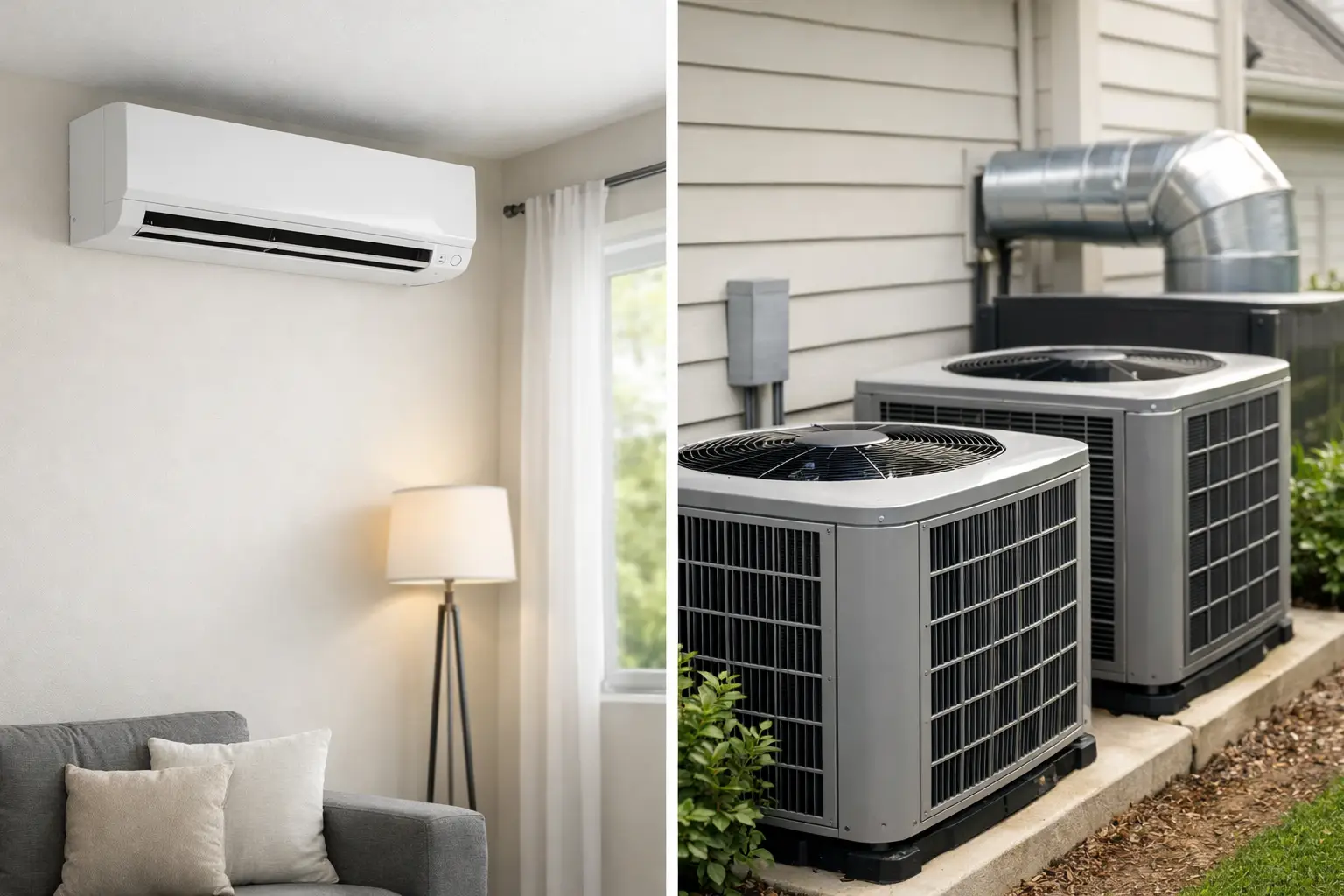
A central air system cools the entire home through ductwork. It uses one indoor unit, one outdoor unit, and a network of supply and return ducts to move conditioned air from room to room. If your house already has ducts in good shape, central air is often the most familiar path.
A mini split system, sometimes called a ductless mini split, skips the ducts. It uses an outdoor unit connected to one or more indoor air handlers placed in specific rooms or zones. Each indoor unit cools its own area, which gives you more control over where and when you use energy.
That difference shapes nearly everything else, from installation cost to comfort to long-term efficiency.
When central air makes more sense
Central air is usually the stronger fit when you want one system to cool the whole home evenly and you already have ductwork that is properly sized and sealed. For many homeowners, there is real value in a setup that feels simple. One thermostat, one system, consistent operation.
It also tends to look cleaner inside the home. With central air, the visible equipment is limited to registers and the thermostat. If you do not want wall-mounted indoor units in bedrooms, living rooms, or offices, that matters.
For larger homes with open layouts, central air often delivers a more natural whole-house solution. You are not managing multiple zones or adjusting several indoor units. If your family tends to keep the same general temperature throughout the house, central air can be the easier system to live with.
That said, central air depends heavily on the duct system. If ducts are leaking, poorly designed, undersized, or routed through very hot spaces, performance drops fast. A high-quality air conditioner connected to bad ductwork will still struggle.
Central air can be the better choice if:
Your home already has well-functioning ducts, you want consistent cooling in every room, and appearance inside the home is a priority. It is also a practical option when you are replacing an older central system and the rest of the setup is still in solid condition.
When a mini split is the better fit
Mini splits shine when flexibility matters more than uniformity. If you have hot and cold spots, rooms that are used at different times, or spaces without duct access, they can solve comfort problems that central air often cannot fix without major work.
They are especially useful for additions, garages, finished basements, older homes, sunrooms, and properties where installing new ducts would be disruptive or costly. Instead of cooling the entire home just to make one room comfortable, a mini split targets the area that needs help.
Zone control is one of the biggest advantages. You can keep a bedroom cooler at night, reduce cooling in unused rooms, or condition a home office during the day without paying to cool the whole house the same way. For households with different comfort preferences, that control can be a real benefit.
Mini splits also avoid the energy losses that can come with ductwork. In homes where duct leakage is a problem, that can improve efficiency in a noticeable way.
A mini split may be the better choice if:
You do not have ducts, only need to cool specific rooms, or want room-by-room temperature control. It is also a smart option when one part of the home has always been hard to keep comfortable.
Installation cost is not always straightforward
A lot of people assume mini splits are always cheaper or central air is always the bigger investment. In practice, it depends.
If your home already has good ducts, central air may be the more cost-effective whole-house option. The infrastructure is there, and the installation is more direct. If your ducts need major repair or you do not have any ductwork at all, central air can become much more expensive.
Mini split pricing depends on how many indoor units you need. One single-zone system for a garage or addition is very different from a multi-zone setup serving several rooms. As the number of zones increases, so does the project cost.
This is where homeowners can get tripped up. A mini split may cost less for one or two problem areas but more than central air if you are trying to cover an entire larger home with multiple indoor heads. The right comparison is not system against system in a vacuum. It is system against your house, your layout, and your goals.
Efficiency and monthly operating costs
Mini splits often have the edge on efficiency, especially in homes without ducts or in households that do not use every room the same way. Because they deliver conditioned air directly into the space and allow zoning, they can reduce wasted energy.
But efficiency on paper is only part of the story. If you prefer to keep the whole house at one steady temperature all summer, central air may perform just fine, especially when paired with a modern high-efficiency unit and properly sealed ducts. A well-installed central system can still be a strong performer.
Usage habits matter. A zoned mini split system rewards selective cooling. Central air works best when whole-home comfort is the goal. Neither system saves money automatically if it is oversized, poorly installed, or used in a way that fights the design.
Comfort feels different with each system
Central air usually delivers a more uniform feel across the home. Air circulates through the house, and many people like that balanced, familiar comfort. It can also integrate well with filtration and indoor air quality upgrades tied into the duct system.
Mini splits are more targeted. That can be a plus or a minus depending on what you want. They cool rooms quickly and let you fine-tune temperatures, but the comfort is more zone-based than house-wide. Some homeowners love that level of control. Others would rather set one thermostat and leave it alone.
Noise can also differ. Mini splits are often very quiet indoors, and central systems can also run quietly when installed correctly. Still, duct noise, blower issues, or poor airflow design can make central air more noticeable in some homes.
Maintenance and long-term service
Both systems need regular maintenance. Filters need attention, coils need to stay clean, and refrigerant, electrical components, and overall performance should be checked seasonally.
With central air, ductwork adds another layer. Dirty, leaking, or damaged ducts can affect airflow and efficiency. With mini splits, each indoor head requires cleaning and service access. If you have several zones, that means more individual components to maintain.
Reliability comes down less to the equipment category and more to sizing, installation quality, and routine service. The best unit on the market can underperform if it is installed poorly. That is why system selection and workmanship should go together.
What works best for older homes, additions, and businesses?
Older homes are often where mini splits make the most sense, especially if there is no existing duct system. They can provide effective cooling without tearing into walls and ceilings to run ducts. For historic properties or homes with limited space for mechanical upgrades, that is a major advantage.
For additions and converted spaces, mini splits are often the cleanest answer. Extending an existing central system is not always possible, and even when it is, it may create airflow issues for the rest of the home.
For small businesses or light commercial properties, the choice depends on building layout and usage patterns. Open spaces with existing ductwork may benefit from central-style systems. Offices with separate rooms or varying schedules may benefit from zoned ductless solutions.
How to choose between mini split vs central air
Start with the house you have, not the system you think you are supposed to buy. If you have solid ductwork and want dependable whole-home cooling, central air is often the practical choice. If you need flexibility, zone control, or cooling in spaces where ducts do not exist, a mini split may be the better investment.
It also helps to think about your next five to ten years. Are you solving a single-room comfort problem, replacing an aging whole-house system, planning an addition, or trying to lower operating costs? The best answer today should still make sense after your needs change.
A professional load calculation and on-site evaluation matter here. Square footage alone will not tell you what system fits. Window exposure, insulation, ceiling height, room usage, and duct condition all affect the recommendation. A contractor should be able to explain the trade-offs clearly, not just push one option.
If you want help comparing systems based on your actual home or building, Strong Heating and Cooling can walk you through the options and provide a clear recommendation without the guesswork.
The best cooling system is the one that fits your space, your budget, and the way you live day to day. When that match is right, comfort feels simple.